Showing posts with label andrew garfield. Show all posts

Wednesday, May 30, 2018

2018 Tony Predictions: Best Actor

We are now less than 2 weeks away from the 2018 Tony Awards, and speculation about who will win Broadway's highest honor on June 10th continues to intensify, including here at Broadway, Etc. After making predictions about the Featured Actor and Actress races, its time to move on to the Leading categories, where I will be predicting who will win as well as pointed out who most deserves it. Read on for more!

Best Actor in a Play

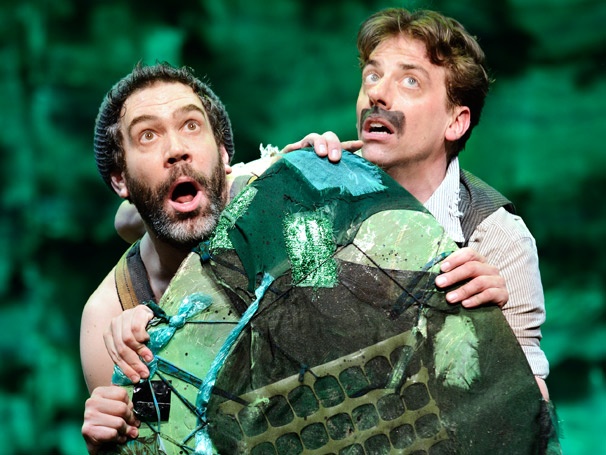
Andrew Garfield (left) as Prior Walter and Nathan Stewart-Jarrett as Belize in Angels in America.

Nominees: Andrew Garfield, Angels in America; Tom Hollander, Travesties; Jamie Parker, Harry Potter and the Cursed Child; Mark Rylance, Farinelli and the King; Denzel Washington, The Iceman Cometh

As with Best Featured Actress in a play, this category is mostly made up of Brits from transferred productions. Tom Hollander seems like the longest shot to win here, as Travesties just doesn't have the awards momentum to overtake the other, more lauded productions represented here. Meanwhile Mark Rylance has never gone through a Tony season without a win (he wasn't nominated for La Bete but won for Jerusalem that same season, and won one of two Tonys he was nominated for in 2014), but this doesn't feel like his year, and honestly he's probably busier campaigning for Farinelli and the King to win Best Play so his wife, the play's author, can experience Tony glory.

Which leaves us with Jamie Parker, Andrew Garfield, and Denzel Washington. Parker seemed like the man to beat heading into this season, before the love for Angels in America somewhat surprisingly surpassed the excitement about Harry Potter and the Cursed Child. Parker certainly isn't down for the count, but his path to Tony gold is a lot harder thanks to an abundance of love for the revival of Tony Kushner's two-part epic. Angels is certainly the more "serious" of the two works, which fairly or not gives Andrew Garfield the edge. But Washington is a dark horse for The Iceman Cometh, a production that pleasantly surprised a lot of critics and provides the Tony and Oscar winner with quite the showcase scene in the final act. I still expect Garfield to win, but I wouldn't be overly surprised to see Parker or Washington sneak through in an upset.

Will Win: Andrew Garfield, Angels in America
Should Win: Abstain

Best Actor in a Musical

Joshua Henry as Billy Bigelow in Carousel.

Nominees: Harry Hadden-Paton, My Fair Lady; Joshua Henry, Carousel; Tony Shalhoub, The Band's Visit; Ethan Slater, SpongeBob SquarePants

There were only 5 eligible performances in this category, a byproduct of it being a weaker year for musicals in general and a welcomed increase in musicals centered around women; 7 of this year's musicals have female leads or co-leads (a couple even feature 2 women sharing the spotlight with all men relegated to supporting roles). That said, the lack of quantity is certainly compensated for by an abundance of quality, with some truly excellent talent on display here. I can't imagine Tony Shalhoub actually winning for The Band's Visit - very much an ensemble show where his leading man status feels like a courtesy extended due to his fame - but he's certainly deserving of a nomination.

I'm not sure what to make of Ethan Slater's chances playing the title character of SpongeBob SquarePants. On the one hand, the young actor is beyond charismatic in his Broadway debut, so effortlessly embodying the eternally optimistic sea sponge that I have trouble imagining anyone else in the role. He has also already racked up Theatre World and Outer Critics' Circle Awards for his performance, so only a fool would count him out of the running (not to mention the Tonys love a Cinderella story). But at the same time, as great as Slater is, I'm not convinced that he's the best of the four nominated actors, or even the runner up.

Joshua Henry and Harry Hadden-Paton both take already great, award-worthy roles and run with them, exceeding expectations in two career milestone performances. Both also succeed in taking characters with extreme cases of toxic masculinity and making them both relatable and even empathetic for audiences hyper aware of how horribly sexist traditional male/female gender dynamics are. And no actor, male or female, tackled a role more closely associated with a specific performer than Hadden-Paton, who successfully makes My Fair Lady's caustic Henry Higgins his own in the wake of Rex Harrison's legendary, Oscar- and Tony-winning performance.

If I were voting, I'd probably choose Hadden-Paton, who I thought was perfection in a near perfect production. But Henry is offering up one of the best, if not the best, sung renditions of Carousel Broadway has ever seen. His "Soliloquy" is the musical highlight of the season, thanks both to his vocal prowess and his stellar acting ability, traits which carry through the entirety of his performance. Henry's just *feels* like a Tony-winning performance, thrillingly sung and expertly acted, and after two prior nominations it looks like the third time will be the charm for this consistently excellent performer.

Will Win: Joshua Henry, Carousel
Should Win: Harry Hadden-Paton, My Fair Lady (just barely edging out Henry)


Keep checking this space for more 2018 Tony Award predictions in the weeks ahead! In the meantime, make your voice heard in the comments, and check out the rest of my Tony coverage by clicking below:

Tony Nominations React
Book and Score
Direction and Choreography
Featured Actor
Featured Actress

Saturday, June 2, 2012

2012 Tony Predictions: Best Featured Actor


The Tony Awards are getting closer every minute, and if I want to finish these prediction articles before next weekend I don’t have time for clever intros!  As you read on, please remember my two caveats:  1) I have not seen all of the nominated shows; and 2) I am predicting who will win, which may be different from who should win (a distinction that will be further discussed in the body of the article).
Moving right along, here come the supporting men.

Best Featured Actor in a Play


Nominees:  Christian Borle, Peter and the Starcatcher; Michael Cumpsty, End of the Rainbow; Tom Edden, One Man, Two Guvnors; Andrew Garfield, Death of a Salesman; Jeremy Shamos, Clybourne Park


I’m not sure how Michael Cumpsty managed to pull himself out from under the massive shadow cast by Tracie Bennett in End of the Rainbow, but good on him for securing one of the five Best Featured Actor nominations.  I hope he is proud of his accomplishment, because a nomination is where his Tony journey ends.  I suspect the same is true for Tom Edden in One Man, Two Guvnors.  While the British import received a host of nominations, I just don’t think it has enough industry buzz to actually win any of the big awards, especially with such strong competition among this season’s plays.

Jeremy Shamos plays two miserable human beings in Clybourne Park, and the fact that he can make you understand where they’re coming from is a testament to both his performance and Bruce Norris’ writing.  But the lack of nominations for his costars seems to indicate Tony voters are more impressed with the work as a whole then the individual performances, even though all are stellar.  Shamos is a long shot for the Featured Actor trophy, but he does have a shot, which is more than I’ll say for both Cumpsty and Edden.

I think this race boils down to Christian Borle versus Andrew Garfield, which raises the eternal acting debate of comedy versus drama.  Which is more difficult, and therefore more worthy of praise when executed successfully?  Tony voters have shown a proven bias toward both serious drama and Hollywood stars making strong Broadway debuts.  In Death of a Salesman, Garfield holds his own against some established stage veterans while bringing new life and immediacy to a well-known Arthur Miller role.  This same trick won Scarlett Johansson a Tony two years back, and I think Garfield has a good chance of repeating her success. 

Borle, on the other hand, has been handed a gem of a role as Peter and the Starcatcher’s scenery chewing villain Black Stache.  After years of solid performances, Stache seems to be Borle’s breakout role, and his work on NBC’s Smash has raised his profile to the point where Tony voters can pretend that in picking him, they are honoring one of the Hollywood stars they love so much.  Borle is also the well-liked Starcatcher’s best shot at an actual win, and I think we’ll be hearing him gush about what a fantastic year he’s had when they call him up to the podium on Tony night.  Poor Mr. Garfield will just have to count his upcoming Amazing Spider-Man royalties in consolation.


Will Win:  Christian Borle, Peter and the Starcatcher
Should Win:  Andrew Garfield, Death of a Salesman (not because Borle is bad, but because in this case I genuinely believe what Garfield accomplished was harder)


Best Featured Actor in a Musical


Nominees:  Phillip Boykin, Porgy and Bess; Michael Cerveris, Evita; David Alan Grier, Porgy and Bess; Michael McGarth, Nice Work If You Can Get It; Josh Young, Jesus Christ Superstar


I was distinctly unimpressed with David Alan Grier’s performance when I saw Porgy and Bess back in January.  The actor didn’t seem to have a proper handle on his character, and the Sportin’ Life who sang “There’s a Boat That’s Leaving Soon” was vastly different than the one who proclaimed “It Ain’t Necessarily So.”  Revisiting the show last month, I’m happy to report that Grier has smoothed out a lot of inconsistencies in his characterization, but I still doubt most voters would consider the performance Tony-worthy. 

Michael Cerveris is probably the best thing about the current Evita revival, at least from an acting standpoint.  Unfortunately, the role of Juan Peron is even more underwritten than most Andrew Lloyd Webber roles, and even an actor Cerveris’ caliber can’t quite hide the fact that he’s working with pretty poor material.  Similarly, Michael McGarth deserves a better show than the misguided Nice Work.  Despite being the most reliably funny aspect of the show, I suspect a general indifference towards Nice Work will keep McGarth out of serious contention.

Phillip Boykin deserves to win this award, as his supremely menacing Crown is the sort of operatic presence Porgy and Bess demands even in this revised musical version.  Boykin is the only cast member who can hold his own vocally against Audra McDonald, and he breathes full life into what could easily become a cartoonishly evil character.  If you need any proof of how well Boykin does his job, just listen to the cheers that erupt from the audience when Norm Lewis’ Porgy finally triumphs over the brute.

But a part of me fears that Josh Young might just rain on Boykin’s parade.  Young is the only nominee in this category I haven’t personally seen, as he was out the night I saw Superstar.  In fact, he was out for a large portion of the preview period and the month immediately following.  While I know these actors are only human, missing so many shows so soon in the run does make me question someone’s Tony worthiness.  Theatre acting is about being able to turn in a stellar performance eight times a week; if you can’t keep yourself healthy, or worse yet blow your voice due to poor singing technique, then I don’t think you’re ready for theatre’s highest honor.  The fact that Young got nominated despite all his missed performances indicates he is either excellent receiving a large pity vote, or both.  I’m going to go with my heart and predict Boykin wins, but I would not be surprised if Young’s name is called on June 10th instead.


Will & Should Win:  Phillip Boykin, Porgy and Bess


Catch up on my other Tony predictions below:

Featured Actress
Book & Score
Direction & Choreography

Monday, May 7, 2012

Attention Must Be Paid

Review: Death of a Salesman
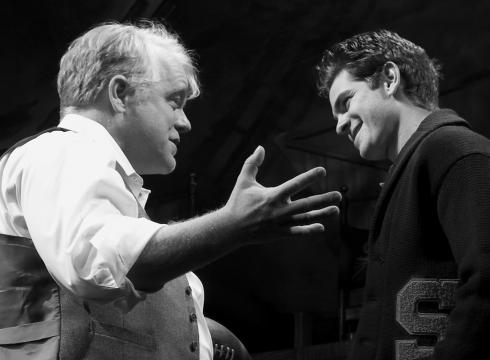
Phillip Seymour Hoffman and Andrew Garfield in Death of a Salesman
On rare occasions, a piece of theatre will leave you so profoundly affected that finding words to describe what you feel proves difficult.  The writing, direction, and performances all combine and send you into a momentary stupor as your brain attempts to process the depth of what you’ve just experienced.  You remain in your seat after the lights come up, hoping that by lingering in the theatre you’ll be able to enjoy its transcendent nature just a while longer.  The knockout revival of Arthur Miller’s Death of a Salesman is such a piece of theatre.

Miller’s script is such an acknowledged masterpiece that it’s easy to forget just how incredible his writing truly is.  This portrait of aging salesman Willy Loman uses incredibly specific characterizations to reveal something universal about the human experience, and it’s themes of shattering disappointment and unfulfilled potential remain timely over sixty years after its premiere.  Seeing a man who has poured his entire life into a company unceremoniously dismissed strikes an especially potent chord in our post-recession economy.  And in a society where adolescence has stretched into a person’s mid-twenties and beyond, Miller’s parallel tale of the arrested development of Willy’s two sons is instantly recognizable.
But a play, even a great one, does not perform itself.  And for this latest Broadway revival, director Mike Nichols has assembled a cast equal to the monumental potential of Miller’s script.  Oscar-winner Phillip Seymour Hoffman anchors this production with a tower performance in one of the theatre’s great roles, embodying Willy’s crushed soul from his first shambling footsteps onto the Barrymore Theatre’s stage.  Although considerably younger his character, Hoffman so convincingly portrays a man suffering from a lifetime of disappointment that you accept him as Willy immediately.  And while his desperation can be uncomfortably oppressive (as it should be), Hoffman peels back those years during the play’s flashback sequences to offer a glimpse of the great man everyone claims Willy used to be.  Hoffman’s contribution to the success of this production cannot be ignored, and anyone interested in seeing a true master at work owes it to themself to see him in this role.
Hoffman is more than ably supported by his costars, particularly Linda Emond.  As Willy’s long-suffering wife Linda, Emond takes a character type that has become cliché and invests it with such conviction that it seems new again.  While you completely understand and sympathize with Linda, you cannot pity her because Emond makes it clear she doesn’t want to be pitied.  Of the characters in the play, Linda is the most at peace with the family’s current situation, which only makes her final monologue all the more heartbreaking.  The play would lead you to believe that Linda has little left to lose, and yet by the end you know that she had everything to lose, and now that it is gone she is will likely never recover.
And then there is Andrew Garfield, a promising young film talent making a phenomenal Broadway debut as Willy’s son Biff.  Garfield is also too young for his role, but just like Hoffman he makes you forget that fact in seconds.  Biff’s tragedy is that he knows exactly what’s wrong with him and yet is powerless to change, and Garfield communicates that conflict flawlessly.  Resentful of the expectations placed on him by his father and filled with guilt over his inability of meet them, Garfield’s Biff is a cornered animal, dangerous and likely to lash out at any moment.  His scenes with Hoffman are simply electric.
Mike Nichols has guided his cast to perfectly pitched performances, ensuring the play moves inexorably towards its final conclusion.  So expertly paced is the piece that although it never drags, it never feels rushed either, with each revelation being afforded the proper dramatic weight.  The sublimely understated sets, costumes, and lighting keep the focus squarely on the human drama at the play’s center, allowing Nichols and his actors to do their work unimpeded.
This revival of Death of a Salesman is an affirmation of the incredible power live theatre can wield, and is an event that only comes around once in a great long while.  A great production of a great play, it simply cannot be missed.