Wednesday, July 25, 2012

She Knows Things Now

Hi, I'm Broadway's Morgan James, and I apparently have no idea how the internet works.


I had another topic in mind for this blog entry, but then I saw this story about the uproar Broadway actress Morgan James caused by tweeting her negative reaction to Shakespeare in the Park’s Into the Woods and felt compelled to write about that instead.
If you’re too lazy to read the linked article, just know that Ms. James attended last night’s first public preview and was decidedly unimpressed.  She said as much via Twitter, criticizing the acting and musicians, and the rest of the Broadway community jumped down her throat for saying such negative things in a public forum.  James has since deleted the offending tweets and half-heartedly apologized, but maintains she is entitled to express her opinion. 
This is a subject that is close to my heart, as I am a theatre professional (or at least semi-professional with professional friends) who has a blog full of show reviews, and not all of them are complimentary.  I agree that James is entitled her opinion and that no one can force her to like a particular show, but I also agree with most people that she is in the wrong for tweet her displeasure.  Why?  In the spirit of the show, I have listed her offenses in the form of fairy tale morals.

1)      The difference between a thought and a tweet is a tweet can cause a commotion


Twitter is a social landmine.  The website’s format encourages users to tweet whatever thought pops into their head immediately, and then keeps a record of that thought forever (or at least until you go back and intentionally delete it).  This causes many users to forgo the mental filter they would use during face to face conversation, and the text format means you can’t claim you were misheard or pretend you didn’t say something.  This has been the bane of many celebrities’ existence, and yet after countless instances of people being taken to task for ill-considered tweets James seems surprised the same thing happened to her.

Also, being limited to 140 characters makes it very difficult to back up any assertions with examples.  If James had been having a face to face conversation (or just posting to something that allowed her more words to express herself), she could have provided some concrete examples of the flaws she was talking about.  But without examples, it comes across as if James is just being catty, especially since most performers give negative critiques in a way that seems to imply they would have done a better job. 


2)      A first preview is not opening night


The entire point of having a preview period is that it gives cast and crew time to work out the production’s kinks.  As a veteran of several Broadway shows, which often have three or four weeks of previews, James should have understood that what she saw last night was not meant to be the final product.  By choosing to attend the first preview, James essentially agreed to see a work in progress, and should have tempered her expectations accordingly.


3)      The harsher the words, the quieter you speak them (especially during previews).


Because elements of the show are still in flux during previews, being too harsh on them is generally frowned upon.  There is still time for things to improve, so speaking out against the show before it is finished makes James appear immature and rude.  This is why critics don’t see shows until the week before opening, and even then they hold off on publishing their judgments until after the production opens out of respect for all the hard working individuals involved.  Yes, theatre professionals love to gossip about troubled musicals, but most have enough tact to engage in those types of conversations in the privacy of their own homes (or a nearby bar) rather than on the very public internet.


4)      The younger the critic, the less people care


This entry could also be entitle, “Respect your elders.”  Simply put, Morgan James hasn’t earned the right to publically bash her fellow artists.  She may have Broadway credits, but you know what they are?  Ensemble in The Addams Family (a bad show), Wonderland (a worse show), and Soloist in Godspell (a decent show).  Nothing about her resume or body of work gives her any kind of industry clout or respect, especially when she is saying Tony winners and Oscar nominees don’t know how to act.  You have to earn the right to speak out against your peers, and James is a long way from being able to insult the abilities of other artists. 

When Stephen Sondheim decided to trash the Porgy and Bess revival before it had even started its out of town tryout, he did so with 60 years’ experience, multiple Tony Awards, a Pulitzer Prize, and a body of acclaimed work that demonstrates he knows a thing or two about what constitutes good musical theatre.  And even with all that expertise, a lot of people still felt he was out of line (although they promptly forgave him, as he’s still Stephen-freaking-Sondheim).  James’ dubious career doesn’t afford her the type of leeway given to the writer of acknowledged masterpieces like Sweeney Todd, Company, and yes, Into the Woods.


Hopefully this incident has taught James (and other performers) that there is a time and a place for peer criticism, and Twitter is not it.  The only acceptable public forum for such criticism is a review, which exists expressly for that purpose and has a format that allows you enough space to back up your assertions with examples.  Other than that, negative critiques should be reserved for private conversation among peers, preferably after the show is opened and therefore “finished.”  Otherwise, keep your damn mouth shut.

Wednesday, July 11, 2012

Hollywood is Calling


Well, that was quick.  Just a month after winning the Best Actress Tony for her work in Venus in Fur, Nina Arianda is headed off to Hollywood to star as Janis Joplin in a biopic about the late singer (re: try really, really hard to win an Oscar).  And I’m pretty damn upset about it.
Now, I’m a huge fan of Arianda and want her to have a successful career; I just want that career to be in the theatre.  Live theatre is one of the most difficult forms of entertainment around.  You don’t get to go back and do another take if you make a mistake, and you have to reach the same level of emotional intensity night after night since there’s no camera around to preserve your performance.  Being able to do that is a rare gift, one that Arianda is blessed to have, and if she decides to focus on a film career it is a gift the Broadway community will be deprived of. 
I understand the allure of film.  Even if you don’t subscribe to the romanticized and glamorous notions of Hollywood portrayed by the media, the simple truth is there’s just more money in film work.  You can make the same amount of money in a couple of months that it would take a year or more to make in the theatre, and if your movie/television show becomes really popular you can make a pretty penny by collecting residuals from work you’ve already done.  You can also reach a much wider audience more easily, increasing your fan base and thus your industry clout (the more people who like you, the more likely producers are to cast you).
However, when a Broadway actor starts their film career, I don’t see all of the opportunities that stand before them.  I see the amazing stage performances they won’t be able to give, and the great theatre that won’t get done because they were focusing their talents elsewhere.  Despite both falling under the blanket term “acting,” film and stage work are such different skillsets that excelling at one in no way guarantee success at the other, meaning a talented performer like Arianda could end up wasting years in a medium that doesn’t really suit her.  And on the flip side, what if she does turn out to be a brilliant film actress?  Then she might decide to focus exclusively on film (after all, that’s where the real money is) and never set foot onstage again, which would be an enormous loss for Broadway.
It is especially disappointing when someone abandons theatre for film and ends up in works not worthy of their immense gifts.  Take Kristin Chenoweth, who after her massive success in Wicked began doing film work that has rarely utilized her to her full potential.  Most of her movie and television roles fall under the supporting category, and the two examples I can think of where she had a starring role (her self-titled sitcom and GCB) were hardly successful.  Yes, she did eventually win an Emmy and seems to be respected by the film community, but it is nowhere near the level of acclaim she receives on Broadway.  If Chenoweth had continued to work primarily in the theatre, she would have been the Star of pretty much everything she did, and I can virtually guarantee she would have won her long sought-after second Tony Award by now.  Think of all the great Kristin Chenoweth stage performances we missed out on because she was busy doing shows like Glee.
We’ve been seeing a lot of stage performers head off to Hollywood lately, and like Arianda the timing of these announcements make it seem like they are purposefully abandoning Broadway.  Already a darling of the New York theatrical community, I have to believe that winning the Tony would have opened up all kinds of interesting stage projects to Arianda, even if she still had to do some leg work to find them.  Sutton Foster, one of the greatest musical comedy actresses working today, left the highly successful Anything Goes revival early to film ABC Family’s Bunheads.  Andrew Rannells and Josh Gad, after giving two of the funniest performances in recent memory and announcing the extension their Book of Mormon contracts into next February, both left the show last month to pursue TV projects.  We are losing our most promising new talents to the film industry, and they seem so eager to leave they aren’t even sticking around to the announced ends of their contracts.
I still adore all of the above mentioned actors, and I wish them nothing but success.  I just find it unfortunate that even the notoriously expensive Great White Way doesn’t pay well enough to encourage these talented folks to stick around.  At least in Arianda’s case I can take solace in the fact she chose movies over television, meaning there’s a better chance she’ll be able to squeeze in a play or two between gigs.  The grueling production schedules of a television series rarely leave enough time between seasons for an actor to rehearse and perform even a limited Broadway run, which is why Broadway went four long years without Audra McDonald while she was on Private Practice.  (The fact she returned with one of the most satisfying musical theatre performances of the decade does help make the wait seem more worthwhile.)
Hopefully Arianda and the rest will remember their theatrical roots and come back to visit once and a while.  The one positive of a film career (besides the increased bank account) is that it can result in enough fans that producers are able to sell tickets based on an actor’s name, which increases the chances said actor will actually get cast.  But I’m still hoping for a reversal to this trend, as Broadway cannot afford to continue losing our most promising talents to Hollywood’s cold, unfeeling embrace.

Saturday, June 30, 2012

Peter and the Overly Ambitious Creative Team


Review:  Peter and the Starcatcher

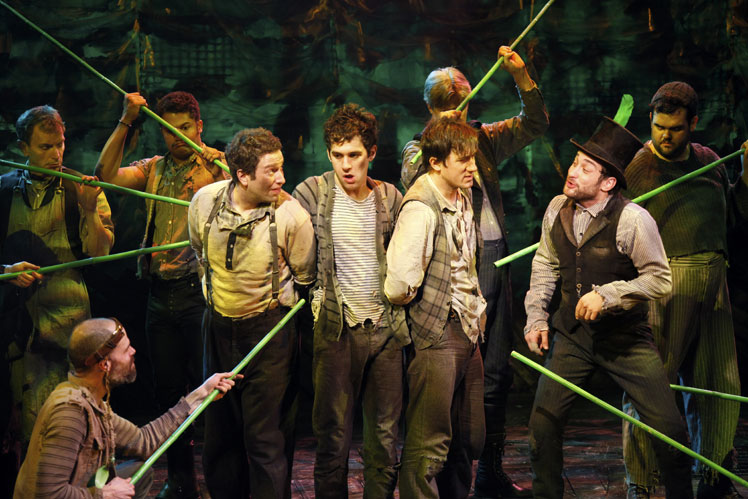
It’s difficult to know what to make of Peter and the Starcatcher, the stage adaptation of the 2004 children’s novel which serves as a Peter Pan prequel.  There is a bevy of talent on display, both onstage and behind the scenes, and the almost endlessly inventive production flies by at such a brisk pace that only the most impatient theatregoers will be bored.  Yet Peter also contains some maddeningly large missteps that are all the more intolerable because of the quality that surrounds them.

The plot is a rousing adventure in which Lord Astor and his daughter Molly attempt to smuggle a chest full of secret treasure out of England at the behest of Queen Victoria.  Unfortunately, their clever plan involving a decoy ship and fake treasure runs into complications when a greedy captain decides he would rather have the treasure for himself.  To make matters worse, a group of pirates led by the maniacal Black Stache simultaneously attack the convoy, and on top of all THAT, Molly discovers a group of orphans about to be sold into slavery, among them an unnamed Boy with a strong dislike of grown-ups (three guesses as to who he becomes).

If all that sounds complicated, it is, and the fact that Peter and the Starcatcher remains coherent throughout is a testament to Rick Elice’s script and the sharp direction by Roger Rees and Alex Timbers.  Despite appearing to be a children’s play, Peter never talks down to its audience, and includes something for people of all ages.  For the kids, there is plenty of physical comedy and even the occasional fart joke, while copious amounts of wordplay and some clever innuendo will keep the adults in the audience interested as well.  The story is so interesting that it’s almost a shame it must tie into the preexisting Peter Pan mythos, as the play’s resolution forgoes a satisfying finale in favor of setting up Peter’s coming adventure with Wendy.

Despite a strong cast (more on them in a bit), Rees and Timbers’ direction and the astounding design work are the real stars here.  The most complicated piece of machinery used is a rolling staircase; almost every you see could be found or easily manufactured by an amateur theatre troupe.  Rees and Timbers use basic items like ropes, umbrellas, and toy ships to communicate cramped holding cells, tropical rainstorms, great naval battles, flying cats and even that famed giant crocodile.  Donyale Werle’s simple set design proves endlessly adaptable, and is lit to perfection by Jeff Croiter’s gorgeous lights.  Paloma Young’s costumes give each character an identity while remaining basic enough to allow the actors to easily transition between characters, and her mermaid outfits alone justify her recent Tony win. 

In fact, there is so much theatrical invention on display that it can become distracting.  Everyone involved is so concerned with proving their creativity that the physical production often takes precedent over the story.  Entire swaths are dialogue are rendered incomprehensible due to the onstage hubbub of actors moving props, miming scenery, and creating constantly changing stage pictures.  All of this visual information is generally clear enough to prevent confusion, but it would have been nice to see these supremely talented folk put more faith in Elice’s sterling script and strike a better balance between the visual and auditory.

As for the actors, they fully commit to their roles and each other, forming a tight-knit ensemble willing to do anything to support their fellow performers.  They allow themselves to be used as set dressing, props, and even furniture, while still creating distinct and even compelling characters.  And if those characters tend towards broadly drawn outlines rather than fully realized individuals, it’s hard to fault the actors for lack of trying.

As the strong-willed but good-hearted Molly, Celia Keenan-Bolger emerges as the production’s heart and soul, anchoring the zaniness of her male co-stars with her no-nonsense yet still hilarious performance.  Arnie Burton is equally charming as Molly’s nanny Mrs. Bumbrake, and Rick Holmes proves to be an excellent authority figure as Lord Astor.  Teddy Bergman spends most of the first act playing supporting roles, but his second act romp as island native Fighting Prawn is so memorable that his contributions to the show prove essential.  Adam Chanler-Berat does seems a little lost at sea as the Boy who becomes Peter Pan, although the script doesn’t do him any favors by keeping Peter passive and uninvolved for a good portion of the show.

And then there’s newly minted Tony-winner Christian Borle as Black Stache (re: Captain Hook).  I certainly can see why he won, and wouldn’t want to advocate taking the award and accompanying recognition from an actor who has been so consistently strong in such different kinds of roles over the years.  But at the performance I saw, Borle’s hamminess and scenery chewing repeatedly crossed the line from entertaining to distracting, throwing the focus of the piece and onstage energy completely out of whack.  It was almost impossible to concentrate on the actual story while he was gallivanting about the stage, and yet I’m not sure any actor would have been able to resist the urge to mug given the over-the-top applause that met any bit of comic business he even attempted.  At one point this was clearly a brilliant performance; unfortunately, it has now grown so broad that it hurts the show as much as it helps it.

There is much to admire about Peter and the Starcatcher, including the commitment of the actors and the unbridled imagination of the creative team.  But sometimes less is more, a truism the play seems to both understand and simultaneously ignore with its shunning of high-tech stagecraft for an overabundance of low-tech alternatives.  A great story gets lost among the frenzy of creativity on display, and after the platitudes given to the show by the rest of the theatrical community, I really was hoping for something better.  As long as expectations are kept in check, Peter and the Starcatcher makes for an fine evening of theatre, especially for those who are young or simply young at heart.

Friday, June 22, 2012

High Art for a Balmy Summer Evening


Review:  As You Like It

David Furr, Renee Elise Goldsberry, and Lily Rabe in Shakespeare in the Park's As You Like It


The problem with producing Shakespeare is that the Bard only wrote so many plays, which are mounted so often that making any individual production stand-out requires a combination of fantastic actors and strong directorial vision.  Thankfully, the As You Like It which just opened Shakespeare in the Park’s 50th anniversary season features both in equal measure, breathing (mostly) new life into this oft-produced comedy.

For those unfamiliar with the plot, As You Like It begins when the evil Duke Frederick banishes a host of people, including his niece Rosalind and his daughter Celia, to go live in the Forest of Arden with his usurped brother Duke Senior.  Just before her exile Rosalind meets and falls in love with the young Orlando, who also ends up in the Forest of Arden for separate reasons.  Unfortunately, in order to avoid execution Rosalind has disguised herself as a boy, and when she and Orland meet again he does not recognize her.  What follows is a series of comic misunderstandings involving a host of supporting characters which eventually sort themselves out just in time for the play’s ending.

As You Like It has never been my favorite Shakespeare, but remains a popular choice for theatre companies due in part to the showcase it offers for the actress playing Rosalind.  This production is blessed with the sensational Lily Rabe in the central role, who gives a dynamic performance that expertly balances comedy and pathos.  Intelligent and charismatic, Rabe lights up the stage with a captivating interpretation that proves she is one of the most gifted actresses of her generation by being entertaining, moving, and most of all truthful.  It is unfortunate that Rosalind isn’t more of a presence in the first act, as the production sags slightly when Rabe isn’t around to elevate it.

That is not to discredit the efforts of her uniformly excellent costars, who combine to create one of the finest acting ensembles of the year.  As Orlando, David Furr projects a humble and quiet confidence that keeps his lovelorn youth from becoming insufferably saccharine (even the other characters tease Orlando about his overly earnest proclamations of love).  As Rosalind’s cousin and best friend Celia, Renee Elise Goldsberry has excellent chemistry with Rabe and provides a welcome contrast to Rosalind and Orlando’s platitudes.  Oliver Platt makes for a hilarious Touchstone, the court jester who accompanies the cousins into the forest, and the veteran actor is particularly skilled in making the Shakespearean wordplay comprehensible to a modern audience.  And as the melancholy Jaques, Stephen Spinella gives an ingeniously underplayed performance which leaves the audience in stitches (he also does an excellent job with the famous “Seven Ages of Man” speech).

The glue holding this entire ensemble together is director Daniel Sullivan, who scored a similar triumph two years ago with the Al Pacino-led Merchant of Venice.  Sullivan is a fantastic director with an excellent understanding of pace and narrative clarity, and even those unfamiliar with the play’s twists and turns should have no trouble following this production.  Sullivan coaxes wonderfully layer performances out of his actors, and continues to be a wonderful asset to the Public Theatre in general and Shakespeare in the Park in particular.

John Lee Beatty’s set design does a great job of evoking the play’s whimsical setting, and it’s a shame the Delacorte’s thrust staging doesn’t allow him to bring his intricate forest setting further downstage.  Jane Greenwood’s period costumes are quite beautiful, and the original grassroots score by Steve Martin does an excellent job of setting the production’s mood. 

Overall, this As You Like It is a first-rate production of one of Shakespeare’s proven crowd-pleasers, and is an excellent way to spend an evening in Central Park.  Lily Rabe’s Rosalind is a marvel, and Daniel Sullivan’s assured direction helps reinvigorate this comedy even for those who are intimately familiar with it.  The impending arrival of the highly anticipated Into the Woods will likely prevent As You Like It from extending its limited run, so any interested parties should rush over to the Delacorte to catch it before it’s gone.

Sunday, June 10, 2012

2012 Tony Predictions: Best Play and Musical


And then there were two.  The only categories left to discuss are the two biggest awards of any Tony season, Best Play and Best Musical.  Winning either of these awards has a major effect on a show’s future prospects, ensuring a high profile that makes the work one of the first scripts regional and amateur theatres assess when programming their upcoming seasons.  For musicals especially, winning this award provides a document box office boost, increasing the length of the show’s run and raising the chances of it actually turning a profit.
As always, I must point out a couple of caveats:  1) I have not seen all of the nominated productions; and 2) I am predicting who will win, which is not the same as who should win.  History is riddled with examples of Tony’s top honor going to something other than the season’s best (find me one person who honestly believes The Music Man is a better overall show than West Side Story), and if that seems to be the case this year, I will say as much in the body of the article.

Best Play


Nominees:  Clybourne Park, Other Desert Cities, Peter and the Starcatcher, Venus in Fur


Since there is no separate playwriting category, the Best Play award functions as an acknowledgement of both the production as a whole and the script in particular, raising the desirability of a win in this category.  For the first time in years, every single nominee is a new American play, a refreshing change of pace from the recent domination of British shows winning this award.

While all of these plays are worthy, this is really a two-way race between Clybourne Park and Other Desert Cities.  Venus is Fur is a lean and thought-provoking work featuring two dazzling performances, but its early season opening has resulting in it losing a lot of buzz to more recent works.  And while many theatregoers are completely enamored with Peter and the Starcatcher, it will struggle to overcome its image as a kids’ play, something the high-minded Tony voters tend to scoff at no matter how well done.  Many would also argue that the direction has as much if not more to do with the Peter’s success than the actual script, a major problem since a Best Play win doubles as a writing honor.

Both Clybourne Park and Other Desert Cities have a lot of elements that Tony voters look for in potential Best Play winners.  Both are ensemble driven pieces that tackle serious issues with a healthy mix of humor and pathos, expertly acted and directed by some of the most talented people in the business.  And from a financial standpoint, Other Desert Cities is one of the most successful plays in years, having sustained strong box office and word of mouth despite being open for the better part of a year (name the last play that opened in October and was still running in early June).  In any other year, it would be the show to beat.

But there is something about Clybourne Park that compels people to vote for it.  While Cities had to settle for being “only” a Pulitzer Prize finalist, the racially charged Clybourne won the prestigious award in 2011.  The show does seem like a new type of play, whereas Cities is very much in the mold of the dozens of family dramas that have come before it.  Helped by a pitch perfect cast who has been with the show since its Off-Broadway premiere, Clybourne Park has the most momentum going into this evening, and I expect Tony voters to crown it this year’s Best Play.


Will Win:  Clybourne Park
Should Win:  Other Desert Cities


Best Musical


Nominees:  Leap of Faith, Newsies, Nice Work If You Can Get It, Once


I have no idea who the Leap of Faith producers paid off to get their critically panned show included among this year’s Best Musical nominees, especially considering the show’s dismal box office and premature closing indicate they didn’t have a lot of money to use for such bribery.  Granted, this has not been a great year for new musicals, especially compared to last year’s incredibly strong crop of new shows, but I have to believe there was a more deserving potential nominee.  But all the money in the world couldn’t secure Faith a win in this category, so I guess there isn’t too much harm done.

Nice Work If You Can Get It really should be better than it actually is, but as last year’s Women on the Verge proved, putting a bunch of past Tony winners in the same room does not automatically produce Tony-worthy work.  Nice Work is perfectly serviceable, but there is nothing exciting or overly interesting about this by the numbers show.  Most of the people involved seem to be there only for the paycheck rather than a love of the material, as evidenced by the lackadaisical performances of both Matthew Broderick and, I hate to say it, Kelli O’Hara.  Kathleen Marshall would have been better off spending the year collecting Anything Goes royalty checks, and I can only hope her next show marks a return to form for the very talented choreographer/director.

From the moment its Broadway transfer was announced, I knew Newsies would be a frontrunner for the Best Musical trophy.  It is easily the most commercial new musical of the season, and potential touring profits have been a deciding factor in this category more than once.  The show’s family friendly song and dance routine is definitely entertaining, and now that Disney has finally stopped playing coy and announced the show for an open-ended run, I expect Newsies to easily outlast the rest of this season’s new shows.  It is not high art, but it is well-done escapist entertainment, which wins the Tony more often than not.

However, I think Disney got the timing wrong on this one.  Had the show opened in April instead of in March, it would still be riding high on its post-opening buzz and sail into an easy Tony victory.  But the show has been running just long enough that we are starting to see some backlash against its lowly ambitions, and the flaws in its slickly-presented façade are more apparent in hindsight.  And the people who realize that Newsies isn’t quite as good as Disney would have you believe will surely vote for Once as the season’s best new show.

At first I was skeptical of Once, fearing this stage adaptation of an Oscar-winning indie film would quickly devolve into two-and-a-half hours of emotionally manipulative sentimentality accompanied by plaintive singer-songwriter style music.  But the show won me over with its expert execution and genuine heart, moving me in a way no other new musical has this season.  While small in scale, Once is large in ambition, and I’m happy to say is succeeds in achieving its lofty goals.  There is more invention and feeling in Once than in the other nominees combined, and the cherry on top of this musical sundae are two fantastic leading performances by breakout stars Steve Kazee and Cristin Milioti.

Once deserves the Best Musical trophy.  It is the best written show of the year, and the acting is the most truthful and heartfelt I’ve seen all season.  No one should be surprised if Newsies takes the prize tonight (I certainly won’t be), but I think Once has built up enough momentum that it might actually triumph over Disney’s pre-ordained classic.  Yes, this year has not been a great one for new musicals, but these two shows are definitely worthy of Broadway and beyond.


Will and Should Win:  Once


And that’s it for my 2012 Tony predictions!  Tune in to the Tony Awards telecast tonight at 8 to see how I did, and check back in the coming days for my reaction to Broadway’s biggest night.  If you’ve missed any of my previous prediction blogs, check them out below:


Best Actor (*Note:  I’ve amended my prediction for Best Actor in a Musical.  A lot of people seem to think Jeremy Jordan has this one in the bag, and since he was a close second for me I’ve upgraded him to “Will Win.”  Danny Burstein still “should win,” but I’m thinking this is Jordan’s year.)
Best Actress
Best Featured Actor
Best Featured Actress
Best Book and Score
Best Direction and Choreography

2012 Tony Predictions - Best Revival


Now that we’ve discussed the creative categories and the acting nominees, all that’s left to predict are the production awards.  These awards are arguably the most prestigious, as theatre is a collaborative medium and a production win is an acknowledgement of excellent in all aspects of a particular show.  As I prepare to predict the season’s best revivals, please keep in mind my two caveats: 1) I have not necessarily seen all of the nominated productions; and 2) I am predicting who will win, which is not necessarily the same as who should win.  Any discrepancies in the two will be discussed in the body of the article.

Best Revival of a Play


Nominees:  Death of a Salesman, The Best Man, Master Class, Wit


Master Class is an extreme long shot in this category, as it opened and closed during the summer of 2011.  Tony voters have notoriously short memories, and given the sheer number of shows that have opened since then, Master Class should consider itself lucky for having been nominated at all.  It is particularly telling that the production’s star, Tyne Daly, failed to receive a Best Actress nomination despite her much ballyhooed turn as opera diva Maria Callas in a piece that is essentially a one woman show with interruptions. 

Wit suffers from a less severe version of the same problem.  Historically, winning a Best Revival trophy has been very difficult when a show isn’t being performed nightly to remind voters how good it is, and Wit has been closed for months.  Cynthia Nixon’s Best Actress nomination proves the show is still present in people’s minds, but despite being highly regarded I don’t think the production as a whole made enough of an impression to secure a Best Revival win.

The Best Man has the distinction of being the only nominated revival that is still running, an invaluable asset in any Tony race.  Unfortunately, it also received the least encouraging reviews of the bunch.  While many critics praised the star-studded cast, they found the show itself a tad slow, indicating that for whatever reason the individual performances aren’t adding up to a satisfying whole.  A show perceived as a disappointment, whether due to unreasonably high expectations or actual shortcomings, rarely wins the big awards.

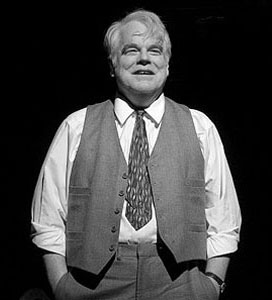
I think Death of a Salesman will easily win Best Revival tonight.  The play is an acknowledged masterpiece, and you couldn’t ask for much better material.  But rather than rest on their laurels, Mike Nichols and his entire team pushed themselves to deliver the most universally praised revival of the year.  The presence of Oscar-winner Phillip Seymour Hoffman made the show a box office bonanza, and the level of buzz surrounding the production was deafening.  Critical acclaim, a towering central performance by an A-list celebrity, and box office success amount to a Tony-winning trifecta, and I would be shocked to see anything other than Salesman win this award.


Will and Should Win:  Death of a Salesman


Best Revival of a Musical


The Tonys have often been accused of being too commercially-minded, favoring box office success over artistic merit.  While there is certainly some truth to this (producers of touring houses make up a large percentage of Tony voters, and they want to be able to book Tony-winning shows that will also make them lots of money), the revival categories seem to be less prone to this phenomenon.  That is why I think despite Evita’s enormous financial success, it has very little chance of winning the big prize.  This current revival has been unfavorably compared to memories of the original 1979 production.  Leading lady Elena Roger has proven to be a divisive Eva, and I would agree with the many audience members who feel her voice simply isn’t up to the challenge of Andrew Lloyd Webber’s demanding score.  Despite a visually stunning physical production and top-notch direction by Michael Grandage, this Evita lacks spark, and has been deemed a disappointment by many of the show’s fans.

The other Lloyd Webber revival of the season, Jesus Christ Superstar, is a much stronger contender.  Though Superstar is far inferior to Evita as a piece of musical theatre writing, director Des McAnuff and his team have polished it to a high gloss.  The end result, which wisely emphasizes the pseudo-love triangle between Jesus, Judas, and Mary, is so good that it managed to win me over despite my deep dislike of Lloyd Webber in general and Superstar in particular.  It helps that McAnuff cast leads that are actually capable of handling the insane vocal demands of the score, but Superstar’s low number of overall nominations indicates it will have a tough time winning against its stiff competition.

The real contenders here are Follies and Porgy and Bess, two fantastic shows which have received first rate productions.  The Stephen Sondheim revival boasted an impeccable cast, a sumptuous physical production and excellent direction, and I truly believe that it will be talked about for years to come as a definitive version of that landmark show.  While there is much to love about Porgy, including an astounding central performance by the incomparable Audra McDonald, purists have been vocally upset about director Diane Paulus’ retooling of a four hour opera into a two-and-a-half hour musical.  Even though Porgy is still running (a major advantage for any Tony-nominated production), I expect the ire over Paulus’ judicious cuts to keep it from taking the big prize, which is as it should be.  Follies was a truly transcendent theatrical experience, and deserves to be recognized as the best revival of the season.


Will and Should Win:  Follies


The only races left to predict are the two biggest, Best Play and Best Musical.  Stay tuned for my thoughts on each, and catch up on the rest of my Tony predictions in the meantime:


Best Actress
Best Featured Actor
Best Featured Actress
Best Book and Score
Best Direction and Choreography

Thursday, June 7, 2012

2012 Tony Predictions - Best Actor


Here we are at the end of the acting categories.  Before I start making Best Actor predictions, I want to remind you of my two caveats:  1) I have not necessarily seen all of the nominees; and 2) I am prediction who will win, which is not always the same as who should win.

Best Actor in a Play


Nominees:  James Corden, One Man, Two Guvnors; Phillip Seymour Hoffman, Death of a Salesman; James Earl Jones, The Best Man; Frank Langella, Man and Boy; John Lithgow, The Columnist


I don’t mean to sound disrespectful of their work, but as far as this season is concerned past winners James Earl Jones, Frank Langella, and John Lithgow are essentially also-rans in a two person Tony race.  Jones received solid reviews for his work in The Best Man, but that show is more of an ensemble piece than a star vehicle, and having a star vehicle is a virtual prerequisite to winning the Best Actor trophy.  Langella’s Man and Boy definitely qualifies as a star vehicle, but outside of his performance the production was dismissed by critics.  It also closed by mid-October and hasn’t been discussed since, leaving Langella without the necessary momentum needed to secure a Tony statuette.

John Lithgow is in a better position than either Jones or Langella, in that The Columnist is a currently-running star vehicle from a well-respected author.  Unfortunately, the deluge of late-April openings resulted in The Columnist getting lost in the shuffle, and many found the play to be serviceable but disappointing given the talent involved (Lithgow is a past Tony winner, and playwright David Auburn is a Tony and Pulitzer Prize winner).

That leaves us with James Corden and Phillip Seymour Hoffman, both of whom have a lot going in their favor.  One Man, Two Guvnors seems to be this season’s British Sensation, the imported new play that has critics practically falling over themselves to praise it.  Corden himself has received plenty of accolades his physically demanding performance, and recent Tony history shows a strong voter bias toward English-bred actors.  However, that same history also shows a bias towards big name Hollywood talent in revivals of classic plays, which perfectly describes Hoffman.  Death of a Salesman is one of the most critically and commercially successful productions of the season, something that couldn’t have been achieved without a commanding central performance.  While I haven’t personally seen Corden, I have trouble imagining him topping Hoffman’s devastating turn in Arthur Miller’s classic, and I suspect Tony voters will feel the same way.


Will and Should Win:  Phillip Seymour Hoffman, Death of a Salesman


Best Actor in a Musical


Nominees:  Danny Burstein, Follies; Jeremy Jordan, Newsies; Steve Kazee, Once; Norm Lewis, Porgy and Bess; Rob Raines, Follies


Unlike their play counterparts, the Best Actor in a Musical nominees are much more evenly matched.  There isn’t a clear-cut front runner, and an argument could be made for any of these fine actors to win the big prize. All of that said, I think we can safely rule out both Norm Lewis and Rob Raines.  I have always felt Lewis’ abilities as an actor have been underrated, and I’m happy to see him receive his first Tony nomination for his accomplished work in Porgy and Bess.  That said, his is by no means the strongest performance of the bunch, and he’s greatly overshadowed by costar Audra McDonald, who from day one has been at the center of all that particular revival’s press coverage. 

Similarly, while Rob Raines did some excellent work in Follies, it did not reach the giddy heights of his costar and fellow nominee Danny Burstein.  Unlike last year, when Andrew Rannells and Josh Gad were so equally matched in The Book of Mormon that they effectively canceled one another out, popular opinion has clearly favored Burstein over Raines.  Anyone who wants to see a Follies win in this category will certainly vote for Burstein.

Jeremy Jordan is technically nominated for Newsies, but I think it’s safe to assume his is a blanket nomination for both that show and his work earlier this season as one of the title characters in Bonnie & Clyde.  Jordan is the hot young talent of the season, and though his work in Newsies isn’t as psychologically complex or emotionally mature as his competition, it is everything you could reasonably expect in a lighthearted show whose sole purpose is to entertain.  The road producers who usually vote for more commercially viable fare will want to ensure Newsies ends up with enough wins to sound impressive in an ad campaign, and Jordan could easily reap the benefits of their Tony love.

Steve Kazee is something of a wildcard.  On the one hand, he is giving a very moving performance in the most critically lauded new musical of the season, and the buzz around Once certainly isn’t hurting his chances.  On the other, for whatever reason the critical love of Once doesn’t quite extend into recognition for its cast (Kazee and costar Cristin Milioti were both conspicuously absent from the Drama Desk nominee list).  Because it is a new work and not a known property, I think some people are overlooking how much of the show’s success is due to its leads, instead of being wholly generated by the very strong book and score. 

I’d say the two gentlemen most likely to hear their name called on Tony night are Danny Burstein and Jeremy Jordan.  Burstein deserves the award for his revelatory and heart-breaking performance in Follies, a production the entire theatrical community went gaga over last fall and will certainly want to see recognized.  Burstein’s role is the hardest of the show’s central quartet to make interesting, making it all the more impressive that he ended up being one of the best parts of that much celebrated production.  But Jeremy Jordan has had a star-is-born season, and the Tonys love to celebrate talented newcomers as much as seasoned pros.  As much as I loved Burstein (I've been saying he needs to win this award since September), I am starting to suspect that this is Jordan's year.


Will Win:  Jeremy Jordan, Newsies
Should Win:  Danny Burstein, Follies


That’s all for the acting awards.  The only predictions I have left to make are the production categories, so look for my picks for the season’s best revivals soon!

In the meantime, here are the rest of my Tony prediction articles in case you missed them:


Best Featured Actor
Best Featured Actress
Best Book and Score
Best Direction and Choreography