Showing posts with label clybourne park. Show all posts

Friday, December 21, 2012

Best Shows of 2012: #7


Best of 2012
#7 – Clybourne Park

Proof the white people should never, EVER attempt to "raise the roof."
 

Clybourne Park’s Broadway transfer almost didn’t happen.  Despite winning both the Pulitzer Prize for Drama and the Olivier Award for Best New Play, its planned Broadway bow was thrown into question when lead producer Scott Rudin withdrew from the production after a dispute with playwright Bruce Norris.  Thankfully producer/theatre owner Jordan Roth swooped in to save the show, as Clybourne Park’s mixture of black comedy and thought-provoking rhetoric made for a fantastically stimulating night at the theatre.

Set in the fictional Chicago neighborhood of Clybourne Park, Act I took place in 1959 and Act II took place in 2009.  The first half of the play concerned the imminent arrival of the neighborhood’s first black family (implied but never explicitly stated to be the Younger family from Lorraine Hansberry’s A Raisin in the Sun), while the latter portion dealt with a white family moving into the now all-black neighborhood.  This structure allowed the play to make many fascinating observations about how racism has and hasn’t changed over the past five decades, and if the first act seemed slow the near perfection of the second half not only elevated the evening but proved everything which preceded it was necessary to fully understanding what Norris had to say.

An actor himself, Norris managed to create two equally compelling sets of nuanced characters, making the racially-charged dialogue feel organic rather than didactic.  Norris also expertly avoided the trap of oversimplifying his arguments, letting every character make valid points which challenged the audience’s beliefs.  It was refreshing to see both black and white characters portrayed as equally right (and wrong), and that quality helped make Clybourne Park an especially satisfying encapsulation of the endlessly complex subject of race.  Even better, the play managed to tackle all of these topics while remaining laugh-out-loud funny, providing a welcome respite from the weighty matters being discussed.

The cast of Clybourne, all of whom originated their roles in the play’s world premiere Off-Broadway, was ideal.  Under the razor-sharp direction of Pam MacKinnon, the seven-strong company was a master class in ensemble acting, supporting and playing off one another with delightful ease.  With every actor tasked with portraying two characters (one in the first act, one in the second), the specificity and nuance in their characterizations became all the more impressive.  Their chameleon-like nature allowed the audience to fully immerse itself in the play’s world, and kept the focus squarely on Norris’ crackling dialogue.  The deserved winner of this year’s Best Play Tony, Clybourne Park gave audiences the perfect blend between art and entertainment, and that is why it is one of the Best Shows of 2012.


To read my full review of Clybourne Park, click here.

Sunday, June 10, 2012

2012 Tony Predictions: Best Play and Musical


And then there were two.  The only categories left to discuss are the two biggest awards of any Tony season, Best Play and Best Musical.  Winning either of these awards has a major effect on a show’s future prospects, ensuring a high profile that makes the work one of the first scripts regional and amateur theatres assess when programming their upcoming seasons.  For musicals especially, winning this award provides a document box office boost, increasing the length of the show’s run and raising the chances of it actually turning a profit.
As always, I must point out a couple of caveats:  1) I have not seen all of the nominated productions; and 2) I am predicting who will win, which is not the same as who should win.  History is riddled with examples of Tony’s top honor going to something other than the season’s best (find me one person who honestly believes The Music Man is a better overall show than West Side Story), and if that seems to be the case this year, I will say as much in the body of the article.

Best Play


Nominees:  Clybourne Park, Other Desert Cities, Peter and the Starcatcher, Venus in Fur


Since there is no separate playwriting category, the Best Play award functions as an acknowledgement of both the production as a whole and the script in particular, raising the desirability of a win in this category.  For the first time in years, every single nominee is a new American play, a refreshing change of pace from the recent domination of British shows winning this award.

While all of these plays are worthy, this is really a two-way race between Clybourne Park and Other Desert Cities.  Venus is Fur is a lean and thought-provoking work featuring two dazzling performances, but its early season opening has resulting in it losing a lot of buzz to more recent works.  And while many theatregoers are completely enamored with Peter and the Starcatcher, it will struggle to overcome its image as a kids’ play, something the high-minded Tony voters tend to scoff at no matter how well done.  Many would also argue that the direction has as much if not more to do with the Peter’s success than the actual script, a major problem since a Best Play win doubles as a writing honor.

Both Clybourne Park and Other Desert Cities have a lot of elements that Tony voters look for in potential Best Play winners.  Both are ensemble driven pieces that tackle serious issues with a healthy mix of humor and pathos, expertly acted and directed by some of the most talented people in the business.  And from a financial standpoint, Other Desert Cities is one of the most successful plays in years, having sustained strong box office and word of mouth despite being open for the better part of a year (name the last play that opened in October and was still running in early June).  In any other year, it would be the show to beat.

But there is something about Clybourne Park that compels people to vote for it.  While Cities had to settle for being “only” a Pulitzer Prize finalist, the racially charged Clybourne won the prestigious award in 2011.  The show does seem like a new type of play, whereas Cities is very much in the mold of the dozens of family dramas that have come before it.  Helped by a pitch perfect cast who has been with the show since its Off-Broadway premiere, Clybourne Park has the most momentum going into this evening, and I expect Tony voters to crown it this year’s Best Play.


Will Win:  Clybourne Park
Should Win:  Other Desert Cities


Best Musical


Nominees:  Leap of Faith, Newsies, Nice Work If You Can Get It, Once


I have no idea who the Leap of Faith producers paid off to get their critically panned show included among this year’s Best Musical nominees, especially considering the show’s dismal box office and premature closing indicate they didn’t have a lot of money to use for such bribery.  Granted, this has not been a great year for new musicals, especially compared to last year’s incredibly strong crop of new shows, but I have to believe there was a more deserving potential nominee.  But all the money in the world couldn’t secure Faith a win in this category, so I guess there isn’t too much harm done.

Nice Work If You Can Get It really should be better than it actually is, but as last year’s Women on the Verge proved, putting a bunch of past Tony winners in the same room does not automatically produce Tony-worthy work.  Nice Work is perfectly serviceable, but there is nothing exciting or overly interesting about this by the numbers show.  Most of the people involved seem to be there only for the paycheck rather than a love of the material, as evidenced by the lackadaisical performances of both Matthew Broderick and, I hate to say it, Kelli O’Hara.  Kathleen Marshall would have been better off spending the year collecting Anything Goes royalty checks, and I can only hope her next show marks a return to form for the very talented choreographer/director.

From the moment its Broadway transfer was announced, I knew Newsies would be a frontrunner for the Best Musical trophy.  It is easily the most commercial new musical of the season, and potential touring profits have been a deciding factor in this category more than once.  The show’s family friendly song and dance routine is definitely entertaining, and now that Disney has finally stopped playing coy and announced the show for an open-ended run, I expect Newsies to easily outlast the rest of this season’s new shows.  It is not high art, but it is well-done escapist entertainment, which wins the Tony more often than not.

However, I think Disney got the timing wrong on this one.  Had the show opened in April instead of in March, it would still be riding high on its post-opening buzz and sail into an easy Tony victory.  But the show has been running just long enough that we are starting to see some backlash against its lowly ambitions, and the flaws in its slickly-presented façade are more apparent in hindsight.  And the people who realize that Newsies isn’t quite as good as Disney would have you believe will surely vote for Once as the season’s best new show.

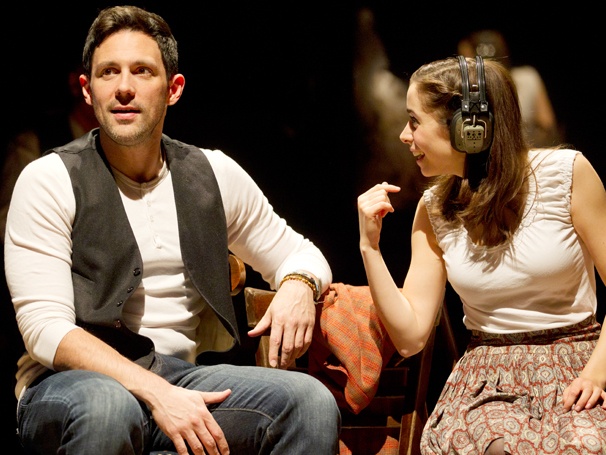
At first I was skeptical of Once, fearing this stage adaptation of an Oscar-winning indie film would quickly devolve into two-and-a-half hours of emotionally manipulative sentimentality accompanied by plaintive singer-songwriter style music.  But the show won me over with its expert execution and genuine heart, moving me in a way no other new musical has this season.  While small in scale, Once is large in ambition, and I’m happy to say is succeeds in achieving its lofty goals.  There is more invention and feeling in Once than in the other nominees combined, and the cherry on top of this musical sundae are two fantastic leading performances by breakout stars Steve Kazee and Cristin Milioti.

Once deserves the Best Musical trophy.  It is the best written show of the year, and the acting is the most truthful and heartfelt I’ve seen all season.  No one should be surprised if Newsies takes the prize tonight (I certainly won’t be), but I think Once has built up enough momentum that it might actually triumph over Disney’s pre-ordained classic.  Yes, this year has not been a great one for new musicals, but these two shows are definitely worthy of Broadway and beyond.


Will and Should Win:  Once


And that’s it for my 2012 Tony predictions!  Tune in to the Tony Awards telecast tonight at 8 to see how I did, and check back in the coming days for my reaction to Broadway’s biggest night.  If you’ve missed any of my previous prediction blogs, check them out below:


Best Actor (*Note:  I’ve amended my prediction for Best Actor in a Musical.  A lot of people seem to think Jeremy Jordan has this one in the bag, and since he was a close second for me I’ve upgraded him to “Will Win.”  Danny Burstein still “should win,” but I’m thinking this is Jordan’s year.)
Best Actress
Best Featured Actor
Best Featured Actress
Best Book and Score
Best Direction and Choreography

Friday, May 25, 2012

2012 Tony Predictions: Choreography and Direction


The time has come.  With a little over two weeks left until the Tony Awards ceremony on June 10th, it’s time for me to get out my crystal ball and predict who will be the winners and losers on Broadway’s big night. But before I start prognosticating, let me mention a couple of caveats: 
1) I haven’t actually seen all of the nominated productions, as I ran out of time and money long before I ran out of shows to see.  But given my 82% success rate in predicting the nominees, I think it’s safe to say I have some idea what I’m talking about. 
2) These are my predictions of who will win, not who should win, which is an important distinction to make.  Like any entertainment award, a fair amount of politics comes into play when determining the winners, especially when a large number of Tony voters are producers themselves and therefore biased.  Which is why in every category, I will pick the nominee who will win and also point out the person I think should win, which is not necessarily the same individual.  Any discrepancies will be addressed in the body of the article.
Now that we’ve laid out the ground rules, let’s get started!

Best Choreography


Nominees:  Rob Ashford, Evita; Christopher Gattelli, Newsies; Steven Hoggett, Once; Kathleen Marshall, Nice Work If You Can Get It

The chances of Evita winning a Best Choreography Tony are almost zero, despite some stunning dance sequences that managed to convert this Rob Ashford naysayer into a fan.  The overall production and especially its star were simply too disappointing to too many people.  And while certainly innovative and theatrical, I don’t see Steven Hoggett’s work on Once triumphing over the “real” dancing in the other nominated shows (that show’s playbill credits him with “movement” rather than full-fledged “choreography).

Kathleen Marshall has won this award three times before, most recently for the still running Anything Goes, which automatically makes her a major contender.  In my opinion, she is one of the most consistent and creative choreographers working today, and her musical staging for Nice Work is the only thing about that particular show which isn’t imminently predictable.  But her recent win combined with the lack of a true showstopper in Nice Work’s – nothing in it comes close to the heights achieved by her “Anything Goes” or “Blow, Gabriel, Blow” – could lead voters to give someone else a moment in the limelight.

That someone would be Christopher Gattelli and his work on Newsies.  The one thing against him is the fact that while superbly executed, a lot of the choreography lacks innovation.  Most of the routines look like combinations you would find in an admittedly advanced jazz class, a problem which kept Memphis from even being nominated two years ago.  But the Tony committee will surely want to give Newsies some recognition for becoming one of the spring’s biggest success stories, and I predict two-time Tony nominee Christopher Gattelli will become Tony-winner Christopher Gattelli on June 10th.

Will Win: Christopher Gattelli
Should Win:  Kathleen Marshall


Best Direction of a Play


Nominees:  Nicholas Hytner (One Man, Two Guvnors); Pam MacKinnon (ClybournePark); Mike Nichols (Death of a Salesman); Roger Rees and Alex Timbers (Peter and the Starcatcher)

After years of Broadway being dominated by British imports, I think the Tony voters are going to finally start rewarding Americans for their contributions to the legitimate theatre.  Which means Nicholas Hytner and his work on One Man, Two Guvnors is out.  I must also disqualify Pam MacKinnon, as I think most of the credit for that show’s success is being given to Bruce Norris’ script and its stellar acting ensemble.

Which leaves Mike Nichols and the combined talents of Roger Rees and Alex Timbers, all of whom were integral to the success of their respective shows.  Death of a Salesman is an acknowledged classic, but Nichols’ direction makes the entire production gel in a way that justifies the existence of this latest revival.  While everyone recognizes that the inventive staging has been the key to Peter and the Starcatcher’s success, I have to give the edge to Nichols.  He is an industry giant who commands an enormous amount of respect (see his seven previous Best Direction Tonys as proof), Salesman has become one of the theatrical events of the spring.  Rees and Timbers could score an upset, but I find it highly unlikely.

Will & Should Win:  Mike Nichols


Best Direction of a Musical


Nominees:  Jeff Calhoun, Newsies; Kathleen Marshall, Nice Work If You Can Get It; Diane Paulus, Porgy and Bess; John Tiffany, Once

If Newsies had opened in April instead of March, I would be predicting a virtual sweep for Disney’s tale of dancing newsboys, but just enough time has passed for the theatrical community to realize that for all of its merits, there is simply better work being done this year.  Direction awards tend to be higher-minded than some of the other categories, and Newsies simply isn’t up to that standard.  Similarly, Marshall’s serviceable job on Nice Work is by no means her best, and for a woman more respected as a choreographer than a director it simply isn’t enough to net her a Best Director trophy.

John Tiffany is the clear front runner here.  Once is the most nominated production of the season, and also the most artistically daring.  Without the delicately realized mood and pacing provided by Tiffany’s direction, Once would collapse under the weight of its own ambitions, instead of emerging as arguably the best new musical of the season. 

I think Diane Paulus has done sensational work on Porgy, and few directors have her gift of making the stagecraft behind the blocking seem so completely organic.  She has successfully brought the show into the 21st century, and made a classic opera seem real and immediate in a way I would not have thought possible.  Unfortunately for Paulus, there are enough purists who cannot accept Porgy as anything other than a 4-hour opera, and while I loved her interpretation I can understand why some people would feel that way.  For a production whose Broadway prospects were once in question – thanks to that infamous letter from Mr. Sondheim – Paulus should consider her inclusion among this year’s nominees a victory in itself.  Without the burden of preconceived notions, Tiffany was free to do whatever he wished with Once, and the results are totally transfixing and definitely Tony worthy.

Will & Should Win:  John Tiffany (although Paulus is a very close second)


That’s it for now, but check back throughout the next two weeks for more of my 2012 Tony predictions!

Wednesday, May 16, 2012

Everyone's a Little Bit Racist

Review:  Clybourne Park
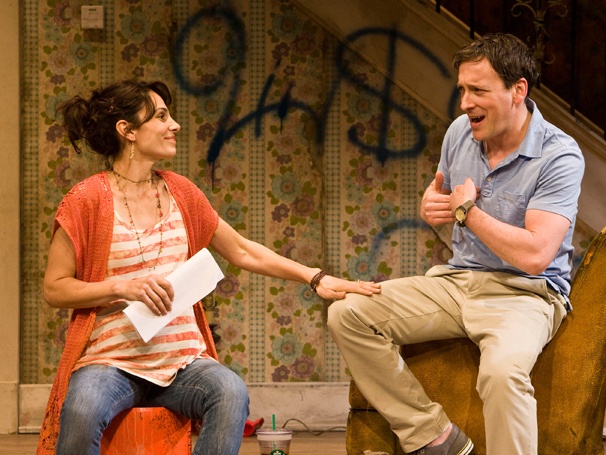
Annie Parisse and Jeremy Shamos in Clybourne Park.

While watching the first act of Clybourne Park, the new comedy by actor turned playwright Bruce Norris, you might find yourself wondering exactly what all the fuss is about.  While well written and ably performed, nothing about the play’s first hour seems to justify the mountains of praised heaped upon the work since its 2010 Off-Broadway premiere, which culminated in it winning of the Pulitzer Prize for Drama.  But by the time you reach the end of the howlingly funny second act, you realize that every word of Norris’ script was necessary to create the non-stop barrage of belly laughs and pointed sociological observations that make Clybourne one of the most entertaining and thought-provoking evenings of the current Broadway season.
Though set 50 years apart, both acts concern the impending arrival of unwanted residents in the fictional Chicago neighborhood which gives the play its title.  Wanting to escape the bad memories associated with their current home, 1950s suburbanites Bev (the excellent Christina Kirk) and Russ (the always outstanding Frank Wood) prepare to leave the all-white neighborhood of Clybourne Park in favor of greener pastures.  When it comes to light that the house has been sold at a deep discount to an African-American family (most likely the Youngers from Lorraine Hansbury’s seminal Raisin in the Sun, although that fact isn’t explicitly stated), Bev and Russ find themselves being harassed by their “concerned” neighbor Karl, played by a fantastic Jeremy Shamos. 
While Norris’ writing and Shamos’ acting ensure there’s more to Karl than just bigotry, it remains his overriding characteristic, and we are clearly meant to sympathize with the unseen black family.  Because of the distance provided by the period setting, it’s easy for us to sit in judgment of Karl, making the first act seem preachy and predictable despite its strong writing and convincing characterizations. 
But then Act II turns everything on its head by jumping ahead 50 years and reversing the races involved.  Clybourne Park, now an all-black neighborhood that has seen better days, is about to receive its first white residents in ages.  New owners Lindsey (Annie Parisse) and Steve (Shamos again, even better than before) plan to remodel the now historic building, prompting a meeting with the homeowners’ association that eventually leads to veiled accusations of racism and gentrification. 
Suddenly everything Norris wants to say becomes crystal clear, and you realize you had to sit through Act I to fully appreciate how far we have and haven’t come as a supposedly progressive society.  Norris expertly illustrates how even when talking about racism we don’t actually discuss it, since none of the characters really listen to what the others are saying, and all of the most racist comments come from characters voicing what they think is the subtext behind someone else’s words.  The second act is about everyday people who say occasionally racist things, and Norris forces us to ask the question, “Does that make them racist?”  The play offers no easy answers, making it all the more engaging.
The cast, who have been with the show since it’s Off-Broadway premiere, is uniformly excellent.  They all imbue their characters with a quirky specificity that adds volumes to the show’s charm without becoming grating or irksome, and everyone manages to create two fully realized people over the course of the evening.  The aforementioned Annie Parisse accomplishes the most drastic transformation – from a deaf housewife into a new aged “progressive” – with particular flair, and threatens to steal the show with her especially hilarious work in Act II.  Her Lindsey is a masterful satire on modern racism masquerading as liberalism, and yet Parisse plays her role without a hint of judgment on Lindsey’s increasingly misguided-if-well-intentioned worldview. 
Making her Broadway debut, Crystal A. Dickinson offers a fascinating look into the way modern racism is often a two-way street.  Her Lena devolves from a well-spoken individual with valid points into a vindictive, passive-aggressive antagonist who constantly invokes what has become colloquially known as “the black card.”  Her self-satisfied smugness as she gets under Lindsey and Steve’s skin is an excellent illustration of how any minority can take their righteous indignation too far, actually undermining their own cause in the name of advancing it.  (Dickinson also gets the biggest laugh of the evening with a joke that is, to put it mildly, extremely off-color.)
By the end of Clybourne Park, Norris has certainly earned his Pulitzer.  With a script that is simultaneously entertaining and intellectually stimulating, he leaves the audience with a lot to digest.  Along with the expert cast and superb direction by Pam MacKinnon’s (whose contributions cannot be underestimated), Norris’ script leaves you feeling satisfied and actually excited to go home and discuss the show with friends.  If that isn’t a hallmark of great theatre, then I don’t know what is.

Thursday, April 26, 2012

Tony Watch: Assessing the 2011-2012 Broadway Season Part 6

I'm sure the play is very good, but if that's what the house in Clybourne Park looks like, I'm not sure why anyone would want to move into it.

Magic/Bird
From the same team behind last year’s Lombardi, this play about the rivalry between NBA stars Magic Johnson and Larry Bird seems destined to be an also-ran in a season so packed with new works.  With less enthusiastic reviews than Lombardi (which wasn’t exactly embraced by critics to begin with) and lacking a critical darling like Judith Light to raise its profile, Magic/Bird simply won’t be among this year’s Tony nominees.

Peter and the Starcatcher
Peter and the Starcatcher, a prequel to Peter Pan, is the essence of an Off-Broadway show.  Relying more on a gifted ensemble and strong script than grand spectacle, this play is by all accounts quirky, inventive, and creatively staged in a way that emphasizes old-fashioned stagecraft over flashy technology.  Like last season’s Bloody Bloody Andrew Jackson, Starcatcher was well reviewed Off-Broadway and similarly praised after its move uptown.  I also predict that it will be similarly ignored by the Tony voters, with the exception of one or two acting nominations.
This has less to do with quality and is more a reflection of Tony politics and preferences.  The voters tend to prefer their plays be high-minded adult dramas rather than family shows, and with so many of the former on the boards this season I don’t see Starcatcher cracking the more competitive categories like Best Play or Best Direction.  I do think Christian Borle’s scene-stealing turn as Black Stache makes him a definite contender for some Best Supporting Actor love, and in such a crowded season for new plays even one Tony nomination is a definite accomplishment.

One Man, Two Guvnors
Quite honestly, I am over the recent trend of West End transfers coming to Broadway and sweeping the Tony Awards.  While there is definitely quality in the execution of these productions, I have found many of them to be overrated, as if the New York theatrical community has so deeply absorbed the idea that the English are better actors than we are that they blindly endorse anything with a British pedigree.
But with so many strong American productions on Broadway this year, I think that trend will finally be broken.  While this farce it could find itself the token British Best Play nominee (there’s always at least one), it is by no means assured a place at the table, given the already mentioned Tony preference for drama over farce.  All that said, even the most jaded theatregoer would have trouble justifying the exclusion of leading man James Corden from the Best Actor category, thanks to his virtuosic performance in such a physically demanding role.

Clybourne Park
This play has Tony bait written all over it.  It is a contemporary drama (or dark comedy, depending on who you ask) that tackles a serious issue (race) with intelligence and a roundly praised acting ensemble, Clybourne Park also has the distinction of being last year’s winner of the Pulitzer Prize for Drama.  In a tough category, that makes the show as close to a guaranteed Best Play nominee as there is this year.
The quality of the acting ensemble will either net the show a boatload of nominations or cancel one another out.  Of all the Tony categories, the acting nominations tend to be the most merit based, but it still helps if a performer is one of the best parts of their respected show.  When everyone is amazing, it sometimes results in no one getting nominated due to vote splitting.  The Best Direction of a Play category is so ridiculously competitive that I’ve given up trying to predict it, although anyone who can coax this many stellar performances out of a group of actors is certainly in the running.

A Streetcar Named Desire
Working on this iconic Tennessee Williams play is both a blessing and a curse.  On the one hand, the script is widely recognized as one of the greatest American plays ever written, with such layered characterizations and universal themes that it’s a veritable gold mine for serious dramatic actors.  However, the play is so well known that most critics have very specific ideas on how it should be handled, and the iconic characters have been played by some of the greatest actors who have ever lived, which makes living up to audience expectations for the work almost impossible.
It seems that this production, like most Streetcar revivals, didn’t fully satisfy critics.  Its inclusion among any of the Tony categories is a complete toss-up.  The strength of the material may get it included among the Best Revival nominees, but the apparent mishandling of that material could also keep it out of contention.  The lead actors all have roles that Tony voters gravitate toward, but it doesn’t sound like any of them have earned the right to join the prestigious company of confirmed greats like Jessica Tandy or Marlon Brando.  And who knows how Tony voters will react to director Emily Mann’s vision of an ethnically diverse production, given how much Williams’ plays rely on their Old South milieu for their themes and characterizations.  Some may feel casting black actors revealed new shades of meaning in this oft-studied work, but others may decide that race has little bearing on the material and is in essence stunt casting (this latter sentiment kept the recent all-black Cat on a Hot Tin Roof from being more of an awards contender).

Ghost the Musical
In a normal season, the critically lambasted Ghost would be such a long shot at any kind of award nominations that discussing it would be a waste of time.  But this is not a normal season, and given the lack of a Book of Mormon-esque critical and commercial success, anything could happen.  I personally don’t think Ghost can secure a Best Musical slot, but then again, I am predicting the absolutely atrocious Spider-Man (which I named the Worst Show of 2011) will be nominated in that very category due to weak competition and Tony politics.  Since the chances of Ghost actually being worse than that train wreck are infinitesimally small, perhaps Ghost stands a chance.
Which also means it could wind up among the Best Book and Score nominees, although I again doubt this will actually happen.  Ghost has not accumulated the industry clout that Spider-Man somehow has, and seemingly lacks the latter show’s mass commercial appeal.  The bland lead actors are also out of luck, as looking pretty and singing well thankfully isn’t quite enough to earn someone a Tony nomination.  Depending on how well Da’Vine Joy Randolph plays up the Sassy Black Woman archetype, she may find herself among the Best Supporting Actress nominees, although her chances of winning are currently next to nothing.  And even though it broke down on the night most critics reviewed the show, Ghost’s set could prove dazzling enough from a technical standpoint to get nominated.

Just one more article to go and we’ll have officially touched on every Broadway production that has opened during this busy season.  Look for it to go live soon!
To read my previous Tony Watch articles, look here:
Part 1
Part 2
Part 3
Part 4
Part 5