Showing posts with label phillip seymour hoffman. Show all posts

Thursday, June 7, 2012

2012 Tony Predictions - Best Actor


Here we are at the end of the acting categories.  Before I start making Best Actor predictions, I want to remind you of my two caveats:  1) I have not necessarily seen all of the nominees; and 2) I am prediction who will win, which is not always the same as who should win.

Best Actor in a Play
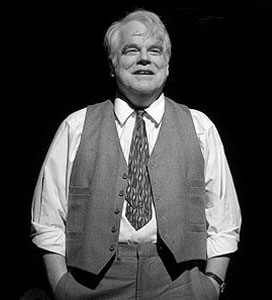


Nominees:  James Corden, One Man, Two Guvnors; Phillip Seymour Hoffman, Death of a Salesman; James Earl Jones, The Best Man; Frank Langella, Man and Boy; John Lithgow, The Columnist


I don’t mean to sound disrespectful of their work, but as far as this season is concerned past winners James Earl Jones, Frank Langella, and John Lithgow are essentially also-rans in a two person Tony race.  Jones received solid reviews for his work in The Best Man, but that show is more of an ensemble piece than a star vehicle, and having a star vehicle is a virtual prerequisite to winning the Best Actor trophy.  Langella’s Man and Boy definitely qualifies as a star vehicle, but outside of his performance the production was dismissed by critics.  It also closed by mid-October and hasn’t been discussed since, leaving Langella without the necessary momentum needed to secure a Tony statuette.

John Lithgow is in a better position than either Jones or Langella, in that The Columnist is a currently-running star vehicle from a well-respected author.  Unfortunately, the deluge of late-April openings resulted in The Columnist getting lost in the shuffle, and many found the play to be serviceable but disappointing given the talent involved (Lithgow is a past Tony winner, and playwright David Auburn is a Tony and Pulitzer Prize winner).

That leaves us with James Corden and Phillip Seymour Hoffman, both of whom have a lot going in their favor.  One Man, Two Guvnors seems to be this season’s British Sensation, the imported new play that has critics practically falling over themselves to praise it.  Corden himself has received plenty of accolades his physically demanding performance, and recent Tony history shows a strong voter bias toward English-bred actors.  However, that same history also shows a bias towards big name Hollywood talent in revivals of classic plays, which perfectly describes Hoffman.  Death of a Salesman is one of the most critically and commercially successful productions of the season, something that couldn’t have been achieved without a commanding central performance.  While I haven’t personally seen Corden, I have trouble imagining him topping Hoffman’s devastating turn in Arthur Miller’s classic, and I suspect Tony voters will feel the same way.


Will and Should Win:  Phillip Seymour Hoffman, Death of a Salesman


Best Actor in a Musical


Nominees:  Danny Burstein, Follies; Jeremy Jordan, Newsies; Steve Kazee, Once; Norm Lewis, Porgy and Bess; Rob Raines, Follies


Unlike their play counterparts, the Best Actor in a Musical nominees are much more evenly matched.  There isn’t a clear-cut front runner, and an argument could be made for any of these fine actors to win the big prize. All of that said, I think we can safely rule out both Norm Lewis and Rob Raines.  I have always felt Lewis’ abilities as an actor have been underrated, and I’m happy to see him receive his first Tony nomination for his accomplished work in Porgy and Bess.  That said, his is by no means the strongest performance of the bunch, and he’s greatly overshadowed by costar Audra McDonald, who from day one has been at the center of all that particular revival’s press coverage. 

Similarly, while Rob Raines did some excellent work in Follies, it did not reach the giddy heights of his costar and fellow nominee Danny Burstein.  Unlike last year, when Andrew Rannells and Josh Gad were so equally matched in The Book of Mormon that they effectively canceled one another out, popular opinion has clearly favored Burstein over Raines.  Anyone who wants to see a Follies win in this category will certainly vote for Burstein.

Jeremy Jordan is technically nominated for Newsies, but I think it’s safe to assume his is a blanket nomination for both that show and his work earlier this season as one of the title characters in Bonnie & Clyde.  Jordan is the hot young talent of the season, and though his work in Newsies isn’t as psychologically complex or emotionally mature as his competition, it is everything you could reasonably expect in a lighthearted show whose sole purpose is to entertain.  The road producers who usually vote for more commercially viable fare will want to ensure Newsies ends up with enough wins to sound impressive in an ad campaign, and Jordan could easily reap the benefits of their Tony love.

Steve Kazee is something of a wildcard.  On the one hand, he is giving a very moving performance in the most critically lauded new musical of the season, and the buzz around Once certainly isn’t hurting his chances.  On the other, for whatever reason the critical love of Once doesn’t quite extend into recognition for its cast (Kazee and costar Cristin Milioti were both conspicuously absent from the Drama Desk nominee list).  Because it is a new work and not a known property, I think some people are overlooking how much of the show’s success is due to its leads, instead of being wholly generated by the very strong book and score. 

I’d say the two gentlemen most likely to hear their name called on Tony night are Danny Burstein and Jeremy Jordan.  Burstein deserves the award for his revelatory and heart-breaking performance in Follies, a production the entire theatrical community went gaga over last fall and will certainly want to see recognized.  Burstein’s role is the hardest of the show’s central quartet to make interesting, making it all the more impressive that he ended up being one of the best parts of that much celebrated production.  But Jeremy Jordan has had a star-is-born season, and the Tonys love to celebrate talented newcomers as much as seasoned pros.  As much as I loved Burstein (I've been saying he needs to win this award since September), I am starting to suspect that this is Jordan's year.


Will Win:  Jeremy Jordan, Newsies
Should Win:  Danny Burstein, Follies


That’s all for the acting awards.  The only predictions I have left to make are the production categories, so look for my picks for the season’s best revivals soon!

In the meantime, here are the rest of my Tony prediction articles in case you missed them:


Best Featured Actor
Best Featured Actress
Best Book and Score
Best Direction and Choreography

Monday, May 7, 2012

Attention Must Be Paid

Review: Death of a Salesman
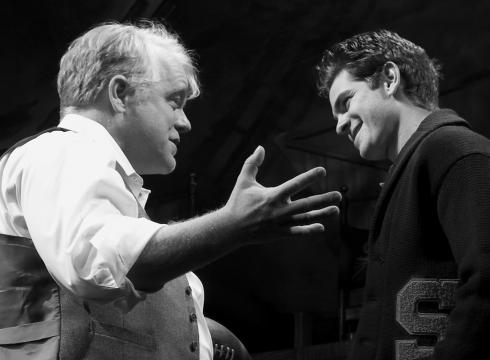
Phillip Seymour Hoffman and Andrew Garfield in Death of a Salesman
On rare occasions, a piece of theatre will leave you so profoundly affected that finding words to describe what you feel proves difficult.  The writing, direction, and performances all combine and send you into a momentary stupor as your brain attempts to process the depth of what you’ve just experienced.  You remain in your seat after the lights come up, hoping that by lingering in the theatre you’ll be able to enjoy its transcendent nature just a while longer.  The knockout revival of Arthur Miller’s Death of a Salesman is such a piece of theatre.

Miller’s script is such an acknowledged masterpiece that it’s easy to forget just how incredible his writing truly is.  This portrait of aging salesman Willy Loman uses incredibly specific characterizations to reveal something universal about the human experience, and it’s themes of shattering disappointment and unfulfilled potential remain timely over sixty years after its premiere.  Seeing a man who has poured his entire life into a company unceremoniously dismissed strikes an especially potent chord in our post-recession economy.  And in a society where adolescence has stretched into a person’s mid-twenties and beyond, Miller’s parallel tale of the arrested development of Willy’s two sons is instantly recognizable.
But a play, even a great one, does not perform itself.  And for this latest Broadway revival, director Mike Nichols has assembled a cast equal to the monumental potential of Miller’s script.  Oscar-winner Phillip Seymour Hoffman anchors this production with a tower performance in one of the theatre’s great roles, embodying Willy’s crushed soul from his first shambling footsteps onto the Barrymore Theatre’s stage.  Although considerably younger his character, Hoffman so convincingly portrays a man suffering from a lifetime of disappointment that you accept him as Willy immediately.  And while his desperation can be uncomfortably oppressive (as it should be), Hoffman peels back those years during the play’s flashback sequences to offer a glimpse of the great man everyone claims Willy used to be.  Hoffman’s contribution to the success of this production cannot be ignored, and anyone interested in seeing a true master at work owes it to themself to see him in this role.
Hoffman is more than ably supported by his costars, particularly Linda Emond.  As Willy’s long-suffering wife Linda, Emond takes a character type that has become cliché and invests it with such conviction that it seems new again.  While you completely understand and sympathize with Linda, you cannot pity her because Emond makes it clear she doesn’t want to be pitied.  Of the characters in the play, Linda is the most at peace with the family’s current situation, which only makes her final monologue all the more heartbreaking.  The play would lead you to believe that Linda has little left to lose, and yet by the end you know that she had everything to lose, and now that it is gone she is will likely never recover.
And then there is Andrew Garfield, a promising young film talent making a phenomenal Broadway debut as Willy’s son Biff.  Garfield is also too young for his role, but just like Hoffman he makes you forget that fact in seconds.  Biff’s tragedy is that he knows exactly what’s wrong with him and yet is powerless to change, and Garfield communicates that conflict flawlessly.  Resentful of the expectations placed on him by his father and filled with guilt over his inability of meet them, Garfield’s Biff is a cornered animal, dangerous and likely to lash out at any moment.  His scenes with Hoffman are simply electric.
Mike Nichols has guided his cast to perfectly pitched performances, ensuring the play moves inexorably towards its final conclusion.  So expertly paced is the piece that although it never drags, it never feels rushed either, with each revelation being afforded the proper dramatic weight.  The sublimely understated sets, costumes, and lighting keep the focus squarely on the human drama at the play’s center, allowing Nichols and his actors to do their work unimpeded.
This revival of Death of a Salesman is an affirmation of the incredible power live theatre can wield, and is an event that only comes around once in a great long while.  A great production of a great play, it simply cannot be missed.

Monday, April 23, 2012

Tony Watch: Assessing the 2011-2012 Broadway Season Part 4

Steve Kazee and Cristin Milioti in Once
There are so many shows opening these days on the Great White Way, I don’t even have time to come up with a pithy opening paragraph.  Picking up right where I left out, let’s talk about the Tony nomination prospects for:

The Road to Mecca
This has not been the best season for the Roundabout Theatre Company.  The once-mighty non-profit has overindulged in its habit of producing merely adequate revivals of merely adequate plays, trapping well-respected theatrical talent in productions that are frankly beneath them.  The Road to Mecca has done nothing to change that trend, and will likely be forgotten by all of the major awards-granting bodies.

Wit
Manhattan Theatre Club, on the other hand, continues to win over both critics and audiences with highly praised revivals of acknowledged classics in addition to their adventurous new works.  The first Broadway production of the Pulitzer Prize-winning Wit will certainly be among this year’s Best Revival nominees, and MTC’s artistic director Lynne Meadow is a contender for the Best Direction award as well.  Cynthia Nixon’s universally praised star turn makes her a shoe-in for a Best Actress nomination, although winning said award will be a much trickier feat.  On both the musical and play fronts, there has been spectacular work from Broadway’s leading ladies this season, and the Best Actress races are shaping up to be two of the most exciting and unpredictable of the this year’s awards.

Shatner’s World: We Just Live In It
This one man show’s run was so brief that even if the Best Theatrical Event Tony still existed, William Shatner might not qualify for it.  Without that category to compete in, this show doesn’t stand a chance.

Death of a Salesman
Take an undisputed theatrical classic, add an unmistakably talented Oscar winner in the lead role, mix well, and you have one of the event shows of the spring.  One of several Pulitzer Prize winners to grace Broadway this season, Salesman is top tier material, and this revival has been embraced by the entire theatrical community.  Although he is about 20 years too young for the role, audiences have been entranced by Phillip Seymour Hoffman’s searing portrayal of the doomed Willy Loman, and Tony voters will surely follow suit by granting him a Best Actor nomination.
But Hoffman isn’t the only thing critics are raving about in this Salesman.  It scored high marks across the board, making it a contender in several of the big categories and an assured Best Revival nominee.  Of the actors, Linda Emond stands the best chance of being nominated alongside Hoffman for her portrayal of Willy’s wife (also named Linda), but the supporting cast can’t be counted out.  With seven Tony Awards for direction already to his name, Mike Nichols is in as good a position as anyone to snag one of the five hotly contested Best Director nominations, and if it wasn’t a reproduction of the original 1949 design and therefore ineligible, the much-ballyhooed scenic design would be a contender as well.

Once
In recent years, the Best Musical race has invariably come down to a competition between the slickly realized Commercial Success and the artistically daring Critics’ Darling.  Once will surely be this season’s representative of the latter category, putting it in the company of shows like The Scottsboro Boys, Fela!, and Next to Normal that have all attempted to take down their more mass-market competition.  The good news for Once is that the Critics’ Darling always winds up with a host of Tony nominations; the bad news is that it tends to lose out in the major categories.
Once will surely be nominated for Best Musical, Best Book, and Best Score, by virtue of its strong reviews and weak competition.  It even stands a good chance of winning the latter two awards, although a Best Musical victory is something of a long shot due to Tony politics best dealt with at a later date.  By virtue of starring in one of the season’s best reviewed musicals, lead performers Steve Kazee and Cristin Milioti cannot be counted out of the acting races, although Kazee is more likely to actually score recognition than Milioti, whose category is shaping up to be a bloodbath.

Jesus Christ Superstar
Let’s be honest: there’s really only one Best Musical Revival slot still up for grabs.  Follies, Porgy and Bess, and Evita are all but assured nominations, and I suspect Jesus Christ Superstar will end up with the fourth and final slot.  I’ve already mentioned how the critically lambasted On a Clear Day doesn’t stand a chance in this category, and Superstar is simply a better-realized production than last fall’s Godspell.  It doesn’t hurt that this Superstar arrived on Broadway due to merit and popular demand, and it earns brownie points for solving a lot of the problems inherent in mounting this notoriously hard to stage work.
Other than the revival race, its prospects for awards are pretty grim.  The acting amounts to little more than pained looks, as all of the performers are clearly more focused on getting through Webber’s beast of a score than emoting.  I wouldn’t rule out Des McAnuff’s direction from the nomination pool, as he is largely responsible for what makes this Superstar special, and has been nominated for far less impressive work (Jersey Boys remains one of the most overrated musicals of the past 10 years).  I would really like to see a choreography nomination for Lisa Shriver’s surprising work on the show, but with song and dance spectacles making a comeback and several perpetually nominated choreographers (Kathleen Marshall, Rob Ashford) eligible for this season’s Tonys, Shriver faces an uphill battle.
I’ve just over a week to speculate on the 15(!) remaining productions of this season, so look for another one of these Tony articles sooner rather than later.