Showing posts with label des mcanuff. Show all posts

Tuesday, April 21, 2015

A Grandeurless Epic, Undone by Its Own Sprawl

Review: Doctor Zhivago

Kelli Barrett and Tam Mutu lead the company of Doctor Zhivago, the new musical epic that just opened at the Broadway Theatre.

The problem in adapting any epic novel for the stage, let alone the musical stage, is that large swaths of the original story are forced to be omitted in the name of time constraints. A great adaptation distills the source material's essence while excising the plot points and characters it doesn't have time to fully explore, which can shift the story's focus but is not necessarily a bad thing. Unfortunately, the musical version of Doctor Zhivago that just opened at the Broadway Theatre is not a great adaptation, with the resulting show long on bombast but short on narrative coherence or emotional impact.

Those lacking a strong familiarity with the source material and/or Russian history will be hard pressed to follow the plot, but at its most basic level Doctor Zhivago is the story of the titular doctor's life during World War I and the ensuing Russian Revolution. To be slightly more specific, Yurii Zhivago is orphaned at a young age and raised by friend's of his previously wealthy family; the Zhivago fortune was squandered away by Yurii's father, although his new guardians appear equally wealthy so this distinction is something of a moot point (the show goes out of its way to mention a lot of details that don't seem to really affect the main plot). Zhivago grows up and dutifully marries his childhood sweetheart Tonia, but their wedding (or is it just a Christmas party?) is interrupted when the beautiful and mysterious Lara appears and attempts to shoot her much older lover Viktor Komarovsky. Eventually war breaks out, Zhivago joins the revolution as a doctor, and he and Lara continue to cross one another's paths in the most unlikely of ways as a forbidden romance blossoms.

The above summary doesn't touch on Lara's husband Pasha (who eventually becomes a prominent figure in postwar Russia and one of the piece's main antagonists), Zhivago's secondary profession as a widely read and beloved poet, or the murky politics that lead to Zhivago and other members of the bourgeois being hunted like animals. Given how much ground there is to cover, it's hard to blame bookwriter Michael Weller, composer Lucy Simon, and co-lyricists Michael Korie and Amy Powers for the musical's unwieldy narrative, but that doesn't change the fact that Doctor Zhivago is exceedingly difficult to follow and that the broadly written characters are almost impossible to care about. Trying to cram so much narrative into two and a half hours leaves very little time for character development, which dampens any momentum or heat to be found in the central romance. The characters are also so busy rushing from one plot point to the next that they rarely have time to just be, and even after the final curtain falls you feel like you hardly know anyone onstage.

Given the Herculean task before him, Weller does a reasonably good job of communicating a lot of information quickly, but loses crucial character motivations as a result. Shortly before the finale Zhivago and Lara are offered the chance at a happy ending which they don't take for unclear reasons, and Pasha's entire character arc is almost incoherent. Weller can't seem to decided which element (politics, romance, a critique of the horrors or war) is most important to him, and the show feels wandering and aimless as a result. Simon's music is generally very pretty, avoiding the kind of bombastic belting that can make this type of show almost unbearable. If anything, Simon could stand a bit more bite to her music; the group numbers attempt to portray an epic grandeur but often end up feeling slight.

The performers compensate for the lack of specificity by going for big emotions and occasionally cross the line into overacting, no an easy feat in an epic musical playing one of Broadway's largest houses. Leading man Tam Mutu is certainly dashing as Zhivago and has a fine singing voice, but fails to fully make up for his character's underwittten nature and ill-defined motivations. He also lacks any kind of chemistry with the often histrionic Kelli Barrett as Lara, which makes their grand love story a very difficult sell given the pair's limited interactions during the first act. By their final scene together they have settled into an effective groove, although it comes as too little too late. Barrett does deserve credit for dialing down her performance for the show's finale, which almost manages to be moving despite the minimal engagement the musical provokes up until that point.

Paul Alexander Nolan is something of a miracle as the mercurial Pasha. His character's motivations are even less defined/developed than Zhivago's, but somehow Nolan manages to create the most interesting and coherent characterization of the night, acting as a reliable anchor when the narrative ship goes astray. His numbers are easily the most memorable, and he sells the show's most logic-defying twist in a way that ultimately feels believable and even somewhat earned. Nolan's performance feels authentically epic without ringing false, and goes a long way towards hiding the material's flaws.

Director Des McAnuff has done a poor job of coaxing believable performances out of his cast, but his staging sure is neat to look at. Making excellent use of Michael Scott-Mitchell's ever evolving raked set (and the upstage projections by Sean Nieuwenhuis), McAnuff creates a constantly engaging series of stage pictures that are often more interesting than the actual story. Choreographer Kelly Devine doesn't have much to do - the choreographers so rarely do in these period epics - but what little dancing is present is at least well executed. Paul Tazewell's costumes aren't quite as lavish as you'd like them to be, but there's at least some level of opulence to them, especially as lit by Howell Binkley.

There is something charmingly old school about the broadly drawn, overly earnest Zhivago, even if it ultimately reminds you why this particular brand of mega musical went out of style by the late 1990s. The show covers a vast breadth of material but contains only the smallest amount of depth, resulting in a show that ultimately seems inconsequential despite the grand language and themes it pays lip service to. Doctor Zhivago's producers had to know they were taking a pretty big risk with this show, and they should be commended for gambling on serious-minded, original material. The gamble fails to yield any exciting dividends, but then again, you can't win them all.

Saturday, December 22, 2012

Best Shows of 2012: #6


Best of 2012
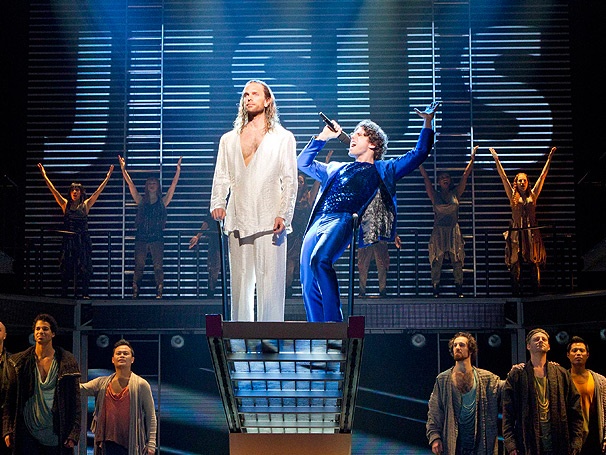
#6 – Jesus Christ Superstar

Jesus learns that living in NYC means ignoring the noise coming from right next to you.
 

Until last spring’s Broadway revival, I couldn’t even begin to fathom the enduring appeal of Andrew Lloyd Webber’s Jesus Christ Superstar.  An indulgently screechy rock opera written for singers with superhuman voices, the show features almost zero character development and a poorly scripted plot that’s nearly incomprehensible to those not already familiar with the story of Jesus Christ’s final days.  But after viewing director Des McAnuff’s pulse-pounding production, I finally “got” the show and why it has continued to appeal to generations of fans.

A dynamically engaging post-apocalyptic setting combined with McAnuff and choreographer Lisa Shriver’s propulsive movement gave this Superstar a drive few musicals can muster.  Each subsequent number would build upon the one which preceded it, and suddenly Lloyd Webber’s constant repetition of melodies and motifs felt purposeful and even necessary.  This staging successfully captured the giddy, over-the-top nature of a rock concert, while simultaneously adding unexpected depth to the show’s key interpersonal dynamics.  Now the relationships between Jesus, Judas, and Mary Magdalene weren’t just talked about but deeply felt, communicated through piercing stares and telling body language.

The entire cast deserves kudos for effortlessly highlighting the show’s hidden complexity and handling its vocal demands as well as any group of actors I’ve ever seen.  Paul Nolan’s pitch perfect rock tenor even managed to make the unending bombast of Jesus’ “Gethsemane” palatable, with the fact that he looked like the walking embodiment of every Renaissance painting of Christ serving as an added bonus.  Although I missed Josh Young’s Tony-nominated Judas due to the actor’s pervasive health issues, understudy Jeremy Kushnier was an entirely compelling anti-hero who genuinely struggled with the decision to betray his former friend.  And Chilina Kennedy’s Mary was the perfect foil for the two estranged friends at the show’s center, delivering the oft-sung “I Don’t Know How to Love Him” with refreshing honesty and conviction.

Jesus Christ Superstar will never be a great show, but this was a truly great production capable of converting even the show’s most ardent critics, myself included.  As a theatrical event and musical experience it exceeded all possible expectations, presenting a fresh take on the tired and at times overwrought material.  Unfortunately Superstar failed to find much of an audience and has long since closed, but those lucky enough to have seen it know why it was one of the Best Shows of 2012.


For a full review of Jesus Christ Superstar, click here.

Monday, April 23, 2012

Tony Watch: Assessing the 2011-2012 Broadway Season Part 4

Steve Kazee and Cristin Milioti in Once
There are so many shows opening these days on the Great White Way, I don’t even have time to come up with a pithy opening paragraph.  Picking up right where I left out, let’s talk about the Tony nomination prospects for:

The Road to Mecca
This has not been the best season for the Roundabout Theatre Company.  The once-mighty non-profit has overindulged in its habit of producing merely adequate revivals of merely adequate plays, trapping well-respected theatrical talent in productions that are frankly beneath them.  The Road to Mecca has done nothing to change that trend, and will likely be forgotten by all of the major awards-granting bodies.

Wit
Manhattan Theatre Club, on the other hand, continues to win over both critics and audiences with highly praised revivals of acknowledged classics in addition to their adventurous new works.  The first Broadway production of the Pulitzer Prize-winning Wit will certainly be among this year’s Best Revival nominees, and MTC’s artistic director Lynne Meadow is a contender for the Best Direction award as well.  Cynthia Nixon’s universally praised star turn makes her a shoe-in for a Best Actress nomination, although winning said award will be a much trickier feat.  On both the musical and play fronts, there has been spectacular work from Broadway’s leading ladies this season, and the Best Actress races are shaping up to be two of the most exciting and unpredictable of the this year’s awards.

Shatner’s World: We Just Live In It
This one man show’s run was so brief that even if the Best Theatrical Event Tony still existed, William Shatner might not qualify for it.  Without that category to compete in, this show doesn’t stand a chance.

Death of a Salesman
Take an undisputed theatrical classic, add an unmistakably talented Oscar winner in the lead role, mix well, and you have one of the event shows of the spring.  One of several Pulitzer Prize winners to grace Broadway this season, Salesman is top tier material, and this revival has been embraced by the entire theatrical community.  Although he is about 20 years too young for the role, audiences have been entranced by Phillip Seymour Hoffman’s searing portrayal of the doomed Willy Loman, and Tony voters will surely follow suit by granting him a Best Actor nomination.
But Hoffman isn’t the only thing critics are raving about in this Salesman.  It scored high marks across the board, making it a contender in several of the big categories and an assured Best Revival nominee.  Of the actors, Linda Emond stands the best chance of being nominated alongside Hoffman for her portrayal of Willy’s wife (also named Linda), but the supporting cast can’t be counted out.  With seven Tony Awards for direction already to his name, Mike Nichols is in as good a position as anyone to snag one of the five hotly contested Best Director nominations, and if it wasn’t a reproduction of the original 1949 design and therefore ineligible, the much-ballyhooed scenic design would be a contender as well.

Once
In recent years, the Best Musical race has invariably come down to a competition between the slickly realized Commercial Success and the artistically daring Critics’ Darling.  Once will surely be this season’s representative of the latter category, putting it in the company of shows like The Scottsboro Boys, Fela!, and Next to Normal that have all attempted to take down their more mass-market competition.  The good news for Once is that the Critics’ Darling always winds up with a host of Tony nominations; the bad news is that it tends to lose out in the major categories.
Once will surely be nominated for Best Musical, Best Book, and Best Score, by virtue of its strong reviews and weak competition.  It even stands a good chance of winning the latter two awards, although a Best Musical victory is something of a long shot due to Tony politics best dealt with at a later date.  By virtue of starring in one of the season’s best reviewed musicals, lead performers Steve Kazee and Cristin Milioti cannot be counted out of the acting races, although Kazee is more likely to actually score recognition than Milioti, whose category is shaping up to be a bloodbath.

Jesus Christ Superstar
Let’s be honest: there’s really only one Best Musical Revival slot still up for grabs.  Follies, Porgy and Bess, and Evita are all but assured nominations, and I suspect Jesus Christ Superstar will end up with the fourth and final slot.  I’ve already mentioned how the critically lambasted On a Clear Day doesn’t stand a chance in this category, and Superstar is simply a better-realized production than last fall’s Godspell.  It doesn’t hurt that this Superstar arrived on Broadway due to merit and popular demand, and it earns brownie points for solving a lot of the problems inherent in mounting this notoriously hard to stage work.
Other than the revival race, its prospects for awards are pretty grim.  The acting amounts to little more than pained looks, as all of the performers are clearly more focused on getting through Webber’s beast of a score than emoting.  I wouldn’t rule out Des McAnuff’s direction from the nomination pool, as he is largely responsible for what makes this Superstar special, and has been nominated for far less impressive work (Jersey Boys remains one of the most overrated musicals of the past 10 years).  I would really like to see a choreography nomination for Lisa Shriver’s surprising work on the show, but with song and dance spectacles making a comeback and several perpetually nominated choreographers (Kathleen Marshall, Rob Ashford) eligible for this season’s Tonys, Shriver faces an uphill battle.
I’ve just over a week to speculate on the 15(!) remaining productions of this season, so look for another one of these Tony articles sooner rather than later.

Friday, April 13, 2012

One Thing I'll Say, This Jesus is Cool

Review:  Jesus Christ Superstar

Paul Nolan as Jesus and the cast during the title number of Jesus Christ Superstar


*Note:  At the performance I attended, the role of Judas was performed by understudy Jeremy Kushnier.  This review reflects his portrayal.*
Like many of Andrew Lloyd Webber’s most famous works, Jesus Christ Superstar is plagued by a host of problems including poor plotting, underwritten characters, and repetitive music.  And just like Webber’s other currently running Broadway musicals (Phantom of the Opera, Evita), the latest revival of his biblically-inspired rock opera is saved by a game cast and stellar direction, resulting in a highly entertaining if not emotionally involving night of theatre.
Des McAnuff’s production, which originated at the Stratford Shakespeare Festival in Canada last summer, is a marvel of fluidity and invention.  Set in a post-apocalyptic future-past, this Superstar starts with a bang and doesn’t let up, as one scene melts into the next so quickly that you are afraid to applaud for fear of missing something important.  This speed definitely works in the show’s favor, as a slower pace would give the audience more time to notice its many structural flaws and the awkward lyrics by Tim Rice.  The pacing also provides tension to a story with such a well-known outcome (in case you didn’t know, Jesus dies at the end).
McAnuff’s staging is helped immensely by Robert Brill’s wonderful scenic design.  What initially appears to be no more than a metal catwalk and two staircases proves remarkably versatile, concealing a multitude of entrances and exits through which McAnuff can deploy his high energy cast.  And the group numbers are given an extra jolt via Lisa Shriver’s athletic choreography, bringing an unexpected visual edge to the staging.  No matter what your opinion of the material, McAnuff and his team ensure that there’s always something interesting to look at.  Paul Tazewell’s tastefully revealing costumes and Howell Binkley’s rock concert lighting only add to the visual wow factor.
It all makes you wish the cast was at the same level as the production team.  Make no mistake, this is a very accomplished group of actors, highly committed to their roles and blessed with vocal chords of steel.  While they don’t always make Webber’s insanely difficult score sound easy, they do consistently hit their money notes without crossing the line from singing to screaming.  Unfortunately, perhaps due to the thinness of the writing, most of the named characters struggle to come across as fully formed human beings.
Of the principal trio, Jeremy Kushnier’s Judas comes across the best, a feat that’s all the more remarkable given that Kushnier is the understudy.  He handles his role’s vocal demands with aplomb, and does an excellent job of conveying Judas’ conflicted feelings about Jesus.  When Judas goes to the high priests to betray Jesus, Kushnier makes clear it is a genuinely hard decision for him, and that he isn’t convinced he made the right choice even after the deal is done.
As Jesus, Paul Nolan certainly looks the part, as if a Renaissance painting of the Messiah came to life and stepped onto the Neil Simon Theatre stage.  Nolan has a stylistically perfect rock tenor and a piercing stare, but his characterization rarely evolves beyond anguished looks and occasional outbursts of anger.  And Chilina Kennedy lacks the grittiness necessary to portray prostitute Mary Magdalene, although she certainly sells her devotion to Jesus.  One of the most intriguing aspects of this production, obviously helped by McAnuff’s direction, is its focus on the pseudo-love triangle between Mary, Jesus, and Judas.  By increasing Mary’s stagetime, McAnuff adds jealousy to the list of Judas’ motives, since he is clearly unhappy with having his place in Jesus’ affections usurped by her.
The rest of the principals all turn in fine performances, with Bruce Dow’s scenery chewing during “Herod’s Song” a particular highlight.  Yet in many ways, the most surprisingly accomplished acting in the show comes from the twenty gifted young performers who make up Superstar’s ensemble.  McAnuff has clearly encouraged this group to develop individualized characters rather than perfectly mimic one another, and the choices lends more interest to the musically and lyrically repetitive group numbers while simultaneously helping to generate much of the show’s propulsive energy.
If you aren’t a fan of Lloyd Webber’s work (and this reviewer is not), Jesus Christ Superstar probably isn’t going to convert you.  But this production will leave you with a begrudging appreciation for his talents as a songsmith and a better understand of why his shows have remained so popular for so long.  Webber himself has called this revival “the best Superstar [he’s] ever seen,” and it’s very hard to argue with the dynamic energy on display.  McAnuff and company have turned what could easily have been a painful two-hour assault on the senses into a surprisingly engaging piece of entertainment, and a great option for those who prefer their musicals with a rock-infused edge.