Friday, May 18, 2012

Let's Call the Whole Thing Off

Review: Nice Work If You Can Get It
Judy Kaye and Michael McGarth sing "By Strauss/Sweet and Lowdown," one of the few instances where Nice Work If You Can Get It lives up to its potential.

The worst thing about Nice Work If You Can Get It, the slight new musical comedy currently playing at the Imperial Theatre, is that the whole thing looked so promising on paper.  Reimagining an old Gershwin musical (in this case, the 1926 Prohibition-era romp Oh, Kay) with a new book and Gershwin catalogue songs produced one of the most entertaining shows of the early ‘90s, the Tony-winning Crazy for You.  Hiring the ever-inventive director-choreographer Kathleen Marshall, fresh off the massive success of last season’s Anything Goes, seemed like an inspired choice, as her previous work demonstrates a strong grasp of this particular brand of musical comedy.  Kelli O’Hara is one of Broadway’s top talents, and teaming her with Matthew Broderick in his first musical since the similarly retro-modern Producers sounded like musical comedy gold.
Yet at some point during the development process, Marshall and her team (including new book writer Joe DiPietro) slightly but irrevocably botched the recipe.  Though the bright candy colors promise a sinfully sweet piece of frothy entertainment, Nice Work leaves you with an off-putting aftertaste that becomes more pronounced with each successive number.  You force yourself to consume the whole thing for fear of offending those who put in the effort to make it, all the while knowing that the next time it’s offered you’ll invent some way to politely decline. 
It’s hard to pinpoint exactly what went wrong with Nice Work. The score is filled with time-tested Gershwin standards like “Someone to Watch Over Me” and the title song, and those classic melodies are as beguiling as ever.  The plot, in which tomboyish bootlegger Billie Bendix (O’Hara) hides her liquor stash in the unused Long Island mansion of billionaire playboy Jimmy Winter (Broderick), is reasonably entertaining despite its predictability.  Joe DiPietro’s book may adhere too closely to the Boy-Meets-Girl formula – you’ll spend the last 15 minutes in particular waiting for the plot to reach the resolution you saw coming from a mile away – but the script is structurally sound and provides its fair share of laughs.  And Marshall stages the musical numbers with the inventive, playful wit and precise choreography that have become her signature, bringing the show closest to the greatness it could achieve with more revisions.
The cast is likewise hard to fault.  Ms. O’Hara’s beautiful voice is perfectly suited to this style of music, and there is a refreshing honesty about her performance that’s missing from too many of the slickly-produced entertainments currently populating the Great White Way.  Michael McGrath provides stellar comic relief as Billie’s sidekick Cookie, who is forced to impersonate the mansion’s butler to maintain their cover.  McGrath is surly but loveable in the role, and does exceedingly well with the multitude of one-liners and physical comedy handed to him.  And as a righteous Prohibitionist on the prowl for any stray bootleggers, Tony winner Judy Kaye really lets loose with her physically demanding and highly humorous supporting turn.
Of the main cast, Broderick is the only one who doesn’t seem quite right for his role.  Essentially reprising his Leo Bloom from The Producers, Broderick’s comic awkwardness isn’t very well suited to playing a womanizer who’s been married three times and is constantly visited by young women willing to take their clothes off for him.  And yet blaming Broderick for all of the show’s problems would be unfair, as he sings and dances as well as he ever did, and does land a consistent number of laughs throughout the course of the evening.
The real problem with Nice Work is that while all of the component parts are perfectly adequate, they don’t play off of each other properly, and the entire enterprise lacks spark.  The cast handles their individual bits quite well, but rarely interacts with one another in a convincing manner, killing any interpersonal chemistry the show might have had.  The show never drags, but it also never achieves the madcap energy and forward momentum needed to pull off the heightened farce that is the essence of musical comedy.
At the end of the day, you just have to wonder why anyone bothered.  Nice Work bears many structural and stylistic similarities to the aforementioned Crazy for You, but the latter work is simply better constructed.  Marshall would be an excellent candidate to helm a revival of that show, and many of this cast would do very well with that material, some of which overlaps with Nice Work anyway.  Instead, we are left with this forgettable “new” show that isn’t the best work of anyone involved.  While you won’t hate your time spent with Billie, Jimmy, and their friends, you probably won’t remember much of it either.  And you certainly won’t be asking for seconds.

Wednesday, May 16, 2012

Everyone's a Little Bit Racist

Review:  Clybourne Park
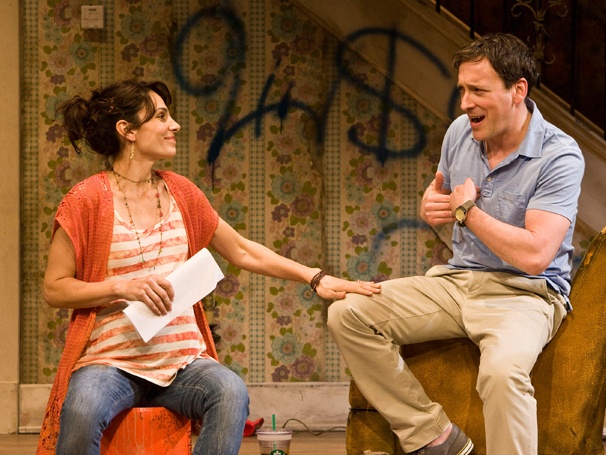
Annie Parisse and Jeremy Shamos in Clybourne Park.

While watching the first act of Clybourne Park, the new comedy by actor turned playwright Bruce Norris, you might find yourself wondering exactly what all the fuss is about.  While well written and ably performed, nothing about the play’s first hour seems to justify the mountains of praised heaped upon the work since its 2010 Off-Broadway premiere, which culminated in it winning of the Pulitzer Prize for Drama.  But by the time you reach the end of the howlingly funny second act, you realize that every word of Norris’ script was necessary to create the non-stop barrage of belly laughs and pointed sociological observations that make Clybourne one of the most entertaining and thought-provoking evenings of the current Broadway season.
Though set 50 years apart, both acts concern the impending arrival of unwanted residents in the fictional Chicago neighborhood which gives the play its title.  Wanting to escape the bad memories associated with their current home, 1950s suburbanites Bev (the excellent Christina Kirk) and Russ (the always outstanding Frank Wood) prepare to leave the all-white neighborhood of Clybourne Park in favor of greener pastures.  When it comes to light that the house has been sold at a deep discount to an African-American family (most likely the Youngers from Lorraine Hansbury’s seminal Raisin in the Sun, although that fact isn’t explicitly stated), Bev and Russ find themselves being harassed by their “concerned” neighbor Karl, played by a fantastic Jeremy Shamos. 
While Norris’ writing and Shamos’ acting ensure there’s more to Karl than just bigotry, it remains his overriding characteristic, and we are clearly meant to sympathize with the unseen black family.  Because of the distance provided by the period setting, it’s easy for us to sit in judgment of Karl, making the first act seem preachy and predictable despite its strong writing and convincing characterizations. 
But then Act II turns everything on its head by jumping ahead 50 years and reversing the races involved.  Clybourne Park, now an all-black neighborhood that has seen better days, is about to receive its first white residents in ages.  New owners Lindsey (Annie Parisse) and Steve (Shamos again, even better than before) plan to remodel the now historic building, prompting a meeting with the homeowners’ association that eventually leads to veiled accusations of racism and gentrification. 
Suddenly everything Norris wants to say becomes crystal clear, and you realize you had to sit through Act I to fully appreciate how far we have and haven’t come as a supposedly progressive society.  Norris expertly illustrates how even when talking about racism we don’t actually discuss it, since none of the characters really listen to what the others are saying, and all of the most racist comments come from characters voicing what they think is the subtext behind someone else’s words.  The second act is about everyday people who say occasionally racist things, and Norris forces us to ask the question, “Does that make them racist?”  The play offers no easy answers, making it all the more engaging.
The cast, who have been with the show since it’s Off-Broadway premiere, is uniformly excellent.  They all imbue their characters with a quirky specificity that adds volumes to the show’s charm without becoming grating or irksome, and everyone manages to create two fully realized people over the course of the evening.  The aforementioned Annie Parisse accomplishes the most drastic transformation – from a deaf housewife into a new aged “progressive” – with particular flair, and threatens to steal the show with her especially hilarious work in Act II.  Her Lindsey is a masterful satire on modern racism masquerading as liberalism, and yet Parisse plays her role without a hint of judgment on Lindsey’s increasingly misguided-if-well-intentioned worldview. 
Making her Broadway debut, Crystal A. Dickinson offers a fascinating look into the way modern racism is often a two-way street.  Her Lena devolves from a well-spoken individual with valid points into a vindictive, passive-aggressive antagonist who constantly invokes what has become colloquially known as “the black card.”  Her self-satisfied smugness as she gets under Lindsey and Steve’s skin is an excellent illustration of how any minority can take their righteous indignation too far, actually undermining their own cause in the name of advancing it.  (Dickinson also gets the biggest laugh of the evening with a joke that is, to put it mildly, extremely off-color.)
By the end of Clybourne Park, Norris has certainly earned his Pulitzer.  With a script that is simultaneously entertaining and intellectually stimulating, he leaves the audience with a lot to digest.  Along with the expert cast and superb direction by Pam MacKinnon’s (whose contributions cannot be underestimated), Norris’ script leaves you feeling satisfied and actually excited to go home and discuss the show with friends.  If that isn’t a hallmark of great theatre, then I don’t know what is.

Monday, May 7, 2012

Attention Must Be Paid

Review: Death of a Salesman
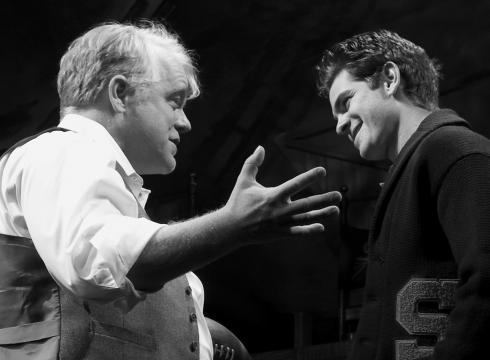
Phillip Seymour Hoffman and Andrew Garfield in Death of a Salesman
On rare occasions, a piece of theatre will leave you so profoundly affected that finding words to describe what you feel proves difficult.  The writing, direction, and performances all combine and send you into a momentary stupor as your brain attempts to process the depth of what you’ve just experienced.  You remain in your seat after the lights come up, hoping that by lingering in the theatre you’ll be able to enjoy its transcendent nature just a while longer.  The knockout revival of Arthur Miller’s Death of a Salesman is such a piece of theatre.

Miller’s script is such an acknowledged masterpiece that it’s easy to forget just how incredible his writing truly is.  This portrait of aging salesman Willy Loman uses incredibly specific characterizations to reveal something universal about the human experience, and it’s themes of shattering disappointment and unfulfilled potential remain timely over sixty years after its premiere.  Seeing a man who has poured his entire life into a company unceremoniously dismissed strikes an especially potent chord in our post-recession economy.  And in a society where adolescence has stretched into a person’s mid-twenties and beyond, Miller’s parallel tale of the arrested development of Willy’s two sons is instantly recognizable.
But a play, even a great one, does not perform itself.  And for this latest Broadway revival, director Mike Nichols has assembled a cast equal to the monumental potential of Miller’s script.  Oscar-winner Phillip Seymour Hoffman anchors this production with a tower performance in one of the theatre’s great roles, embodying Willy’s crushed soul from his first shambling footsteps onto the Barrymore Theatre’s stage.  Although considerably younger his character, Hoffman so convincingly portrays a man suffering from a lifetime of disappointment that you accept him as Willy immediately.  And while his desperation can be uncomfortably oppressive (as it should be), Hoffman peels back those years during the play’s flashback sequences to offer a glimpse of the great man everyone claims Willy used to be.  Hoffman’s contribution to the success of this production cannot be ignored, and anyone interested in seeing a true master at work owes it to themself to see him in this role.
Hoffman is more than ably supported by his costars, particularly Linda Emond.  As Willy’s long-suffering wife Linda, Emond takes a character type that has become cliché and invests it with such conviction that it seems new again.  While you completely understand and sympathize with Linda, you cannot pity her because Emond makes it clear she doesn’t want to be pitied.  Of the characters in the play, Linda is the most at peace with the family’s current situation, which only makes her final monologue all the more heartbreaking.  The play would lead you to believe that Linda has little left to lose, and yet by the end you know that she had everything to lose, and now that it is gone she is will likely never recover.
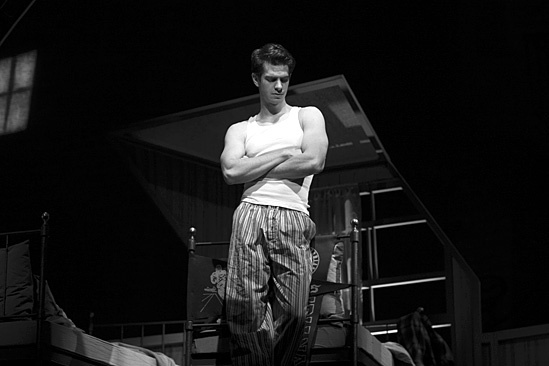
And then there is Andrew Garfield, a promising young film talent making a phenomenal Broadway debut as Willy’s son Biff.  Garfield is also too young for his role, but just like Hoffman he makes you forget that fact in seconds.  Biff’s tragedy is that he knows exactly what’s wrong with him and yet is powerless to change, and Garfield communicates that conflict flawlessly.  Resentful of the expectations placed on him by his father and filled with guilt over his inability of meet them, Garfield’s Biff is a cornered animal, dangerous and likely to lash out at any moment.  His scenes with Hoffman are simply electric.
Mike Nichols has guided his cast to perfectly pitched performances, ensuring the play moves inexorably towards its final conclusion.  So expertly paced is the piece that although it never drags, it never feels rushed either, with each revelation being afforded the proper dramatic weight.  The sublimely understated sets, costumes, and lighting keep the focus squarely on the human drama at the play’s center, allowing Nichols and his actors to do their work unimpeded.
This revival of Death of a Salesman is an affirmation of the incredible power live theatre can wield, and is an event that only comes around once in a great long while.  A great production of a great play, it simply cannot be missed.

Thursday, May 3, 2012

2012 Tony Nominations React

Emmy-winning Broadway veterans Jim Parsons and Kristin Chenoweth announce the 2012 Tony Award nominations.

The Tony Award nominations came out yesterday, making it the second most important day of the entire Broadway season (the first being the day the awards are actually handed out).  In case you somehow missed them, I’ve listed the nominees in the Big 12 categories below, with the starred names indicating the nominees I correctly predicted.

Best Performance by an Actor in a Featured Role in a Play
*Christian Borle, Peter and the Starcatcher
Michael Cumpsty, End of the Rainbow
Tom Edden, One Man, Two Guvnors
*Andrew Garfield, Arthur Miller’s Death of a Salesman
*Jeremy Shamos, Clybourne Park


Best Performance by an Actress in a Featured Role in a Play
*Linda Emond, Arthur Miller’s Death of a Salesman
Spencer Kayden, Don’t Dress for Dinner
*Celia Keenan-Bolger, Peter and the Starcatcher
*Judith Light, Other Desert Cities
*Condola Rashad, Stick Fly


Best Performance by an Actor in a Featured Role in a Musical
*Phillip Boykin, The Gershwins’ Porgy and Bess
*Michael Cerveris, Evita
*David Alan Grier, The Gershwins’ Porgy and Bess
Michael McGrath, Nice Work If You Can Get It
*Josh Young, Jesus Christ Superstar


Best Performance by an Actress in a Featured Role in a Musical
Elizabeth A. Davis, Once
Jayne Houdyshell, Follies
*Judy Kaye, Nice Work If You Can Get It
*Jessie Mueller, On A Clear Day You Can See Forever
*Da’Vine Joy Randolph, Ghost the Musical


Best Performance by an Actor in a Leading Role in a Play
*James Corden, One Man, Two Guvnors
*Philip Seymour Hoffman, Arthur Miller’s Death of a Salesman
*James Earl Jones, Gore Vidal’s The Best Man
Frank Langella, Man and Boy
John Lithgow, The Columnist


Best Performance by an Actress in a Leading Role in a Play
*Nina Arianda, Venus in Fur
*Tracie Bennett, End of the Rainbow
*Stockard Channing, Other Desert Cities
*Linda Lavin, The Lyons
*Cynthia Nixon, Wit


Best Performance by an Actor in a Leading Role in a Musical
*Danny Burstein, Follies
*Jeremy Jordan, Newsies
*Steve Kazee, Once
*Norm Lewis, The Gershwins’ Porgy and Bess
*Ron Raines, Follies


Best Performance by an Actress in a Leading Role in a Musical
*Jan Maxwell, Follies
*Audra McDonald, The Gershwins’ Porgy and Bess
*Cristin Milioti, Once
*Kelli O’Hara, Nice Work If You Can Get It
Laura Osnes, Bonnie & Clyde


Best Revival of a Play
*Arthur Miller’s Death of a Salesman
*Gore Vidal’s The Best Man
*Master Class
*Wit

Best Revival of a Musical
*Evita
*Follies
*The Gershwins’ Porgy and Bess
*Jesus Christ Superstar
Best Play
*Clybourne Park
*Other Desert Cities
*Peter and the Starcatcher
*Venus in Fur

Best Musical

Leap of Faith
*Newsies
*Nice Work If You Can Get It
*Once

I have to say, I’m pretty pleased with myself.  I correctly guessed 46 of 56 nominees, or an 82% average for those of you keeping score at home.  And when it comes to the four production categories (Best Play, Musical, Play Revival, and Musical Revival), I did even better, predicting 11 out of 12 eventual nominees.  Or 10.5 out of 12 if you want to get picky, since I had listed Master Class as my runner-up for Best Play Revival.  Apparently Tony voters don’t appreciate stunt casting in their Tennessee Williams plays.
We’ll dissect who has the best chances of winning at a later date, but for now here are my gut reactions to this year’s nominations:
- I am saddened to see play scores taking up two of the four Best Score nominations, mostly because I think it’s a sad comment on the writing being done for the musical theatre these days.  Too many new musicals rely on preexisting scores that are ineligible for the Tony (that would be you, Once), and the ones that do have new scores aren’t all that memorable.  I don’t think we lack the talent to write great scores; rather, I think these composers are being overlooked in favor of less talented people who can churn out a serviceable movie adaptation rather than a more innovative and therefore challenging theatrical score.
- I am thrilled to see Norm Lewis land his first Tony nomination.  Long recognized as an incredibly gifted vocalist, Lewis’ talents as an actor have been often overlooked, and it’s great to see him receive this kind of acknowledgement.
- On a similar note, good for Laura Osnes scoring a Best Actress nomination in a very competitive category.  At this point, I think we can officially forgive her for using that awful Grease: You’re the One That I Want reality show as a starting point for her Broadway career.  She has definitely proven that she has the talent to back up that lucky break.
- Although it did well in other categories, I’m really glad to see One Man, Two Guvnors excluded from the Best Play category.  It is about time the Tony voters began encouraging homegrown American playwrights after years of giving the Best Play trophy to slickly produced British imports of questionable artistic merit (*cough*War Horse*cough*).
- I’m shocked the critically reviled Leap of Faith managed to land one of the four Best Musical nominations.  It just goes to show you how weak the competition in that category was this year.  The fact that it can land such a high honor as its only nomination nominations proves that most of the exciting work being done this year was in revivals and straight plays.
- I’m not at all surprised but still very happy to see such a strong showing from last fall’s Follies.  While I haven’t seen all of this spring’s musicals (including the much ballyhooed Once), that Stephen Sondheim-James Goldman masterpiece is easily the best musical I’ve seen this season, revival or otherwise.

That’s all for now.  Get ready for a month of wild speculation and heated debate, as I’ve got plenty to say about all of the nominees and cannot wait to share it all with you!  And for a taste of what’s to come, here are my reviews of the Tony nominated productions I have personally seen.
Evita
Jesus Christ Superstar
Lysistrata Jones (only listed here because of its completely undeserved Best Book nomination)
Newsies
Porgy and Bess
Venus in Fur

*I saw Follies (three times, in fact) before I started this blog, hence it’s exclusion.  In place of a review, just imagine me gushing praise for every conceivably aspect of the show for 1000 words*

Monday, April 30, 2012

My Nominees for the 2012 Tony Awards


Before the Tony Awards nominations are announced tomorrow morning, I thought I would compile a list of my predictions for the eventual nominees.  While I certainly *hope* that you take the time to read all of my Tony Watch articles (the latest of which can be found here) on this same subject, this should provide an easy frame of reference for those of you who haven’t gotten to all of them yet.
Plus, it’s nice to take one final look back now that all the shows have opened and we can put everything in perspective.  And having an official list will make it easier to see how accurate my predictions actually are.  So here are my picks for all the major Tony categories, along with a Runner-Up that I could see knocking one of my nominees out of the running.
Andrew Garfield in Death of a Salesman
Best Featured Actor in a Play
Andrew Garfield, Death of a Salesman
Christian Borle, Peter and the Starcatcher
Jeremy Shamos, Clybourne Park
Michael Esper, The Lyons
Thomas Sadoski, Other Desert Cities
Runner-Up:  Dick Latessa, The Lyons                           

Best Featured Actress in a Play
Angela Lansbury, The Best Man
Celia Keenan-Bolger, Peter and the Starcatcher
Condola Rashad, Stick Fly
Judith Light, Other Desert Cities
Linda Edmond, Death of a Salesman
Runner-Up:  Christina Kirk, Clybourne Park
Phillip Boykin in Porgy and Bess
Best Featured Actor in a Musical
David Alan Grier, Porgy and Bess
Josh Young, Jesus Christ Superstar
Michael Cerveris, Evita
Patrick Page, Spider-Man: Turn Off the Dark
Phillip Boykin, Porgy and Bess
Runner-Up:  Tom Hewitt, Jesus Christ Superstar

Best Featured Actress in a Musical
Da’Vine Joy Randolph, Ghost
Elaine Page, Follies
Jessie Mueller, On a Clear Day, You Can See Forever
Judy Kaye, Nice Work If You Can Get It
Melissa van der Schyff, Bonnie and Clyde
Runner-Up:  Terri White, Follies
Tracie Bennett in End of the Rainbow
Best Actor in a Play
Alan Rickman, Seminar
James Corden, One Man, Two Guvnors
James Earl Jones, The Best Man
Phillip Seymour Hoffman, Death of a Salesman
Stacy Keach, Other Desert Cities
Runner-Up:  Hugh Dancy, Venus in Fur

Best Actress in a Play
Cynthia Nixon, Wit
Linda Lavin, The Lyons
Nina Arianda, Venus in Fur
Stockard Channing, Other Desert Cities
Tracie Bennett, End of the Rainbow
Runner-Up:  Jennifer Lim, Chinglish
Jan Maxwell in Follies
Best Actor in a Musical
Danny Burstein, Follies
Jeremy Jordan, Newsies/Bonnie and Clyde
Norm Lewis, Porgy and Bess
Rob Raines, Follies
Steve Kazee, Once
Runner-Up:  Raul Esparza, Leap of Faith

Best Actress in a Musical
Audra McDonald, Porgy and Bess
Bernadette Peters, Follies
Cristin Milioti, Once
Jan Maxwell, Follies
Kelli O’Hara, Nice Work If You Can Get It
Runner-Up:  Elena Roger, Evita

Elaine Paige and the boys of Follies
 Best Revival of a Play
The Best Man
Death of a Salesman
A Streetcar Named Desire
Wit
Runner-Up:  Master Class

Best Revival of a Musical
Evita
Follies
Jesus Christ Superstar
Porgy and Bess
Runner-Up:  Godspell
The cast of Newsies

Best Play
Clybourne Park
Other Desert Cities
Peter and the Starcatcher
Venus in Fur
Runner-Up:  The Lyons

Best Musical
Newsies
Nice Work If You Can Get It
Once
Spider-Man: Turn Off the Dark
Runner-Up:  Bonnie and Clyde

Check back tomorrow morning to see how I did!

Saturday, April 28, 2012

Tony Watch: Assessing the 2011-2012 Broadway Season Part 7

Matthew Broderick and the cast of Nice Work If You Can Get It celebrate their Best Musical Tony nominaton.
We’re in the home stretch of the spring season.  Only five more shows to discuss before next week’s Tony nominations, and they are:

The Lyons
When Tony Award winner Linda Lavin passed on the Broadway transfers of both Follies and Other Desert Cities in order to play the lead role in The Lyons, she raised quite a few industry eyebrows.  But something about the script for this Off-Broadway premiere – which at the time had no intention of transferring – caught her eye, and in hindsight it’s clear Lavin knew what she was doing.  The play’s strong reviews prompted a late season Broadway transfer, where it again opened to much critical praise for the play as a whole and Lavin’s performance in particular.
It will be interesting to see just how far The Lyons can infiltrate the Tony Awards in this very crowded season.  Its transfer to Broadway has been entirely merit-based, and opening just before the Tony eligibility cutoff date ensures it is fresh in everyone’s minds.  Will that be enough to net the work a Best Play nomination against its higher profile competition?  It just might be. 
Lavin is in a very strong position to secure a Best Actress nomination, and some of her costars may even join her for the ride.  Fellow Tony-winner Dick Latessa is well-respected in the theatrical community and giving another critically praised performance, and the young Michael Esper is so strong in the show that he’s managed to stand out next to such industry heavyweights.  Neither performer can be ruled out of the Supporting Actor race, and The Lyons could well end up being the Little Show That Could.

Nice Work If You Can Get It
One of the biggest question marks heading into the spring season was the “new” Gershwin musical Nice Work If You Can Get It.  A thorough reworking of Oh Kay, one of George and Ira’s lesser known musicals, Nice Work sports a cast and creative team with plenty of Tony pedigree.  Both of its stars have multiple Tony nominations to their name, and director/choreographer Kathleen Marshall is still riding high on the success of last season’s hit Anything Goes.  Yet the show received little pre-opening press or buzz, with many taking the lack of info as a sign that the show was on the road to disaster.
But now the show has opened to good if not great reviews, and more importantly has performed quite strongly in New York’s other theatrical contests like the Drama Desk and Outer Critics Circle Awards.  Like The Lyons, being so new has certainly helped Nice Work in this area, and all that momentum makes the show a serious Tony contender.  I predict it will indeed manage to nab one of the four coveted Best Musical nominations, a major victory for a show no one was even talking about a month ago.
Other all-but-guaranteed nominations: leading lady Kelli O’Hara for Best Actress and Kathleen Marshall for Best Choreography (and possibly Best Direction), as the latter is definitely working within her wheelhouse here.  Another likely nominee is Judy Kaye for her scene stealing comic turn, and while his lukewarm reviews aren’t very encouraging, Matthew Broderick cannot be completely ruled out of the Best Actor race.  And I expect one or more of the show’s design elements to get nominated, with Martin Pakledinaz’s flapper era costumes a particularly strong contender.

The Columnist
This new play from Manhattan Theatre Club certainly has a Tony-worthy pedigree.  Written by Pulitzer Prize-winning playwright David Auburn (Proof) and directed by Tony-winning director Daniel Sullivan (also Proof, as well as last season’s Merchant of Venice), the show stars multiple Tony winner John Lithgow as a 1960s era newspaper columnist named Joseph Alsop.  Unfortunately, The Columnist seems to have been lost among the plethora of shows that have opened in the past two weeks, and I don’t foresee it being much of a contender for this year’s awards.

Don’t Dress for Dinner
Hopefully Roundabout will finally learn a lesson after their extremely anemic offerings this season.  They need to stop producing subpar Broadway revivals of plays no one has heard of or cares about.  With tens of thousands of existing plays to choose from, not to mention the thousands more awaiting a first production, there’s no excuse for Roundabout to continually pick such poor material.  Don’t Dress for Dinner has earned some of the worst reviews of the spring, and the best it can hope for is to finish out its limited run without a premature closing.

Leap of Faith
An extremely last minute addition to the Broadway season facilitated by the closing of the Harry Connick Jr. bomb On a Clear Day, the new musical Leap of Faith ended the Broadway season on a whimper.  Critically reviled, I can’t imagine Faith ended up among this year’s Best Musical nominees, even with such weak competition.  The score by perpetual Tony bridesmaid Alan Menken has a better chance at a nomination, especially since it was just announced that the score for Once will be ineligible since it was written for the movie and not specifically for the stage.
Since by all accounts the libretto for Faith is one of the show’s primary problems, I’m ruling it out of the Best Book category, which leaves Raul Esparza as the only other real chance the show has at some Tony love.  And even then, it’s entirely possible that the four-time Tony nominee will find himself excluded from the Best Actor race due to the poor quality of his star vehicle.


And that, ladies and gentleman, brings us to the official end of the 2011-2012 Broadway season!  Be sure to check back on Tuesday when the Tony Award nominations are announced to see how I did with my predictions, and look for further Tony chatter throughout the month of May leading up to the big night on June 10th.  I can’t wait to talk more, and I hope you’ll join me for the ride.
And in case you missed my previous Tony Watch articles, you can catch up on them here:


Thursday, April 26, 2012

Tony Watch: Assessing the 2011-2012 Broadway Season Part 6

I'm sure the play is very good, but if that's what the house in Clybourne Park looks like, I'm not sure why anyone would want to move into it.

Magic/Bird
From the same team behind last year’s Lombardi, this play about the rivalry between NBA stars Magic Johnson and Larry Bird seems destined to be an also-ran in a season so packed with new works.  With less enthusiastic reviews than Lombardi (which wasn’t exactly embraced by critics to begin with) and lacking a critical darling like Judith Light to raise its profile, Magic/Bird simply won’t be among this year’s Tony nominees.

Peter and the Starcatcher
Peter and the Starcatcher, a prequel to Peter Pan, is the essence of an Off-Broadway show.  Relying more on a gifted ensemble and strong script than grand spectacle, this play is by all accounts quirky, inventive, and creatively staged in a way that emphasizes old-fashioned stagecraft over flashy technology.  Like last season’s Bloody Bloody Andrew Jackson, Starcatcher was well reviewed Off-Broadway and similarly praised after its move uptown.  I also predict that it will be similarly ignored by the Tony voters, with the exception of one or two acting nominations.
This has less to do with quality and is more a reflection of Tony politics and preferences.  The voters tend to prefer their plays be high-minded adult dramas rather than family shows, and with so many of the former on the boards this season I don’t see Starcatcher cracking the more competitive categories like Best Play or Best Direction.  I do think Christian Borle’s scene-stealing turn as Black Stache makes him a definite contender for some Best Supporting Actor love, and in such a crowded season for new plays even one Tony nomination is a definite accomplishment.

One Man, Two Guvnors
Quite honestly, I am over the recent trend of West End transfers coming to Broadway and sweeping the Tony Awards.  While there is definitely quality in the execution of these productions, I have found many of them to be overrated, as if the New York theatrical community has so deeply absorbed the idea that the English are better actors than we are that they blindly endorse anything with a British pedigree.
But with so many strong American productions on Broadway this year, I think that trend will finally be broken.  While this farce it could find itself the token British Best Play nominee (there’s always at least one), it is by no means assured a place at the table, given the already mentioned Tony preference for drama over farce.  All that said, even the most jaded theatregoer would have trouble justifying the exclusion of leading man James Corden from the Best Actor category, thanks to his virtuosic performance in such a physically demanding role.

Clybourne Park
This play has Tony bait written all over it.  It is a contemporary drama (or dark comedy, depending on who you ask) that tackles a serious issue (race) with intelligence and a roundly praised acting ensemble, Clybourne Park also has the distinction of being last year’s winner of the Pulitzer Prize for Drama.  In a tough category, that makes the show as close to a guaranteed Best Play nominee as there is this year.
The quality of the acting ensemble will either net the show a boatload of nominations or cancel one another out.  Of all the Tony categories, the acting nominations tend to be the most merit based, but it still helps if a performer is one of the best parts of their respected show.  When everyone is amazing, it sometimes results in no one getting nominated due to vote splitting.  The Best Direction of a Play category is so ridiculously competitive that I’ve given up trying to predict it, although anyone who can coax this many stellar performances out of a group of actors is certainly in the running.

A Streetcar Named Desire
Working on this iconic Tennessee Williams play is both a blessing and a curse.  On the one hand, the script is widely recognized as one of the greatest American plays ever written, with such layered characterizations and universal themes that it’s a veritable gold mine for serious dramatic actors.  However, the play is so well known that most critics have very specific ideas on how it should be handled, and the iconic characters have been played by some of the greatest actors who have ever lived, which makes living up to audience expectations for the work almost impossible.
It seems that this production, like most Streetcar revivals, didn’t fully satisfy critics.  Its inclusion among any of the Tony categories is a complete toss-up.  The strength of the material may get it included among the Best Revival nominees, but the apparent mishandling of that material could also keep it out of contention.  The lead actors all have roles that Tony voters gravitate toward, but it doesn’t sound like any of them have earned the right to join the prestigious company of confirmed greats like Jessica Tandy or Marlon Brando.  And who knows how Tony voters will react to director Emily Mann’s vision of an ethnically diverse production, given how much Williams’ plays rely on their Old South milieu for their themes and characterizations.  Some may feel casting black actors revealed new shades of meaning in this oft-studied work, but others may decide that race has little bearing on the material and is in essence stunt casting (this latter sentiment kept the recent all-black Cat on a Hot Tin Roof from being more of an awards contender).

Ghost the Musical
In a normal season, the critically lambasted Ghost would be such a long shot at any kind of award nominations that discussing it would be a waste of time.  But this is not a normal season, and given the lack of a Book of Mormon-esque critical and commercial success, anything could happen.  I personally don’t think Ghost can secure a Best Musical slot, but then again, I am predicting the absolutely atrocious Spider-Man (which I named the Worst Show of 2011) will be nominated in that very category due to weak competition and Tony politics.  Since the chances of Ghost actually being worse than that train wreck are infinitesimally small, perhaps Ghost stands a chance.
Which also means it could wind up among the Best Book and Score nominees, although I again doubt this will actually happen.  Ghost has not accumulated the industry clout that Spider-Man somehow has, and seemingly lacks the latter show’s mass commercial appeal.  The bland lead actors are also out of luck, as looking pretty and singing well thankfully isn’t quite enough to earn someone a Tony nomination.  Depending on how well Da’Vine Joy Randolph plays up the Sassy Black Woman archetype, she may find herself among the Best Supporting Actress nominees, although her chances of winning are currently next to nothing.  And even though it broke down on the night most critics reviewed the show, Ghost’s set could prove dazzling enough from a technical standpoint to get nominated.

Just one more article to go and we’ll have officially touched on every Broadway production that has opened during this busy season.  Look for it to go live soon!
To read my previous Tony Watch articles, look here:
Part 1
Part 2
Part 3
Part 4
Part 5