As any musical theatre fan already knows, the big budget film adaptation of Les Miserables is coming to theatres in just one short month. In preparation for the big event, I assembled a panel of experts (well, opinionated theatre people) to discuss the modern rejuvenation of the movie musical. I'm joined by returning podcaster Jessica and first-timers Spencer, Jackie, and Brian for a conversation about what makes for a good film adapatation of a hit stage show, as well as a frank discussion of the successes and failures of the various musical films released since 2003 Best Picture-winner Chicago.
Also, I am looking to really increase the podcast presence on this blog in the coming months, so any feedback about it is greatly appreciated. Let me know if you like the long format or would prefer shorter installments, and any suggestions for podcast topics are always welcome.
Enjoy, and have a Happy Thanksgiving!
Tuesday, November 20, 2012

Monday, November 19, 2012
Sunny Days are Here Again
Review: Annie
 |
| Lilla Crawford and Sunny the dog in the Broadway revival of Annie. |
For better and for worse, the 1977 Tony-winning smash Annie has become synonymous with the
words “Broadway musical.” Its eternal cheerfulness
and broad comedy represent the pinnacle of the musical-as-escapist-entertainment,
allowing audiences young and old the chance to laugh away their cares for a few
hours. However, the show’s saccharine
sweet reputation has caused an entire generation of potential theatregoers to
avoid musical theatre like the plague, assuming the entire genre is nothing but
smiling moppets singing shallow paeans to all that is good and right in the
world. Any modern revival must contend
with staying true to the show’s roots while trying to appeal to the jaded
cynics that make up a sizeable portion of the country’s population.
Director James Lapine’s handsome revival attempts to solve
this conundrum by adopting a more grounded approach to the material, and while
not always successful, his interpretation does allow the show’s enormous heart
to shine bright. Little orphan Annie’s
search for a family of her own is as emotionally involving as it’s ever been,
even if some of the more overtly comedic elements of Thomas Meehan’s book and
Charles Strouse’s score suffer due to Lapine’s new focus. While there are still plenty of laughs, they
are not as hearty as they might have been, though the show as a whole remains
thoroughly entertaining. The young and
young-at-heart will find it impossible to resist Annie’s many charms, and even this jaded critic found himself quite
taken by the entire affair.
Lilla Crawford, the young actress who the New York Times dubbed “pretty much
perfect” in the title role, was unfortunately absent from the performance I
attended. However, I am happy to report
that her understudy, Taylor Richardson, is supremely charming as the
street-smart orphan with the unwavering optimism. There is enough sass in Richardson’s performance
to keep the character’s sweetness from becoming sickening, and an innocence about
her that keeps you on her side throughout the show’s entire runtime. Her impressively bright belt makes even the
oft-mocked “Tomorrow” sound fresh, and the young actress imbues the part with
such sincerity that she proves impossible to resist.
Although they don’t get nearly the same amount of stage time
as Richardson, the rest of this Annie’s orphans
are equally talented and possibly even more adorable. Ranging from seven to eleven years old, these
precocious balls of energy sing and dance with an infectious, reckless abandon
that lights up the cavernous interior of the Palace Theatre. Lapine and choreographer Andy Blankenbuehler play
up the girls’ cuteness factor without seeming gratuitous, provoking the
evening’s biggest belly laughs in the process.
And while all of the orphans are standouts, tiny Emily Rosenfeld
threatens to steal the show as Molly, the littlest orphan with the biggest
personality.
In contrast to the uniform excellence of the child actors,
the adult roles are more of a mixed bag.
On the positive side, Anthony Warlow is sublime perfection as Oliver
Warbucks, the curmudgeonly billionaire who initially invites Annie to his 5th
Avenue mansion as a publicity stunt. As
Warbucks slowly falls for the plucky orphan, Warlow convincingly sheds his
gruff exterior to create the most multifaceted and three-dimensional
characterization of the entire show. His
gloriously sung “Something Was Missing” turns the sappy ballad into the evening’s
uncontested highlight, serving as the perfect encapsulation of the unadulterated
love a parent feels for their child. In
the thankless role of Warbucks’ chief secretary Grace Farrell, Brynn O’Malley
is also quite lovely, though not quite on the same level as her costar and
onstage boss.
Gifted with the production’s showiest role, two-time Tony-winner
Katie Finneran is a slight disappointment as the evil Miss Hannigan. A more developed variation of her
Tony-winning Marge from Promises,
Promises, Finneran’s take on the orphanage maven is an example of the
downside to Lapine’s more grounded take on the material. In trying to make Hannigan more sympathetic,
Lapine and Finneran have lost the character’s comedic bite, leaving the show
without the clear-cut villain it needs to fully succeed. The performance is often hysterical, and the
actress is especially adept at slapstick and physical comedy, but Finneran is simply
too nice in the role. By shying away
from her character’s inherent meanness, she prevents her Hannigan from being
the tour de force it was in the hands of Dorothy Loudon in the original or
Carol Burnett in the 1982 film version.
Yet Finneran’s minor shortcomings are nothing compared to
the complete ineptitude of Clarke Thorell and J. Elaine Marcos as Rooster
Hannigan and his bumbling accomplice, Lily.
While not large roles, both characters are essential to the show’s plot,
and in the right hands can become riotously funny scene stealers. Thorell and Marcos seem completely unaware of
this, offering up self-indulgent and decidedly unfunny portrayals of the two
small time crooks. It should be noted
that Thorell makes out slightly better than Marcos, although both seem so
completely out of their element that it hardly matters.
Aesthetically, David Korins’ storybook-inspired set gives
the show a unique look without differing wildly from what audiences have come
to expect from this classic show. Susan
Hilferty’s costumes similarly avoid reinventing the wheel, but the lovingly
constructed garments look gorgeous nonetheless.
When Annie finally dons her iconic red dress late in Act II, the young
actress looks truly beautiful, thanks in no small part to Hilferty’s
efforts. Andy Blankenbuehler’s
choreography is a more radical departure from the norm, bordering on too
contemporary for this Depression-era tale.
Blankenbuehler also needs to abandon his signature hip-hop inspired
scene transitions, which have brought him diminishing returns since they first
appeared in In the Heights and are
wholly inappropriate here.
Overall, this production looks and feels enough like the
classic Annie to avoid offending
purists while offering enough subtle twists to hold the interest of those who
have seen the show many times over. This
is not a radical reinvention of the material, but its enduring popularity over
the past 35 years proves that the show doesn’t really need reinventing. Under Lapine’s assured hand, this production
feels fresh and offers up a bevy of top-notch performances, ensuring that the
show’s target audience of young girls will absolutely adore it. Thankfully, there is plenty for the adults to
appreciate as well, and in these trying times it’s nice to have such a
sparkling reminder that the sun will indeed come out tomorrow.
Thursday, November 15, 2012
A Sleazy, Empty One Night Stand
Review: The
Performers
 |
| The Performers would be approximately 35.7% better if Cheyenne Jackson spent the entire show wearing this. |
Complaining about the vulgarity in The Performers is akin to complaining the music at a rock concert
is too loud. The new comedy by David
West Read is set in the world of the adult entertainment industry, so of course
there’s going to be a large amount of graphic sex talk that doesn’t confine
itself to proper anatomical terms. But unlike
in other, better plays, the vulgarity in The
Performers doesn’t serve any higher purpose than mere shock value, and
results in an evening that is both unfulfilling and forgettable.
Set in a Las Vegas hotel during the annual Adult Entertainment
Awards, the play opens with porn star – or performer, to use his preferred
title – Mandrew being interviewed by his high school friend Lee for a story in The New York Post. Mandrew is married to
fellow performer Peeps, who is experiencing an extreme fit of jealousy after
learning he kissed scene partner Sundown LeMay (Peeps and Sundown are already
in a fight over the cartoonishly large breast implants Sundown got without
informing her supposed best friend Peeps).
Also in the mix are Mandrew’s older professional rival Chuck Wood and
Lee’s mousy fiancée Sara, all of whom go through some sort of personal crisis
that is neatly resolved by the end of the play’s short 90 minute runtime.
Read’s writing is high on dirty words but low on character
development, which makes even the shortened length feel too long. Read frequently resorts to sentimentality and
clichéd observations about love and intimacy in an attempt to create audience
sympathy for these walking punch lines, but it almost always falls flat. The constant stream of obscenities and dick
jokes does provide some laughter, although the frat boy sense of humor proves
too lowbrow to be consistently entertaining.
To Read’s credit, there are some truly funny bits in the play’s second
half, including a hilarious riff on the original Freaky Friday film and a perfectly executed callback to a
previously established joke about the Where’s
Waldo? book series.
The biggest laughs come courtesy of the play’s two best actresses,
Ari Graynor and Jenni Barber as Peeps and Sundown, respectively. Both women turn their insanely vapid
characters into legitimate human beings, nailing the comedy while still demonstrating
a convincing emotional underpinning to their shenanigans. For all her non sequitur ramblings and
incessant whining, Graynor’s Peeps emerges as the most sympathetic character of
the bunch, made relatable by the emphasis on her desire for a loving marriage
and job security. Meanwhile, Barber
manages the small miracle of not being overshadowed by her insanely large fake
breasts (they really must be seen to be believed) and turns her limited
dialogue into comedic gold. Both
actresses elevate their material to the next level, and the production
noticeably suffers when neither is onstage.
As Mandrew and Chuck Wood, Cheyenne Jackson and Henry Winkler
aren’t as compelling as their female costars, but both do respectable jobs with
subpar material. Jackson continues to be
a reliable supporting player, making his Mandrew suitably dense yet lovable,
but the actor still hasn’t found the breakout role he deserves. (Note:
Those hoping for an eyeful of Jackson’s chiseled physique will be
disappointed, because despite his revealing opening outfit the star spends the
rest of the night fully clothed.)
Winkler, who isn’t in the show nearly as much as the promotional materials
would have you believe, still seems somewhat uncomfortable with his character’s
blue humor, but he does have a rather touching moment with Jackson that is
surprisingly heartfelt for such an empty-headed production.
Unfortunately, Daniel Breaker and Alicia Silverstone aren’t up to
snuff as engaged couple Lee and Sara.
Breaker has the unforgiving job of being the straight man, and seeing
him flounder in the role reiterates just how hard that character type is to
play. Breaker also undercuts his
effectiveness by mugging to the audience in inappropriate places, leaving his
scenes feeling unbalanced and unfocused.
Meanwhile, Silverstone is a disaster for much of the show, displaying
none of the charisma she’s usually known for.
She saves face thanks to a well-executed drunk scene towards the play’s
climax, although it comes as too little, too late.
The costumes by Jessica Wegener Shay and sets by Anna Louizos are
suitably tacky for a play with this subject matter, and the direction by Evan
Cabnet is serviceable but uninspiring.
Ultimately, the piece feels like an Off-Broadway or regional production
that somehow snuck onto a Broadway stage.
The script is well-intentioned but lacks sparks, and with the possible
exception of Graynor and Barber none of the performances feel like they’re
Broadway caliber. Given the wealth of
other options on tap for this season, The
Performers just isn’t worth your time and money.
Wednesday, November 14, 2012
Murder Can Be Fun (Provided You Have the Right Cast)
Review: The
Mystery of Edwin Drood
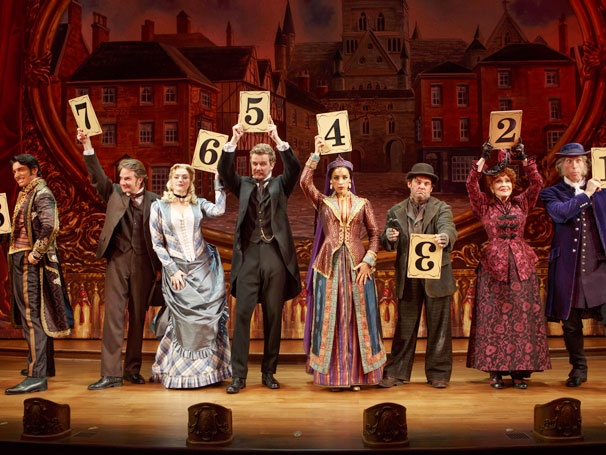 |
| The merry muderers of the Music Hall Royale in their rendition of "The Cell Block Tango" |
Let’s get one thing straight: The
Mystery of Edwin Drood – the 1985 musical murder mystery with book, music,
and lyrics by Rupert Holmes – is a terrible show. The music is bland, unmemorable, and breaks
so many rules of good theatrical composition that the mind boggles. The poorly constructed book consists of an
endless parade of paper-thin characters prattling on about nothing, with an
abundance of puns thrown into the mix to distract the audience from the fact
that nothing is actually happening. The
show’s central gimmick, allowing the audience to pick an ending for Charles
Dickens’ unfinished final novel of the same name, is a good one, but Drood relies so heavily on that conceit
that the initial two hours suffer mightily in comparison. Rarely have I found so few redeeming
qualities in a Broadway musical.
Having said all that, the Roundabout Theatre Company’s
current revival is an excellent production that manages to transcend all of the
script’s shortcomings to emerge as one of the most entertaining musicals of the
fall season. The hilarious and supremely
talented ensemble cast features a host of Broadway veterans all doing excellent
work, and the magnificent physical production offers a richly colored tapestry
on which the show unfolds. This is an
excellent mounting of a horrible show, and only the most jaded audience members
won’t find at least some enjoyment among the production’s many charms.
The show is set in the fictional Music Hall Royale of London
during the Victorian era, and the resident acting troupe has taken it upon
themselves to present a musicalized adaptation of the unfinished Mystery of Edwin Drood. The show-within-a-show concerns the
drug-addicted John Jasper’s unhealthy attraction to the beautiful Rosa Bud, who
has been betrothed to marry Edwin Drood since birth. Other characters in the tale include twin
siblings Helena and Neville Landless, their caretaker the Reverend Crisparkle,
opium purveyor Princess Puffer, and the town’s resident drunk Durdles. What any of these characters have to do with
one another remains something of a mystery, even after the show’s conclusion,
and matters are further complicated by the fact that the Music Hall Royale’s
actors are constantly breaking character to make asides or react to scripted
mistakes. Thankfully, the characters of Drood and the fictional actors who play
them are brought to such uniformly charming life by the show’s cast that this
narrative murkiness doesn’t really matter.
Donning drag to portray the titular character, Stephanie J.
Block has found the perfect vehicle to showcase her many talents. Block’s natural charisma helps taper the
character’s more abrasive qualities, and her broadly comedic portrayal provides
plenty of belly laughs. Her
spine-tinglingly good voice makes Holmes’ amateurish songs sounds leagues
better than they actually are, and her rendition of the show’s finale is
positively thrilling. She also possesses
a winning chemistry with Betsy Wolfe’s delightfully coquettish Rosa Bud, and
the pair is nothing short of enchanting whenever they share the stage.
Will Chase is clearly having a blast as the cartoonishly
sinister John Jasper, and his delight in the role’s over-the-top nature is
infectious. He’s the type of villain you
love to hate, even if his excessive snarling sometimes prevents him from making
the best use of his strong singing voice.
Andy Karl’s hot-headed Neville Landless is a hoot, and as his twin
sister with the “geographically untraceable accent” Jessie Mueller continues to
prove that she’s one of the most versatile actresses of her generation. Doing a complete one-eighty from her equally
winning work as Cinderella in this summer’s Into
the Woods, Mueller’s Helena Landless emanates a steely resolve and exotic
beauty that extends to the back of the balcony and beyond. Mugging in all the right places and given too
few opportunities to demonstrate her superb alto singing voice, Mueller is one
of the show’s strongest assets, and although her part is sizeable she still
leaves you wanting more.
This Drood also
sees the welcome return of the Chita Rivera to the Broadway stage, and the
legendary actress makes the most of her limited stage time. If her Princess Puffer doesn’t quite live up
to the insanely high standard the actress has set for herself, Rivera remains
the consummate professional and an utter joy to watch.
And then there’s Jim Norton.
As the Chairman and master of ceremonies of the Music Hall Royale, the veteran
actor’s virtuosic performance is the highlight of the evening. Although he initially appears to be little
more than a genial guide meant to hold the audience’s hand throughout the
freewheeling show, each scene allows Norton to reveal more and more of his vast
reserve of talent. The actor’s deft
comic timing makes even the most groan-inducing puns seem hilarious, and the
detached, slightly perturbed way in which he introduces scenes and characters
only serves to add to his charm. Norton
can turn a raised eyebrow or muttered aside into comedic gold, and when a
scripted mishap forces him to assume a more active role in the
show-within-a-show Norton unleashes the most hilarious characterization of the night.
Like the cast, Drood’s
physical production is top-notch.
William Ivey Long’s sumptuous Victorian costumes are resplendent in
their beauty, utilizing a deep color palette and intricate detail work to jump
off the stage. His attention to detail
permeates everything, from the perfectly tailored suit Will Chase wears for the
duration of the evening down to a breathtaking gown Stephanie J. Block wears
for all of thirty seconds. Anna Louizos’
set simply and effectively evokes the show-within-a-show’s multiple locations
and the English music hall the entire event occurs in (even the lobby has been
given a suitable Victorian makeover).
Brian Nason’s lighting design makes both the sets and the costumes pop,
and the overall result is a stage that is almost as interesting as the action
taking place on it.
The Roundabout’s Broadway productions have been hit or miss
for the past few seasons, but the ones that have worked have worked extremely
well. The Mystery of Edwin Drood is an example of a production that works,
despite the subpar material’s best attempts to derail the entire endeavor. The cast is top notch, and the fact that many
of them are playing roles outside their typical wheelhouse (and succeeding
brilliantly at it) adds an extra layer of enjoyment to their performances. While it would be a mistake to come to Drood expecting high art or evening
coherent storytelling, an abundance of fun and loads of laughs are virtually
guaranteed.
Sunday, November 4, 2012
What's So Speacial About the Original Cast?
 |
| There have been five Broadway productions of Gypsy, and for many the Ethel Merman original remains the best |
One interesting phenomenon among musical theatre
aficionados – really all theatre fans, but it’s more pronounced in musical
theatre circles – is the near-universal belief that a show’s original cast is
always the best one. No matter how many
times a show has been successfully revived or remounted, these fans insist the
original group of actors represent the best possible incarnation of a property. If the work is particularly beloved, suggesting
different actors for the lead roles becomes tantamount to sacrilege, and
eventually you get people who think the then 43-year-old Sarah Brightman is an
appropriate choice to play ingénue Christine Daae in the 2004 Phantom of the Opera film.
The above example is extreme, but the thinking
behind it is so widespread that people have paid good money to see a
37-year-old Adam Pascal play Roger in Rent
or a septuagenarian Carol Channing do Hello,
Dolly! Those real-life examples can
be explained away as people who missed legendary performances willingly
suspending their disbelief in order to see great actors recreate their most
famous roles, but such reasoning doesn’t justify the idea that no matter how
many times Gypsy or West Side Story get done, the original
cast will always be the best.
So what’s driving this belief? Is there any substance to the assertion that
the original cast is always the superior one?
In large part, I think the primary reason comes down to mere
familiarity. With musicals, many times
the only thing resembling a permanent record of the show is the Original Cast
Recording. This is how the vast majority
of fans are first exposed to a show, and it is just about the only way anyone
can relive the experience of actually seeing a live production. The particular set of mannerisms, vocal tics,
and acting choices captured by the recording becomes subconsciously ingrained
in the listener’s head, and through repeated exposure becomes the accepted or
“correct” way the material should be done.
If the person has never actually seen the show in question, then the
cast album becomes representative of the ideal version of the property that’s
been created in the listener’s head. Any
deviation from this imagined ideal can prove off-putting, even with supposedly
open-minded people.
But if the reasoning behind this preference for the
original cast seems somewhat arbitrary, that doesn’t mean the resulting wisdom
is entirely wrong. The truth of the
matter is that the originating actor often ends up being the best, or at least
one of the best, people to tackle a particular role. If the performer is lucky enough to have the
part written expressly for them, the way Gypsy
was written for Ethel Merman or The
Producers was tailored specifically to Nathan Lane, then of course he or
she is going to impress in the role.
Even if the writers don’t have a particular person in mind when creating
a character, they will inevitably end up fashioning the part around the person
chosen to play it. If a scene or song
isn’t working, any rewrites will almost certainly take the performer’s
strengths into account. In a
particularly collaborative environment, the actor may have direct input into
the character’s moods and actions, subtly but forever skewing the script
towards that performer’s interpretation of the role.
Then there are the times when a performer proves so
compelling in a role that it takes on a life of its own, becoming greatly
expanded in order to fully utilize that actor’s talents. Anyone who has read the novel Wicked will tell you Glinda is a much
more prominent presence in the musical, because the writers wanted to put for
focus on Kristin Chenoweth’s bravura performance. Stephen Flaherty and Lynn Ahrens wrote the
song “Sarah Brown Eyes” in Ragtime specifically
to give Tony-winner Audra McDonald more to do, since she was simply too good to
leave out of the second act. Rory O’Malley’s
Elder McKinley didn’t even exist is early drafts of The Book of Mormon, but Matt Stone and Trey Parker were so
entertained by his antics in the ensemble they crafted a role to better
highlight him. When a role is so
specifically tailored to the original performer, their take on it will
naturally be one of the strongest.
Original casts (and premiere casts of revivals) also
have the benefit of extended rehearsal time to explore their roles. A typical Broadway musical has about a month
of rehearsals and another month of previews, giving the performers plenty of
time to discover the nuances of their characterizations and iron out any kinks. Add to that the months or even years spent
workshopping a modern musical, and you have an artist who is intimately
familiar with their particular character.
By the time workshops, out-of-town tryouts, and previews are taken into
account, Idina Menzel spent three to four years
refining her Elphaba, whereas her many replacements got at best a couple weeks
of rehearsal before their first public performance.
The massive investment of time, combined with the knowledge
that they are the first person to portray a particular role, results in actors
feeling a sense of ownership that is difficult to replicate. The original cast of a show has a heightened
investment in making the show succeed, and going through the journey of
discovering their characters with the writers and director gives their
performances a more fully-realized and believable quality. In contrast, many subsequent actors are
encouraged to replicate the original’s performance, which can create a feeling
of inauthenticity in their work. Even if
the production is new, such as a revival with entirely original staging, the
shadow of their predecessor can loom large over any actor. Every woman who’s played Joanne in Company has had to choose between trying
to mimic Elaine Stritch (thereby inviting director comparison) or veering from Stritch’s
blueprint and likely being criticized for it.
As we have seen, there are a lot of factors that
contribute to making the original cast of a particular show the preferred one. Because of this, I will always try to see a
show while the original company is intact, but I have also seen enough
replacements and understudies to know that they can be every bit as strong as
the original performers. I’ve also seen
some incredible revivals that surely must compare favorably with the originals,
such as the Patti LuPone-led Gypsy or
the most recent New York staging of Follies. Ultimately, the right actor in the right
role will make for amazing theatre, whether that actor is the first person to
ever play that character of the hundredth.
That is what makes live theatre so exciting, and being able to see
multiple interpretations of the same show is what keeps me coming back, time
and again.
Sunday, October 21, 2012
The Best Bad Party You'll Ever See
Review: Who’s
Afraid of Virginia Woolf?
 |
| George has found his bite, and it's truly scary. Carrie Coon, Tracy Letts, Madison Dirks, and Amy Morton in Steppenwolf's Who's Afraid of Virginia Woolf? |
You just can’t keep a good play down. Edward Albee’s classic drama Who’s Afraid of Virginia Woolf? last played
Broadway a scant seven years ago, but any audience member thinking it’s too
soon to revive this American masterpiece will have all doubts wiped away within
the first few minutes of the sensational new production currently playing the
Booth Theatre. Imported from Chicago’s
famed Steppenwolf Theatre Company with its original cast intact, this
devastating new interpretation of the 50-year-old work feels as immediate and
fresh as if it were written yesterday.
For those unfamiliar with the play, Who’s Afraid of Virginia Woolf? depicts the incredibly dysfunctional
relationship of a college history professor named George (Tracy Letts) and his supremely
dissatisfied wife, Martha (Amy Morton).
Booze-addled and vicious, the pair has turned their frequent verbal assaults
into a highly structured game of wits that’s been perfected through years of
practice. They’ve tricked the
unsuspecting Nick and Honey (Madison Dirks and Carrie Coon, respectively) into unwittingly
participating in this blood sport by inviting the younger couple over for a
nightcap following a faculty party, and after a series of escalating arguments the
sun rises on four completely shattered human beings.
Albee is a three-time Pulitzer Prize winner and acknowledged
master of the theatre, and Virginia Woolf
is the work that first catapulted him to national attention. The passage of time has done nothing to dull
its incendiary bite and pulse-pounding immediacy, and the depth of these
supposedly civilized characters’ cruelty remains shocking 50 years later. The dialogue, especially that of the fiercely
intelligent George and Martha, dazzles with its inventiveness and complexity,
offering a feast for the ears while providing a wealth of information about the
characters speaking it. How the
characters talk is just as revealing as what they say, and repeated visits will
unearth new turns of phrase and clever wordplay to appreciate.
Albee has such fun with the language that his play manages
to be oppressively dark and blisteringly funny, a duality wisely highlighted by
director Pam MacKinnon and her phenomenal cast.
MacKinnon’s razor sharp direction perfectly balances comedy and drama,
giving the play a kinetic energy that alternates between uproarious laughter
and squirm-inducing discomfort. The
play’s three-plus hours fly by, leaving you thoroughly exhausted and yet hungry
for more.
The cast may lack any recognizable Hollywood names, but the
level of talent displayed by this incredible ensemble of Steppenwolf actors
more than compensates for the lack of star wattage. This is the finest group of performers to set
foot on Broadway in years, working in such perfect tandem that the production
never feels anything less than completely authentic. The attention to detail and emotional honesty
is truly stunning, and although I don’t typical prognosticate in reviews, I
expect this company to do exceedingly well come Tony season.
The greatest revelation among the cast is Tracy Letts, who
won virtually every award imaginable as the author of the Pulitzer
Prize-winning August: Osage County. His acting talents are every bit as astounding
as his playwriting abilities, and his George emerges as the standout in a play
usually dominated by Martha’s grandstanding theatrics. Letts initially appears to be the unambitious
“nothing” Martha constantly accuses him of being, but as the night progresses
he shows a bite and extreme callousness that far surpasses anything his wife is
capable of. His malice is palpable, and when
George loses his cool you’ll find yourself shrinking away in abject horror. But just as George reaches his most
monstrous, Letts will do something so utterly charming that you cannot help but
be drawn to him, and by play’s end he’s demonstrated that all of his actions
are motivated by a twisted but wholly sincere love for his wife.
Of course, George cannot exist without Martha, and Amy
Morton does thoroughly impressive work in the role. From her first entrance she displays a
perfectly modulated level of intoxication, using every nuance of her movement
and mannerisms to create the most convincing depiction of a high functioning
alcohol I’ve ever seen. Morton fully
embraces all of Martha’s less admirable qualities, including her particularly
egregious actions in Act II, but tempers her anger enough that you never once
doubt her deep, uninhibited love of George.
Morton creates a devastating portrait of a tragically lonely, wounded
human being, one who ultimately knows she’s brought this all upon herself and
is deeply remorseful about it. The interplay
between Morton and Letts is the centerpiece of the evening, and they portray
George and Martha’s relationship in all of its off-putting complexity.
As the most unfortunate houseguests ever, Carrie Coon and
Madison Dirks more than hold their own against the powerhouse performances
going on around them. Carrie Coon’s
Honey may not have much to say, but she communicates volumes through her body
language and physicality. Honey’s the
most obviously intoxicated of the bunch, and Coon creates a convincing
alcohol-induced haze around herself while still giving the audience access to
the myriad of thoughts swirling around in her head. Coon also provides the evening’s most hilarious
moments of physical comedy, gamely throwing herself at whatever piece of
furniture (or person) happens to be closest.
Madison Dirks has the trickiest role in the show, as Nick
acts as much as an audience surrogate as he does a participant in the story. Instantly distrustful of George and Martha’s
antics, Nick initially seems like a nice guy caught in a bad situation, but
eventually reveals himself to be every bit as depraved and morally
reprehensible as his hosts. Dirks slowly
unravels the layers of pretension and arrogance surrounding Nick, leaving us
with a wholly honest portrait of a young man already beginning to feel the bitter
sting of regret.
The production design perfectly complements and enhances the
work of the actors. Todd Rosenthal’s set
looks exactly like you’d expect the house of two alcoholic academics to look, with
each nook and cranny filled with enough perfectly ordered chaos that it could
hold our attention all by itself. Allen
Lee Hughes’ lighting subtly conveys the passage of time as the evening wears on
and dawn approaches, and the costumes by Nan Cibula-Jenkins inform all of the
characters without overwhelming any of them.
In short, this top-tier Virginia
Woolf is a must see for any serious theatre fan. The Steppenwolf Theatre Company is home to
some of the greatest actors working today, and we are lucky that these four have
chosen to grace the New York stage with their abundance of talent. Tracy Letts and Amy Morton earn their place
among the all-time great George and Marthas, while Pam MacKinnon’s expert
direction keeps the entire production moving forward with a crackling energy
that is thrilling to behold. Who’s Afraid of Virginia Woolf? is the
epitome of Broadway theatre, and simply cannot be missed.
Thursday, October 18, 2012
Defying Gravity, Almost 9 Years Later
Review: Wicked
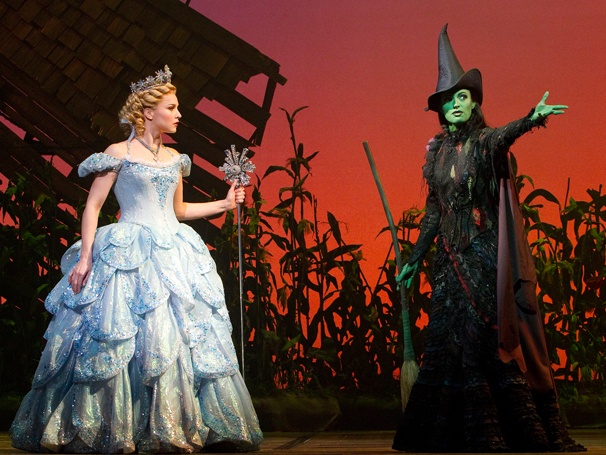 |
| Chandra Lee Schwartz as Glinda and Jackie Burns as Elphaba in the Broadway production of Wicked. |
Wicked is a show I’ve
been interested in revisiting for quite some time. After seeing the original Broadway cast during
the summer of 2004, I left the show entertained but not blown away, and honestly
wasn’t quite sure what all the fuss was about.
But after seeing the show do years of sell-out business in New York and
on the road, while also developing an incredibly loyal fan community, my
curiosity started getting the best of me.
Wicked has become not just a
hit show, but a phenomenon that has struck a chord with millions of people, and
I began wondering if there was something I had missed the first time around. So eight years after my initial viewing, I
headed back to the Gershwin Theatre this past weekend to view the Land of Oz
with fresh eyes.
Seeing the show again, I can’t say my overarching opinion of
it has changed much, but I will admit to appreciating Stephen Schwartz’s magnum
opus more now than I did in 2004. Now
that the hype around the show has calmed down, it’s easier for me to evaluate
the show own its own merits. During that
initial viewing, the show was widely considered a guaranteed winner for the Best
Musical Tony, and as such I was evaluating it against some very high
expectations (Wicked lost the award
to Avenue Q just days after my first
viewing). I found Elphaba’s story to be
full of big-budget spectacle but light on heart, which made the entire
enterprise feel somewhat empty.
Wicked remains big
and loud, but this time through I saw a lot more heart than I originally gave the
show credit for. The relationship
between Elphaba and Glinda is one of the more complex musical theatre dynamics
in recent history, and the musical does a good job hinting at the political
implications of Gregory Maguire’s source novel without becoming bogged down
with polemics. Book writer Winnie
Holzman did a great job of condensing that sprawling text into something more
manageable and inherently theatrical, while still finding room to have a great
deal of fun with the references to Dorothy’s concurrent adventures. But keeping Dorothy offstage causes the
second act to feel choppy, and I’d say the show’s greatest flaw is that it doesn’t
satisfactorily pay off all its various plot threads. But Holzman does give at least some indication
how all of those stories turn out, which is more than can be said for a lot of
lesser musical librettists.
The score is probably the best Stephen Schwartz has ever composed
for the theatre, and he probably should have won his long-overdue first Tony
for it. The only explanations for his
loss in the Best Score category are the absolute clunkers written for the
Wizard, since the rest of the score displays an inventive adventurousness that
holds up well to repeated listening. Wicked is also one of the few shows
where you can see exactly what your $135 ticket price is going toward, with
lavish costumes and sets that are impressive for both their scale and attention
to detail. Joe Mantello’s staging moves
everything along at a pace that never sags but still allows time for quiet
character moments, which when played correctly supply the heart every good
piece of theatre requires.
One concern I had going into the show was how the current
cast would stack up to the near-legendary performances of the original
company. Such comparisons may not be
fair but they are bound to happen, especially when this reviewer actually saw
said performances and is not just extrapolating them from what’s preserved on
the cast recording. Happily, this
current company acquits itself of the material quite well, with one major
exception that I’ll address in a minute.
Jackie Burns does a great job of fleshing out the different
layers of Elphaba, the “Wicked” Witch of the West, making a clear transition
from shy youth to impassioned freedom fighter while preserving the character’s
internal logic. Burns’ portrayal makes
the show firmly (and rightfully) Elphaba’s story, rather than splitting the
focus between her and Glinda as the original cast did. Also, Burns has the vocal ability to make these
oft-sung songs sound fresh and alive, an invaluable gift for such warhorses as “Defying
Gravity” and “For Good.”
Many of the supporting actors do an excellent job of making
a lasting impression with limited stage time.
Randy Danson chews scenery in the best possible way as Madame Morrible, displaying
that perfect combination of camp and malice usually reserved for only the best
Disney-style villains. Jenny Fellner
makes her Nessarose as complex as the writing will allow, keeping her
sympathetic enough that we like her while understanding why other people
wouldn’t. If Kyle Dean Massey is a
little too caught up in his Norbert Leo Butz impersonation to be an entirely
compelling Fiyero, he still does a fine job in a role whose importance is often
overstated to begin with. And Adam
Grupper is the one significant improvement over the original, as his Wizard
comes across as far more interesting and menacing than Joel Grey’s ever did.
Unfortunately, the cast’s one weak link is a major one, and
that is Chandra Lee Schwartz as Glinda.
Now admittedly I am biased after seeing Kristin Chenoweth’s truly
transcendent take on the role, a performance I can recall in great detail to this
very day. But even grading on a curve,
Ms. Schwartz fails because she is so concerned with the comedy that she forgets
to make Glinda an actual human being. Her
attempts at comedy produce mixed results, and the more dramatic scenes fall
completely flat. There is nothing
sympathetic about her performance, and her motivations remain so murky and
unconvincing that you ultimately wish she would just go away so we could get
back to the much more compelling story of Elphaba. Considering every eligible actress in town
has surely auditioned for this role, I find it tough to believe that Schwartz
is the best the producers could find.*
All that said, I thoroughly enjoyed my return trip to the Land
of Oz. Any complaints I have are minor
in comparison to the many things Wicked
does right. With its combination of
compelling characters, interesting plot, and big-budget spectacle, Wicked earns its place as one of
Broadway’s biggest hits. It may not be a
great musical, but it is a very good one, and makes an excellent First Broadway
Show for kids and out-of-town relatives that don’t see theatre all that
often. The current cast performs the
material with an abundance of professionalism and gusto, and I for one can
think of a lot worse ways to spend an evening.
*Note: Between the
time I saw the show and wrote this review, Chandra Lee Schwartz left the
Broadway company of Wicked. The role of Glinda is currently played by
Alli Mauzey, who is hopefully a lot better.
Subscribe to:
Posts (Atom)