Showing posts with label wicked. Show all posts

Monday, March 11, 2013

Why Shorter Runs are Good for Broadway

 
When it first opened on Broadway, Oklahoma!'s 5 year run made it an unprecedented smash.  This past January, Phantom of the Opera celebrated its 25th year on the Great White Way.

Anyone who’s paying attention has probably noticed that even Broadway’s big hits aren’t running as long as they used to.  In a trend kickstarted by the singular sensation A Chorus Line, it seemed like almost every hit musical from the eighties and nineties was guaranteed a nice, long run that routinely stretched past the ten year mark.  Shows like Cats, Les Miserables, and The Phantom of the Opera (whose recorded shattering run has lasted over 25 years) made a compelling argument for hit shows that could run essentially forever. 

But around the dawn of the new millennium, things began to change.  Many of the old stalwarts like Les Miz and Cats played their final performances, and even Tony-winning megahits like The Producers and Hairspray began posting closing notices sooner than expected (although still long after they had turned a profit).  Some people bemoaned this fact; after all, I’m sure more than few producers have sent their kids through college using the money they made from long-running hits like The Lion King and Chicago, and the steady work such shows provide performers and technicians can be a godsend in an industry where stability is a rare commodity.  But I would argue the trend towards shorter runs is actually beneficial for the industry, and not just because there are only so many times I can hear “Dancing Queen” without wanting to punch someone.

To me, it seems the biggest benefit of the end of long runs is the theatre space it frees up.  There are only a finite number of Broadway theatres, and every season Wicked or Jersey Boys run they prevent another, potentially great production from receiving its Broadway debut.  This spring has already seen both The Velocity of Autumn and The Miss Firecracker Contest postpone their announced Broadway engagements due to lack of theatre space.  There is an extremely well-reviewed production of The Glass Menagerie currently playing at A.R.T. in Boston that producers would love to transfer (and I would love to see), but there’s no suitable theatre available.  Simply put, we have reached a point where there are more potential Broadway shows than there are Broadway theatres, and the longer the current shows run the longer we must wait to see what’s next.

An increased number of shows also means an increased number of playwrights, composers, and directors who get the invaluable experience of creating a show on Broadway.  This is particularly true for musical theatre artists, as finding an Off-Broadway venue with the space and resources to mount a new musical is at best challenging and at worst near impossible.  Yes, there are plenty of large regional theatres that are both willing and able to produce new musicals, and while an out-of-town experience is certainly useful, even vital, to the development of a show and its writers, it cannot duplicate the scrutiny and exposure a Broadway mounting brings with it.

The decrease in long-running shows will also help stem the tide of artistic stagnation that has been threatening to overtake Broadway for years.  New shows automatically increase the amount of fresh and exciting ideas circulating within in the industry, while preventing once innovative notions from wearing out their welcome.  A recent visit to the long-running Chicago revival confirmed what I had long feared:  what was once a fresh, exciting production has been overtaken by lackadaisical actors going through the motions, making the entire affair feel rather bland in the process.  This is not to say the show is bad; it still has its moments (the choreography, for example), and many of the tourists who make up the show’s demographic are blissfully unaware that they are experiencing a third rate version of this once first rate entertainment.  But Broadway is supposed to be the top tier of the American theatre industry, and unfortunately the longer a show runs the more likely it is to lose the luster that once made it seem revelatory.

More regular change also keeps Broadway’s performers on their toes, creating an environment where they can grow artistically thanks to a steady stream of new experiences.  While there is certainly something to be said for a steady paycheck, too many talented performers become seduced by that notion and spend three or four years doing the same show, eventually reaching the point where they could perform the show in their sleep.  The skills that are not actively required by that particular role become dull or lost, which will make landing the next job that much harder and keep the actor from achieving their full potential.

Finally, shorter runs lead to smarter budgeting by producers.  While it has never been a sound decision to budget a show so that it must run for years to turn a profit, the eighties and nineties spawned enough examples of long-running shows that producers began assuming every show would be equally successful.  Now that even the hit shows are closing sooner, producers will (hopefully) start creating shows with more sensible, sustainable budgets so that a greater number of them recoup their investment, thereby generating more income that can be used to finance the next wave of productions.

To be clear, I am not saying that long runs are inherently bad.  Good shows deserve financial success, and the employment opportunities afforded by long-running shows are certainly appreciated in these tough economic times.  For instance, The Book of Mormon is an incredible artistic achievement that has earned every bit of its runaway success, meriting the nice long run it will surely enjoy.  Shows like Wicked and Rent have introduced an entire generation to the joys of live theatre, and many of the people entering the industry today were inspired to do so by their experience with those shows.  But I do think that wanting everything to run for decades is neither realistic nor healthy for the industry as a whole, and that shows which run for a more than five years should be the exception and not the rule.

Thankfully, I think Broadway is heading back in this direction.  Now that many of the old juggernauts have closed, the industry seems to be recalibrating its definition of success to a more realistic standard.  A two or three year run is a very respectable achievement for any show, and as those become more standard it should prompt producers to begin budgeting their upcoming productions accordingly.  This way, we should be treated to a steady stream of new shows that will keep Broadway artistically vibrant while ensuring our next generation of writers are fully nurtured and supported.  And that will benefit us all in the long run.

Sunday, November 4, 2012

What's So Speacial About the Original Cast?

There have been five Broadway productions of Gypsy, and for many the Ethel Merman original remains the best

One interesting phenomenon among musical theatre aficionados – really all theatre fans, but it’s more pronounced in musical theatre circles – is the near-universal belief that a show’s original cast is always the best one.  No matter how many times a show has been successfully revived or remounted, these fans insist the original group of actors represent the best possible incarnation of a property.  If the work is particularly beloved, suggesting different actors for the lead roles becomes tantamount to sacrilege, and eventually you get people who think the then 43-year-old Sarah Brightman is an appropriate choice to play ingĂ©nue Christine Daae in the 2004 Phantom of the Opera film.

The above example is extreme, but the thinking behind it is so widespread that people have paid good money to see a 37-year-old Adam Pascal play Roger in Rent or a septuagenarian Carol Channing do Hello, Dolly!  Those real-life examples can be explained away as people who missed legendary performances willingly suspending their disbelief in order to see great actors recreate their most famous roles, but such reasoning doesn’t justify the idea that no matter how many times Gypsy or West Side Story get done, the original cast will always be the best.

So what’s driving this belief?  Is there any substance to the assertion that the original cast is always the superior one?  In large part, I think the primary reason comes down to mere familiarity.  With musicals, many times the only thing resembling a permanent record of the show is the Original Cast Recording.  This is how the vast majority of fans are first exposed to a show, and it is just about the only way anyone can relive the experience of actually seeing a live production.  The particular set of mannerisms, vocal tics, and acting choices captured by the recording becomes subconsciously ingrained in the listener’s head, and through repeated exposure becomes the accepted or “correct” way the material should be done.  If the person has never actually seen the show in question, then the cast album becomes representative of the ideal version of the property that’s been created in the listener’s head.  Any deviation from this imagined ideal can prove off-putting, even with supposedly open-minded people.

But if the reasoning behind this preference for the original cast seems somewhat arbitrary, that doesn’t mean the resulting wisdom is entirely wrong.  The truth of the matter is that the originating actor often ends up being the best, or at least one of the best, people to tackle a particular role.  If the performer is lucky enough to have the part written expressly for them, the way Gypsy was written for Ethel Merman or The Producers was tailored specifically to Nathan Lane, then of course he or she is going to impress in the role.  Even if the writers don’t have a particular person in mind when creating a character, they will inevitably end up fashioning the part around the person chosen to play it.  If a scene or song isn’t working, any rewrites will almost certainly take the performer’s strengths into account.  In a particularly collaborative environment, the actor may have direct input into the character’s moods and actions, subtly but forever skewing the script towards that performer’s interpretation of the role.

Then there are the times when a performer proves so compelling in a role that it takes on a life of its own, becoming greatly expanded in order to fully utilize that actor’s talents.  Anyone who has read the novel Wicked will tell you Glinda is a much more prominent presence in the musical, because the writers wanted to put for focus on Kristin Chenoweth’s bravura performance.  Stephen Flaherty and Lynn Ahrens wrote the song “Sarah Brown Eyes” in Ragtime specifically to give Tony-winner Audra McDonald more to do, since she was simply too good to leave out of the second act.  Rory O’Malley’s Elder McKinley didn’t even exist is early drafts of The Book of Mormon, but Matt Stone and Trey Parker were so entertained by his antics in the ensemble they crafted a role to better highlight him.  When a role is so specifically tailored to the original performer, their take on it will naturally be one of the strongest.

Original casts (and premiere casts of revivals) also have the benefit of extended rehearsal time to explore their roles.  A typical Broadway musical has about a month of rehearsals and another month of previews, giving the performers plenty of time to discover the nuances of their characterizations and iron out any kinks.  Add to that the months or even years spent workshopping a modern musical, and you have an artist who is intimately familiar with their particular character.  By the time workshops, out-of-town tryouts, and previews are taken into account, Idina Menzel spent three to four years refining her Elphaba, whereas her many replacements got at best a couple weeks of rehearsal before their first public performance.

The massive investment of time, combined with the knowledge that they are the first person to portray a particular role, results in actors feeling a sense of ownership that is difficult to replicate.  The original cast of a show has a heightened investment in making the show succeed, and going through the journey of discovering their characters with the writers and director gives their performances a more fully-realized and believable quality.  In contrast, many subsequent actors are encouraged to replicate the original’s performance, which can create a feeling of inauthenticity in their work.  Even if the production is new, such as a revival with entirely original staging, the shadow of their predecessor can loom large over any actor.  Every woman who’s played Joanne in Company has had to choose between trying to mimic Elaine Stritch (thereby inviting director comparison) or veering from Stritch’s blueprint and likely being criticized for it.

As we have seen, there are a lot of factors that contribute to making the original cast of a particular show the preferred one.  Because of this, I will always try to see a show while the original company is intact, but I have also seen enough replacements and understudies to know that they can be every bit as strong as the original performers.  I’ve also seen some incredible revivals that surely must compare favorably with the originals, such as the Patti LuPone-led Gypsy or the most recent New York staging of Follies.  Ultimately, the right actor in the right role will make for amazing theatre, whether that actor is the first person to ever play that character of the hundredth.  That is what makes live theatre so exciting, and being able to see multiple interpretations of the same show is what keeps me coming back, time and again. 

Thursday, October 18, 2012

Defying Gravity, Almost 9 Years Later


Review:  Wicked
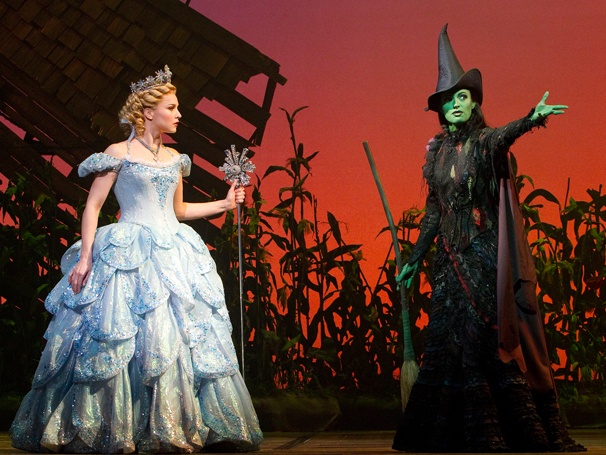
Chandra Lee Schwartz as Glinda and Jackie Burns as Elphaba in the Broadway production of Wicked.


Wicked is a show I’ve been interested in revisiting for quite some time.  After seeing the original Broadway cast during the summer of 2004, I left the show entertained but not blown away, and honestly wasn’t quite sure what all the fuss was about.  But after seeing the show do years of sell-out business in New York and on the road, while also developing an incredibly loyal fan community, my curiosity started getting the best of me.  Wicked has become not just a hit show, but a phenomenon that has struck a chord with millions of people, and I began wondering if there was something I had missed the first time around.  So eight years after my initial viewing, I headed back to the Gershwin Theatre this past weekend to view the Land of Oz with fresh eyes.

Seeing the show again, I can’t say my overarching opinion of it has changed much, but I will admit to appreciating Stephen Schwartz’s magnum opus more now than I did in 2004.  Now that the hype around the show has calmed down, it’s easier for me to evaluate the show own its own merits.  During that initial viewing, the show was widely considered a guaranteed winner for the Best Musical Tony, and as such I was evaluating it against some very high expectations (Wicked lost the award to Avenue Q just days after my first viewing).  I found Elphaba’s story to be full of big-budget spectacle but light on heart, which made the entire enterprise feel somewhat empty.

Wicked remains big and loud, but this time through I saw a lot more heart than I originally gave the show credit for.  The relationship between Elphaba and Glinda is one of the more complex musical theatre dynamics in recent history, and the musical does a good job hinting at the political implications of Gregory Maguire’s source novel without becoming bogged down with polemics.  Book writer Winnie Holzman did a great job of condensing that sprawling text into something more manageable and inherently theatrical, while still finding room to have a great deal of fun with the references to Dorothy’s concurrent adventures.  But keeping Dorothy offstage causes the second act to feel choppy, and I’d say the show’s greatest flaw is that it doesn’t satisfactorily pay off all its various plot threads.  But Holzman does give at least some indication how all of those stories turn out, which is more than can be said for a lot of lesser musical librettists.

The score is probably the best Stephen Schwartz has ever composed for the theatre, and he probably should have won his long-overdue first Tony for it.  The only explanations for his loss in the Best Score category are the absolute clunkers written for the Wizard, since the rest of the score displays an inventive adventurousness that holds up well to repeated listening.  Wicked is also one of the few shows where you can see exactly what your $135 ticket price is going toward, with lavish costumes and sets that are impressive for both their scale and attention to detail.  Joe Mantello’s staging moves everything along at a pace that never sags but still allows time for quiet character moments, which when played correctly supply the heart every good piece of theatre requires.

One concern I had going into the show was how the current cast would stack up to the near-legendary performances of the original company.  Such comparisons may not be fair but they are bound to happen, especially when this reviewer actually saw said performances and is not just extrapolating them from what’s preserved on the cast recording.  Happily, this current company acquits itself of the material quite well, with one major exception that I’ll address in a minute. 

Jackie Burns does a great job of fleshing out the different layers of Elphaba, the “Wicked” Witch of the West, making a clear transition from shy youth to impassioned freedom fighter while preserving the character’s internal logic.  Burns’ portrayal makes the show firmly (and rightfully) Elphaba’s story, rather than splitting the focus between her and Glinda as the original cast did.  Also, Burns has the vocal ability to make these oft-sung songs sound fresh and alive, an invaluable gift for such warhorses as “Defying Gravity” and “For Good.”

Many of the supporting actors do an excellent job of making a lasting impression with limited stage time.  Randy Danson chews scenery in the best possible way as Madame Morrible, displaying that perfect combination of camp and malice usually reserved for only the best Disney-style villains.  Jenny Fellner makes her Nessarose as complex as the writing will allow, keeping her sympathetic enough that we like her while understanding why other people wouldn’t.  If Kyle Dean Massey is a little too caught up in his Norbert Leo Butz impersonation to be an entirely compelling Fiyero, he still does a fine job in a role whose importance is often overstated to begin with.  And Adam Grupper is the one significant improvement over the original, as his Wizard comes across as far more interesting and menacing than Joel Grey’s ever did.

Unfortunately, the cast’s one weak link is a major one, and that is Chandra Lee Schwartz as Glinda.  Now admittedly I am biased after seeing Kristin Chenoweth’s truly transcendent take on the role, a performance I can recall in great detail to this very day.  But even grading on a curve, Ms. Schwartz fails because she is so concerned with the comedy that she forgets to make Glinda an actual human being.  Her attempts at comedy produce mixed results, and the more dramatic scenes fall completely flat.  There is nothing sympathetic about her performance, and her motivations remain so murky and unconvincing that you ultimately wish she would just go away so we could get back to the much more compelling story of Elphaba.  Considering every eligible actress in town has surely auditioned for this role, I find it tough to believe that Schwartz is the best the producers could find.*

All that said, I thoroughly enjoyed my return trip to the Land of Oz.  Any complaints I have are minor in comparison to the many things Wicked does right.  With its combination of compelling characters, interesting plot, and big-budget spectacle, Wicked earns its place as one of Broadway’s biggest hits.  It may not be a great musical, but it is a very good one, and makes an excellent First Broadway Show for kids and out-of-town relatives that don’t see theatre all that often.  The current cast performs the material with an abundance of professionalism and gusto, and I for one can think of a lot worse ways to spend an evening.

 
*Note:  Between the time I saw the show and wrote this review, Chandra Lee Schwartz left the Broadway company of Wicked.  The role of Glinda is currently played by Alli Mauzey, who is hopefully a lot better.