Showing posts with label stephen schwartz. Show all posts

Sunday, March 22, 2015

The Dark and Beautiful Bells of "Notre Dame"

Review: The Hunchback of Notre Dame
Michael Arden leads the cast of Disney's first-rate Hunchback of Notre Dame at Paper Mill Playhouse.

Some readers may find the following statement blasphemous, but I stand by it: Disney's The Hunchback of Notre Dame is not a good movie. No matter how glorious the score may be (and it is indeed glorious), the animated film embodies a lot of the problems that occur when the Mouse House attempts to bend more complex material to its family friendly house style. Tonally and emotionally, the film doesn't work, either on its own merits or especially as an adaptation of Victor Hugo's dark, morally complicated novel.

Which makes the stage adaptation of that very same film currently running at Paper Mill Playhouse all the more remarkable. This Hunchback fixes virtually all of the problems with the animated film while augmenting its strongest feature, Alan Menken and Stephen Schwartz's sweeping score. This adaptation may not be perfect, but it is the most thematically interesting piece Disney Theatricals has ever produced, and is quite possibly the company's best musical to date.

Right from the start, the show makes clear it will be a darker, more complex version of this tale. In addition to restoring antagonist Claude Frollo to his position as Archdeacon - the film portrayed him as a judge to avoid being seen as a critique of the church - the musical's prologue also provides us with much more detail about his background. This not only creates a far greater understanding of Frollo's motivations, but makes the character simultaneously more sympathetic and more monstrous, as his often deplorable actions can no longer be written off as the ravings of a cartoon villain.

Frollo raises Quasimodo, the "half formed" hunchback of the title, in seclusion deep inside the Norte Dame cathedral, forbidding his charge from going outside in order to protect him from the jeers and mockery of a callous public. On the day of the Feast of Fools, the one day a year when gypsies are allowed to roam the city streets without punishment, Quasimodo sneaks out of the cathedral only to meet and fall in love with the beautiful Esmeralda, whose kind soul and beguiling ways also attract the attention of Captain Phoebus and the lustful Frollo.

Peter Parnell's book has no problem throwing out large segments of the film in favor of plot points that hew more closely to the source material, almost invariably for the better. Gone are the talking, singing gargoyles that serve as Quasimodo's friends/confidantes in the film, along with most of the movie's more overtly comedic sequences. Parnell does allow some laughs in order to prevent the show from collapsing under the weight of its own seriousness, but unlike most Disney musicals this show is clearly aimed at adults.

Composer Alan Menken and lyricist Stephen Schwartz have augmented their liturgical-inspired film score with equally grand new material, all of which sounds especially glorious when sung by the full choir which occupies the upstage portion of Alexander Dodge's multi-tiered set. Menken's richly layered work is occasionally undermined by Michael Starobin's sometimes questionable orchestrations, which can sound bright and cheery when the lyrics and melody are quite the opposite. But overall this Hunchback sounds every bit as epic as movie fans could hope, and there is no denying the score's raw emotional power.

The casting of the central trio of Quasimodo, Frollo, and Esmeralda is pitch perfect, taking already strong material and deepening it through the power of their performances. Michael Arden is a revelation as the partially deaf Quasimodo, his full commitment to the character's physicality and mannerisms completely selling the hunchback's deformity despite minimal makeup. Arden also sounds fantastic, with a rich, full tenor that avoids the shrillness that sometimes plagues contemporary musical theatre actors. His rendition of Quasimodo's anthem "Out There" is particularly lovely, expertly sung and acted with such pureness that you can't help but get swept away by the moment.

Patrick Page and his booming bass were tailor-made to play Frollo, and the actor's unwavering conviction to every syllable he utters is positively transfixing. It's difficult to label his Frollo a villain, both due to the increased understanding provided by the aforementioned prologue and Page's incredibly nuanced performance, but he is often terrifying and the lengths to which he's willing to go to get what he wants are horrific. It's a shame Frollo's big number "Hellfire," easily the film's most memorable thanks to its unsettling chord progression and some absolutely stunning animation, doesn't land with quite the same effectiveness onstage despite Page's best efforts. Starobin's simplified orchestrations remove most of the song's bite, and sound designer Gareth Owen could stand to turn down the choir's mics so that Page's voice is more prominent throughout.

As Esmeralda, Ciara Renee takes a character in danger of becoming a plot device and turns her into a fully formed human being. Beautiful and exotic, Renee oozes confidence and sexuality without ever becoming vulgar or trashy, and she manages to genuinely connect with the men in the show without appearing to manipulate them or lead them on. She is particularly lovely during her Act I duet with Arden called "Top of the World," which solidifies Quasimodo and Esmeralda's relationship and sets up the story's deeply moving conclusion (fair warning: it's nowhere near as cheery as the animated film). Andrew Samonsky is serviceable as Phoebus and Erik Liberman has some nice moments as the gypsies' leader Clopin, but the show ultimately belongs to Arden, Page, and Renee.

Director Scott Schwartz - the son of lyricist Stephen Schwartz - directs the show with a firm hand that keeps things moving without sacrificing character moments; this is the only adaptation of an animated Disney film that doesn't feel unnecessarily padded out. Furthermore, the younger Schwartz's decision to stage the show using only techniques available during the story's fifteenth century setting makes for a refreshing change of pace from the technical wizardry often on display in such big budget musicals. He lets the audience's imagination do a lot of the work, which makes the piece more theatrical and more cinematic, as your mind provides the sweeping vistas and grand visuals Schwartz couldn't possibly achieve onstage. He makes excellent use of Dodge's gorgeous set, which suggests the cathedral and its surroundings without getting bogged down in producing an exact replica of it.

As of right now, Disney has not announced any plans for Hunchback beyond its current engagement at Paper Mill. The show is certainly strong enough to transfer to Broadway; Menken and Schwartz's score deserves to be heard live by as many people as possible, and the central performances are all top notch. But this dark and morally complex tale is decidedly off-brand for the family-friendly company, which means there's a very real possibility the show's professional life ends when this run concludes on April 5th. So fans of the score and anyone interested in seeing what happens when Disney Theatricals puts its considerable resources behind riskier artistic fare owes it to themselves to catch this production before its too late. This show is definitely worth the trek.

Thursday, April 25, 2013

They've Got Magic to Do, and It's Extraordinary


Review:  Pippin
Because it wouldn't be a Fosse show without canes and top hats.
 

There’s no reason to mince words:  Diane Paulus has done it again.  Her revival of Pippin, like her Hair and Porgy and Bess before it, takes a classic piece of musical theatre and effortlessly modernizes it, imbuing it with a vibrancy and relevance that feels wholly contemporary while still respecting what made the show popular to begin with.  Ambitious in scope and stunningly theatrical, this Pippin is above all a celebration of the magic of live performance, a sumptuous feast for the senses brought to life by one of the finest ensembles of this Broadway season.

The story of Pippin is (very) loosely based on the life of the eldest son of King Charlemagne, who ruled over all of Western Europe at the start of the ninth century.  Well-educated but without much purpose in life, Pippin spends the show searching for fulfillment through various pursuits including war, political activism, and even the pleasures of the flesh.  This is all presented as a show-within-a-show performed by a group of traveling Players, enacted for the audience’s enjoyment at the behest of their leader (appropriately called the Leading Player).  The narrative is not without its problems; the libretto by Roger O. Hirson definitely shows its age, and despite some incredibly catchy numbers it is clear this show represents Stephen Schwartz before he gained full command of his musical gifts.

What Pippin needs, and what it gets in Paulus, is a director with a definitive concept to shape the production around.  Paulus’ stroke of genius is making the Players members of an actual circus, similar in style to Cirque du Soleil.  In conjunction with Gypsy Snider of the circus troupe Les 7 doigts de la main, Paulus has filled this revival to the brim with dizzying displays of athletic superiority and acrobatic prowess.  Performers jump, dive, and climb into a mind-boggling array of positions and pairings, all while singing and dancing the Fosse-inspired choreography by Chet Walker.  Between the aerial work, tumbling, knife throwing, fire juggling, and copious amount of magic tricks, your jaw is guaranteed to drop in amazement at least once over the course of the evening.  Yet for all the feats of human agility on display, Paulus keeps a remarkable grip on the actual narrative, portraying it with more clarity and genuine heart than it probably deserves. 

Paulus’ inspired direction is expertly executed by her top-notch cast, a mix of Tony-nominated veterans and Broadway newcomers that are all completely at home here.  As the Leading Player, Patina Miller follows up her star-making debut in Sister Act with another full-throttle performance.  Tackling the song-and-dance role head on, Miller belts to the rafters and uses her lithe frame to embody the Fosse style with surprising dexterity, all the while charming the audience into submission with her winning smile.  In fact, the only complaint that can be leveled against Miller is that she sometimes seems to be working too hard, with her performance lacking the ease of the most accomplished stage actors.

Matthew James Thomas plays Pippin with the appealing earnestness of a young man looking to find his way in the world, and manages to do so without coming across as whiny or petulant.  The character is underwritten and a bit of a cipher, but Thomas more than makes up for it with his winning personality and rock-tinged tenor.  Terrance Mann gives a delightfully hammy performance as Charlemagne, oscillating between doting father and imposing authority figure with ease, and his real life spouse Charlotte d’Amboise portrays his onstage wife, Queen Fastrada, with the perfect mix of political cunning and feigned ignorance.  Finally, special recognition must be given to Tony-winner Andrea Martin’s scene-stealing turn as Pippin’s grandmother Berthe.  Over the course of one ten-minute scene, Martin manages to make one of the strongest impressions of the night and leaves the audience practically begging for more. 

Pippin’s intentionally garish production design only adds to the show’s overall charm, from the barely-there costumes of Dominique Lemieux to Scott Pask’s big top-inspired set.  This revival is a triumph, a coup de theatre that celebrates all that is magical about the Great White Way.  With her bold but wholly organic direction, Paulus has rescued a work in danger of becoming dated and brought it crashing into the 21st century, appealing to modern sensibilities while still honoring the show’s roots.  There’s plenty of magic to be found in this production, and anyone interested in seeing it should buy their tickets now before they disappear.

Thursday, October 18, 2012

Defying Gravity, Almost 9 Years Later


Review:  Wicked
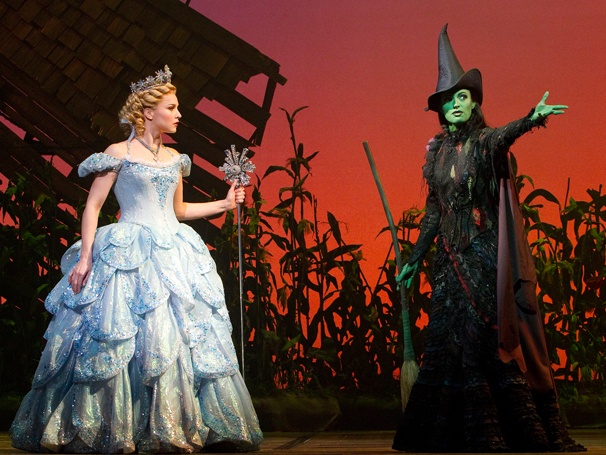
Chandra Lee Schwartz as Glinda and Jackie Burns as Elphaba in the Broadway production of Wicked.


Wicked is a show I’ve been interested in revisiting for quite some time.  After seeing the original Broadway cast during the summer of 2004, I left the show entertained but not blown away, and honestly wasn’t quite sure what all the fuss was about.  But after seeing the show do years of sell-out business in New York and on the road, while also developing an incredibly loyal fan community, my curiosity started getting the best of me.  Wicked has become not just a hit show, but a phenomenon that has struck a chord with millions of people, and I began wondering if there was something I had missed the first time around.  So eight years after my initial viewing, I headed back to the Gershwin Theatre this past weekend to view the Land of Oz with fresh eyes.

Seeing the show again, I can’t say my overarching opinion of it has changed much, but I will admit to appreciating Stephen Schwartz’s magnum opus more now than I did in 2004.  Now that the hype around the show has calmed down, it’s easier for me to evaluate the show own its own merits.  During that initial viewing, the show was widely considered a guaranteed winner for the Best Musical Tony, and as such I was evaluating it against some very high expectations (Wicked lost the award to Avenue Q just days after my first viewing).  I found Elphaba’s story to be full of big-budget spectacle but light on heart, which made the entire enterprise feel somewhat empty.

Wicked remains big and loud, but this time through I saw a lot more heart than I originally gave the show credit for.  The relationship between Elphaba and Glinda is one of the more complex musical theatre dynamics in recent history, and the musical does a good job hinting at the political implications of Gregory Maguire’s source novel without becoming bogged down with polemics.  Book writer Winnie Holzman did a great job of condensing that sprawling text into something more manageable and inherently theatrical, while still finding room to have a great deal of fun with the references to Dorothy’s concurrent adventures.  But keeping Dorothy offstage causes the second act to feel choppy, and I’d say the show’s greatest flaw is that it doesn’t satisfactorily pay off all its various plot threads.  But Holzman does give at least some indication how all of those stories turn out, which is more than can be said for a lot of lesser musical librettists.

The score is probably the best Stephen Schwartz has ever composed for the theatre, and he probably should have won his long-overdue first Tony for it.  The only explanations for his loss in the Best Score category are the absolute clunkers written for the Wizard, since the rest of the score displays an inventive adventurousness that holds up well to repeated listening.  Wicked is also one of the few shows where you can see exactly what your $135 ticket price is going toward, with lavish costumes and sets that are impressive for both their scale and attention to detail.  Joe Mantello’s staging moves everything along at a pace that never sags but still allows time for quiet character moments, which when played correctly supply the heart every good piece of theatre requires.

One concern I had going into the show was how the current cast would stack up to the near-legendary performances of the original company.  Such comparisons may not be fair but they are bound to happen, especially when this reviewer actually saw said performances and is not just extrapolating them from what’s preserved on the cast recording.  Happily, this current company acquits itself of the material quite well, with one major exception that I’ll address in a minute. 

Jackie Burns does a great job of fleshing out the different layers of Elphaba, the “Wicked” Witch of the West, making a clear transition from shy youth to impassioned freedom fighter while preserving the character’s internal logic.  Burns’ portrayal makes the show firmly (and rightfully) Elphaba’s story, rather than splitting the focus between her and Glinda as the original cast did.  Also, Burns has the vocal ability to make these oft-sung songs sound fresh and alive, an invaluable gift for such warhorses as “Defying Gravity” and “For Good.”

Many of the supporting actors do an excellent job of making a lasting impression with limited stage time.  Randy Danson chews scenery in the best possible way as Madame Morrible, displaying that perfect combination of camp and malice usually reserved for only the best Disney-style villains.  Jenny Fellner makes her Nessarose as complex as the writing will allow, keeping her sympathetic enough that we like her while understanding why other people wouldn’t.  If Kyle Dean Massey is a little too caught up in his Norbert Leo Butz impersonation to be an entirely compelling Fiyero, he still does a fine job in a role whose importance is often overstated to begin with.  And Adam Grupper is the one significant improvement over the original, as his Wizard comes across as far more interesting and menacing than Joel Grey’s ever did.

Unfortunately, the cast’s one weak link is a major one, and that is Chandra Lee Schwartz as Glinda.  Now admittedly I am biased after seeing Kristin Chenoweth’s truly transcendent take on the role, a performance I can recall in great detail to this very day.  But even grading on a curve, Ms. Schwartz fails because she is so concerned with the comedy that she forgets to make Glinda an actual human being.  Her attempts at comedy produce mixed results, and the more dramatic scenes fall completely flat.  There is nothing sympathetic about her performance, and her motivations remain so murky and unconvincing that you ultimately wish she would just go away so we could get back to the much more compelling story of Elphaba.  Considering every eligible actress in town has surely auditioned for this role, I find it tough to believe that Schwartz is the best the producers could find.*

All that said, I thoroughly enjoyed my return trip to the Land of Oz.  Any complaints I have are minor in comparison to the many things Wicked does right.  With its combination of compelling characters, interesting plot, and big-budget spectacle, Wicked earns its place as one of Broadway’s biggest hits.  It may not be a great musical, but it is a very good one, and makes an excellent First Broadway Show for kids and out-of-town relatives that don’t see theatre all that often.  The current cast performs the material with an abundance of professionalism and gusto, and I for one can think of a lot worse ways to spend an evening.

 
*Note:  Between the time I saw the show and wrote this review, Chandra Lee Schwartz left the Broadway company of Wicked.  The role of Glinda is currently played by Alli Mauzey, who is hopefully a lot better.