Showing posts with label lilla crawford. Show all posts

Saturday, December 27, 2014

I Never Thought I'd Be So Happy (With This Film)

Movie Review: Into the Woods

James Cordon as the Baker and Meryl Streep as the Witch in Disney's Into the Woods.

After what seems like an eternity, Disney's highly anticipated film adaptation of Stephen Sondheim's Into the Woods has finally arrived in theatres. The good news is that the internet's concerns about the film's fidelity to the source material are almost entirely unfounded; this is an incredibly faithful and respectful adaptation of the beloved stage show. Even better news is that the movie is a very good and at times even great film in its own right, featuring an excellent cast and a suitable dose of movie magic to make this fractured fairy tale truly sing on the big screen. Purists will no doubt have their complaints, but for most fans and the uninitiated this is an excellent representation of a contemporary classic from one of musical theatre's undisputed masters.

For those who don't know, Into the Woods weaves the well-known fairy tales of Cinderella, Jack and the Beanstalk, Little Red Riding Hood, and Rapunzel together with an original tale about a childless Baker and his Wife. Early in the film, the Baker discovers that his family has been cursed by the village's resident Witch, and the only way to lift the spell is to collect four magical objects before the impending blue moon. What follows is a series of misadventures that ultimately subverts the notion of "happily ever after" while also exploring what happens when you get exactly what you want, only to find that it wasn't at all like you expected.

The musical's original librettist James Lapine adapts his own script into a very smart condensation of the stage show. Into the Woods has always been a marvel of tight pacing, so the fact that Lapine managed to trim things in way that doesn't sacrifice plot is truly impressive. Cut musical numbers are replaced with scenes that cover the same story beats, and the bridging of the musical's two distinct acts is handled about as well as conceivably possible. Sondheim has tweaked some lyrics where necessary, and listening to Jonathan Tunick's symphonic arrangements is like hearing this score afresh. Even the musical numbers that didn't make the film are represented via underscore in their same approximate locations, and truly sharp-eared fans will catch a surprising reference to one of Sondheim's other Tony-winning musicals.

Speaking of the fans, those afraid Disney would sanitize the musical's darker edges can rest easy. Pretty much everything that happens onstage happens in the movie, with the difference being the film tends to only imply things the stage version made more explicit. There's even a surprisingly sexual "Hello, Little Girl" that somehow slipped past the censors, proving that director Rob Marshall and company weren't lying when they insisted they were doing a very faithful adaptation.

Rob Marshall's direction is somewhere between his Oscar-nominated work on Chicago and his more questionable choices on the underwhelming Nine. His kinetic camerawork certainly keeps things interesting, although the constantly revolving camera sometimes distracts from the storytelling rather than enhances it. Marshall smartly limits his use of special effects to some key moments, which keeps the magic feeling magical without overwhelming the characters. His production team has lovingly designed the film with lavish sets and costumes, although the film tends so dark it can be difficult to make out the details.

One thing Marshall and his team have absolutely nailed is the casting, with nary a weak link among the story's dozen or so principal and secondary characters. Oscar-winner Meryl Streep is clearly having a blast as the Witch, making a veritable feast out of the "Witch's Rap" and chewing the scenery in the best possible way. Streep also sings like a dream, ranging from breathy intimacy to full throttle belting over the course of her musical numbers. Her tour de force performance of "Last Midnight" meets even the loftiest expectations and definitely proves that whether or not he intended to, Sondheim wrote a genuine showstopper when he added the song after the musical's out of town tryout.

The always enjoyable Emily Blunt is excellent as the Baker's Wife, a natural comedienne with a surprisingly strong voice and effortlessly natural line delivery. Her chemistry with James Corden's Baker is palpable, with the latter also doing a fine job with his character's more emotional scenes during the movie's second half. Anna Kendrick continues to prove adept at just about anything she sets her mind to, even if the more intimate medium of film highlights that some key points of Cinderella's emotional growth occur off screen. Her "Steps of a Palace" is a knockout, aided by Marshall's brilliant decision to play the entire song as a split second decision that occurs while Cinderella is being chased by the Prince.

Speaking of the Prince, Chris Pine isn't quite as at home in a movie musical as many of his costars, but that doesn't stop him from being a perfectly aloof foil to Kendrick's introspective Cinderella. Pine and Billy Magnussen's gloriously campy "Agony" is nearly perfect in its beefcake-skewering brilliance, second only to Streep's "Last Midnight" on the list of the film's standout moments. Lilla Crawford makes for a hilariously deadpan Little Red, and Daniel Huttlestone brings a genuine boyish glee to the role of Jack. Tracey Ullman, Christine Baranski, and Johnny Depp all make strong impressions despite limited screentime, and the uniformly excellent cast is one of the movie's strongest assets.

Into the Woods is ultimately about as good an adaptation as one could hope for. Purists will certainly find things to nitpick, and fans will no doubt miss some of the cut songs (I'm particularly sorry we lost the Witch's "A bear?/Bears are sweet..." segment from the Act II opening), but overall this is an incredibly faithful adaptation in spirit, tone, and execution. The plot and themes remain virtually unchanged from the stage version, with Marshall and his game cast embracing the opportunities offered by the big screen without abandoning what has made this such an enduringly popular property in the first place. It won't replace the invaluable recording of the original Broadway production, but it is an excellent companion piece and definitely worth seeking out.

Thursday, December 20, 2012

Best Shows of 2012: #8


Best of 2012
#8 – Annie

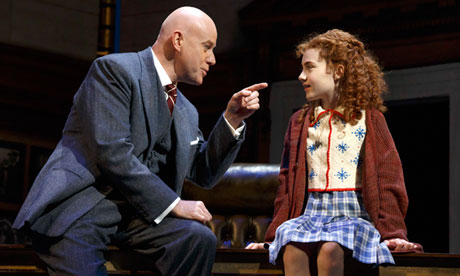
Anthony Warlow and Lilla Crawford are the two stellar stars of James Lapine's handome new Annie.
 

When it first opened on Broadway in the spring of 1977, Annie received near-universal acclaim and became so prolific that even people with zero interest in musical theatre knew it by name.  The show about the little orphan with the big heart has since become synonymous with the sun-drenched optimism that typifies classic musical comedies, and in an increasingly cynical world that earnestness has made it a subject of scorn and derision.  It’s easy to forget that behind that relentlessly positive outlook lies a solidly constructed tuner just waiting for the right production to reveal its multitude of charms.

James Lapine’s splashy revival is just such a production, shedding the decades of baggage and expectation Annie brings with it to emerge as one of the year’s freshest pieces of escapist entertainment.  By focusing on the text and the truth of the show’s world, Lapine and his actors have reached a level of earnestness that makes the many songs about hope and positivity feel both genuine and necessary.  The show’s version of Depression-era New York is unabashedly naïve, but that viewpoint is wholly appropriate to the musical’s child protagonist and its message about the value of looking on the bright side of life.

Lapine has found an extremely talented group of young women to embody Annie and her orphan pals, and their unbridled enthusiasm proves to be infectious and one of the show’s strongest assets.  In a performance sure to result in a Tony nomination, Anthony Warlow’s Daddy Warbucks is sublime perfection, with his growing fondness for Annie creating some unexpectedly moving moments.  Two-time Tony-winner Katie Finneran may not be doing her best work as the villainous Miss Hannigan (and the show does suffer because of it), but the comedic actress brings plenty of raucous energy and a particular gift for physical comedy to the scene-stealing role.

Annie’s family friendly nature ensures it will be many children’s first exposure to the wonders of live theatre, and from the opening chords of the overture until the final curtain young audiences are sure to be utterly enchanted.  But fun has no age limit, and anyone who remembers (or would like to remember) the joy and limitless possibilities of youth will find plenty to appreciate in this handsome staging.  Here’s hoping that this Annie has many, many tomorrows in its future.


For my full review of Annie, click here.

Monday, November 19, 2012

Sunny Days are Here Again


Review:  Annie
Lilla Crawford and Sunny the dog in the Broadway revival of Annie.

For better and for worse, the 1977 Tony-winning smash Annie has become synonymous with the words “Broadway musical.”  Its eternal cheerfulness and broad comedy represent the pinnacle of the musical-as-escapist-entertainment, allowing audiences young and old the chance to laugh away their cares for a few hours.  However, the show’s saccharine sweet reputation has caused an entire generation of potential theatregoers to avoid musical theatre like the plague, assuming the entire genre is nothing but smiling moppets singing shallow paeans to all that is good and right in the world.  Any modern revival must contend with staying true to the show’s roots while trying to appeal to the jaded cynics that make up a sizeable portion of the country’s population.

Director James Lapine’s handsome revival attempts to solve this conundrum by adopting a more grounded approach to the material, and while not always successful, his interpretation does allow the show’s enormous heart to shine bright.  Little orphan Annie’s search for a family of her own is as emotionally involving as it’s ever been, even if some of the more overtly comedic elements of Thomas Meehan’s book and Charles Strouse’s score suffer due to Lapine’s new focus.  While there are still plenty of laughs, they are not as hearty as they might have been, though the show as a whole remains thoroughly entertaining.  The young and young-at-heart will find it impossible to resist Annie’s many charms, and even this jaded critic found himself quite taken by the entire affair.

Lilla Crawford, the young actress who the New York Times dubbed “pretty much perfect” in the title role, was unfortunately absent from the performance I attended.  However, I am happy to report that her understudy, Taylor Richardson, is supremely charming as the street-smart orphan with the unwavering optimism.  There is enough sass in Richardson’s performance to keep the character’s sweetness from becoming sickening, and an innocence about her that keeps you on her side throughout the show’s entire runtime.  Her impressively bright belt makes even the oft-mocked “Tomorrow” sound fresh, and the young actress imbues the part with such sincerity that she proves impossible to resist.

Although they don’t get nearly the same amount of stage time as Richardson, the rest of this Annie’s orphans are equally talented and possibly even more adorable.  Ranging from seven to eleven years old, these precocious balls of energy sing and dance with an infectious, reckless abandon that lights up the cavernous interior of the Palace Theatre.  Lapine and choreographer Andy Blankenbuehler play up the girls’ cuteness factor without seeming gratuitous, provoking the evening’s biggest belly laughs in the process.  And while all of the orphans are standouts, tiny Emily Rosenfeld threatens to steal the show as Molly, the littlest orphan with the biggest personality.

In contrast to the uniform excellence of the child actors, the adult roles are more of a mixed bag.  On the positive side, Anthony Warlow is sublime perfection as Oliver Warbucks, the curmudgeonly billionaire who initially invites Annie to his 5th Avenue mansion as a publicity stunt.  As Warbucks slowly falls for the plucky orphan, Warlow convincingly sheds his gruff exterior to create the most multifaceted and three-dimensional characterization of the entire show.  His gloriously sung “Something Was Missing” turns the sappy ballad into the evening’s uncontested highlight, serving as the perfect encapsulation of the unadulterated love a parent feels for their child.  In the thankless role of Warbucks’ chief secretary Grace Farrell, Brynn O’Malley is also quite lovely, though not quite on the same level as her costar and onstage boss.

Gifted with the production’s showiest role, two-time Tony-winner Katie Finneran is a slight disappointment as the evil Miss Hannigan.  A more developed variation of her Tony-winning Marge from Promises, Promises, Finneran’s take on the orphanage maven is an example of the downside to Lapine’s more grounded take on the material.  In trying to make Hannigan more sympathetic, Lapine and Finneran have lost the character’s comedic bite, leaving the show without the clear-cut villain it needs to fully succeed.  The performance is often hysterical, and the actress is especially adept at slapstick and physical comedy, but Finneran is simply too nice in the role.  By shying away from her character’s inherent meanness, she prevents her Hannigan from being the tour de force it was in the hands of Dorothy Loudon in the original or Carol Burnett in the 1982 film version.

Yet Finneran’s minor shortcomings are nothing compared to the complete ineptitude of Clarke Thorell and J. Elaine Marcos as Rooster Hannigan and his bumbling accomplice, Lily.  While not large roles, both characters are essential to the show’s plot, and in the right hands can become riotously funny scene stealers.  Thorell and Marcos seem completely unaware of this, offering up self-indulgent and decidedly unfunny portrayals of the two small time crooks.  It should be noted that Thorell makes out slightly better than Marcos, although both seem so completely out of their element that it hardly matters.

Aesthetically, David Korins’ storybook-inspired set gives the show a unique look without differing wildly from what audiences have come to expect from this classic show.  Susan Hilferty’s costumes similarly avoid reinventing the wheel, but the lovingly constructed garments look gorgeous nonetheless.  When Annie finally dons her iconic red dress late in Act II, the young actress looks truly beautiful, thanks in no small part to Hilferty’s efforts.  Andy Blankenbuehler’s choreography is a more radical departure from the norm, bordering on too contemporary for this Depression-era tale.  Blankenbuehler also needs to abandon his signature hip-hop inspired scene transitions, which have brought him diminishing returns since they first appeared in In the Heights and are wholly inappropriate here.

Overall, this production looks and feels enough like the classic Annie to avoid offending purists while offering enough subtle twists to hold the interest of those who have seen the show many times over.  This is not a radical reinvention of the material, but its enduring popularity over the past 35 years proves that the show doesn’t really need reinventing.  Under Lapine’s assured hand, this production feels fresh and offers up a bevy of top-notch performances, ensuring that the show’s target audience of young girls will absolutely adore it.  Thankfully, there is plenty for the adults to appreciate as well, and in these trying times it’s nice to have such a sparkling reminder that the sun will indeed come out tomorrow.