Showing posts with label betsy wolfe. Show all posts

Thursday, October 27, 2016

Welcome to Falsettoland

Review: Falsettos


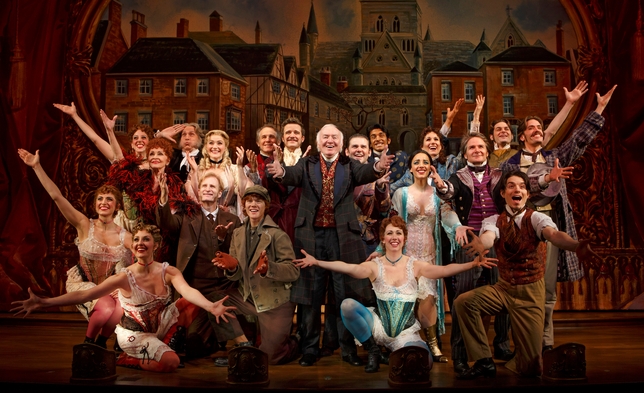
The cast of Falsettos, one of the most hotly anticipated musicals of the fall season.

Alternatively messy and engaging, the first Broadway revival of William Finn and James Lapine's Falsettos highlights the core strengths and weaknesses of the piece in sometimes unexpected ways. Originally premiering on Broadway in 1992, the show is composed of two one act musicals (which debuted Off-Broadway in 1981 and 1990 respectively) that chart the growth of gay protagonist Marvin's unorthodox family over the course of two years. While some of the narrative specifics are deeply tied to the late '70s/early '80s setting, this production thankfully proves the show's core themes of love, family, and identity are universal and still relevant despite the huge advances in gay rights and the advent of marriage equality. Unfortunately, this production also highlights how the William Finn who wrote March of the Falsettos, the basis for Act I, is a far inferior writer to the William Finn who wrote Falsettoland, the basis for Act II.

In Act I, we are introduced to Marvin, who has left his ex-wife Trina and their son Jason to live with his male lover, Whizzer. The breakup of Marvin's traditional family unit has left all three in various states of distress, leading each to seek the help of Mendel, a therapist with questionable professional ethics who ultimately becomes involved with Trina. The second act moves the action forward two years and sees everyone obsessing over the planning of Jason's upcoming bar mitzvah, while also introducing the specter of the AIDS crisis.

Act I proves to be a rather disjointed affair, more of an impressionistic character study than a coherent narrative. The young Finn has yet to refine his signature off-kilter sensibility, which comes across as manic here and lacks the thematic coherence which connects his later flights of fancy. Musically the writing isn't anywhere near as complex or interesting as Finn's later work, and as a result both the performers and director James Lapine (who also wrote the book) seem slightly adrift as they struggle to sell the material. The songs don't build the way you want them to, and Lapine attempts to compensate for this lack of emotional momentum by having the performers constantly rearrange the pieces of David Rockwell's jenga cube of a set. Layer onto this Spencer Liff's awkwardly flailing choreography - which often hinders the performer's ability to enunciate their lyrics - and the first half of Falsettos becomes an exhaustively busy journey with characters that aren't particularly likable or compelling.

Act II is a much richer and more rewarding experience, as it's clear that in the nine years between writing March of the Falsettos and Falsettoland Finn vastly matured as a songwriter and storyteller. Centering the act on Jason's impending bar mitzvah gives Finn and Lapine a stronger foundation to build their characters' quirky behavior around, and Finn becomes much more adept at tempering his characters' off-putting neuroses with humanizing qualities. Even with the introduction of two additional characters - Cordelia and Dr. Charlotte, the "lesbians next door" - everyone feels more nuanced and alive in the second half, and the show does a better job of balancing its wry cynicism with deeply felt emotion. With stronger writing to work with, Lapine and the cast are able to relax; the busy choreography is all but abandoned, and Lapine's staging is less self-consciously showy. The two halves are integrated enough that it would rob Act II of some of its impact to completely throw out Act I, but the jump in quality is pronounced.

The best unifying element of this revival is the strength of its cast, all of whom range from good to great. As Marvin, Christian Borle abandons the scenery chewing that has defined his last two Broadway outings to deliver a more nuanced, believable characterization. Unfortunately, the first half of the show really highlights Marvin's self-serving qualities, something you wish Borle was able to undercut with some tenderness to make him a more likable protagonist. The second act gives Borle a lot more opportunity to show different sides of Marvin, and ultimately your heart breaks with him during the show's final scene (which also features the most striking image of Lapine's staging).

Andrew Rannells is a competent foil as Whizzer, although you wish the show afforded him more of a chance to show off his comedic chops. Brandon Uranowitz brings much appreciated authenticity to his portrayal of Mendel, and young Anthony Rosenthal's innate charm makes the temperamental Jason feel like a real preteen rather than an adult author's caricature of one. Tracie Thoms and Betsy Wolfe are a welcomed presence as the next door neighbors, with Thoms notably in very fine voice throughout.

But the cast's biggest standout is Stephanie J. Block, back on Broadway for the first time since her Tony-nominated turn in The Mystery of Edwin Drood. As Trina, Block blossoms into the most compellingly drawn and engaging character in the show, to the point where she often feels like the lead in what is ostensibly Marvin's show. Block is certainly its emotional center, which makes her effortless delivery of "I'm Breaking Down," one of the most broadly comedic songs in the show, all the more impressive. Block offers a fascinating peak beneath Trina's determinedly perfect facade, showing us a woman not wholly prepared to deal with the curveballs life has given her and yet soldiering on anyway. It is a marvelously accomplished performance which is endlessly watchable and yet never overstated.

Overall, there is both good and bad to be found in Falsettos, and it's unfortunate that the less successful elements are concentrated in the first half. By the end of the night, Falsettos proves to be an engaging and even moving portrait of an imperfect yet loving family, with the talented cast doing much to smooth over the rough patches at the beginning of the show. When the show stops being concerned with novelty and showiness, it truly sings, illustrating how the trials and tribulations of love and family are the same no matter what your sexual orientation.

Wednesday, April 3, 2013

Goodbye Until Tomorrow


Review:  The Last Five Years

You'll want to spend more than just the next ten minutes with Adam Kantor and Betsy Wolfe in The Last Five Years.

The original production of Jason Robert Brown’s semi-autobiographical musical The Last Five Years only ran for two months Off-Broadway, but thanks to a beloved cast album featuring Norbert Leo Butz and Sherrie Renee Scott the show has gone on to achieve genuine cult status.  But despite hundreds of college and regional productions during the eleven years since its premiere, the current Second Stage Theatre revival marks this chamber musical’s first return New York City engagement, and the first chance many fans (myself included) have had to actually see the show live.  Those myriad fans, and anyone else with an appreciation for serious musical dramas, will be happy to know that this revival not only meets but at times even exceeds the lofty expectations brought on by its vaunted reputation.

A high concept affair based in part on Brown’s failed first marriage, The Last Five Years chronicles the relationship of aspiring young actress Cathy Hyatt and writing wunderkind Jamie Wellerstein.  The twist is that while Jamie’s story unfolds in chronological order, Cathy’s tale is told in reverse, beginning with the couple’s divorce and ending on the night of their first date.  While an interesting idea, this approach means the actors in this two person chamber musical almost never interact, save during their wedding day at the show’s midpoint.  The concept also requires the audience to track the two stories separately and figure out how they overlap as the evening progresses.  Although an ultimately rewarding gimmick, the time jumping narrative does keep the audience from fully engaging with the characters for the first twenty or so of the show’s intermissionless ninety minutes.

Thankfully, whatever clunkiness is caused by the show’s narrative structure is more than compensated for by its lushly romantic score.  Since first bursting onto the scene in the mid-nineties with Songs for a New World, Brown has been routinely hailed as one of the most sophisticated composers of his generation.  The Last Five Years is his most unabashedly beautiful score to date, a perfect melding of pop-influenced character songs and gut-wrenching ballads.  Vocally demanding and richly textured, Brown’s music rewards repeated listening thanks to its subtle motifs and complex, often surprising lyrics which speak volumes about the characters singing them.  Brown has also ingeniously orchestrated the piece with a fullness that belies the six person pit’s small size, making judicious use of strings to add to the music’s romantic flair.

Brown’s music is notoriously difficult to sing, and finding two young performers with the vocal ability and emotional maturity to bring this score to life is one of the primary challenges facing any proposed production.  For this incarnation, Brown – who also assumes directing duties – has found the exceedingly talented Betsy Wolfe and Adam Kantor to embody Cathy and Jamie, respectively. 

Wolfe in particular is simply sensational, immediately banishing any memories of Sherrie Renee Scott’s performance (no small task) and making Cathy entirely her own.  With an emotional vulnerability that pulls the audience in, she creates a wholly sympathetic portrayal of a not entirely likable woman, as Cathy’s crushing self-doubt and neurotic need for attention are at least partially to blame for her marriage’s eventual collapse.  Wolfe starts the show on a high note with a superbly acted “Still Hurting” and proceeds to improve from there, and as Cathy regresses to happier times Wolfe gets to display her finely tuned skills as a comedienne.  She turns Brown’s purposefully ridiculous “A Summer in Ohio” into comedic gold, and her pitch-perfect send up of every bad audition habit during “Climbing Uphill” will be especially appreciated by anyone unlucky enough to experience such a thing in person.  The actress sings like a dream, tenderly caressing her notes or belting them to the rafters as the score dictates.  It is a star-making performance, and I expect Wolfe to become one of the city’s most in-demand musical actresses following her work here.

Kantor is slightly more problematic as Jamie, at least initially.  His first song, “Shiksa Goddess,” is surprisingly subdued both vocally and emotionally considering the song is about the unequaled thrill of a stellar first date.  But as the show progresses Kantor becomes steadily more effective, and by the time he sings his final farewell to Cathy your heart breaks with his.  Credit must be given to Brown for writing Jamie – obviously an author analogue – as a real person and not a faultless saint, and Kantor’s performance makes it clear that Jamie hates himself as much as anyone for the mistakes he makes, a trait most readily illustrated during his particularly forlorn rendition of “Nobody Needs to Know.”  Kantor also transforms “The Schmuel Song,” which has always seemed overlong and unnecessary on the cast recording, into one of the most surprisingly touching moments of the show, displaying a gift for emotional clarity and a charming sensitivity that goes a long way towards explaining why Cathy puts up with Jamie’s ever-burgeoning ego.

Brown’s staging of the work is excellent, emphasizing clarity and emotional honesty over any theatrical trickery.  The amount of visual interest Brown derives from what is essential an uninterrupted succession of solos is astounding, and with each scene transition it is immediately clear both where and when the characters are in their journey.  Brown has permitted his actors to take slight liberties with the rhythm and tempo of the music, and while this may initially throw fans of the cast recording for a loop, almost every change brings with it greater illumination of the show’s lyrics and the psychological state of its characters.  Set designer Derek McLane and costumer Emily Rebholz provide minimalistic but evocative designs in purples and blues, all gorgeously lit by Jeff Croiter’s rich lighting design.

Anyone interested in The Last Five Years should run, not walk, to purchase their tickets to this deeply moving Off-Broadway revival.  This is a definitive production of Brown’s deeply personal work, representing the show as he intended it to be and executed with the utmost professionalism by all involved.  Kantor and Wolfe are promising young talents poised for great things, and this could be the last chance to see them in such an intimate setting.  Like Sondheim before him, Brown has pushed the boundaries of what the contemporary musical can be, creating an artistic triumph that demands to be seen by all.

Thursday, December 13, 2012

Best Shows of 2012: #9


Best of 2012
#9 – The Mystery of Edwin Drood

Damned if there you are!
 
I firmly believe that Rupert Holmes’ The Mystery of Edwin Drood is one of the worst musicals ever written.  Based on Charles Dickens’ unfinished last novel, the show is two hours of uninteresting exposition and merely passable songs that mark time until we reach the musical’s central gimmick, which is letting the audience vote on the mystery’s solution and thereby choose the show’s ending.  The nearly incomprehensible “plot” and exceedingly shallow characters require a top-notch production to mask their many deficiencies and make the show even vaguely tolerable.

Thankfully, the Roundabout Theatre Company’s current Broadway revival is a top-notch production.  Filled to the brim with outstanding performances, the talent involved elevates Drood into a musical confection that’s still devoid of meaning but so much fun you hardly care.  Stephanie J. Block has found the perfect vehicle for her many talents, with her turn as the title character equally highlighting her skills as a musical comedienne and her nearly unmatched vocal prowess.  In any other show, a performance of Block’s caliber would make her the unequivocal star, but this production features so many outstanding supporting turns that Block is but one jewel in a musical crown.

Rising star Jessie Mueller demonstrates remarkable range as the fiery Helena Landless, proving just as entrancing here as she was playing the ingĂ©nue Cinderella in this summer’s Into the Woods.  As the musical’s master of ceremonies, Jim Norton turns what could be a rather bland role into one of the year’s great comedic performances, hamming things up with delightful abandon.  Will Chase chews the scenery with infectious, giddy delight as the musical’s villain, and as the object of his lascivious desires Betsy Wolfe is a dream.  The show also boasts Chita Rivera’s return to the Broadway stage after a six year absence, and this living legend proves that she’s still got it.  The sets and costumes are just as impressive as the starry cast, with William Ivey Long’s gorgeous Victorian outfits a particular standout sure to net the designer his umpteenth Tony nomination.

Roundabout’s Broadway productions have been hit or miss in recent seasons, but The Mystery of Edwin Drood is a definite hit.  The not-for-profit has given this musical a far better production than it deserves, and those high standards have resulted in one of the most entertaining musicals of the year.  Anyone looking for a carefree night of bawdy jokes and hammy performances will absolutely adore Drood, and even the most ardent Scrooges in the audience won’t be able to resist cracking a smile or two.


For my full review of The Mystery of Edwin Drood, click here.

Wednesday, November 14, 2012

Murder Can Be Fun (Provided You Have the Right Cast)


Review:  The Mystery of Edwin Drood
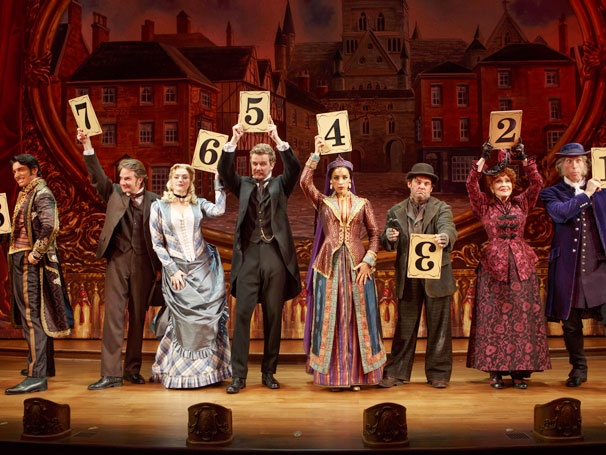
The merry muderers of the Music Hall Royale in their rendition of "The Cell Block Tango"

Let’s get one thing straight:  The Mystery of Edwin Drood – the 1985 musical murder mystery with book, music, and lyrics by Rupert Holmes – is a terrible show.  The music is bland, unmemorable, and breaks so many rules of good theatrical composition that the mind boggles.  The poorly constructed book consists of an endless parade of paper-thin characters prattling on about nothing, with an abundance of puns thrown into the mix to distract the audience from the fact that nothing is actually happening.  The show’s central gimmick, allowing the audience to pick an ending for Charles Dickens’ unfinished final novel of the same name, is a good one, but Drood relies so heavily on that conceit that the initial two hours suffer mightily in comparison.  Rarely have I found so few redeeming qualities in a Broadway musical.

Having said all that, the Roundabout Theatre Company’s current revival is an excellent production that manages to transcend all of the script’s shortcomings to emerge as one of the most entertaining musicals of the fall season.  The hilarious and supremely talented ensemble cast features a host of Broadway veterans all doing excellent work, and the magnificent physical production offers a richly colored tapestry on which the show unfolds.  This is an excellent mounting of a horrible show, and only the most jaded audience members won’t find at least some enjoyment among the production’s many charms.

The show is set in the fictional Music Hall Royale of London during the Victorian era, and the resident acting troupe has taken it upon themselves to present a musicalized adaptation of the unfinished Mystery of Edwin Drood.  The show-within-a-show concerns the drug-addicted John Jasper’s unhealthy attraction to the beautiful Rosa Bud, who has been betrothed to marry Edwin Drood since birth.  Other characters in the tale include twin siblings Helena and Neville Landless, their caretaker the Reverend Crisparkle, opium purveyor Princess Puffer, and the town’s resident drunk Durdles.  What any of these characters have to do with one another remains something of a mystery, even after the show’s conclusion, and matters are further complicated by the fact that the Music Hall Royale’s actors are constantly breaking character to make asides or react to scripted mistakes.  Thankfully, the characters of Drood and the fictional actors who play them are brought to such uniformly charming life by the show’s cast that this narrative murkiness doesn’t really matter.

Donning drag to portray the titular character, Stephanie J. Block has found the perfect vehicle to showcase her many talents.  Block’s natural charisma helps taper the character’s more abrasive qualities, and her broadly comedic portrayal provides plenty of belly laughs.  Her spine-tinglingly good voice makes Holmes’ amateurish songs sounds leagues better than they actually are, and her rendition of the show’s finale is positively thrilling.  She also possesses a winning chemistry with Betsy Wolfe’s delightfully coquettish Rosa Bud, and the pair is nothing short of enchanting whenever they share the stage.

Will Chase is clearly having a blast as the cartoonishly sinister John Jasper, and his delight in the role’s over-the-top nature is infectious.  He’s the type of villain you love to hate, even if his excessive snarling sometimes prevents him from making the best use of his strong singing voice.  Andy Karl’s hot-headed Neville Landless is a hoot, and as his twin sister with the “geographically untraceable accent” Jessie Mueller continues to prove that she’s one of the most versatile actresses of her generation.  Doing a complete one-eighty from her equally winning work as Cinderella in this summer’s Into the Woods, Mueller’s Helena Landless emanates a steely resolve and exotic beauty that extends to the back of the balcony and beyond.  Mugging in all the right places and given too few opportunities to demonstrate her superb alto singing voice, Mueller is one of the show’s strongest assets, and although her part is sizeable she still leaves you wanting more.

This Drood also sees the welcome return of the Chita Rivera to the Broadway stage, and the legendary actress makes the most of her limited stage time.  If her Princess Puffer doesn’t quite live up to the insanely high standard the actress has set for herself, Rivera remains the consummate professional and an utter joy to watch.

And then there’s Jim Norton.  As the Chairman and master of ceremonies of the Music Hall Royale, the veteran actor’s virtuosic performance is the highlight of the evening.  Although he initially appears to be little more than a genial guide meant to hold the audience’s hand throughout the freewheeling show, each scene allows Norton to reveal more and more of his vast reserve of talent.  The actor’s deft comic timing makes even the most groan-inducing puns seem hilarious, and the detached, slightly perturbed way in which he introduces scenes and characters only serves to add to his charm.  Norton can turn a raised eyebrow or muttered aside into comedic gold, and when a scripted mishap forces him to assume a more active role in the show-within-a-show Norton unleashes the most hilarious characterization of the night.

Like the cast, Drood’s physical production is top-notch.  William Ivey Long’s sumptuous Victorian costumes are resplendent in their beauty, utilizing a deep color palette and intricate detail work to jump off the stage.  His attention to detail permeates everything, from the perfectly tailored suit Will Chase wears for the duration of the evening down to a breathtaking gown Stephanie J. Block wears for all of thirty seconds.  Anna Louizos’ set simply and effectively evokes the show-within-a-show’s multiple locations and the English music hall the entire event occurs in (even the lobby has been given a suitable Victorian makeover).  Brian Nason’s lighting design makes both the sets and the costumes pop, and the overall result is a stage that is almost as interesting as the action taking place on it.

The Roundabout’s Broadway productions have been hit or miss for the past few seasons, but the ones that have worked have worked extremely well.  The Mystery of Edwin Drood is an example of a production that works, despite the subpar material’s best attempts to derail the entire endeavor.  The cast is top notch, and the fact that many of them are playing roles outside their typical wheelhouse (and succeeding brilliantly at it) adds an extra layer of enjoyment to their performances.  While it would be a mistake to come to Drood expecting high art or evening coherent storytelling, an abundance of fun and loads of laughs are virtually guaranteed.