Showing posts with label linda emond. Show all posts

Thursday, July 10, 2014

Willkommen Back

Review: Cabaret

Alan Cumming, reprising his Tony-winning role as the Emcee, leads the nubile denizens of the Kit Kat Klub in Roundabout's revival of Cabaret.


When Roundabout Theatre Company announced they were remounting Sam Mendes and Rob Marshall's acclaimed, Tony Award-winning production of Cabaret, the news was understandably greeted with some scepticism.  Roundabout made very clear that this would be a near exact recreation, boasting the same creative team and Tony-winning star - Alan Cumming, reprising his near-legendary performance as the Emcee - of a production that had only closed on Broadway 10 years prior.  It all sounded like a shameless cash grab, something the nation's largest non-profit was doing to finance the rest of its season rather than something born out of any artistic need or urgency.

Thankfully, while all of the above may be true, this resurrected Cabaret is a powerful interpretation of one of the undisputedly great musical dramas.  Nothing about Mendes' recreated staging feels canned or stale, and this representation of the decadent days proceeding the second World War is both highly entertaining and deeply unsettling.  This is a show with something important and downright challenging to say (an all too rare occurrence in contemporary musical theatre), and with the exception of one key piece of casting it is carried off with such artistic integrity and assurance that only a fool would begrudge Roundabout's return to the Kit Kat Klub.

For those who have never seen Cabaret, the show takes place in 1930s Berlin right before the Nazis' ascent to political dominance.  Bisexual American novelist Cliff Bradshaw moves to the city looking for inspiration for his next book, and is soon pulled into the exhilaratingly seedy world of the Kit Kat Klub, which is overseen by an otherworldly Emcee and headlined by the free spirited Sally Bowles.  Cliff and Sally move in together and begin a romance, while their landlady Fraulein Schneider is wooed by a Jewish fruit seller named Herr Schultz.  As the country's Nazi leanings become more pronounced, all of the characters are forced to decide whether to continue their carefree, pleasure-focused lives in the face of mounting political tension.

Cabaret remains a rock-solid piece of theatrical writing, featuring perhaps the finest collection of showtunes Kander and Ebb ever created during their 50-plus years of collaboration (this production has smartly incorporated several songs the pair wrote specifically for the movie, including "Mein Herr" and "Maybe This Time").  Joe Masteroff's libretto expertly juggles multiple plot threads while creating multifaceted characterizations, and the show tackles some very big issues in a way that is digestible without diminishing their importance or complexity. 

Co-directors Mendes and Marshall (who also handled choreographic duties) expertly guide the narrative with clarity and precision, nailing the juxtaposition of tones for maximum theatrical effect.  Celebrations of life's decadence such as "Willkommen" and "Two Ladies" are intoxicatingly delightful, while the scenes between Herr Schultz and Fraulein Schneider are positively charming.  But the show can turn on a dime to deeply unsettling, powerfully staged moments like "If You Could See Her," the Act I closer "Tomorrow Belongs to Me," or the show's chilling final tableau.  Mendes and Marshall make excellent use of Masteroff's book and Kander and Ebb's score to lull the audience into a false sense of complacency before springing the show's more disturbing elements on us, demonstrating just how easily anyone can be caught unawares by life's dark side.

All these years later, the Emcee remains Alan Cumming's signature role, and the Scottish actor is every bit as astounding as one could hope.  Cumming's voice remains virtually unchanged, and he exudes a carefree confidence tinged with a hint of menace.  Cumming is game for pretty much anything, from performing lewd gestures to dancing overtly sexual choreography to donning various androgynous costumes (or sometimes wearing almost nothing at all).  At first genial, Cumming becomes slowly unhinged and more antagonistic as the evening wears on, and by the time he asks, "Where are your troubles now?" during the finale, it's as much an accusation as anything else, implying that human selfishness is what allows tragedies like to Holocaust to happen.

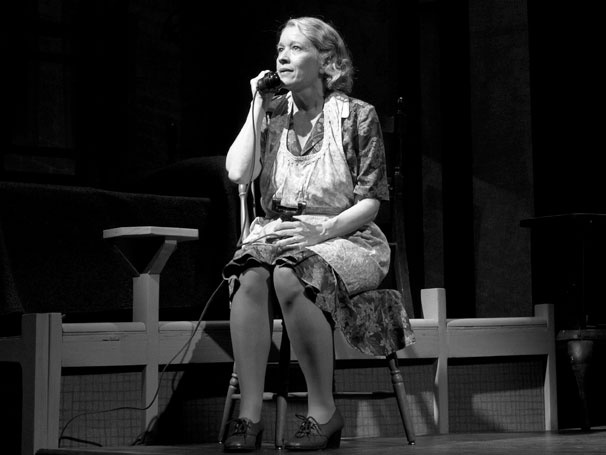
As Fraulein Schneider and Herr Schultz, Linda Emond and Danny Burstein are close to perfection, with an easy chemistry and a gravitas that makes their relationship the heart of the show.  And while Burstein is well-known for his musical theatre chops, Emond's play-focused career has denied the world of hearing her fantastically strong voice until now.  Bill Heck acts the role of Cliff with conviction, and Aaron Krohn is excellent as Ernst Ludwig, the charming Nazi sympathizer made all the more unnerving by his utter normalcy.  The cast and ensemble (who also doubles as the orchestra) are uniformly excellent, with one very notable exception.

Unfortunately, that exception is Michelle Williams as Sally Bowles.  The Oscar-nominated actress is making her Broadway debut, and while no one can accuse her of resting on her laurels, she gives a deeply misguided and ultimately unsatisfying performance.  Probably miscast, Williams has moments of strength and a surprisingly sturdy singing voice (remember that Sally is supposed to be at best a second rate singer, a fact the movie ignored in favor of casting the excellent Liza Minelli).  But Williams' performance rings false thanks to a collection of character tics that don't really work for her.  She constantly shakes and has an entirely unplaceable accent, making it unclear whether Sally is an addled drug addict, putting on an adopted persona, on the brink of a nervous breakdown, or some combination of all three.  Whatever it is, it doesn't really click, making a character that has in previous versions been defined by her authenticity feel fake and untruthful.  It's also unclear what about this Sally makes Cliff, who as played by Heck clearly prefers men to women, stay with and ultimately fall in love with such a deeply damaged individual.

Everything and everyone around Williams is excellent, and there is plenty to recommend this revival (especially to those who missed the production the first time around).  But the role of Sally is such a pivotal one that Williams' labored performance does bring the show down a notch or two.  With another actresses in the role, this Cabaret would easily be one of the best things running on Broadway.  As is, it is still a strong production of one of the musical theatre's greatest dramatic works, an adult work just as interested in challenging the audience as it is in entertaining them. Fans of that kind of theatre should definitely head over to Studio 54 and heed Cumming's opening entreaties to "bleibe, reste, stay."

Thursday, May 29, 2014

2014 Tony Predictions: Best Featured Actress

In my last post we discussed the supporting men, and today we discuss the supporting women who are up for Tony Awards in just a couple weeks' time.  Predicting these two categories will be tough, as both races are pretty wide open at the moment.  And then you have to take into account that the actress who should win is not always the person who will when, which throws another wrench into any sort of speculation.  But I am nothing if not persistent, so read on to see my best guesses for this year's big winners.

Best Featured Actress in a Play

The always charming Celia Keenan-Bolger was ideally cast as Laura in The Glass Menagerie, even if director John Tiffany let her down with some of his more bizarre choices.
 
Nominees: Sarah Greene, The Cripple of Inishmaan; Celia Keenan-Bolger, The Glass Menagerie; Sophie Okonedo, A Raisin in the Sun; Anika Noni Rose, A Raisin in the Sun; Mare Winningham, Casa Valentina

Many deserving women are nominated in this category, but at the same time there aren't any that seem to demand Tony recognition.  The Cripple of Inishmann, despite positive reviews and the presence of Daniel Radcliffe in the title role, has proven to be a bit of a non-event in terms of box office and awards potential.  That will hurt Sarah Greene's chances, along with the fact that her character comes across as a tad two-dimensional due to the broad nature of playwright Martin McDonagh's script.  A Raisin in the Sun's Sophie Okonedo and Anika Noni Rose will likely cancel one another out, with the final nail in the coffin being the lukewarm critical reception to that revival in general.  Okonedo is not entirely out of the picture, although she does face the significant handicap of playing the same role Audra McDonald inhabited to Tony-winning effect only 10 years ago.

Mare Winningham of Casa Valentina has been this season's stealth awards contender.  She didn't receive a lot of attention when the Harvey Fierstein dramedy opened last month, but has been a regular fixture on Best Supporting Actress lists and won the Outer Critics Circle Award for her work in the show.  She is probably Celia Keenan-Bolger's biggest competition, although the latter drew universal praise for her lonely, damaged Laura in last fall's The Glass Menagerie.  This is Keenan-Bolger's 3rd career nomination, and she still has a lot of goodwill left from her equally praised turn in Peter and the Starcatcher 2 years ago, which only increases her chances of finally winning.  I'm going to give the slightest of edges to Keenan-Bolger, but she and Winningham are so neck and neck that this is almost too close to call.

Should Win:  Toss-up between Mare Winningham (Casa Valentina) and Celie Keenan-Bolger (The Glass Menagerie)
Will Win:  Celia Keenan-Bolger, The Glass Menagerie                                                                     
 
Best Featured Actress in a Musical

Ingenues are deceptively simply roles to play.  With the wrong actress, they become boring or even worse, obnoxious.  Thankfully Lauren Worsham manages to avoid both of those pitfalls while looking absolutely *fabulous* in her Edwardian hat.
 
Nominees: Linda Emond, Cabaret; Lena Hall, Hedwig and the Angry Inch; Anika Larsen, Beautiful: The Carole King Musical; Adriane Lenox, After Midnight; Lauren Worsham, A Gentleman's Guide to Love and Murder

This is certainly an eclectic group of nominees.  Lena Hall does a lot with very little in Hedwig and the Angry Inch, but in this case I think the nomination is the win, and would be very surprised if she was actually called up to the podium on June 8th.  Adriane Lenox is the only previous winner in this group, and although she nails her two big numbers in After Midnight I suspect Tony voters will opt to spread the wealth.  And Anika Larsen is a complete wildcard; despite Beautiful's clutch of nominations I don't consider it to be a serious contender for most awards, but the sheer number of nominations for a show with such a small amount of buzz (despite steadily strong box office) means it must have impressed a lot of people.  Larsen may reap the benefits of that love, especially since Beautiful's subject matter allows her to do more serious "Acting" than many of the nominees in this category.  (Even in musicals, there's the usual awards bias towards dramatic roles, even if it is less pronounced than in plays or film.)

Linda Emond probably deserved to win for her long-suffering wife in the Phillip Seymour Hoffman-led Death of a Salesman (writing these predictions, I'm realizing just how much I disagree with the way the 2012 Tony Awards turned out).  Although I haven't personally seen the show yet, I'm sure Emond is excellent in Roundabout's resurrected Cabaret, but the Tony committee's distaste for that production is probably her biggest stumbling block.  Which leaves us with newcomer Lauren Worsham, who is making a sensational Broadway debut in A Gentleman's Guide to Love and Murder.  Like 2011 winner Nikki M. James, Worsham plays the reliably winsome ingénue in a comedy dominated by two hilarious men, and like James, I think Worsham's ability to turn a potentially boring part into a fully formed, believable character will net her Tony gold this year.

Should Win:  Linda Emond, Cabaret
Will Win:  Lauren Worsham, A Gentleman's Guide to Love and Murder


That takes us through all of the Featured categories; check back soon for my predictions for Best Actor and Actress.  And in the interim, check out the rest of my 2014 Tony Awards coverage below!

2014 Tony Nominations React
Best Direction and Choreography
Best Book and Score
Best Featured Actor

Thursday, May 31, 2012

2012 Tony Predictions: Best Featured Actress


Now we get to the meat of the Tonys, the acting awards.  Given the sheer volume of eligible work, someone always gets snubbed when the nominations are handed out, and even then there are still several deserving candidates for each statuette.  Before reading any father, please remember my two caveats:  1) I have not seen all of the nominated shows; and 2) I am predicting who will win, which may be different from who should win, especially in the acting categories.  As always, I will point out those discrepancies in the body of the article.

Since any gentleman knows that its ladies first, here are my predictions for the Best Supporting Actress categories.


Best Featured Actress in a Play


Nominees:  Linda Emond, Death of a Salesman; Spencer Kayden, Don’t Dress for Dinner; Celia Keenan-Bolger, Peter and the Starcatcher; Judith Light, Other Desert Cities; Condola Rashad, Stick Fly


Right off the bat, I think we can count out Spencer Kayden and Condola Rashad.  Kayden is the only bright spot in a critical and commercial failure, and if it weren’t produced by the not-for-profit Roundabout Theatre Company I’m sure Don’t Dress for Dinner would have already posted a closing notice.  Rashad could be called a dark horse candidate, but while critics loved her, Stick Fly as a whole didn’t make much of an impression and closed months ago.  One of the biggest advantages a Tony nominee can have is being in a currently running show, which leaves Rashad with an uphill battle that I doubt she can win.

While I have not personally seen Peter and the Starcatcher, my understanding is that all of the actors play multiple roles, which always impresses Tony voters and is a major plus for Celia Keenan-Bolger.  Unfortunately, Peter isn’t as “serious” a work as Death of a Salesman or Other Desert Cities, which probably negates any advantage the multiple role trick gave her.  In straight plays, Tony voters tend to reward dramatic acting or its exact opposite, full-on farce; anything in-between like Peter goes underappreciated.

If we rule out Keenan-Bolger, we are left with Judith Light and Linda Emond, with the edge definitely going to the latter.  Emond is clearly the female lead in Salesman, with all of the accompanying stage time and character development, giving her more and better material to work with than her fellow nominees.  This same situation led Nikki M. James to a somewhat surprising but wholly deserved Featured Actress in a Musical win last year, and I expect a similar outcome for Emond.  And lest you think it all comes down to politics, I have seen Salesman and can assure you she is devastatingly good, easily holding her own against Phillip Seymour Hoffman and making even the play’s most famous lines sound fresh and alive.


Will & Should Win:  Linda Emond, Death of a Salesman


Best Featured Actress in a Musical


Nominees:  Elizabeth A. Davis, Once; Jayne Houdyshell, Follies; Judy Kaye, Nice Work If You Can Get It; Jessie Mueller, On a Clear Day, You Can See Forever; Da’Vine Joy Randolph, Ghost the Musical


For me, this is a somewhat odd list of nominees.  It’s not that I think any of the included ladies are bad, but I don’t quite understand what some of them did to edge out other equally fine performances.  For instance, as hilarious as she was singing “Broadway Baby,” was Jayne Houdyshell really that much better than her Follies costars Elaine Page or Terri White?  And how did Elizabeth A. Davis, even with her striking good looks and beautiful singing voice, get herself nominated when the rest of the ensemble of Once went unrecognized?  I suspect I am not the only one who feels this way, and it is a sentiment that will probably prevent either of them from leaving the Beacon theatre a winning next Sunday.

Now, I hesitate to say I don’t want Da’Vine Joy Randolph to win, but…I don’t want her to win.  I haven’t seen her in Ghost, and the problem is I don’t need to in order to know exactly what her performance is like.  I’m sure she’s sassy, fires off a succession of one-liners, and sings the hell out of her big, gospel-tinged solo.  Add in one or two “serious” moments masquerading as character depth, and you have the same performance given by almost every featured black actress in the past ten years.  It’s such a cliché that someone even wrote a song about it, although in fairness to the writers of Ghost they at least had the decency to make Randolph’s character integral to the plot.  But it still isn’t the sort of thing that should be rewarded with Tony Awards, especially because such a win will only encourage musical theatre writers to continue using this stereotype rather than creating roles of substance for black women.

Judy Kaye is perfectly fine in Nice Work If You Can Get It, but I don’t think this role will net the Tony Award-winner a second statuette.  The show as a whole is too run-of-the-mill, and Kaye doesn’t do enough to rise above that.  On the other hand, Jessie Mueller did rise above her subpar show and gave one of the most praised supporting turns of the season.  Everyone who actually saw On a Clear Day agrees that Mueller’s big number was the highlight of the evening and a genuine showstopper.  Plus, Broadway loves a Cinderella story, and what could be more fairy tale-esque than a young woman playing the lead in her Broadway debut, stealing the show, and winning a Tony for it?


Will & Should Win:  Jessie Mueller, On a Clear Day You Can See Forever


That’s all for now.  Check back soon to see which Featured Actors should be practicing their acceptance speeches.  And check out the rest of my Tony predictions here:


Direction& Choreography

Monday, May 7, 2012

Attention Must Be Paid

Review: Death of a Salesman
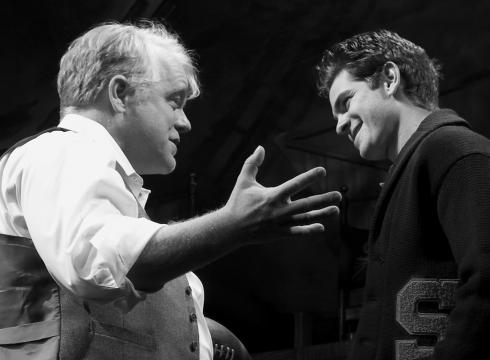
Phillip Seymour Hoffman and Andrew Garfield in Death of a Salesman
On rare occasions, a piece of theatre will leave you so profoundly affected that finding words to describe what you feel proves difficult.  The writing, direction, and performances all combine and send you into a momentary stupor as your brain attempts to process the depth of what you’ve just experienced.  You remain in your seat after the lights come up, hoping that by lingering in the theatre you’ll be able to enjoy its transcendent nature just a while longer.  The knockout revival of Arthur Miller’s Death of a Salesman is such a piece of theatre.

Miller’s script is such an acknowledged masterpiece that it’s easy to forget just how incredible his writing truly is.  This portrait of aging salesman Willy Loman uses incredibly specific characterizations to reveal something universal about the human experience, and it’s themes of shattering disappointment and unfulfilled potential remain timely over sixty years after its premiere.  Seeing a man who has poured his entire life into a company unceremoniously dismissed strikes an especially potent chord in our post-recession economy.  And in a society where adolescence has stretched into a person’s mid-twenties and beyond, Miller’s parallel tale of the arrested development of Willy’s two sons is instantly recognizable.
But a play, even a great one, does not perform itself.  And for this latest Broadway revival, director Mike Nichols has assembled a cast equal to the monumental potential of Miller’s script.  Oscar-winner Phillip Seymour Hoffman anchors this production with a tower performance in one of the theatre’s great roles, embodying Willy’s crushed soul from his first shambling footsteps onto the Barrymore Theatre’s stage.  Although considerably younger his character, Hoffman so convincingly portrays a man suffering from a lifetime of disappointment that you accept him as Willy immediately.  And while his desperation can be uncomfortably oppressive (as it should be), Hoffman peels back those years during the play’s flashback sequences to offer a glimpse of the great man everyone claims Willy used to be.  Hoffman’s contribution to the success of this production cannot be ignored, and anyone interested in seeing a true master at work owes it to themself to see him in this role.
Hoffman is more than ably supported by his costars, particularly Linda Emond.  As Willy’s long-suffering wife Linda, Emond takes a character type that has become cliché and invests it with such conviction that it seems new again.  While you completely understand and sympathize with Linda, you cannot pity her because Emond makes it clear she doesn’t want to be pitied.  Of the characters in the play, Linda is the most at peace with the family’s current situation, which only makes her final monologue all the more heartbreaking.  The play would lead you to believe that Linda has little left to lose, and yet by the end you know that she had everything to lose, and now that it is gone she is will likely never recover.
And then there is Andrew Garfield, a promising young film talent making a phenomenal Broadway debut as Willy’s son Biff.  Garfield is also too young for his role, but just like Hoffman he makes you forget that fact in seconds.  Biff’s tragedy is that he knows exactly what’s wrong with him and yet is powerless to change, and Garfield communicates that conflict flawlessly.  Resentful of the expectations placed on him by his father and filled with guilt over his inability of meet them, Garfield’s Biff is a cornered animal, dangerous and likely to lash out at any moment.  His scenes with Hoffman are simply electric.
Mike Nichols has guided his cast to perfectly pitched performances, ensuring the play moves inexorably towards its final conclusion.  So expertly paced is the piece that although it never drags, it never feels rushed either, with each revelation being afforded the proper dramatic weight.  The sublimely understated sets, costumes, and lighting keep the focus squarely on the human drama at the play’s center, allowing Nichols and his actors to do their work unimpeded.
This revival of Death of a Salesman is an affirmation of the incredible power live theatre can wield, and is an event that only comes around once in a great long while.  A great production of a great play, it simply cannot be missed.