Sunday, November 10, 2013

A "Night" Full of Laughs, Just as the Bard Intended

Review:  Twelfth Night

Don't let the puzzled expression fool you; Mark Rylance knows exactly what he's doing as Olivia in Shakespeare's Twelfth Night


I have a confession: I can't stand Twelfth Night, that perennially popular Shakespearean comedy of mistaken identity.  It always strikes me as dreadfully dull and decidedly unfunny in performance, with the only consistently entertaining parts being the B-plot focused on the servants’ attempts to humble the unbearably pompous Malvolio.  I also have a generalized disdain for companies who mount Shakespeare using the original Elizabethan practices, as the all-male casting is usually there to mask the fact the director has nothing new to say about the play.  So when I heard Twelfth Night was being revived on Broadway with an all-male cast, the only thing that seemed remotely interesting to me was the opportunity to see the incredibly gifted Mark Rylance perform onstage once again.

I need not have been so cynical; this latest production of the Bard’s comedy is the finest one I’ve ever seen, and one of the most accessible and interesting Shakespearean productions to grace the New York stage in a long time.  For the uninitiated, the show’s main plot concerns twin brother and sister Viola and Sebastian, who become separated during a great storm at sea.  Each has assumed the other drowned, and for reasons that never fully make sense to me Viola decides that her best course of action is to dress as a boy named Cesario and go work for Duke Orsino.  The Duke is madly in love with the countess Olivia, who is in mourning for her dead brother and will not entertain any of Orsino’s advances.  He sends Cesario/Viola to woo Olivia for him, but the countess find herself far more interested in the well-spoken servant "boy" than the lovelorn Duke.  

This contrivance has always been difficult to swallow, not only because the actress playing Viola almost never makes a convincing man but also because when her twin brother Sebastian reenters the picture the two are constantly confused for one another despite incredibly obvious physical differences.  The beauty of this all-male production is that Viola finally makes a convincing man, and the pale makeup and identical costumes she and Sebastian wear make them virtually indistinguishable physically.  The other characters' confusion is finally credible, yet there are enough context clues and subtle differences in physicality for the audience to be able to figure out who’s who.  Samuel Barnett and Joseph Timm - as Viola and Sebastian, respectively - are both fine actors in rather thankless roles, and Barnett in particular does an admirable job of playing the straight man during the play's increasingly ridiculous situations.

But while Samuel Barnett may technically be playing the lead, this production is all about Mark Rylance’s virtuosic performance as Olivia, a hilariously over-the-top rendition that finds laughs in every line of dialogue and bit of stage business.  Most performers tend to emphasize Olivia’s regal air, given her position as a countess; Rylance completely forgoes that route and has created a supremely vain, vaguely stupid woman-child prone to tantrums and side-splittingly inept flirting.  Two-time Tony-winner Rylance has always been an extremely physical actor, and over the course of the evening he throws himself on the floor, scrambles over furniture, hurls props at his fellow actors, and even wields a battle axe for some of the play’s biggest belly laughs.  Although vastly different from the typical interpretation, Rylance’s performance is entirely supported by the text and his unequaled commitment to the role makes it wholly believable.  It's a shame the part doesn’t allow Rylance doesn’t more stage time, but he milks what he has for everything it's worth.

As Olivia’s handmaiden Maria, Paul Chahidi doesn’t even attempt to hide the fact he is a man in a dress, but he also doesn’t comment on the fact.  He merely reacts naturally to the play’s circumstances, and the honesty of his performance allows you to instantly accept him as Maria and enjoy his gleeful mugging.  Colin Hurley is a riot as the constantly drunk Sir Toby Belch, and with Angus Wright’s Sir Andrew Aguecheek as his partner in crime is responsible for some of the biggest laughs not involving Rylance.  And although the character doesn’t really get a chance to shine until the second act, Stephen Fry makes for a masterful Malvolio, the unsuspecting butt of a particularly cruel but also hilarious joke concocted by Maria and Toby.

The intentionally spartan set design by Jenny Tiramani is a refreshing change of pace from the overly elaborate sets that have become the norm these days, and the decision to use onstage seating as an approximation of the thrust staging seen at Shakespeare’s Globe is a nice touch (and watching said audience members double over in laughter provides added entertainment value).  Tiramani is also responsible for the gorgeous period costumes, whose elaborate detail is visible even from the back of the theatre.  Director Tim Carroll makes excellent use of all of this in his staging, which maintains a brisk pace and keeps the focus squarely on the text and the performers.


Twelfth Night is running in repertory with Richard III, and the idea of this same group of actors tackling an entirely different type of play is intriguing, given that they have so thoroughly nailed the spirit of this whimsical comedy.  As Olivia, Rylance proves once again that he is one of the most gifted, versatile, and hardworking actors of his generation, and he is surrounded by equally capable and appealing performers both young and old.  Whether you love Twelfth Night or can't quite comprehend its enduring popularity, this production will leave you smiling.

Wednesday, October 23, 2013

My Top 10 Theatre Experiences: Part 2

A few weeks ago, I started to publish a list of my Top 10 theatrical experiences of all time.  This list includes the shows that have had a profound impact on my theatre-going life, and the ones that have remained the most vivid in my memory since initially seeing them.  You can read the first article for a more thorough breakdown of the criteria I've used, but basically for a show to make the list it had to play Broadway and be solid from top to bottom (excellent star turns in mediocre shows have been left off).  And the list is alphabetical, because coming up with a numbered ranking for these 10 shows would just be too hard.

So picking up where I left off:

The Book of Mormon

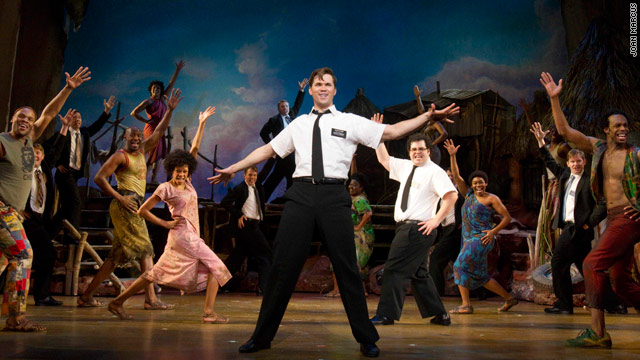
Andrew Rannells and the original Broadway cast of The Book of Mormon

The Book of Mormon holds a distinction that I do not give out lightly; despite my hesitancy to rank the shows on this list, almost 3 years after my first viewing I can safely say that The Book of Mormon is the best night I've ever spent in the theatre.  The energy inside the theatre was palpable during the early March preview I attended back in 2011; though highly anticipated, the show was shrouded in secrecy.  The producers had only released four production stills, there was no video or audio available, and the program purposefully lacked a song list or even a basic scene breakdown.  None of us quite knew what we were getting into, and the experience was all the better for it.

As a huge fan of South Park: Bigger, Longer, and Uncut (easily among my favorite films of all time), I had enormous expectations for this show, and it handily exceeded every one of them.  By the end of the opening number I was grinning from ear to ear, and soon after that I was howling with laughter.  The show was every bit as gleefully offensive as you could imagine, and crossed a couple of boundaries even I wasn't sure they were allowed to.  And yet the show was so hilarious, and more importantly so heartfelt, that it didn't matter.  The show had a soul, and a soul that not only respected but embraced the traditions of the glitzy book musicals of days past.  There are rousing production numbers, comic duets, and second act power ballads that manage to both gently mock the absurdity of such things while at the same time being excellent examples of those troupes.

Simply put, The Book of Mormon is one of the best constructed musicals of the new millennium, as well as one of the funniest.  But what made this experience truly transcendent for me was the absolutely extraordinary original cast.  Everyone, from the principals to the ensemble members, was an extremely talented triple threat with spot-on comic timing and amazing chemistry.  While Josh Gad was rightly praised for his scenery chewing turn as the hopelessly awkward Elder Cunningham, I think Andrew Rannells' supremely smug Elder Price was the show's true revelation.  Rannells managed to play straight man to Gad's comic genius while remaining hilarious in his own right, and turned what could have been a thoroughly off-putting character into a beacon of charisma and old-school showmanship.  (Also, Rannells' pop-tenor is nearly flawless.)  Tony-winner Nikki M. James provided the show's heart and soul as Ugandan tribeswoman Nabalungi, and Rory O'Malley led one of this decade's great production numbers with his showstopping "Turn It Off" (which incidentally includes my favorite sight gag in the entire show, and one that made me audibly gasp in delight when I first saw it).

The Book of Mormon is rightfully one of the hottest tickets in town, commanding upwards of $450 per ticket for the premium seats.  It is the only show running I would even consider paying that much money for, and I will continue to recommend it to any and everyone who will listen.

Follies (2011 Revival)

The "Loveland" sequence from the 2011 revival of Follies

Stephen Sondheim's utter mastery of the musical theatre form is sometimes taken for granted, and I often call him the Shakespeare of the musical stage.  Like the Bard, Sondheim's works have the remarkable ability to reveal new facets of meaning with each subsequent viewing, and have proven able to withstand a wide array of reimaginings and concept-based stagings.  But sometimes, as the breathtaking 2011 revival of Follies proved, all you need is to do the show the way it was written.  Grandly opulent and utterly heartbreaking, this revival took a show I had always found intriguing and skyrocketed it up my personal list to the point where I consider it one of the finest musicals ever created.

The show, centered around the reunion of the last remaining performers of a Ziegfeld Follies-esque spectacle, is simultaneously about nothing and everything.  There is very little plot, and yet over the course of the evening the show manages to make deeply poignant observations about growing older and regret while still celebrating the vast amount of beauty to be found in life.  Sondheim's score is a parade of pastiches that include some of the greatest ballads ever written, including cabaret standards like "I'm Still Here" and "Losing My Mind."  The most expensive musical ever produced at the time of its original premiere, Follies requires an elaborate physical production and enormous cast, and this revival hit both of those elements out of the park.

Bernadette Peters' performance as Sally Durante-Plummer is probably one of the more divisive in recent Broadway history; I personally loved her, and found her character's slow unraveling to be a fascinating portrait of the cost of unmet ambitions.  But nobody could argue with the stunning brilliance of her onstage husband Danny Burstein, who was a revelation as Buddy Plummer and robbed (ROBBED!) of a justly deserved Tony Award.  And Jan Maxwell's pitch-perfect embodiment of the jaded, bitter Phyllis Rogers-Stone was such a masterclass in musical theatre acting that I can still vividly recall her two big numbers ("Could I Leave You?" and "The Story of Lucy and Jessie").  The only reason I am okay with her not winning a long-overdue Tony is because that year's victor was Audra McDonald for Porgy and Bess, which was one step beyond perfection.

Finally, Follies has what may be one of the most thrilling theatrical climaxes of any musical I've ever seen.  Watching the main quartet of characters finally reach their breaking point, triggering the 20-minute long "Loveland" sequence in which each character is deconstructed in an elaborately-staged Follies-style production umber, had me on the edge of my seat in the way few shows ever had.  I can still see that initial reveal, with the downstage drop curtain falling to floor to reveal the dazzling Loveland set, as if it had happened this morning.


That's enough for today.  Hopefully I will be a little more regular on the blog postings, but even if it takes a while I promise the rest of this list is coming!

Sunday, October 6, 2013

A Tall Tale Expertly Told


Review:  Big Fish

 
Kate Baldwin, Norbert Leo Butz, and believe it or not one of the simpler sets for Broadway's Big Fish

Based on the 2003 Tim Burton film and the novel of the same name, Big Fish has a big budget ($14 million, to be exact) and it shows.  There is no shortage of props, costumes, and various other theatrical accoutrements filling the Neil Simon’s stage, to the point where the elaborate physical production seems poised to overshadow the actual story being told.  Thankfully, the boundless talent and creativity of both the performers and director/choreographer Susan Stroman outshines any stage business, making Big Fish a thoroughly enjoyable musical comedy for the modern era.

The multifaceted story of Big Fish centers on Edward Bloom, a traveling salesman prone to telling fantastical stories about his life to anyone who will listen.  After a lifetime of stories about giants, mermaids, and witches instead of actual human interaction, Edward’s grown son Will harbors a deep-seated resentment towards his absentee father.  But when Will’s mother Sandra calls to reveal Edward has contracted a potentially terminal cancer, the junior Bloom decides now is the time to find out the truth behind his father’s tall tales.  As the narrative jumps between Edward’s fanciful past and less uplifting present, Big Fish ultimately reveals itself as a show very much concerned with fathers, sons, and the legacy we all leave behind when we die.

The whimsical nature of Edward’s stories and the uncomfortably real estrangement between father and son makes for a tricky combination of tones, and kudos must be given to bookwriter John August for blending these disparate elements so seamlessly.  The more outrageous production numbers transition smoothly into intimate character scenes, and the show’s book manages to be both laugh-out-loud funny and surprisingly moving.  August has provided his cast, particularly the charming rascal Edward, with some genuinely hilarious one-liners, while at the same time fleshing out his characters with more depth than typically seen in a musical comedy.  The one real flaw in the script is that it could stand a more cohesive ending; the three false endings presented muddle what could be a powerful conclusion by failing to agree on what the final sentiment of the show should be.

The score by Andrew Lippa is more problematic.  His melodies are certainly pleasing to the ear, and the entire show has been lushly orchestrated by Tony-winner Larry Hochman.  It’s not that Lippa has written bad music, but he does seem to have written the wrong music, and his unnecessarily rangy pop-influenced bombast drowns out the delicate and emotionally complex ideas in his lyrics.  The show’s best musical moments are the quieter ballads, but Lippa seems distrustful of the notion that the simplest solution can often be the best.  So he throws in another modulation and some vocal grandstanding for good measure, making the show sound like every other Broadway score of the past 5 years.  All of that said, Lippa and August have done an excellent job of integrating the songs into the show’s book, and with the exception of Will’s first act solo “Stranger” every musical number feels purposeful and necessary.

5-time Tony winner Susan Stroman directs this material with her trademark wit and invention, creating an unending parade of delightful surprises throughout her fluid staging.  Stroman’s choreography finds the delicate balance between being earnest and self-aware, winking at the audience without mocking the story or the characters.  The only minor quibble with Stroman’s work here is that the material doesn’t afford her a showstopping production number like “Springtime for Hitler” in The Producers or “I’ve Got Rhythm” in Crazy for You.  That said, she does stellar work in the Stomp-influenced opening number “Be the Hero” and the wonderfully cheeky USO-inspired “Red, White and True” at the top of the second act.  Her playfulness never distracts from the show’s pace or emotional core, and there is a much-appreciated old school polish to her staging.

Stroman has also assembled a dynamite cast, headed by two-time Tony-winner Norbert Leo Butz in yet another spectacular display of his seemingly unending list of talents.  Butz combines the charisma of a leading man with the finely-honed comedic timing of a character actor to create a magnetic Edward Bloom that anchors the entire evening.  Butz gets to play Bloom at every stage of his life, seamlessly transitioning back and forth between Edward’s various ages with only minimal help from costumes and makeup.  Rarely leaving the stage, Butz conjures up unexpected depth and unparalleled showmanship as required, reaffirming his status as one of the most talented actors of his generation and making it impossible to take your eyes off him.

Tony-nominee Bobby Steggert has a tougher time finding his footing in the role of Edward’s son Will, although it is not for lack of trying.  Butz is such a dominate personality that Steggert’s character arc often seems secondary, although the latter actor manages the tricky feat of constantly antagonizing the show’s most charming character without becoming unsympathetic himself.  The subtlety of Steggert’s performance helps guide the audience to an understanding of Edward without beating them over the head with it, and the young performer is in fine voice throughout.

Rounding out the main cast is Kate Baldwin as Sandra Bloom, wife to Edward and mother to Will.  Baldwin is fantastic as the love of Edward’s life, creating a fully realized person in a role which leaves many things unsaid.  With a single glance and a carefully timed sigh Baldwin shows us glimpses of the immense turmoil within this woman forced to watch the two most important men in her life fight with one another, and she fills the flashback scenes with such unbridled joy you instantly understand why Edward is so smitten with her (their initial meeting, the haunting “Time Stops,” is perhaps the single most effective moment of the show).  Baldwin’s crystalline voice also does the best job navigating the highs and lows of Lippa’s score, and her Act II ballad “I Don’t Need a Roof” is heartbreaking.

As for the show’s physical production, making a value judgment about it is unusually tough.  On the one hand, everything about the show is expertly crafted and visually stunning.  The rubic’s cube of a set by Julian Crouch makes the many scene changes virtually seamless, and the projection design by Benjamin Pearcy elevates that particular art to an entirely new level.  Susan Stroman’s continually surprising staging would not be possible without the endlessly inventive costumes by William Ivey Long, several of which provoked audible audience reactions the night I attended.  And yet there is so much of everything, from the various set pieces to the gargantuan number of costumes and props, that it verges on distracting.

There is a lot to like about Big Fish, starting with the dynamic central performance of Norbert Leo Butz.  He is backed by a supremely talented and funny cast that is able to effortlessly shift between the comedic and dramatic tones demanded by the story, which has been expertly mapped out by bookwriter John August and composer Andrew Lippa.  Susan Stroman’s staging is creative without becoming gimmicky, and her originality ensures that there is always something fresh and exciting around the corner.  Like the best tall tales, this show transports the audience to a world at once familiar and exciting, and that sense of wonder will linger with you long after the story is done.

Saturday, September 21, 2013

My Top 10 Theatre Experiences: Part 1

Ever since Playbill.com started publishing "Their Favorite Things," in which notable Broadway talent lists the 10 Broadway performances that most affected them as audience members, I have toyed with the notion of doing a similar feature on this blog.  But every time I've gone to write it, I've shied away, since making lists of my "favorite" or "the best" theatre is not something I do lightly.  It takes time to fully process the best theatre, and to ensure that your enjoyment was of the piece as a whole and not just a particularly flashy performance or technical element.  There are many productions I enjoyed immensely at the time that I have trouble remembering now, and while those types of shows are certainly valuable experiences they are not ones I feel belong on a "best of" list.

But after a lot of careful consideration, I have (I think) come up with a list that represents the 10 shows that have had the greatest effect on me as person.  These are the shows that made me feel, that made me laugh out loud, fight back tears, and stare in wonder at the sheer amount of talent on display.  I want to be clear:  this is NOT a list of what I consider the 10 Best Shows of All Time.  There are several shows that I adore as pieces of writing that I've never seen a wholly satisfactory production of, and though my theatrical knowledge is broad I don't consider it broad enough to make such sweeping proclamations.

No, this list was created with a pretty specific list of caveats.  It is confined entirely to productions I have personally experienced, and the specific casts I saw in those productions.  Also, I have borrowed Playbill.com's convention of limiting the list to Broadway productions, as it provides a narrower field to choose from (and has honestly been the home of almost all of the best theatre I've seen).  And in making my picks, I focused on productions that were outstanding as a whole, which has led to the exclusion of some of my favorite individual performances because the vehicles they starred in were flawed in some way.  Perhaps one day I'll make a companion list that is performer-based, but for now, a stellar production overrules a singular star turn.

Oh, and one last note: the shows are in alphabetical order, because attempting to rank them from 1 to 10 simply proved too difficult.  At this level, separating number 1 from number 2 or number 9 from number 10 would be splitting hairs.

Here's the start of the list:

August: Osage County

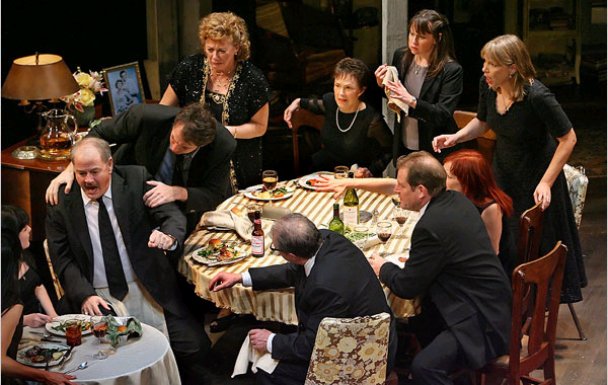
Perfection personified.  The acting ensemble for August: Osage County was everything!
  

On my first trip to New York after college, I bought a seat in the back of the balcony to August: Osage County based entirely on the ecstatic word of mouth from my friends.  The following three-and-a-half hours were some of the most thrillingly theatrical I've ever experienced, as playwright Tracy Letts and the astound ensemble of actors hurled the Great American Drama into the 21st century.  A deftly written dark comedy at turns hilarious and chilling, this Pulitzer Prize-winning masterpiece was riveting, and I left with a renewed sense of excitement about the possibilities of theatre as an artistic medium. 

The cast, all of whom transferred with the play from its world premiere at the Steppenwolf Theatre Company in Chicago, was uniformly astounding, forming a tightly-knit ensemble that truly felt as if they had known each other their entire lives.  They were the Weston clan, and the extended second act dinner scene was one of the greatest master classes in acting that I've ever seen.  And while everyone was phenomenal, I must give special mention to Amy Morton as the eldest Weston daughter, Barbara.  Her slow unraveling under the psychological torture of her monstrous mother was mesmerizing, and her bellowed declaration of "I'm running things now!" at the end of Act II was perhaps the most electrifying curtain line in any play ever.  I would gladly have watched three more hours of such astonishing acting, and to this day August remains one of the finest dramas I've ever experienced.

Avenue Q

Puppets, humans, and Gary Coleman all live in happy harmony down on Avenue Q.


A smartly written, expertly executed examination of the struggles of early twenty-somethings in the new millennium, Avenue Q will forever be remembered as the show that beat megahit Wicked for the 2004 Best Musical Tony.  Having seen both productions just before said award was handed out, I must say that I wholeheartedly agree with the Tony voters' choice.  Avenue Q went far beyond its gimmicky-sounding Sesame-Street-meets-South-Park premise to become the perfect distillation of early-2000s pop culture, and in my opinion had a heart far bigger than the giant set-pieces on display at the Gershwin Theatre.  The show had me *howling* with laughter, even though I knew all of the songs by heart long before I made a trip to the Golden Theatre to actually see the show that contained them.

And while that was in no small part due to the writing, the insanely talented ensemble took the show over the edge as far as quality was concerned.  Most shows have two or three stand-out numbers; in the hands of that original cast, Avenue Q had 8 or 9.  John Tartaglia's and Stephanie D'Abruzzo's dual roles helped show me what true musical theatre acting looks like; when Kate Monster had her confrontation with Lucy the Slut I thought little of it until I realized D'Abruzzo played both characters, at which point my jaw dropped.  And I will never understand how Ann Harada failed to even be nominated for her career-defining work as Christmas Eve; a supremely talented comedienne, Harada had me rolling in the aisles and then blew me away with her powerhouse vocals on "The More You Ruv Someone."  10 years later I can still clearly remember large swaths of this show, and those memories never fail to bring a smile to my face.


That's all for now.  Check back soon for the next 4 shows in my top 10, including the show I'm fairly certain is my favorite theatrical experience of all time.

Friday, August 23, 2013

This Girl is Far from Revolting


Review:  Matilda
It's not a dream; Matilda really is as good as you've heard.
 
The producers of the American premiere of the Olivier-winning smash hit Matilda have done themselves a great disservice by allowing the musical to be marketed as a children’s show.  True, there is nothing anyone but the most overprotective parents would find in the least bit offensive, but there is more wit, intelligence, and invention in this adaptation of the Roald Dahl novel than in any other Broadway musical of the season.  This is a show of supreme sophistication which dares to actually challenge its young audience rather than speak down to them, and offers as many if not more pleasures for the adults lucky enough to find themselves in the audience.

Like the book on which it’s based, the musical follows the misadventures of precocious 5-year-old Matilda as she begins her first year of school.  Unwanted by her vapid and emotionally abusive parents – her father refuses to even acknowledge her gender, repeatedly referring to her as “boy” – Matilda has taken solace in reading and study.  Her incredible intelligence immediately catches the attention of her meek but kind-hearted teacher, Miss Honey, who quietly vows to do everything she can to help Matilda reach her extraordinary potential.  Unfortunately the headmistress of Matilda’s school is the villainous Miss Trunchbull, whose motto “Bambinatum est Maggitum" (“Children Are Maggots”) tells you everything you need to know about why her presence is a problem.

The libretto by Dennis Kelly is a bravura piece of theatrical writing, establishing the show’s off-kilter tone with such assuredness that you buy into it immediately.  Simultaneously oversized and understated, the characters inhabit a realm of magical realism that is utterly fascinating without losing the feeling of familiarity.  Kelly has gifted his hyper-literate lead and her cohorts with some of the sharpest dialogue to grace the musical stage in years, and Matilda’s unending amount of wordplay and dry humor is positively delicious.  Kelly has also created a framing device in which Matilda tells the local librarian serialized fragments of a seemingly inconsequential story that slowly illuminate the quirky intelligence of his heroine and her feelings about the series of mishaps she finds herself in.  And on top of everything else, Kelly also manages to work in some rather biting satire of modern-day parenting without distracting from the main narrative, giving the show an added layer of social commentary on top of its already full plate.

The songs by Tim Minchin are equally inventive.  In fact, one of the few knocks against the show is that between the lightning-fast tempos and the sometimes shrill registers of the children’s ensemble, it is almost impossible to fully comprehend Minchin’s incredibly playful lyrics.  It’s never enough of a problem that it obscures the story, but the lyrics you do catch are so damned clever you can’t help but feel like you’re missing out on something worth hearing.  Musically, the score is light and bouncy, with a few tender ballads thrown in to keep things fresh.  Minchin hasn’t written an enormous number of songs for Matilda, but what is present perfectly balances with Kelly’s dynamite libretto and the needs of the narrative.

Matthew Warchus elevates this already strong material to the next level through his ingenious direction, which keeps the show moving and visual interest high.  He effortlessly conjures up feelings of dread or elation as the situation dictates, and at multiple points his staging is genuinely jaw-dropping (special praise must be given to Matilda’s arrival at her appropriately ominous school, which left me speechless).  Warchus is aided and abetted by the incredible word-tile set of Rob Howell, which has exploded well beyond the confines of the Shubert Theatre stage and taken over the entire auditorium.  If you somehow find yourself bored by the onstage action (an unlikely scenario, to be sure), spotting the thematically important words carefully hidden among the scenery is entertainment onto itself, and this exceptionally versatile set seamlessly transforms into whatever is required.

Matilda is such a stellar example of strong writing and direction that it’s easy to underrate the contributions of the cast, which is uniformly excellent.  Four young actresses share the title role, and if they are all as effortlessly enchanting as young Oona Laurence (who played the performance I saw), we have four future stars on our hands.  There is a nuance and understated complexity to her Matilda that is rarely seen in actors so young, and she effortlessly carries the show on her petite shoulders.  Laurence is complimented by the insanely talented collection of child actors playing her classmates, whose abounding energy has been perfectly harnessed by Warchus and choreographer Peter Darling to create the most gleefully unique bunch of misfits on the Great White Way.  The children’s numbers, of which there are many, are more cleanly executed than those in musicals with adult casts, and not because Darling has dumbed down his steps for the young performers.  These kids are blissfully unaware of how difficult what they’re doing truly is, and their energy is completely infectious.

The adults are thankfully just as good.  Lauren Ward gives a pitch perfect performance as the meekly maternal Miss Honey, beautifully complimenting Matilda’s yearning for love and acceptance with her own.  In addition to sounding lovely, Ward brings exactly the kind of warm, calming presence the role demands.  But it’s the antagonists that get to have the real fun, and all of the nasty adults in Matilda’s life make scenery chewing meals out of their delightfully daffy roles.  As Matilda’s neglectful parents, Lesli Margherita and Gabriel Ebert are utterly despicable and yet endlessly entertaining.  The pair has managed to add enough venom to their performances to be effective without being so harsh that their antics become tiring, and both bring excellent comic timing to their respective roles.  And as Matilda’s impossibly stupid older brother, Taylor Trensch turns his monosyllabic lines into comedy gold.

Towering over everyone else in the cast is Bertie Carvel’s absolutely magnificent turn as Miss Trunchbull, the Olympic-level hammer thrower and headmistress of Matilda’s school.  Carvel’s every hand gesture, facial tic, and change in inflection is completely compelling, a master class in character acting that completely disguises the performer underneath.  Although Carvel’s dressed in drag, with no real effort made to disguise that fact, you instantly believe that he is Trunchbull, thanks to the combination of his unequaled commitment and magnetic stage presence.  It’s difficult to say this perfectly balanced show would be better by adding more of Carvel, but every time the actor leaves the stage you eagerly anticipate his next appearance.

Although imported from London’s West End, everything about Matilda screams Broadway.  It is a show where absolutely everyone involved is working at the highest possible level, from the writers and performers to the production team and the expert craftsmen responsible for the gorgeously detailed sets and costumes.  While the smallest theatregoers may be too young to fully appreciate the brilliance of Matilda, it is a show that can be enjoyed by everyone from age 8 to 80 and beyond.  It is one of the few British transfers that full delivers on the lofty expectations created by its pre-opening buzz, and is not to be missed.

Sunday, August 18, 2013

Shakespeare Sings, and It's (Mostly) Beautiful Music


Review:  Love’s Labour’s Lost
It's Shakespeare, but it's fun!  See?  His bowtie is untied and everything!
 
The Public Theatre’s annual Shakespeare in the Park program was started with a very simple mission: to provide free Shakespeare to the entirety of New York City, not just those able to afford the increasingly high price of theatre tickets.  Over the years this mission has expanded to include revivals of other classic playwrights and even the occasional musical, with multiple productions eventually transferring to healthy and critically acclaimed runs on Broadway.  This year the Public is using the program to launch an original musical for only the third time in its history, reuniting the creative team of the Tony-nominated Bloody Bloody Andrew Jackson for a reimagining of the Bard’s early comedy Love’s Labour’s Lost.  And while the Public is clearly hoping that the show follows in the footsteps of Two Gentlemen of Verona and The Mystery of Edwin Drood, shows that transferred to Broadway and won Best Musical, this slickly produced new work is in need of at least one major round of rewrites before being ready for the big leagues.

For those unfamiliar with Shakespeare’s original play (and I must confess that I was not), the plot concerns the King of Navarre and three of his noble friends forswearing women and other earthly delights in order to devote themselves to study and personal betterment.  This vow is immediately tested by the arrival of the Princess of France and her entourage, who have come on behalf of her father to discuss some financial matters.  In an attempt to keep his vow the King insists the women camp outside his house rather than enter it, but the noblemen and women soon fall desperately in love.  There is also a subplot involving a Spanish lothario named Armado who is attempting to woo a tavern wench named Jaquenetta, and several other periphery characters that seem to be given a disproportionately large amount of stage time in comparison to their almost complete irrelevance to the plot.

Since I have neither seen nor read the original Shakespeare play, I cannot tell if this production’s narrative problems stem from the original text or from bookwriter/director Alex Timbers’ adaptation of it.  But the problems are definitely there, with multiple characters feeling underwritten and besieged by inconsistent motivations.  The show’s resolution also isn’t nearly as tidy as the almost painfully thorough denouements Shakespeare is known for, although the bizarre tonal shift at the play’s end does stem from the source material.  Timbers would have been better served by cutting several nonessential characters and subplots during his condensation of the show’s narrative, which would have allowed him more time to explore the principle characters and sharpen the thematic parallels between the love story of the nobles and the Armado/Jaquenetta subplot.

On the positive side, Timbers’ reimagining of the characters and setting is often ingenious.  He has reset the show in the present day and recast the noblemen and women as Ivy League college grads.  The men’s vow to devote themselves to further study calls to mind the decision many young people make to enter grad school rather than confront the harsh realities of adult life that their education and upbringing has done so little to prepare them for.  It is a crisis that will be especially familiar to the Millennials in the audience, and makes the play double as a funhouse commentary on the very real challenges facing today’s young adults. 

Timbers also does an excellent job of blending the contemporary jargon found in Michael Friedman’s lyrics with the Shakespearean dialogue used in the book scenes, and does a much better job of integrating Friedman’s rock-influenced score into the show’s structure than the pair managed in Bloody Bloody Andrew Jackson, whose music often felt like an afterthought.  The score is also much more accomplished than the bare bones affair Friedman created for Bloody Bloody, although the composer still doesn’t have a firm grasp on how to use reprises and often struggles to find appropriate buttons for his sometimes truncated songs.

The slickness of Timbers’ and Friedman’s writing is matched by the outstanding production design.  John Lee Beaty’s unit set is one of the most visually interesting constructions the prolific designer has created for the Delacorte stage, and is perfectly complimented by Jennifer Moeller’s spectacular modern dress costumes.  Jeff Croiter beautifully lights all of the onstage shenanigans, with designs ranging from naturalistic mood lighting to rock concert razzle dazzle with a pit stop into the world of Eastern European performance art strobe lights.  (And while we’re on the subject, the deliciously non-sequitur performance art set piece is easily the highlight of the evening, and one of the most side-splittingly funny moments of the year.)

It is unfortunate that the performances don’t achieve the same uniform cohesion as the physical production.  Some of the actors do great work and some struggle unsuccessfully to make their characters pop, which only serves to highlight the show’s less successful moments.  In general, the women make a greater impression than the men, with Patti Murin’s indignant valley girl Princess emerging as the most consistently engaging performance of the evening.  Murin possesses excellent comic timing and a fine voice, while bringing a depth to the role that almost sells the heavy-handed ending the show is saddled with.  Rebecca Naomi Jones’ Jaquenetta has been gifted with the show’s best song, the smoldering rock ballad “Love’s a Gun,” and she knocks it out of the part.  But most importantly, the women display a genuine camaraderie and sense of teamwork that is sorely lacking among the men.

Colin Donnell comes across the better than the rest of his male costars as Berowne, the most conflicted of the four nobles, but Donnell’s role is more fully developed than most and even at his best he rarely rises above passable.  Daniel Breaker’s King has his moments, although his characterization also feels unintentionally separate from the rest of the noblemen.  Caesar Samayoa plays Armado as a dim puppy dog who is far too eager to please, and his cloyingly indulgent performance will repeatedly test the audience’s patience.  It is disappointing that such a high profile production ended up with such an uneven cast, and there are times where it’s obvious the dubious performances are holding the material back from the greatness it is pursuing.

Despite its many flaws, there is definitely potential in this material.  The writing shows flashes of brilliance and invention without disrespecting its source material, and the rock score is generally pleasing to the ear even if it isn’t particularly memorable.  Unlike too many new musicals, Lost never feels like it’s overstaying its welcome, and the intermissionless two hours is just about the perfect amount of time for it to tell it’s simple but engaging story.  It is often beautiful to look at, with the direction complimenting the design work perfectly.  If the cast doesn’t always reach the level one would hope for, there are certainly more good performances than bad, and several of the young leads are clearly on the cusp of the next level of stardom.  The show isn’t quite strong enough to merit a transfer, so anyone who is interested should hurry out and catch it before it disappears into the balmy summer night.

Monday, August 12, 2013

A Triumphant Return for Broadway's Greatest Funnyman


Review:  The Nance
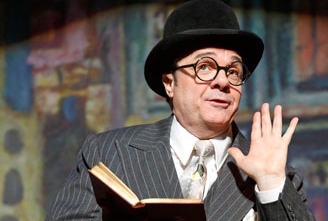
Nathan Lane commands the stage in his latest tour de force performance, as the title character in Douglas Carter Beane's The Nance.
 
After several forays into the world of musical theatre bookwriting, Douglas Carter Beane returns to his roots as a serio-comedic playwright with The Nance, his latest Broadway venture that is recently finished up its run at the Lyceum Theatre (and will be recorded for broadcast on PBS).  And while the play is certainly a more accomplished work than any of his musical outings, it remains a frustratingly conflicted piece that attempts a variety of things without fully succeeding at any of them.  The play wants to be a probing character study but fails to really explore the motivations of its protagonist.  It wants to make an admittedly topical political statement but ends up feeling preachy and pedantic rather than relevant and illuminating.  It wants to be both a serious drama and a low-brow comedy, but rather than complimenting one another each of these disparate elements continually undercuts the effectiveness of the other.

But at the play’s center is a Herculean performance so electric, so accomplished in its specificity and authenticity that it almost succeeds in elevating the play to the lofty realms which it so obviously aspires to.  Nathan Lane’s work as protagonist Chauncey Mills is nothing short of extraordinary, reasserting his status as one of the most accomplished stage actors of his generation.  With no disrespect meant to his very talented costars, Lane acts circles around everyone else onstage, and actually manages to make the play’s disparate tones seem organic and even necessary. 

The plot centers on Lane’s Chauncey Mills character, a man who has made a name for himself doing burlesque skits in Depression Era New York City.  Mills’ signature role is that of the overtly effeminate stock character dubbed “The Nance,” a professional choice made infinitely more complex by the fact that Mills is himself gay.  After years of anonymous sex with strangers, Mills seduces a young man named Ned who is just coming to grips with his own sexuality, and to the surprise of both men they find themselves entering a long-term relationship together.  Meanwhile, Mills’ burlesque theatre and his act in particular are coming under increasing pressure from city officials taking a stance against indecency, forcing the outspoken Mills to make a choice between being himself and suppressing his true nature to fit in.

It cannot be overstated how brilliant Nathan Lane is in the central role. From the opening moments of the show until the final curtain, Lane dominates the stage and exhibits such mastery of his craft that even his accomplished costars look like amateurs in comparison.  The play gives him ample opportunity to demonstrate his dramatic chops, while simultaneously providing him with an unending string of zingers and comic bits that utilize his unparalleled sense of comedic timing.  Throughout the play we are treated to excerpts from Mills’ stage act, and Lane absolutely kills in these scenes of perfectly reconstructed vaudeville comedy.  Where a normal actor would earn one laugh Lane manages to get three, often by using little more than a cock of the eyebrow or a sideways glance at the audience.  More miraculous still is Lane’s ability to make such carefully calculated choices feel utterly spontaneous, leaving the audience with the impression that this virtuosic performance is being created from scratch each night.

And while none of his costars are operating on Lane’s level (there are few actors in the world that could match such inspired lunacy), the rest of the cast turns in fine performances in their own right.  In his Broadway debut, Jonny Orsini charts a beautifully realized journey of self-acceptance as Mills’ lover Ned, and watching him realize that his sexuality doesn’t automatically prevent him from enjoying the perks of a domesticated life is particularly poignant in this time when marriage equality is on the forefront of the national debate.  If there is one criticism of Orsini’s performance it’s that he plays the character rather dumb, which at times comes into direct conflict with the highly literate dialogue playwright Beane has provided all of the characters.

Lewis J. Stadlen plays the lovably gruff Efram with aplomb, and makes an excellent foil for Lane during the burlesque skits that are the show’s highlight.  In a lesser actor’s hands Efram’s discomfort with Mills’ sexuality would make him the clear villain of the piece, but Stadlen tempers his performance with enough begrudging respect to make it clear that Efram isn’t a bad person.  As the trio of burlesque dancers that work at the same theatre, Cady Huffman, Jenni Barber and Andrea Burns make for excellent support, although the writing doesn’t do enough to differentiate their three characters.  Huffman (reunited with Lane after they both won Tonys for The Producers a decade ago) makes the strongest impression, although she is unfortunately saddled with the most overtly political and unnecessarily knowing dialogue.

Director Jack O’Brien keeps the evening moving at a steady pace, and during the show’s final twenty minutes manages to synthesize the disparate bits and repeating motifs into something resembling resonance.  He is aided immensely by John Lee Beaty’s marvel of a rotating set, which allows for virtually seamless transitions from one locale to the next.  Ann Roth clearly had a ball with the period costumes, and her designs for the burlesque outfits in particular possess just the right amount of winking outlandishness.  The lights and sound by Japhy Weideman and Leon Rothenberg get the job done but aren’t particularly memorable, and the original music by Glen Kelly is a nice if unassuming addition to the proceedings.

Ultimately, The Nance’s primary reason for being is to provide Nathan Lane with a showcase for his immense talents, and in that respect it succeeds wholeheartedly.  The comedic genius’ work manages to elevate Douglas Carter Beane’s passable script into something approaching greatness, and everyone involved has graciously taken a backseat while letting the master work his magic.  It is a worthwhile evening for those who are interested, although I do hope that Lane’s next Broadway outing is in a vehicle more worthy of his extraordinary gifts.