Showing posts with label alex timbers. Show all posts

Friday, March 14, 2014

He Could Have Been a Contender

Review: Rocky

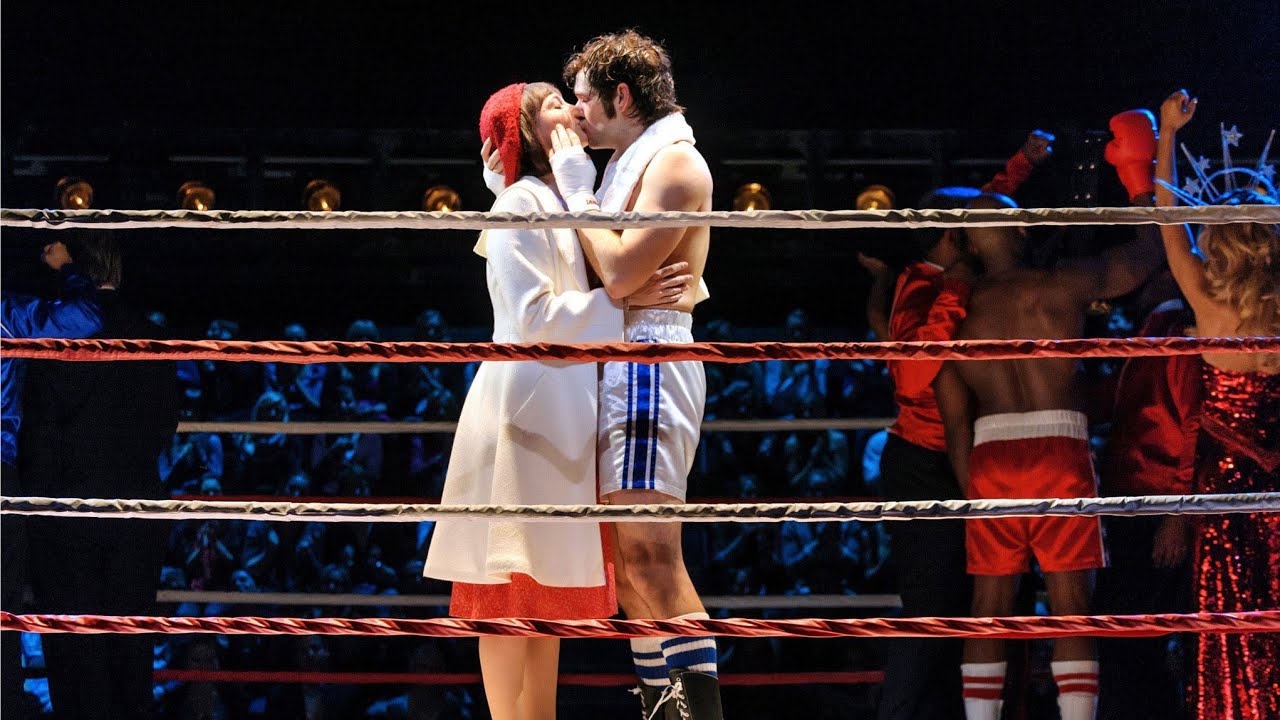
Let's try not to think about how disgusting and bloody Rocky's face must be right now.

The main message of Rocky the Film is that simply seeing something through to completion, despite whatever obstacles you may face, is its own form of winning.  And in that sense, everyone involved with Rocky the Musical should consider themselves huge winners, since the project has been met with huge amounts of skepticism since it was first announced.  Unfortunately, this interesting mess of a stage show fails to really go the distance, and was probably better off remaining an Oscar-winning film.

Rocky follows the titular down and out fighter from Philadelphia as he trains to take on undefeated heavyweight champion Apollo Creed in the "fight of the century."  Or at least, that's the plot of the second act; the first is almost entirely focused on the budding romance between Rocky and unassuming shop girl Adrian, and that narrative disassociation proves to be one of the show's biggest flaws.  Bookwriters Thomas Meehan and Sylvester Stallone (who also wrote and starred in the film version) can't seem to decide if the show's focus should be on the love story or the underdog sports story, and rather than interweaving the two plots they've awkwardly segregated them, to the detriment of both. 

The first act has some beautiful, nuanced scenes between Rocky and Adrian that really take the time to believably develop their relationship, only to have the pair suddenly jump to being a committed, happy couple in the second act so the show can focus on Rocky's preparation for the big fight.  The transition is jarring, and the lack of boxing elements in the first act means the second is starting from square one in terms of stakes and audience engagement.  Anyone who was interested in Rocky and Adrian's evolving relationship has to subside on what they were shown in the first half, because it's barely even mentioned in Act II.

Meehan and Stallone also don't seem to know what to do with the various supporting characters, who are either underdeveloped, serve no real narrative purpose, or both.  Adrian's brother Paulie is introduced as a nice guy who initially brings Rocky and Adrian together, only to suddenly morph into an insufferable alcoholic who all the characters despise but tolerate for unknown reasons.  The show goes to great lengths to establish the resentment Rocky harbors against unsupportive gym owner Mickey, but immediately after a particularly intense confrontation Rocky takes him on as a coach, despite have told him mere seconds before to get lost.  The book does little to illustrate what motivates such massive shifts in attitude, and most of it feels like manufactured conflict because the show's real antagonist, Apollo Creed, barely interacts with anyone until the final fight.

Meanwhile, the score by Stephen Flaherty and Lynn Ahrens can at best be called unmemorable, and in all honesty probably merits harsher adjectives.  This is particularly disappointing as Flaherty and Ahrens among the greatest songwriting duos in the history of the musical theatre, easily the equal of Kander and Ebb or Rodgers and Hammerstein, and together they have written some of the greatest scores of the past 30 years.  Rocky is nowhere near their previous highs, barring the exception of the gorgeous Act I ballad "Raining" which serves as our first real introduction to Adrian.  The songs feel disconnected from the story; they work on their own as bits of musical storytelling, but are awkwardly inserted into book scenes that do nothing to set them up or build on what they establish.  They are also almost entirely forgettable, and are completely upstaged by the inclusion of "Eye of the Tiger" two thirds of the way through (a song which is technically from Rocky III, but who's keeping track?).

The performances in Rocky are generally solid, although it is often uncomfortable to watch the actors struggle through such questionable material.  Andy Karl makes for a fine Rocky, tipping his hat to Sylvester Stallone's performance and mannerisms while still maintaining an air of authenticity.  Karl also has excellent chemistry with the Adrian of Broadway newcomer Margo Seibert, whose beautiful alto has the privilege of singing the score's best songs.  Together Karl and Seibert create the evening's most fully realized characters, and it's a shame the second act shifts focus away from their interactions.  Danny Mastrogiorgio sells every scene he's in as Paulie, even if the writing does little to provide a cohesive throughline for his actions.  The only weak link in the cast is Terence Archie's Apollo Creed, who looks the part but comes across as a borderline offensive caricature of African-American stereotypes (a problem made all the more shocking when one considers that Flaherty and Ahrens are responsible for Ragtime, one of the greatest gifts ever given to singing actors of color).

The staging by rising director Alex Timbers (which is intrinsically tied to Christopher Barreca's Rubik's cube of a set) is a mixed bag, simultaneously impressive and underwhelming.  The smaller, character focused first act is overwhelmed by the massive, constantly moving set, while the larger, more spectacle-oriented second half isn't visually interesting enough to overcome the weakness of the storytelling.  Rocky feels like a small-scale show that has been unsuccessfully blown up in order to fill the massive Winter Garden Theatre, and while watching Barreca's set reconfigure itself into various settings is impressive it is not emotionally involving.  The one genuinely thrilling sequence is the fourth wall-breaking final fight, which moves the action out into the audience and is unlike anything seen on a Broadway stage.  This electrifying set piece goes a long way towards making you forget about the shortcomings of the previous two hours, and if one thing can be said about Rocky, it's that the show ends on its highest note.

Overall, Rocky is a noble but misguided effort that doesn't really have a discernible target audience.  The book and score aren't sophisticated enough for high minded audiences, nor are they entertaining enough for those who just want to have a good time.  The size and spectacle of the physical production overwhelms the intimate love story the writers are trying to tell, without being impressive enough to hold our attention on its own.  Rocky was never a property that begged for musicalization, and the unwieldy show that has resulted confirms it would have been better served by remaining an iconic film.  The show isn't quite awful enough to be a career killer for anyone involved (all of whom are established talents to begin with), but it also won't be high on the list of their greatest achievements.  Like Rocky himself, let's give everyone involved credit for trying and move on with our lives.

Sunday, August 18, 2013

Shakespeare Sings, and It's (Mostly) Beautiful Music


Review:  Love’s Labour’s Lost
It's Shakespeare, but it's fun!  See?  His bowtie is untied and everything!
 
The Public Theatre’s annual Shakespeare in the Park program was started with a very simple mission: to provide free Shakespeare to the entirety of New York City, not just those able to afford the increasingly high price of theatre tickets.  Over the years this mission has expanded to include revivals of other classic playwrights and even the occasional musical, with multiple productions eventually transferring to healthy and critically acclaimed runs on Broadway.  This year the Public is using the program to launch an original musical for only the third time in its history, reuniting the creative team of the Tony-nominated Bloody Bloody Andrew Jackson for a reimagining of the Bard’s early comedy Love’s Labour’s Lost.  And while the Public is clearly hoping that the show follows in the footsteps of Two Gentlemen of Verona and The Mystery of Edwin Drood, shows that transferred to Broadway and won Best Musical, this slickly produced new work is in need of at least one major round of rewrites before being ready for the big leagues.

For those unfamiliar with Shakespeare’s original play (and I must confess that I was not), the plot concerns the King of Navarre and three of his noble friends forswearing women and other earthly delights in order to devote themselves to study and personal betterment.  This vow is immediately tested by the arrival of the Princess of France and her entourage, who have come on behalf of her father to discuss some financial matters.  In an attempt to keep his vow the King insists the women camp outside his house rather than enter it, but the noblemen and women soon fall desperately in love.  There is also a subplot involving a Spanish lothario named Armado who is attempting to woo a tavern wench named Jaquenetta, and several other periphery characters that seem to be given a disproportionately large amount of stage time in comparison to their almost complete irrelevance to the plot.

Since I have neither seen nor read the original Shakespeare play, I cannot tell if this production’s narrative problems stem from the original text or from bookwriter/director Alex Timbers’ adaptation of it.  But the problems are definitely there, with multiple characters feeling underwritten and besieged by inconsistent motivations.  The show’s resolution also isn’t nearly as tidy as the almost painfully thorough denouements Shakespeare is known for, although the bizarre tonal shift at the play’s end does stem from the source material.  Timbers would have been better served by cutting several nonessential characters and subplots during his condensation of the show’s narrative, which would have allowed him more time to explore the principle characters and sharpen the thematic parallels between the love story of the nobles and the Armado/Jaquenetta subplot.

On the positive side, Timbers’ reimagining of the characters and setting is often ingenious.  He has reset the show in the present day and recast the noblemen and women as Ivy League college grads.  The men’s vow to devote themselves to further study calls to mind the decision many young people make to enter grad school rather than confront the harsh realities of adult life that their education and upbringing has done so little to prepare them for.  It is a crisis that will be especially familiar to the Millennials in the audience, and makes the play double as a funhouse commentary on the very real challenges facing today’s young adults. 

Timbers also does an excellent job of blending the contemporary jargon found in Michael Friedman’s lyrics with the Shakespearean dialogue used in the book scenes, and does a much better job of integrating Friedman’s rock-influenced score into the show’s structure than the pair managed in Bloody Bloody Andrew Jackson, whose music often felt like an afterthought.  The score is also much more accomplished than the bare bones affair Friedman created for Bloody Bloody, although the composer still doesn’t have a firm grasp on how to use reprises and often struggles to find appropriate buttons for his sometimes truncated songs.

The slickness of Timbers’ and Friedman’s writing is matched by the outstanding production design.  John Lee Beaty’s unit set is one of the most visually interesting constructions the prolific designer has created for the Delacorte stage, and is perfectly complimented by Jennifer Moeller’s spectacular modern dress costumes.  Jeff Croiter beautifully lights all of the onstage shenanigans, with designs ranging from naturalistic mood lighting to rock concert razzle dazzle with a pit stop into the world of Eastern European performance art strobe lights.  (And while we’re on the subject, the deliciously non-sequitur performance art set piece is easily the highlight of the evening, and one of the most side-splittingly funny moments of the year.)

It is unfortunate that the performances don’t achieve the same uniform cohesion as the physical production.  Some of the actors do great work and some struggle unsuccessfully to make their characters pop, which only serves to highlight the show’s less successful moments.  In general, the women make a greater impression than the men, with Patti Murin’s indignant valley girl Princess emerging as the most consistently engaging performance of the evening.  Murin possesses excellent comic timing and a fine voice, while bringing a depth to the role that almost sells the heavy-handed ending the show is saddled with.  Rebecca Naomi Jones’ Jaquenetta has been gifted with the show’s best song, the smoldering rock ballad “Love’s a Gun,” and she knocks it out of the part.  But most importantly, the women display a genuine camaraderie and sense of teamwork that is sorely lacking among the men.

Colin Donnell comes across the better than the rest of his male costars as Berowne, the most conflicted of the four nobles, but Donnell’s role is more fully developed than most and even at his best he rarely rises above passable.  Daniel Breaker’s King has his moments, although his characterization also feels unintentionally separate from the rest of the noblemen.  Caesar Samayoa plays Armado as a dim puppy dog who is far too eager to please, and his cloyingly indulgent performance will repeatedly test the audience’s patience.  It is disappointing that such a high profile production ended up with such an uneven cast, and there are times where it’s obvious the dubious performances are holding the material back from the greatness it is pursuing.

Despite its many flaws, there is definitely potential in this material.  The writing shows flashes of brilliance and invention without disrespecting its source material, and the rock score is generally pleasing to the ear even if it isn’t particularly memorable.  Unlike too many new musicals, Lost never feels like it’s overstaying its welcome, and the intermissionless two hours is just about the perfect amount of time for it to tell it’s simple but engaging story.  It is often beautiful to look at, with the direction complimenting the design work perfectly.  If the cast doesn’t always reach the level one would hope for, there are certainly more good performances than bad, and several of the young leads are clearly on the cusp of the next level of stardom.  The show isn’t quite strong enough to merit a transfer, so anyone who is interested should hurry out and catch it before it disappears into the balmy summer night.

Saturday, June 30, 2012

Peter and the Overly Ambitious Creative Team


Review:  Peter and the Starcatcher

It’s difficult to know what to make of Peter and the Starcatcher, the stage adaptation of the 2004 children’s novel which serves as a Peter Pan prequel.  There is a bevy of talent on display, both onstage and behind the scenes, and the almost endlessly inventive production flies by at such a brisk pace that only the most impatient theatregoers will be bored.  Yet Peter also contains some maddeningly large missteps that are all the more intolerable because of the quality that surrounds them.

The plot is a rousing adventure in which Lord Astor and his daughter Molly attempt to smuggle a chest full of secret treasure out of England at the behest of Queen Victoria.  Unfortunately, their clever plan involving a decoy ship and fake treasure runs into complications when a greedy captain decides he would rather have the treasure for himself.  To make matters worse, a group of pirates led by the maniacal Black Stache simultaneously attack the convoy, and on top of all THAT, Molly discovers a group of orphans about to be sold into slavery, among them an unnamed Boy with a strong dislike of grown-ups (three guesses as to who he becomes).

If all that sounds complicated, it is, and the fact that Peter and the Starcatcher remains coherent throughout is a testament to Rick Elice’s script and the sharp direction by Roger Rees and Alex Timbers.  Despite appearing to be a children’s play, Peter never talks down to its audience, and includes something for people of all ages.  For the kids, there is plenty of physical comedy and even the occasional fart joke, while copious amounts of wordplay and some clever innuendo will keep the adults in the audience interested as well.  The story is so interesting that it’s almost a shame it must tie into the preexisting Peter Pan mythos, as the play’s resolution forgoes a satisfying finale in favor of setting up Peter’s coming adventure with Wendy.

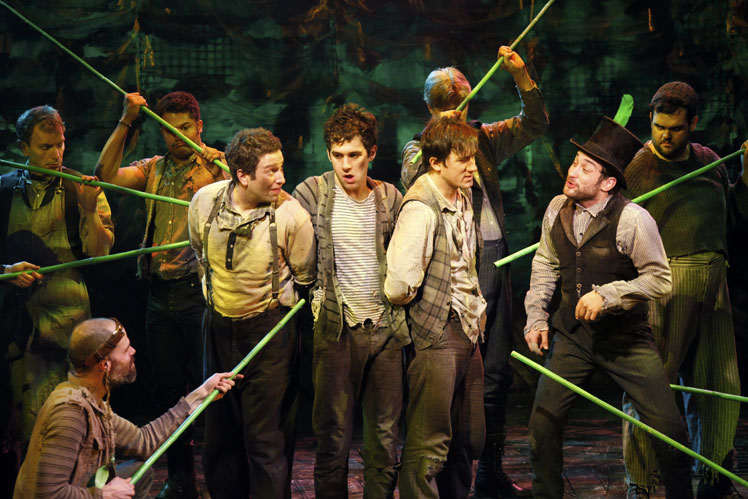
Despite a strong cast (more on them in a bit), Rees and Timbers’ direction and the astounding design work are the real stars here.  The most complicated piece of machinery used is a rolling staircase; almost every you see could be found or easily manufactured by an amateur theatre troupe.  Rees and Timbers use basic items like ropes, umbrellas, and toy ships to communicate cramped holding cells, tropical rainstorms, great naval battles, flying cats and even that famed giant crocodile.  Donyale Werle’s simple set design proves endlessly adaptable, and is lit to perfection by Jeff Croiter’s gorgeous lights.  Paloma Young’s costumes give each character an identity while remaining basic enough to allow the actors to easily transition between characters, and her mermaid outfits alone justify her recent Tony win. 

In fact, there is so much theatrical invention on display that it can become distracting.  Everyone involved is so concerned with proving their creativity that the physical production often takes precedent over the story.  Entire swaths are dialogue are rendered incomprehensible due to the onstage hubbub of actors moving props, miming scenery, and creating constantly changing stage pictures.  All of this visual information is generally clear enough to prevent confusion, but it would have been nice to see these supremely talented folk put more faith in Elice’s sterling script and strike a better balance between the visual and auditory.

As for the actors, they fully commit to their roles and each other, forming a tight-knit ensemble willing to do anything to support their fellow performers.  They allow themselves to be used as set dressing, props, and even furniture, while still creating distinct and even compelling characters.  And if those characters tend towards broadly drawn outlines rather than fully realized individuals, it’s hard to fault the actors for lack of trying.

As the strong-willed but good-hearted Molly, Celia Keenan-Bolger emerges as the production’s heart and soul, anchoring the zaniness of her male co-stars with her no-nonsense yet still hilarious performance.  Arnie Burton is equally charming as Molly’s nanny Mrs. Bumbrake, and Rick Holmes proves to be an excellent authority figure as Lord Astor.  Teddy Bergman spends most of the first act playing supporting roles, but his second act romp as island native Fighting Prawn is so memorable that his contributions to the show prove essential.  Adam Chanler-Berat does seems a little lost at sea as the Boy who becomes Peter Pan, although the script doesn’t do him any favors by keeping Peter passive and uninvolved for a good portion of the show.

And then there’s newly minted Tony-winner Christian Borle as Black Stache (re: Captain Hook).  I certainly can see why he won, and wouldn’t want to advocate taking the award and accompanying recognition from an actor who has been so consistently strong in such different kinds of roles over the years.  But at the performance I saw, Borle’s hamminess and scenery chewing repeatedly crossed the line from entertaining to distracting, throwing the focus of the piece and onstage energy completely out of whack.  It was almost impossible to concentrate on the actual story while he was gallivanting about the stage, and yet I’m not sure any actor would have been able to resist the urge to mug given the over-the-top applause that met any bit of comic business he even attempted.  At one point this was clearly a brilliant performance; unfortunately, it has now grown so broad that it hurts the show as much as it helps it.

There is much to admire about Peter and the Starcatcher, including the commitment of the actors and the unbridled imagination of the creative team.  But sometimes less is more, a truism the play seems to both understand and simultaneously ignore with its shunning of high-tech stagecraft for an overabundance of low-tech alternatives.  A great story gets lost among the frenzy of creativity on display, and after the platitudes given to the show by the rest of the theatrical community, I really was hoping for something better.  As long as expectations are kept in check, Peter and the Starcatcher makes for an fine evening of theatre, especially for those who are young or simply young at heart.