 |
| Let's try not to think about how disgusting and bloody Rocky's face must be right now. |
The main message of Rocky the Film is that simply seeing something through to completion, despite whatever obstacles you may face, is its own form of winning. And in that sense, everyone involved with Rocky the Musical should consider themselves huge winners, since the project has been met with huge amounts of skepticism since it was first announced. Unfortunately, this interesting mess of a stage show fails to really go the distance, and was probably better off remaining an Oscar-winning film.
Rocky follows the titular down and out fighter from Philadelphia as he trains to take on undefeated heavyweight champion Apollo Creed in the "fight of the century." Or at least, that's the plot of the second act; the first is almost entirely focused on the budding romance between Rocky and unassuming shop girl Adrian, and that narrative disassociation proves to be one of the show's biggest flaws. Bookwriters Thomas Meehan and Sylvester Stallone (who also wrote and starred in the film version) can't seem to decide if the show's focus should be on the love story or the underdog sports story, and rather than interweaving the two plots they've awkwardly segregated them, to the detriment of both.
The first act has some beautiful, nuanced scenes between Rocky and Adrian that really take the time to believably develop their relationship, only to have the pair suddenly jump to being a committed, happy couple in the second act so the show can focus on Rocky's preparation for the big fight. The transition is jarring, and the lack of boxing elements in the first act means the second is starting from square one in terms of stakes and audience engagement. Anyone who was interested in Rocky and Adrian's evolving relationship has to subside on what they were shown in the first half, because it's barely even mentioned in Act II.
Meehan and Stallone also don't seem to know what to do with the various supporting characters, who are either underdeveloped, serve no real narrative purpose, or both. Adrian's brother Paulie is introduced as a nice guy who initially brings Rocky and Adrian together, only to suddenly morph into an insufferable alcoholic who all the characters despise but tolerate for unknown reasons. The show goes to great lengths to establish the resentment Rocky harbors against unsupportive gym owner Mickey, but immediately after a particularly intense confrontation Rocky takes him on as a coach, despite have told him mere seconds before to get lost. The book does little to illustrate what motivates such massive shifts in attitude, and most of it feels like manufactured conflict because the show's real antagonist, Apollo Creed, barely interacts with anyone until the final fight.
Meanwhile, the score by Stephen Flaherty and Lynn Ahrens can at best be called unmemorable, and in all honesty probably merits harsher adjectives. This is particularly disappointing as Flaherty and Ahrens among the greatest songwriting duos in the history of the musical theatre, easily the equal of Kander and Ebb or Rodgers and Hammerstein, and together they have written some of the greatest scores of the past 30 years. Rocky is nowhere near their previous highs, barring the exception of the gorgeous Act I ballad "Raining" which serves as our first real introduction to Adrian. The songs feel disconnected from the story; they work on their own as bits of musical storytelling, but are awkwardly inserted into book scenes that do nothing to set them up or build on what they establish. They are also almost entirely forgettable, and are completely upstaged by the inclusion of "Eye of the Tiger" two thirds of the way through (a song which is technically from Rocky III, but who's keeping track?).
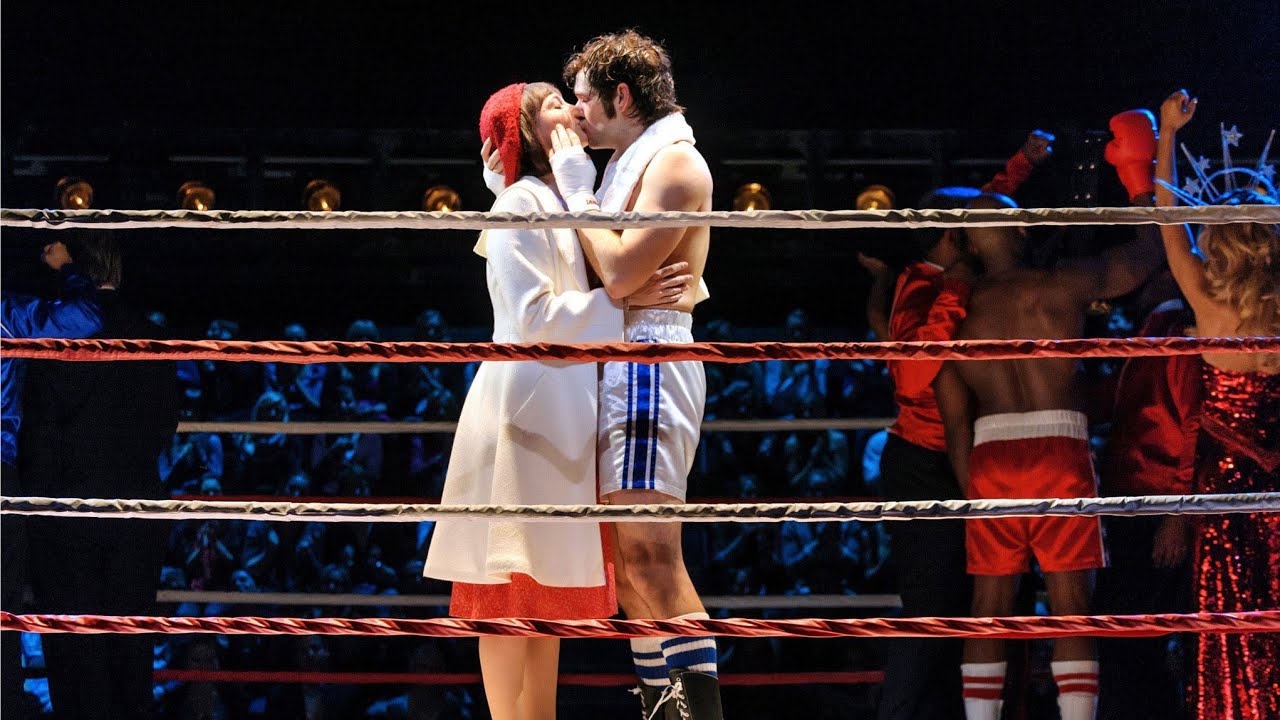
The performances in Rocky are generally solid, although it is often uncomfortable to watch the actors struggle through such questionable material. Andy Karl makes for a fine Rocky, tipping his hat to Sylvester Stallone's performance and mannerisms while still maintaining an air of authenticity. Karl also has excellent chemistry with the Adrian of Broadway newcomer Margo Seibert, whose beautiful alto has the privilege of singing the score's best songs. Together Karl and Seibert create the evening's most fully realized characters, and it's a shame the second act shifts focus away from their interactions. Danny Mastrogiorgio sells every scene he's in as Paulie, even if the writing does little to provide a cohesive throughline for his actions. The only weak link in the cast is Terence Archie's Apollo Creed, who looks the part but comes across as a borderline offensive caricature of African-American stereotypes (a problem made all the more shocking when one considers that Flaherty and Ahrens are responsible for Ragtime, one of the greatest gifts ever given to singing actors of color).
The staging by rising director Alex Timbers (which is intrinsically tied to Christopher Barreca's Rubik's cube of a set) is a mixed bag, simultaneously impressive and underwhelming. The smaller, character focused first act is overwhelmed by the massive, constantly moving set, while the larger, more spectacle-oriented second half isn't visually interesting enough to overcome the weakness of the storytelling. Rocky feels like a small-scale show that has been unsuccessfully blown up in order to fill the massive Winter Garden Theatre, and while watching Barreca's set reconfigure itself into various settings is impressive it is not emotionally involving. The one genuinely thrilling sequence is the fourth wall-breaking final fight, which moves the action out into the audience and is unlike anything seen on a Broadway stage. This electrifying set piece goes a long way towards making you forget about the shortcomings of the previous two hours, and if one thing can be said about Rocky, it's that the show ends on its highest note.
Overall, Rocky is a noble but misguided effort that doesn't really have a discernible target audience. The book and score aren't sophisticated enough for high minded audiences, nor are they entertaining enough for those who just want to have a good time. The size and spectacle of the physical production overwhelms the intimate love story the writers are trying to tell, without being impressive enough to hold our attention on its own. Rocky was never a property that begged for musicalization, and the unwieldy show that has resulted confirms it would have been better served by remaining an iconic film. The show isn't quite awful enough to be a career killer for anyone involved (all of whom are established talents to begin with), but it also won't be high on the list of their greatest achievements. Like Rocky himself, let's give everyone involved credit for trying and move on with our lives.

