Showing posts with label lincoln center. Show all posts

Thursday, April 26, 2018

By George, They've Got It!

Review: My Fair Lady


Harry Hadden-Paton, Lauren Ambrose, and Allan Corduner in Lincoln Center's lavish My Fair Lady.

Lerner and Loewe's My Fair Lady has quite the conflicting reputation. On one hand, this musical adaptation of George Bernard Shaw's Pygmalion is almost universally agreed to be an expertly constructed Golden Age book musical, overflowing with Loewe's beautiful music and possessing an exceedingly sharp, emotionally complex book by Lerner. But with each passing year, more and more people have rightly expressed discomfort with the way the show treats its protagonist Eliza Doolittle, who many feel is made over against her will to suit the ideals of misogynistic language professor Henry Higgins. Is it even possible to stage the show in a way that honors its original intent without alienating modern audiences who are increasingly aware of the mistreatment women have endured throughout history?

The answer is a resounding "yes" thanks to the brilliant direction of Bartlett Sher, who seemingly specializes in mounting supposedly dated classics to feel as timely and relevant as the day they first premiered (see his Tony-winning revivals of South Pacific and The King & I, also for Lincoln Center). Sher has largely solved My Fair Lady's perceived problems with an approach so straightforward it feels revolutionary: he has ignored the way the show is "traditionally" performed and refocused on the text, revealing it to be much more thoughtful and equitable than originally thought. The often thrilling, always fascinating result is a triumphant production that firmly refocuses the show on Eliza and makes her a much more active participant in her own narrative without changing a single line of dialogue.

The script has always had Eliza show up at Higgins' residence asking for elocution lessons, but Sher's production is one of the first to fully emphasize that she chooses to do so without being forced. Higgins has always explicitly stated the difficulty in what Eliza is attempting, and praised her for the speed at which she picks it up, but for the first time it all feels like genuine praise rather than insincere small talk. Eliza has always called Higgins on his appalling behavior, but this is the first time it hasn't felt like she's taken her critique back by the end of the show. The only thing one can argue Sher actually changed is the show's final tableau, but again, he hasn't changed a word, and his version of the ending feels much truer to the spirit of the piece than what has traditionally been done.

To achieve such a subtle but substantial reinterpretation of the text, Sher needed actors of the highest caliber, and he has found them in this top notch cast. Lauren Ambrose provides perhaps the best acted version of Eliza to date, up to and including Audrey Hepburn's beloved performance in the film. Ambrose sparkles with intelligence and strength from the very beginning, making it clear Eliza's cockney accent by no means indicates stupidity. Her expressive face and eyes radiate warmth while conveying volumes about her complex inner life, making it difficult to take your eyes off her. Whether Ambrose is relishing the small victories Eliza finds during her arduous dictation lessons, reevaluating and adjusting her behavior during her hysterical public debut as a lady, or visibly rallying herself prior to the embassy ball, she will have you utterly captivated. It is a testament to Ambrose's sheer magnetism that even when Higgins and his servants are gallivanting about the stage during "You Did It," the audience's eyes remain fixed on Eliza in the corner, as Ambrose charts her growing disgust with her situation.

Vocally, Ambrose is not as assured a singer as someone like Julie Andrews (Broadway's original Eliza) or Marni Nixon (who dubbed Hepburn's vocals in the film). She has some lovely moments and never comes close to sounding outright bad, rather just suffers a *tad* in comparison to some of the most accomplished sopranos in musical theatre history. And Ambrose's acting is so sensational that its difficult to hold any perceived vocal shortcomings against her, as its hard to imagine a more trained singer acting the role better. Ambrose's performance is that good.

Ambrose is excellently matched by Harry Hadden-Paton making an absolutely thrilling Broadway debut in a role virtually synonymous with Rex Harrison (who won both the Tony and the Oscar for his Higgins). It must be noted that casting Higgins as closer in age to Eliza goes a long way towards putting the characters on more equal footing, but the rest of the gap is closed by Hadden-Paton as perhaps the most compassionate Higgins in history. That's not to say the tart tongued linguist has lost any of his bite; Hadden-Paton can unleash a stream of insults with the best of them, with a natural charisma and intelligence that will have you laughing so hard you almost forget how thoroughly he's eviscerated his target. But this Higgins actually does care for Eliza, and Hadden-Paton makes it clear that for all his bluster he is genuinely horrified by the idea that he may have unknowingly mistreated her. You won't necessarily like this Higgins, but you will have far more understanding of him and his childish outbursts than you've likely ever had, all thanks to Hadden-Paton's excellent scene work.

The supporting cast is every bit as enchanting as the leads. Allan Corduner is outstanding as Colonel Pickering, an excellent foil for Hadden-Paton and a fascinating actor in his own right. Dame Diana Rigg makes the most of her relatively small role as Mrs. Higgins (Henry's mother), effortlessly cutting her misbehaving son down to size with little more than a look and a quick word. Jordan Donica offers up a beautiful sung, endearingly goofy Freddy, forever smitten with Eliza and waiting for her "On the Street Where You Live." And two-time Tony-winner Norbert Leo Butz takes the primarily comic role of Alfred P. Doolittle, Eliza's father, and turns him into one of the most fully realized humans in the entire piece. The fact that he also leads the sensational chorus of 25 in a showstopping rendition of "Get Me to the Church on Time" is just an added bonus.

At this point, it is practically a given that Lincoln Center's revivals of these Golden Age classics will be visually sumptuous affairs, and My Fair Lady continues that proud tradition. Catherine Zuber's costumes continually astound, especially her lavender-tinted finery for the "Ascot Gavotte" and her breathtaking version of Eliza's iconic hat. Michael Yeargan's scenic design for Higgins' study is impressively grand on its own, but when the house begins to revolve and expose the residence's other rooms you may just let out a gasp of delight. Everything is beautifully lit by Donald Holder, and Marc Salzberg's sound design ensures you can hear every wonderful note of the score played by the massive orchestra under the baton of Ted Sperling. Describing the physical production as lavish almost feels like an understatement.

In the end, you'd be hard pressed to find much to fault in this production of My Fair Lady. Impeccably acted and gorgeously staged, it feels as fresh and relevant as the day the show first premiered, if not more so. Higgins is still undeniably a misogynist, but he no longer has tyrannical control over Eliza, and she has far more agency in her own story than one might expect. Popular opinion will ultimately decide if the show is too unsavory for modern audiences, but Sher and company have made a compelling argument for this classic to maintain its status as one of the crown jewels of the musical theatre cannon. Its examination of class and gender politics has plenty to teach us even today, all while entertaining us with one of the most glorious scores of the Golden Age.

Friday, August 14, 2015

This Diva Needs Her Stage, Small Though It May Be

Review: Shows for Days

Caught with his cell phone out during the show, Michael Urie is forced to hide from Patti LuPone's wrath.

Douglas Carter Beane must be quite the charmer. Despite a tenuous grasp of cohesive storytelling technique, the playwright and musical librettist not only continually convinces producers to mount his often undercooked shows, but he also manages to attract some of the industry's top talent to perform it. Beane's last play The Nance starred no less than the great Nathan Lane, and his latest work Shows for Days has the distinction of featuring two-time Tony-winner Patti LuPone in one of the central roles. LuPone does heroic work in a play that doesn't really merit her many talents, even if individual scenes in the piece prove to be side-splittingly hilarious.

This semi-autobiographical comedy about Beane's early days in the theatre follows Car, the idealized author stand-in who stumbles across a small community theatre troupe in Reading, Pennsylvania during the summer of 1973. Initially volunteering as a set painter to kill time, 14-year-old Car finds himself entranced by the allure of this tight-knit group of misfits led by the firebrand producer/director/actress Irene. Irene dreams of a permanent, legitimate theatre company to rival any of the town's established troupes, using her outsized personality to cajole, convince, or outright threaten the city into supporting her cause with funds and free performance space. Car soon becomes a valuable member of the group, eventually commissioned to write their first original play all while trying to find an escape from the small town life that has left him feeling trapped.

John Lee Beatty's set cleverly mimics the organized chaos of any low-budget performance space, with colored tape indicating the outlines of the play's many different settings (this will be instantly familiar to anyone who has ever set foot inside a rehearsal studio). Beane and director Jerry Zaks also use the charming conceit of Car literally setting the stage as he narrates his life, moving chairs, tables, and other pieces of furniture to their various locations as the action shifts from place to place. It all evokes a warm nostalgia for the simplicity of small scale theatre, and reminds you of the magic that can be achieved by a group of actors fully committed to doing their best with whatever is onhand.

Unfortunately, Beane's script is the opposite of simple, so overstuffed with sitcom-style zingers that the intricacies of the plot get lost amid the quest for laughs. While portions of the script are admittedly very funny, all of playwright's dialogue smacks of a need to demonstrate the breadth of his theatrical knowledge and wit. It's acceptable and even admirable to expect your audience to keep pace with your rapid-fire references (Something Rotten is grossing a million dollars a week using precisely that brand of humor), but Beane's writing tries a little too hard to call attention to how clever he's being, with a vague air of judgment should you be unable to keep up. Beane and Zaks also appear uncomfortable with any moment of genuine emotion, bulldozing over the play's more serious beats in a breakneck race towards the next punchline.

As Car, Michael Urie is in no way a convincing teenager (something both the actor and the script acknowledge early on), but he brings an impish, innocent quality to his performance that is innately appealing despite its lack of depth. Urie embodies the play's more negative aspects by shamelessly mugging throughout, even during the few times when Car is required to show some genuine anguish. The actor's undisputable good looks also undermine a key subplot where the object of Car's first crush specifically rejects him for being sexually undesirable, which in a play with so much metahumor registers as a joke until you realize that is actually the root of the pair's relationship issues.

While Urie may be the nominal lead, LuPone is the unquestioned star of the show. Yes, casting the famously temperamental LuPone as an outsized theatrical diva is an obvious choice, but the genius of her performance is she manages to simultaneously surprise while also giving you exactly what you expect. She chews the scenery while delivering many of the play's best lines, highlighting her top notch comic timing in an effortlessly hilarious performance. Yet unlike Urie, LuPone remembers to create a real person underneath Irene's over the top exterior, and when the script presents her with the opportunity to let us see behind that bravura façade she brilliantly capitalizes on it. The few times Irene's shell cracks and we glimpse the wounded woman underneath not only showcase LuPone's versatility, but also ground Irene as recognizably human and someone worth rooting for.

The rest of the cast offers solid support to the two leads, although the script doesn't provide them with much more than broadly drawn outlines. Dale Soules as the lesbian stage manager Sid is the most multi-dimensional, although her more understated moments get lost among the overt hamminess of Urie's mugging. Jordan Dean plays the dumb pretty boy very well, and Zoe Winters is suitably high strung as the needy actress Maria. Understudy Lance Roberts went on in the role of the troupe's gay leading man Clive at the performance I saw, and did a fine job despite the fact that Beane has written him as a caricature rather than an actual human.

Ultimately, Shows for Days proves to be an enjoyable if slightly frustrating experience as LuPone and company struggle to find the right balance between the play's farcical leanings and its brief flirtations with more dramatic material. Playwright Beane's insistence on making almost every line a laugh line proves exhausting for both the cast and the audience, a relentlessness that is only highlighted by Zaks' by the numbers staging. Yet Beane has an obvious and sincere affection for both this period of his life and small-scale theatre in general, lending the play just enough emotional honesty that it cannot be dismissed completely out of hand. Patti LuPone once again proves she is a theatrical force to be reckoned with, and if nothing else, Shows provides its audience with the chance to watch this legendary diva work her magic.

Monday, April 20, 2015

Something Truly Wonderful

Review: The King and I

Ken Watanabe and Kelli O'Hara are exquisitely matched in Bartlett Sher's knockout revival of Rodgers and Hammerstein's The King and I.

There's no such thing as perfection, especially in a subjective artistic medium like the theatre. That said, Lincoln Center's ravishing, radiant, and visually stunning revival of Rodgers and Hammerstein's The King and I is so close to an ideal evening at the theatre that for all intents and purposes it is exactly that. Perhaps even more than the non-profit's critically lauded South Pacific several seasons back, this revival removes all artifice, pretention, and preexisting baggage from a well worn show and reveals it anew as an emotionally complex, culturally relevant and deeply moving piece of musical writing from one of the greatest creative teams to ever live.

Following the pitch perfect overture (played by a 29 piece orchestra under the baton of Ted Sperling), we are whisked away to the beautifully exotic kingdom of Siam circa 1862. On the prow of an incoming ship we meet British schoolteacher Anna Leonowens (a luminous Kelli O'Hara), who has come to this faraway land with her son to educate the King of Siam's many children and wives in the ways of the West. The imposing and often temperamental King (a gleeful Ken Watanabe, in his Broadway debut) has more than a few clashes with the strong-willed Misses Anna as the show turns an intelligent and quizzical eye towards issues of imperialism, gender politics, and the qualifications of a good ruler. There are multiple subplots to round out the evening, but the central relationship of Anna and the King is the musical's primary concern, and it is one of the most richly textured and nuanced in the entire musical theatre cannon.

Despite the show's age, nothing about director Barlett Sher's superlative staging feels dusty or antiquated; indeed, many of Hammerstein's observations about gender politics and race relations remain relevant even today. Sher unearths the many layers in both the book scenes and the songs in such a way that everything feels necessary, and every line, lyric, and piece of incidental musical adds to our overall understanding of the characters and the plot. Unlike many productions of Rodgers and Hammerstein's work, there is nothing precious or twee about this revival, which treats the work with the same seriousness as a great drama without shying away from the piece's inherent humor and charm. And moreso than almost any other director working today, Sher knows how to make excellent use of the cavernous Vivian Beaumont Theatre's thrust stage, creating a neverending series of beautiful stage pictures that seamlessly ensure a good view of the action no matter where you're sitting (Christopher Gattelli's choreography is equally entrancing).

Once again, Sher guides his frequent collaborator Kelli O'Hara to a performance of startling depth and emotional honesty. Rodgers and Hammerstein's score doesn't allow O'Hara to show the full range of her gorgeous soprano, but that doesn't prevent her from sounding absolutely stunning on the score's many standards. When she wraps her golden tones around "Getting to Know You," it's every bit as warm and inviting as you'd hope, and her rendition of "Hello, Young Lovers" is positively captivating. But it's not just O'Hara's nearly unequalled vocal technique that makes her a joy to watch; her thoughtful, textured delivery of the lyrics makes these much sung songs sound like entirely new, spur of the moment thoughts (a quality best showcased during her superlative "Shall I Tell You What I Think of You?" towards the end of the first act). O'Hara makes you believe every syllable of what she's saying, and she imbues every gesture with a multitude of meaning in yet another stellar addition to her ever growing resume.

Her performance is matched every step of the way by an incredibly affecting and genuinely exciting star turn from Ken Watanabe as the King. Watanabe doesn't completely throw out the template created by Tony-winner Yul Brynner, but by the end of the show he has created a take on the commanding monarch that is wholly his own and just as effective. His King exhibits a palpable joy when learning more about his charge and her culture, and both the actor and the character clearly relish their frequent, playful sparring with O'Hara's Anna. Yet the immensely likable Watanabe is also capable of producing an intense anger that strikes fear in his subjects' hearts, a juxtaposition that explains why most of the characters seem both terrified and fiercely protective of their King. Most importantly, Watanabe has excellent chemistry with O'Hara, which pays off in spades during their exhilarating "Shall We Dance?"

The supporting cast is just as capable as the leads, often while being given decidedly less to work with. Ruthie Ann Miles is superb as the King's primary wife Lady Thiang, showing exquisite depth and nuance as she regally slinks across the stage and turning "Something Wonderful" into a legitimate showstopper. As the impetuous Tuptim, a young girl given to the King as a gift despite longing for another, Ashley Park displays beautiful vocal control during her soaring ballads and also grounds the particularly harrowing confrontation between herself and the King during the show's climax. Jake Lucas brings surprising honesty to his performance as Anna's son Louis, and shares a particularly lovely duet with Jon Viktor Corpuz's Prince Chulalongkorn, the King's eldest son and heir.

For the physical production, Lincoln Center and the show's design team have pulled out all the stops, creating one of the most unabashedly gorgeous musicals of the past decade. Michael Yeargan's gasp-inducing set is a continual delight, its rich color palette and thoughtfully detailed scenic units combining to create a world that is at once mystifying and intoxicating. Catherine Zuber's costumes are a show unto themselves, resplendent jewel toned creations that celebrate the musical's Asian setting without feeling tacky or disrespectful. There is a beautiful movement to all of her pieces, but most especially the showstopping dress O'Hara dons during the famous "Shall We Dance" waltz; watching the iridescent purple gown twirl about the massive stage is one of the most stunning and memorable images of the season. And everything is beautifully lit by Donald Holder in bold colors and patterns that make the already expansive set appear even larger than it actually is.

The King and I is must see theatre, the kind of event show that only comes along once in a great while. Everything about this revival sparkles, from Sher's direction to the uniformly fantastic performances to the absolutely breathtaking production design. It is difficult to imagine a more accomplished production of this oft-produced show, and this version is sure to stay with you long after the final ultimo emanates from the Beaumont's orchestra pit. It is something wonderful indeed.

Monday, August 12, 2013

A Triumphant Return for Broadway's Greatest Funnyman


Review:  The Nance
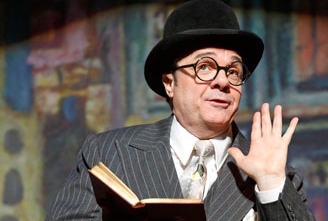
Nathan Lane commands the stage in his latest tour de force performance, as the title character in Douglas Carter Beane's The Nance.
 
After several forays into the world of musical theatre bookwriting, Douglas Carter Beane returns to his roots as a serio-comedic playwright with The Nance, his latest Broadway venture that is recently finished up its run at the Lyceum Theatre (and will be recorded for broadcast on PBS).  And while the play is certainly a more accomplished work than any of his musical outings, it remains a frustratingly conflicted piece that attempts a variety of things without fully succeeding at any of them.  The play wants to be a probing character study but fails to really explore the motivations of its protagonist.  It wants to make an admittedly topical political statement but ends up feeling preachy and pedantic rather than relevant and illuminating.  It wants to be both a serious drama and a low-brow comedy, but rather than complimenting one another each of these disparate elements continually undercuts the effectiveness of the other.

But at the play’s center is a Herculean performance so electric, so accomplished in its specificity and authenticity that it almost succeeds in elevating the play to the lofty realms which it so obviously aspires to.  Nathan Lane’s work as protagonist Chauncey Mills is nothing short of extraordinary, reasserting his status as one of the most accomplished stage actors of his generation.  With no disrespect meant to his very talented costars, Lane acts circles around everyone else onstage, and actually manages to make the play’s disparate tones seem organic and even necessary. 

The plot centers on Lane’s Chauncey Mills character, a man who has made a name for himself doing burlesque skits in Depression Era New York City.  Mills’ signature role is that of the overtly effeminate stock character dubbed “The Nance,” a professional choice made infinitely more complex by the fact that Mills is himself gay.  After years of anonymous sex with strangers, Mills seduces a young man named Ned who is just coming to grips with his own sexuality, and to the surprise of both men they find themselves entering a long-term relationship together.  Meanwhile, Mills’ burlesque theatre and his act in particular are coming under increasing pressure from city officials taking a stance against indecency, forcing the outspoken Mills to make a choice between being himself and suppressing his true nature to fit in.

It cannot be overstated how brilliant Nathan Lane is in the central role. From the opening moments of the show until the final curtain, Lane dominates the stage and exhibits such mastery of his craft that even his accomplished costars look like amateurs in comparison.  The play gives him ample opportunity to demonstrate his dramatic chops, while simultaneously providing him with an unending string of zingers and comic bits that utilize his unparalleled sense of comedic timing.  Throughout the play we are treated to excerpts from Mills’ stage act, and Lane absolutely kills in these scenes of perfectly reconstructed vaudeville comedy.  Where a normal actor would earn one laugh Lane manages to get three, often by using little more than a cock of the eyebrow or a sideways glance at the audience.  More miraculous still is Lane’s ability to make such carefully calculated choices feel utterly spontaneous, leaving the audience with the impression that this virtuosic performance is being created from scratch each night.

And while none of his costars are operating on Lane’s level (there are few actors in the world that could match such inspired lunacy), the rest of the cast turns in fine performances in their own right.  In his Broadway debut, Jonny Orsini charts a beautifully realized journey of self-acceptance as Mills’ lover Ned, and watching him realize that his sexuality doesn’t automatically prevent him from enjoying the perks of a domesticated life is particularly poignant in this time when marriage equality is on the forefront of the national debate.  If there is one criticism of Orsini’s performance it’s that he plays the character rather dumb, which at times comes into direct conflict with the highly literate dialogue playwright Beane has provided all of the characters.

Lewis J. Stadlen plays the lovably gruff Efram with aplomb, and makes an excellent foil for Lane during the burlesque skits that are the show’s highlight.  In a lesser actor’s hands Efram’s discomfort with Mills’ sexuality would make him the clear villain of the piece, but Stadlen tempers his performance with enough begrudging respect to make it clear that Efram isn’t a bad person.  As the trio of burlesque dancers that work at the same theatre, Cady Huffman, Jenni Barber and Andrea Burns make for excellent support, although the writing doesn’t do enough to differentiate their three characters.  Huffman (reunited with Lane after they both won Tonys for The Producers a decade ago) makes the strongest impression, although she is unfortunately saddled with the most overtly political and unnecessarily knowing dialogue.

Director Jack O’Brien keeps the evening moving at a steady pace, and during the show’s final twenty minutes manages to synthesize the disparate bits and repeating motifs into something resembling resonance.  He is aided immensely by John Lee Beaty’s marvel of a rotating set, which allows for virtually seamless transitions from one locale to the next.  Ann Roth clearly had a ball with the period costumes, and her designs for the burlesque outfits in particular possess just the right amount of winking outlandishness.  The lights and sound by Japhy Weideman and Leon Rothenberg get the job done but aren’t particularly memorable, and the original music by Glen Kelly is a nice if unassuming addition to the proceedings.

Ultimately, The Nance’s primary reason for being is to provide Nathan Lane with a showcase for his immense talents, and in that respect it succeeds wholeheartedly.  The comedic genius’ work manages to elevate Douglas Carter Beane’s passable script into something approaching greatness, and everyone involved has graciously taken a backseat while letting the master work his magic.  It is a worthwhile evening for those who are interested, although I do hope that Lane’s next Broadway outing is in a vehicle more worthy of his extraordinary gifts.

Saturday, December 17, 2011

The Best Shows of 2011

As the New Year approaches, it’s only natural to take a few moments to reflect on the year that was, with all its attendant highs and lows.  So every day starting today, I plan on writing about some of the year’s best (and worst) shows.  I should note that this is not meant to be a definitive “Best of Broadway” list, as it will be limited to only those shows I have personally seen.  So don’t expect to see critically praised works like Good People or Other Desert Cities make the cut, as I haven’t actually seen them.  (Jerusalem, however, is being purposely excluded, as I found the British import to be vastly overrated despite a strong central performance by Mark Rylance.)

I should also mention that I was originally intending to list the year’s 10 best productions, but have only come up with 8.  This isn’t because 2011 was any worse than past years.  There was a lot of competent theatre produced this year, and in general 2011 was a much stronger year artistically than 2010.  But if we are talking about truly great theatre, the kind that sticks with you long after the final curtain has fallen, there are only 8 productions I personally saw that merit inclusion on this list (and at least one of those comes with a caveat).

So let’s get this party started.  My number 8 pick for Best Show of 2011 is:


War Horse


It should be noted that I struggled about whether or not to include this show.  As you may have noticed, the British hit received an enormous number of accolades following its American premiere, including the Tony Award for Best Play.  I have a problem with this, because as a play, the show is decidedly average.  The script is simplistic and emotionally manipulative, belying its roots as a children’s novel.  The “war is bad” sentiment is exceptionally trite, the characters are drawn in broad strokes, and the titular war horse makes so many improbable escapes from near death that it pushes the limits of suspended disbelief.

I also find it interesting that not a single one of the human deaths in a show supposedly about the horrors of war causes much distress among viewers, but even the suggestion that equine protagonist Joey might die elicits collective gasps of shock and horror.  In short, this is a simplistic show that I believe will have very little life after the current Broadway and West End productions close.

So why is it on my list?  Because the way in which Joey and his fellow horses are realized onstage is sheer genius.  Rather than attempt to train live animals (which would likely make for a disgusting and smelly backstage) or manufacture realistic-looking puppets, the creators of War Horse have taken a page from Julie Taymor’s Lion King and made the stagecraft involved readily apparent.  You can see the inner workings of the horse puppets, and the three operators it takes to bring them to life are always visible.  Yet within a minute of Joey’s first appearance, you completely forget that he is a puppet and instead invest in him as a living, breathing animal, all because of the enormous skill of the puppeteers who play him.  His ears twitch.  His tail flicks.  He whinnies, neighs, rears up on his hind legs, and gallops across the stage (sometimes with an actual human rider on top).  And at every moment you know exactly what Joey is feeling, making him the most compelling and fully realized character on the stage.  And for that feat of theatre magic along, War Horse is one of the best shows from 2011.