Showing posts with label lin-manuel miranda. Show all posts

Monday, May 23, 2016

2016 Tony Award Predictions: Book and Score

The 2016 Tony Awards are less than 3 weeks away, which means it's time for me to get cracking on my annual prediction articles. Many people in the industry are assuming Hamilton will sweep the awards, and while I expect the hip-hop musical to do extremely well on June 12th I think several of the big categories are a lot more competitive than you might expect.

As I do every year, I will be predicting the winner in all of the non-design categories, discussing the pros and cons of each nominee before making my official choice. However, since who will win is an entirely separate concept from who I think should win, whenever those two artists don't line up I will be sure to mention it in my analysis. With that said, let's start out easy and look at two categories that feel like foregone conclusions at this point, Best Book and Best Score.

Warning: Occasional snark and plenty of speculation to follow.


Best Book of a Musical

Lin-Manuel Miranda and the cast of Hamilton

Nominees: Steve Martin, Bright Star; Lin-Manuel Miranda, Hamilton; Julian Fellowes, School of Rock; George C. Wolfe, Shuffle Along

There's a bit of misunderstanding among many theatre fans about what a musical book writer actually does, to the point where the head of the Dramatist Guild actually felt the need to write in to the New York Times to clarify. Many people equate a musical's book with its spoken dialogue, and while that is a part of it a musical's book is really its structure, which is why through-composed works like Rent, Les Miserables, and a little show called Hamilton all have them. And Lin-Manuel Miranda's book for Hamilton is nothing short of genius, effortlessly balancing the sweep of the historical narrative with the emotional journeys of the story's various characters. Every single principle and supporting character has a narrative arc, and they are so deftly handled that you never have trouble tracking the various storylines even when a character disappear for long stretches of time. 

I haven't seen all of the nominees in this category, but I have trouble imagining any of them carrying off the immense difficulty of such a task with the ease and finesse of Miranda (indeed, George C. Wolfe's ambitious but unwieldy book causes a lot of Shuffle Along's more glaring problems). Broadway's favorite writer/composer/performer has this one in the bag.

Will & Should Win: Lin-Manuel Miranda, Hamilton

Best Score

Tony nominees Christopher Jackson and Lin-Manuel Miranda as George Washington and Alexander Hamilton in Hamilton.

Nominees: Steve Martin & Edie Brickell, Bright Star; Lin-Manuel Miranda, Hamilton; Andrew Lloyd Webber & Glenn Slater, School of Rock; Sara Bareilles, Waitress

There are some incredibly worthy nominees in this category, and in a year without a juggernaut like Hamilton any one of them could be a frontrunner to actually win. Bright Star didn't get amazing reviews, but even the naysayers all singled out the bluegrass score as a highlight. School of Rock has been hailed as a return to form for Sir Andrew Lloyd Webber, who love him or hate him has proven repeatedly that he knows how to write hummable, instantly recognizable melodies. And Sara Bareilles' brand of story-driven pop rock always seemed like a natural fit for the world of musical theatre, so it's no surprise to see the Broadway neophyte represented here.

But Hamilton is another beast entirely. Anyone who has heard the cast album can tell you it is compulsively listenable, drawing you in the way few shows can. Lin-Manuel Miranda took musical styles not normally associated with Broadway and made them insanely theatrical, showing a melodic and rhythmic genius that In the Heights only hinted at. The breadth of the score is astounding, from the giddy girl-group excitement of "The Schuyler Sisters" to the Brit pop of "You'll Be Back" to the soulful R&B influenced "Satisfied," a song which may be the most bravura example of musical theatre composition from the past ten years. The endlessly inventive score sees US Cabinet members debating via rapid fire rapping and secret government meetings backed by a pounding club beat, all wrapped up in some of the most brilliant lyrics to grace the Broadway stage. The score reveals new layers upon each hearing, be it a sly lyrical reference to Gilbert and Sullivan or a melodic motif that appears in an unexpected bit of underscoring, making Miranda the clear favorite here.

Will & Should Win: Lin-Manuel Miranda, Hamilton


Agree? Disagree? Let me know in the comments, and check back throughout the next few weeks for more Tony predictions.

Monday, February 1, 2016

Extremely Early 2016 Tony Predictions: Part II

I love talking Tony Awards, but this year's awards offer an interesting conundrum. Many of the musical categories, which are typically my favorite to discuss and dissect, feel like a foregone conclusion thanks to the overwhelming (and deserved) critical and commercial success of Hamilton. If any show can give this musical juggernaut even a minor challenge it will be a miracle, as everyone I know expects the show to clean up at this year's ceremony.

Luckily, the acting categories are much more competitive, given the overwhelming number of positively reviewed productions from the fall. There's already enough noteworthy performances to make for some truly exciting races, and that's not even taking into account all of the yet-to-open spring shows. The one problem with many of these performances (especially the non-musical ones) is that they will be nothing but a memory by the time Tony nominations are announced in May, meaning any acting hopefuls will have to have made a major impression on the theatrical community to stay in contention. So who do I think has done just that? Find out below!

Best Actor in a Musical


Danny Burstein (left) as Tevye in Bartlett Sher's first-rate Fiddler on the Roof.

As far as I'm concerned, this award *needs* to go to Danny Burstein. He is one of the greatest character actors currently in the business, and the fact he has yet to win a Tony is one of the industry's biggest headscratchers. He will definitely get nominated for his superb Tevye in the latest Fiddler on the Roof revival, but will have to overcome some serious competition to actually win. Lin-Manuel Miranda seems destined for an acting nod for his work as the title character in Hamilton, and he will almost certainly be joined in the Lead Actor category by costar Leslie Odom, Jr. thanks to the latter's expertly nuanced portrayal of Aaron Burr.

After those three locks, things get much trickier to predict. Assuming The Color Purple's Isaiah Johnson is deemed a Lead Actor for his role as the villainous Mister, he is one to watch out for and will definitely be a part of the conversation. And many critics were mightily impressed with Alex Brightman's star turn in School of Rock, keeping his name in the mix as well. That's already enough for a full slate of Best Actor in a Musical nominees, and it doesn't even take into account the well-liked work of Austin P. McKenzie in Deaf West's Spring Awakening or any of the leading men from the spring shows. American Psycho's Benjamin Walker; Shuffle Along's Brian Stokes Mitchell, Joshua Henry, and Brandon Victor Dixon (depending on the size of their roles); and Tuck Everlasting's Andrew Keenan-Bolger are all well-respected performers who are definitely in contention, meaning this could be the first Tony race to use last year's rule change to expand past the traditional five nominees.

Best Actress in a Musical

Newcomer Cynthia Erivo in The Color Purple, making one of the most sensational Broadway debuts in years.

Here again we have a category that is already fairly competitive even without taking the spring shows into consideration. The Color Purple's Cynthia Erivo is the clear front-runner at the moment; every critic and audience member I know has been absolutely floored by her soul-stirring performance as the put-upon Celie. The other surefire nominee at this point would be Hamilton's Phillipa Soo, who I had pegged as one to watch during her Off-Broadway debut in Natasha, Pierre, and the Great Comet of 1812. Soo's Eliza Hamilton provides the Broadway's latest blockbuster with much of its heart, and the captivating actress gets to display the kind of wide emotional range that makes a performance catnip to awards voters.

Beyond Erivo and Soo, we might not see much representation for the fall shows. I have to imagine the previous Tony-winners Audra McDonald, Jessie Mueller, and Laura Benanti will be among this year's contenders for their highly anticipated spring shows, which would give us a full slate of nominees *unless* the category expands. Should a sixth slot become available, I think On Your Feet's Ana VillafaƱe is the most likely to fill it thanks to her utterly charming Broadway debut. One also cannot completely rule out Lea Salonga, although the fact that Allegiance will be long gone by the time nominations are announced severely hinders her chances. At this point, my gut tells me this category will stay at five nominees, meaning Mueller or Benanti would have to severely disappoint to make room for one of the other possibilities (the idea of Audra McDonald disappointing in anything is so unlikely it isn't even worth considering).

Best Actor in a Play

Mark Strong in Lincoln Center's avant-garde production of A View from the Bridge.

Currently, there are no clear front-runners in this category, which makes the nomination slots basically up for grabs. Tim Pigott-Smith and Mark Strong were both nominated for Olivier Awards for their work in the King Charles III and A View from the Bridge respectively, and I expect them to be nominated for Tonys as well (Strong ultimately won the Olivier). Aside from them, I don't really see anyone else from the fall slate of plays making the cut. There is a slightly possibility Fool for Love's Sam Rockwell or The Gin Game's James Earl Jones get recognition for their well-reviewed work, but both shows already feel like they closed ages ago and will likely be long forgotten by the time nominations are announced. As this is another category I fully expect to remain at five nominees, I think there's enough contenders among the spring shows to keep the number of fall nominees low.

Best Actress in a Play

Annaleigh Ashford as the titular pooch in A.R. Gurney's Sylvia.

This category is certainly more competitive than Best Actor in a Play at the moment, with several well-loved actresses having already turned in some highly respected performances. Last year's Best Featured Actress winner Annaleigh Ashford will likely find herself competing in the Best Actress category this year her work in Sylvia, as she is someone who just earns better reviews each time she steps onstage. Laurie Metcalfe is probably one of the most respected actresses in the business to not have a Tony, and by all accounts she single-handedly makes Misery watchable, so I expect her to be in contention as well. And if Andrea Martin can not just get nominated but win a Tony for 10 minutes of stage time in Pippin, one has to imagine that playing the lead in Noises Off puts her in a very good position heading into Tony season. We also cannot completely rule out previous Tony winners Nina Arianda, Cecily Tyson, and Linda Lavin from consideration, although at this point all three feel like long shots. And while Kiera Knightly is generally an awards show darling, I think Therese Raquin was simply too divisive of a play to secure her a nomination.


Feel free to share your thoughts on the Lead Actor/Actress categories in the comments, and keep an eye out for the third part of this feature coming soon. In the meantime, you can always check out my previous Tony coverage by clicking on the link below:

Extremely Early 2016 Tony Award Predictions: Part I

Thursday, December 31, 2015

The Best Shows of 2015: Part II

With the impending arrival of 2015, it's time to take a look back at the year that was and assess some of the highlights of the year in theatre. I've already shared 5 of my Best of 2015 picks in my previous post, and today it is time to reveal my picks for the Top 5 shows of the past calendar year. As always, this list is limited to productions which officially opened in 2015 and which I actually saw, so think of it more as a personal favorite list rather than a definitive ranking.

Without further ado, here are my favorite theatrical experiences of 2015!

5) Honeymoon in Vegas

Rob McClure (center) and the cast of Honeymoon in Vegas

Jason Robert Brown just can't seem to catch a break when it comes to his Broadway shows. Just like the criminally ignored Bridges of Madison County (my absolute favorite show of 2014), Honeymoon in Vegas was another stellar musical that just couldn't find an audience. Brown's first attempt at full blown musical comedy, this delightful Vegas-set tale featured a brassy, big band score and the kind of witty, tongue-twisting lyrics the composer is known for. The cast was first rate, especially Rob McClure and Brynn O'Malley as the romantic leads, so I couldn't begin to tell you why the well-reviewed show didn't do better at the box office. Maybe it was the prolonged two-month preview period, which made the show seem like old news by the time it opened in mid-January. Maybe it was the presence of Tony Danza in the cast, which many people seemed to mistake for stunt casting even though the TV star actually turned in a rather appealing performance. Thankfully the show received a cast album, and I suspect that like many of Brown's other works this is a show that will be discovered and cherished by many musical theatre fans for years to come.

4) The Color Purple

Jennifer Hudson leads the cast of The Color Purple in a rousing rendition of "Push Da Button."

There are many reason to praise God for John Doyle's absolutely stunning revival of The Color Purple, but perhaps the biggest blessing of this scaled back version is it has allowed critics to see what I saw while rushing the original Broadway production 10 years ago: The Color Purple is a superbly written emotional sucker punch of a show, a harrowing but ultimately joyous celebration of life and overcoming adversity. This production also finally brought Jennifer Hudson to Broadway, something we've all been waiting for since her Oscar-winning turn as Effie White in the Dreamgirls film. And while Hudson is excellent, the talk of the town is sure to be British newcomer Cynthia Erivo, who blows the roof off the Bernard B. Jacobs Theatre as the beleaguered Miss Celie. Erivo inhabits the role with a commanding stage presence that far exceeds her diminutive frame, and her powerhouse voice turns mere songs into soul rattling epiphanies set to music. Even if the rest of the production was garbage, this Color Purple would be worth seeing for Erivo alone. The fact that the rest of the cast often matches her awe-inspiring commitment and intensity makes this easily one of the best shows of the year.

3) The Hunchback of Notre Dame

Michael Arden and Ciara Renee in Paper Mill Playhouse's The Hunchback of Notre Dame.

The best Disney Theatrical show I've ever seen didn't even make it to New York, instead playing across the river in New Jersey's Paper Mill Playhouse. The long-rumored stage adaptation of Disney's Hunchback of Notre Dame took the most problematic film of the studio's Animation Renaissance and de-Disneyfied it, returning to the darker, more melancholy tone of Victor Hugo's original novel. This approach made all the difference, resulting in a decidedly adult show that didn't shy away from the nastier implications of this Parisian-set tragedy. In providing the villainous Claude Frollo with more morally complex, clearly defined motivations, he actually emerged as an even more monstrous and menacing villain than the cartoonishly evil character in the film (a quality augmented by Patrick Page's excellent performance). And let's not forget Michael Arden's wonderfully effective and thrillingly sung take on the title character, nor Ciara Renee's beguiling gypsy Esmeralda. I ultimately understand Disney's decision not to move the show to Broadway (it is not one of the family-friendly spectacles the company has become known for), but that doesn't lessen the sting of the show's all too brief run. I'm just glad I made the trek out to Jersey before it closed.

2) The King and I

Tony-winner Kelli O'Hara and Tony-nominee Ken Watanabe in Lincoln Center's The King and I. I'll say it again: TONY-WINNER KELLI O'HARA!

Simply glorious. That's the best way to describe the absolutely transcendent Lincoln Center Theatre production of Rodgers and Hammerstein's The King and I, one of the most lavishly produced and lovingly crafter musical revivals I've ever seen. From the second the radiant (now Tony-winner!) Kelli O'Hara makes her entrance on the imposing prow of her ship to the final tableau of Anna and the King of Siam surrounded by the next generation, this expertly handled production remains riveting throughout its three hour runtime. Director Bartlett Sher's genius lies in his ability to radically alter the way a show is performed without appearing to do anything at all, to the point where you leave the theatre convinced his take on the material is what the authors had always intended. This King and I functions as both a family friendly musical entertainment and a highly complex character drama, directly tackles issues such as female empowerment and the nature of rule while providing all the eye-popping visuals audiences have come to expect in a modern musical. Anchoring it all is O'Hara and the supremely talented cast, which also includes the hypnotic Ruthie Ann Miles as the King's primary wife, Lady Thiang. This is as good a production of the Rodgers and Hammerstein classic as we're ever likely to see, and it will hopefully run for a good long while.

1) Hamilton

You know your show has a devoted following when a minor character like Peggy Schuyler (who has maybe 10 lines total) has her own rabid fanbase.

How could anything but Hamilton top my list of 2015's best shows? Lin-Manuel Miranda's hip-hop magnum opus has dominated Broadway websites for the better part of the year, while also crossing over into pop-culture in a way few musicals ever do. Yet the reason Hamilton tops my personal list is not its record-breaking financial success, nor its near ubiquity in the theatrical conversation. The show earns the title of Best Show of 2015 due to the fact that when you strip away all the hype, you are left with a near-perfect piece of theatrical writing, brazenly adventurous and yet hugely respectful of all that has come before. The score is a compulsively listenable work of genius, instantly captivating and yet so richly nuanced that new surprises reveal themselves with each repeated hearing. The cast is simply astounding, from Miranda's commanding performance in the title role to Leslie Odom, Jr.'s star making turn as Aaron Burr to the scene stealing Daveed Diggs in the dual roles of the Marquis de Lafayette and Thomas Jefferson. And let's not forget Phillipa Soo's deeply felt performance as Eliza Hamilton or Renee Elise Goldsberry's revelatory (and Tony-worthy) work as Eliza's sister Angelica. Everyone from the top billed stars to the ensemble - one of the hardest working group of dancer/singers on Broadway - give 110% from start to finish, executing Thomas Kail's brilliant staging and Andy Blankenbuehler's hard-hitting choreography flawlessly. Do whatever you have to secure a ticket and witness theatrical history being made, as Hamilton may well prove to be the Best Show of the Decade.


And that wraps up my look back at the Best Shows of 2015. Looking back, the breadth of the type of shows which have been produced, and their artistic daring, gives me great hope for the future of the industry. This is a year where producers took some major risks, and many of them paid off not only artistically but commercially. An intimate musical about a lesbian coming to terms with her closeted father won the Tony and turned a profit, and a hip-hop musical with a multi-ethnic cast has become the most critically and commercially successful musical in years. Here's hoping for a 2016 that is equally varied and artistically ambitious, and be sure to keep checking Broadway Etc. for coverage of all the latest and greatest the New York theatre scene has to offer.

Happy New Year!

Sunday, August 16, 2015

Hamilton Takes His Shot, and It's a Bullseye

Review: Hamilton
Phillipa Soo and Lin-Manuel Miranda as Eliza and Alexander Hamilton.
 
There are many reasons why Hamilton is an historic, groundbreaking, and important show, the kind of genre-defining work of genius destined to be mentioned along with the likes of A Chorus Line and Rent as a musical that changed the definition of what was possible on the Broadway stage. But all of those reasons stem from the show's chief strength, which is the fact that it is quite simply an incredible achievement in musical storytelling. Lin-Manuel Miranda's hip-hop magnum opus manages to convey both the epic sweep of our country's history and the personal drama occurring in the lives of those who shaped it, distilling the ideals of the American Revolution down to their essence and presenting them in a package that is wildly unexpected and yet completely intuitive. Hamilton functions on so many levels simultaneously that it's somewhat mind-blowing, and yet the show is also one of the most accessible productions currently playing Broadway.

On its most basic level, Hamilton is the life story of Alexander Hamilton, the "Ten Dollar Founding Father" who came to America as an immigrant, helped usher it through the turmoil of the Revolution, and ultimately created the basis of the financial system that has allowed it to become one of the most prosperous nations in the world. But what makes the show so exciting, so viscerally engaging and interesting, is that it is about so much more than one man's life. It is about the very ideals our country was founded on, the same political and philosophical quandaries that trouble today's world leaders as much as they did the rowdy bunch of colonists who rebelled against England's rule in 1776. Hamilton doesn't just speak to how our country was then, but how it is now, a parallel made all the more apparent thanks to the wholly contemporary prism through which this story is presented.

Miranda's score is a work of unadulterated genius, fusing many disparate influences into a crystalized, coherent whole that is immediately engaging, emotionally appealing, and constantly surprising. Expertly crafted rap battles form the basis of political debate, a close knit group of sisters adopt the vocal stylings of a Destiny's Child-esque girl group, and jealous political rivals express their vaulting ambition in the form of hard hitting club thumpers. This throughcomposed work is filled with sly lyrical references to everything from contemporary politics to Rodgers and Hammerstein, all packaged into intricately rhymed passages so dense with meaning that repeated listening only reveals more and more layers of nuance. Yes, the show can be classified as a rap musical, but there are also soaring R&B ballads, tightly harmonized choral numbers, and enough subconscious-permeating melodic hooks that even the staunchest detractors of contemporary music will probably leave humming a bar or two.

Not only is Miranda's score exceptional - quite possibly the best theatrical writing of the new millennium - but his airtight plotting packs an astounding amount of detail into the show's never boring two hour and forty-five minute runtime. Miranda never sacrifices historical accuracy for narrative clarity, and the intercutting between Hamilton's personal life and the larger historical canvas is so deftly handled you'll never once question what's going on. The show was already remarkable during its Off-Broadway run earlier this year, but Miranda has used the time between the show's world premiere and Broadway bow to tighten the storytelling even further. Every minute of the production is not only necessary but also supremely interesting, with nary a wasted subplot or musical motif to be found.

While Miranda's writing pulses with a vivacious life all its own, the production's staging kicks things into overdrive. Director Thomas Kail and choreographer Andy Blankenbuehler work together so seamlessly their contributions look like the work of a single (supremely gifted) individual; Hamilton hits the ground running and only picking up steam from there. Dancers appear and disappear throughout David Korins' deconstructed wood and mortar set, and both Kail and Blankenbuehler make excellent use of the double turntable Korins has provided them. The actors rarely stop moving, and yet this never veers into manic or distracting territory thanks to the sheer inventiveness and unerringly dramatic composition of the evening's stage pictures. Coupled with Paul Tazewell's top notch riffs on eighteenth century clothing and Howell Binkley's *incredible* lighting design, the show is a sumptuous visual feast of intricate staging to rival anything Broadway has ever seen. (Tip: while the orchestra view is no doubt incredible, the full genius of Kail and Blankenbuehler's intricate formations and Tazewell's outstanding lights can only be fully appreciated from the mezzanine.)

And then there's the cast. This is the kind of supremely talented ensemble whose work is destined to become the stuff of theatrical legend, lead by Miranda's fearless performance in the title role. The composer-lyricist-actor acquitted himself very nicely Off-Broadway, but here he has taken things to the next level with his multi-faceted portrayal of the "young, scrappy, and hungry" Founding Father. Miranda perfectly captures the combination of charisma and outspokenness that made Hamilton such an influential figure in early US politics, and also demonstrates just enough personal arrogance that you understand why the author of the Federalist Papers provoked so much scorn among his political rivals.

Counterbalancing Miranda's fire is Leslie Odom, Jr.'s slow burn portrayal of Aaron Burr, the lawyer and politician who famously shot Hamilton in a duel. Odom, Jr. slinks in and out of the narrative during the show's first half, calmly collected while Hamilton's revolutionary fire makes the latter a natural center of attention. But behind Odom, Jr.'s smile is a growing hunger that glistens in his eyes as Burr watches Hamilton go on to greater and greater things, an ambition that boils over during the actor's full-throttle, showstopping performance of "The Room Where It Happens." Other actors portraying famous historical figures include Christopher Jackson as an imposingly dignified George Washington, Jonathan Groff hamming it up as the embittered and foppish King George III, and Daveed Diggs in a star-making dual turn as the showboating Marquis de Lafayette and legendary author of the constitution Thomas Jefferson.

While history is undoubtedly a boys' club, Hamilton still finds plenty of time to explore the women who exerted a huge amount of influence over the title character, specifically his wife Eliza and her sister Angelica Schuyler. Eliza is perfectly embodied by Phillipa Soo, who plays her with a convincing combination of girlish excitement and quiet strength. Soo's big moments come in the musical's latter half, when Hamilton and his family fall subject to the nation's first sex scandal and a heartwrenching personal tragedy; this is where the actress' carefully laid character work from her earlier scenes really helps to sell Eliza's anguish and inner resolve. And Renee Elise Goldsberry is a revelation as Angelica, with her performance of "Satisfied" ranking among the most blissful minutes of musical theatre perfection in the past ten years.

Much has been written about Hamilton in the past six months, to the point where it seems impossible the show could live up to the hype surrounding it. And yet even with the weight of overwhelming expectations upon it, Hamilton soars thanks to a fantastically talented collection of artists all working at the absolute pinnacle of their respective fields to tell a universally appealing story about men and women striving towards their ideals. The characters may falter, but Hamilton never does, making it the must-see theatrical production of the decade. At one point in the show, the Schuyler sisters sing, "Look around, look around/At how lucky we are to be alive right now." We are all lucky to live in a world where a work as daringly ambitious and wildly successful as Hamilton exists.

Wednesday, March 4, 2015

"Hamilton" Brings a Revolution to the Public

Review: Hamilton

"Look around, look around/At how lucky we are to be alive" in a world that gives birth to shows like the transcendent Hamilton.

Believe the hype. Hamilton, Lin-Manuel Miranda's hip-hop historical opus that has the entire town buzzing, is every bit as good as you've heard. This kinetic, high-energy production fuses old and new with an energy and drive seldom seen in this world of mass appeal musicals, ironically resulting in a show with wider appeal to both traditional and non-traditional theatregoers than 95% of the past decade's hits. A work of singular vision and uncompromising artistic integrity, Hamilton builds upon the promise of Miranda's In the Heights to become a dazzling celebration of American history and the unlimited malleability of the musical theatre, one of the few distinctly American art forms.

At its core, Hamilton is the story of how an orphaned immigrant used his intelligence and drive to not just make a difference but quite literally change the world. Alexander Hamilton was instrumental in founding this county, laying the groundwork for our entire economic system before his untimely death at the hands of former colleague Aaron Burr. The musical breathlessly covers the life and numerous accomplishments of one of America's least discussed Founding Fathers, while simultaneously showcasing the pulse-pounding energy and excitement of the birth of our nation. Despite dense plotting and potentially dry subject matter, Hamilton is never anything less than engrossing, making centuries old events feel both cool and relevant.

Hamilton eclipses Miranda's Tony-winning In the Heights score in every way possible, expanding on the traits which garnered Miranda notice and rewriting the book on the types of music that can work in the theatre. Completely sung-through, Hamilton contains an abundance of rap passages backed by hip-hop beats, dizzyingly deft in their specificity, inventiveness, and poetic nuance. R&B also features heavily in the score, whether its the tight harmonies of "The Schuyler Sisters" (which reimagines Hamilton's future wife and her sisters as a Destiny's Child-esque girl group) or the smooth yet ominous club rhythms of "The Room Where It Happens." Richly textured harmonies and complex syncopation are the score's hallmarks, but for all the musical skill on display the songs remain accessible, hummable, and thoroughly engaging. The rapid fire rhymes sound as natural as speaking, with everything filtered through just enough of a traditional showtune sensibility to keep things from sounding jarring.

As refreshingly unique as Miranda's score is the show's beautifully multi-ethnic cast, a group of supremely talented individuals who inhabit Hamilton's world seamlessly. No one even partially resembles their real life counterparts, but they convey the essence of these historical figures flawlessly. They reflect the ethnic makeup of modern day America, and in doing so drive home the point that our Founding Fathers' dreams are universal. By the end of the show's knockout opening number the unconventional casting fades to the background, allowing the story to take center stage and boldly commenting on race by refusing to comment on it (the casts' ethnicities aren't even jokingly acknowledged). One can only hope the unmitigated success of Hamilton as a piece of theatre triggers an increased open-mindedness among all creative teams when it comes to color-blind casting.

Miranda tackles the title role with aplomb, his natural charisma keeping Hamilton deeply sympathetic even when his actions veer towards the unsavory (the show strikes the perfect balance between acknowledging its subject's flaws without reveling in them). Miranda has smartly tailored the role to his strengths while stretching himself just enough to keep things interesting; he is particularly affecting during a second act scene which finds Hamilton's oldest son wounded in a duel. As Hamilton's wife Eliza, Phillipa Soo has little to do in the show's first act but several standout moments in the second, including "It's Quiet Uptown" and the haunting ballad "Burn." Brian D'Arcy James* has a scene stealing turn as England's King George, who views the newly formed America with all the jealous disdain of a jilted lover. Christopher Jackson is suitably imposing as George Washington, and Daveed Diggs and Okieriete Onaodowan are hilarious in multiple roles.

As Hamilton's friend/rival Aaron Burr, the phenomenal Leslie Odom Jr. commands the stage in a star-making performance of startling depth, breadth, and nuance. Calling to mind Shakespeare's Iago - although an Iago with a bit more substance behind his grievances - Odom makes it abundantly clear he deeply admires Hamilton, even as Burr's career ambitions put the pair increasingly at odds with one another. Odom's full throttled performance of the aforementioned "Room Where It Happens" is an especially memorable showstopper in an evening full of such numbers, and watching his soul-shattering realization of the cost of his ambition during the show's finale is heartwrenching.

Finally, Renee Elise Goldsberry is an absolute revelation as Eliza Hamilton's older sister Angelica, making a character that could easily fade into the background pop every moment she's onstage. Goldsberry is never less than riveting even before her big number, the dazzling, tour de force "Satisfied." Goldsberry provides a play's worth of character development over the course of this R&B stunner, a breathtaking achievement in songwriting and performance that may well be the highlight of the entire evening.

As the ringmasters of this historical circus, director Thomas Kail and choreographer Andy Blankenbuehler have created one of the most fluid and visually appealing stagings in years. While the pair makes excellent use of David Korins' absolutely gorgeous unit set (complete with a triple turntable), they are never reliant on the set to provide visual interest, constantly finding new and intriguing stage pictures and scene transitions. The pair work so well together its nearly impossible to tell where one's contribution ends and the other's begins, with Blankenbuehler's high-impact choreography growing seamlessly from Kail's propulsive staging and then just as organically fading into the background. Most importantly, Kail and Blankenbuehler have imbued the piece with a forward momentum the keeps things moving throughout the show's 2 hour and 45 minute runtime.

Like any new musical, Hamilton could stand a few tweaks before its impending Broadway transfer, but it cannot be overstated how entertaining, informative, and moving this work already is. Lin-Manuel Miranda has written a work of genius that seems destined to join the pantheon of groundbreaking works like A Chorus Line or Rent, one of the rare new musicals that arrives with a lot of fanfare and still manages to exceeds expectations. The show combines contemporary musical styles with historical subject matter in a manner brimming with wit, invention, and razor sharp intelligence, performed by a thrillingly multi-ethnic cast giving the performances of their lives. This is a show that doesn't just need to be seen but demands to be seen, and anyone lucky enough to snag a ticket to the downtown run is in for the theatrical event of the season. For everyone else, I recommend snatching up a seat to the Broadway run when they go onsale March 8th; whatever you have to pay, it will be worth it to see theatrical history being made.


*Note: Since I saw this show, the role of King George has been taken over by Tony-nominee Jonathan Groff so that Brian D'Arcy James can prepare for the Broadway musical Something Rotten.

Wednesday, February 25, 2015

Why "Hamilton's" Producers Made the Right Decision

Lin-Manuel Miranda's sung through Hamilton is moving uptown this summer, ending weeks of speculations about when and how it would make its Broadway bow.

After a couple of brief but intense weeks of speculation, we now know the timeline for the Broadway transfer of Lin-Manuel Miranda's critically acclaimed Hamilton. The producers of the hip-hop musical just announced a July 13th start date for the production's Main Stem bow, which means everyone can stop speculating and start lining up for tickets. The question was never if Hamilton would transfer, which was a given based on the thrice-extended tuner's ticket sales and over the moon reviews, but rather when, with the most popular rumor stating that producers were desperately trying to get the show to Broadway in time for this year's Tony eligibility cutoff.

The truth is preferable to the rumors for a number of reasons, the biggest of which is timing. I always found the rumblings of a spring transfer dubious because of the extremely accelerated timeline it called for, which among other things would have involved cancelling the musical's lucrative extension at the Public Theatre. While technically possible (the show's contract with the Public allowed for the extension to be cancelled in favor of a Broadway run), such a move would have been horrible customer service to the show's ticketholders and created a rescheduling nightmare for the Public and the show.

Furthermore, the only Broadway theatre up for grabs is the Richard Rodgers, which will continue to house If/Then until that show's March 22nd closing date. By the time stagehands managed to load out If/Then's complex set and load in Hamilton's, not to mention the week of technical rehearsals the cast would need to get accommodated to their new playing space, the show would have an extremely limited preview period if it wanted to open before the April 23rd eligibility cutoff. Press performances would have started almost immediately, which would preclude any kind of rewrites, trimming, or tightening up of the show before it was thrust onto the most high profile stage in the country.

I also never understood how a spring transfer would benefit the Public Theatre, which helped develop Hamilton and will surely have a stake in the Broadway production. In addition to having to refund/reschedule thousands of tickets for the cancelled performances, premiering Hamilton on Broadway during the same season as Fun Home (another critically acclaimed musical which originally debuted at the Public) would pit two of the non-profit's highest profile titles against one another. Fun Home's intriguing but decidedly non-commercial premise means its only real hope at a healthy Broadway run is critical acclaim, and if Hamilton were added to this spring's slate the reportedly game-changing historical show would surely dominate most of the spring press and awards talk. By delaying Hamilton's Broadway bow, the Public could potentially have two Tony winning musicals to add to its resume instead of one, with all the added prestige and additional income that implies.

The show's current timeline makes much more sense, both commercially and artistically. By taking a 3 month break between the end of the Off-Broadway run and the beginning of Broadway previews, Miranda and his artistic team have time to rethink elements of the show they might not be entirely satisfied with. It also gives everyone, cast and crew, a chance to catch their breath before diving into a rigorous and open-ended Broadway production schedule. The hip-hop musical is also one of the few shows that might actually sustain a summer opening, a time when a majority of the focus is on the past season's Tony winners and the long-running tourist friendly shows. Given the massive level of buzz surrounding Hamilton, I imagine the initial months will sell well and possibly even sell out primarily on the strength of its Off-Broadway reviews and already high demand (The Public run is entirely sold out despite the three aforementioned extensions). By the time fall rolls around good reviews and word of mouth should have spread far enough to get the tourists interested, and it will get a virtually guaranteed boost in ticket sales once the 2016 awards season starts in earnest.

It looks like Hamilton is going to be the kind of blockbusting hit Broadway hasn't seen for several seasons, so I would recommend any interested parties book tickets as soon as they go onsale March 8th. It really is looking like we're going to have a Book of Mormon level critical and commercial hit on our hands, and I suspect anyone who waits until performances begin to look for tickets is going to have a hard time tracking one down. And when they do, they could well have to pay an arm and a leg for the privilege of seeing the show, which is something Hamilton is already slightly infamous for.

I know I'll be buying my tickets when they go onsale! And as soon as I get in to see it, you can certainly expect a full review!

Thursday, February 19, 2015

Hamilton and the "Not-For-Profit" Off-Broadway Theatre Scene

This is as close as most of us will be able to get to Hamilton, Lin-Manuel Miranda's much ballyhooed new musical about one of America's founding fathers.

Anyone hoping to see Lin-Manuel Miranda's hotly anticipated new musical Hamilton better already have tickets. The show's thrice extended world premiere at the Public Theatre was essentially sold out even before the show opened to rapturous reviews on Tuesday night, making the chances of finding a ticket now about as likely as winning the lottery. Which is wonderful for Miranda, the actors, the Public Theatre, and the producers who are surely already plotting a Broadway transfer, but is maybe not the best thing for the Off-Broadway theatre scene.

Why? Because the Public Theatre, a non-profit which spends a great deal of time talking about making theatre accessible to everyone, has been charging almost Broadway level prices for the privilege of seeing this apparently groundbreaking new work. Regular tickets run $120, whereas Public Theatre members - who have already made a donation in support of this supposed not-for-profit - have access to tickets at the low, low price of $85. And as they have sold out an entire four month run, there isn't a whole lot to stop other Off-Broadway producers from attempting to charge the same thing.

To be fair, the Public is offering a daily "Hamilton for a Hamilton" lottery, with a whopping two whole seats per performance available for $10 each. And there is supposedly a $20 ticket lottery in the theatre's lobby prior to each performance "subject to availability," which in this case probably means "if anyone cancels." This to me does not sound like a company that is trying to make theatre accessible to the masses.

Now, obviously there are a lot of production costs involved with mounting a brand new musical, especially one with a large cast like Hamilton. Furthermore, I know that the Public has a whole season to finance, and many of their shows lack the sort of commercial appeal of Miranda's hip-hop historical opus. I'm sure a portion of the profits from Hamilton will go towards funding some of the Public's more obscure works, not to mention their hugely popular and much appreciated Shakespeare in the Park series (which remains free to anyone with the time and patience to wait in the legendarily long ticket line). And obviously they aren't charging more than the market can bear since, as previously mentioned, the show is legitimately sold out.

But I still find it sad and more than a little upsetting that Off-Broadway, and specifically not-for-profit Off-Broadway, has gotten so ridiculously expensive. What used to be known as a low cost alternative to the ever-more-expensive Broadway now routinely costs upwards of $100 for high profile shows, a price point most people can't afford more than once or twice a year if that. It's hard to totally blame the Public for charging what they're charging (obviously many people are happy to pay $120 a head), but at the same time it would be nice if a greater number of seats were set aside at a more affordable level for the vast number of people who don't have hundreds of dollars to spend on an evening's entertainment. Hamilton has a gloriously multicultural cast and a musical style that could attract vast segments of the population who don't normally see theatre, but for a multitude of reasons way too complex to address in this blog many of the people who look like the cast of Hamilton couldn't even begin to afford a ticket.

The New York theatre scene is currently in the midst of a vicious, self-destructive cycle that will take some drastic measures to change, and Hamilton is just the latest example. High ticket prices keep all but a narrow segment of the population from being able to see theatre, a segment that if we're being honest is getting older and dying out without a new generation of patrons to replace them. These high prices put pressure on producers to give audiences their money's worth in the form of needless spectacle and too many works that pander to the lowest common denominator. After all, if shows cost millions of dollars to mount, producers are understandably reluctant to tackle projects without a decent chance of financial success, which generally rules out more adventurous works and less established creative voices. Because the industry is notoriously tight lipped about each show's actual costs, it's difficult to know where cuts and changes can be made, but someone needs to tackle this problem before live theatre becomes just a diversion for the wealthy that has little cultural impact or significance to the general population. If a major non-profit with a stated focus on accessibility like the Public isn't willing/able to lower prices, then it may already be too late.

Tuesday, August 14, 2012

Sometimes, Pretty Is Enough


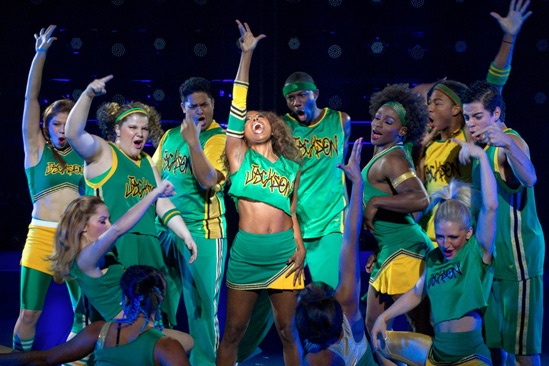
Review:  Bring It On: The Musical

Adrienne Warren and the cast of Bring It On serve up major musical theatre realness.  And they're pretty good athletes, too.

Needless to say, Bring It On: The Musical is not high art.  Anyone with such lofty expectations for the show has a gross misunderstanding of the source material on which it is based.  What this stage adaptation of the film series of the same name does offer is plenty of fun and high-flying acrobatics, even if some questionable story and tonal choices keep it from becoming the great piece of fluff theatre it could be.

Set in the world of competitive cheerleading, Bring It On doesn’t precisely follow the plot of the original movie or any of its sequels, instead using the franchise’s general premise and themes as inspiration for an original story.  The show begins with perky blonde Campbell being elected captain of the Truman High School cheerleading squad, but her dreams of winning the National Cheering Trophy are dashed when some questionable school redistricting results in her forced transfer to the scary multi-ethnic Jackson High.  Not only is Campbell a fish out of water, but the closest thing to a cheerleading squad at Jackson is a dance crew led by sassy queen bee Danielle.  This is obviously the Worst Thing Ever, and poor Campbell must somehow find a way to convince Danielle to form a cheerleading squad so that they both can compete at Nationals and win that coveted trophy.

Obviously, this campy setup is meant to provide more jokes than drama, a fact the show knows but doesn’t fully embrace.  The biggest problem is that Bring It On doesn’t take the outrageousness far enough, opting to play a large portion of the show completely straight despite a steady stream of one-liners provided by book writer Jeff Whitty (a Tony-winner for his work on Avenue Q).  As a result, the predictable plot drags at the start, although the approach does lead to some surprisingly heartfelt scenes as the characters struggle with growing up.  The second act ballad “Enjoy the Trip” is an especially poignant and insightful commentary on the ultimate importance of high school drama, and a highlight of the show.

Like most musical comedies, the real interest lies in the production numbers, which are plentiful and generally well done.  The contemporary score, co-written by Tom Kitt (Next to Normal) and Lin-Manuel Miranda (In the Heights), highlights the very distinctive styles of its two composers while still sounding like a cohesive whole.  The R&B stylings that characterize Miranda’s work are particularly prominent and enticing, and the Bring It On score ends up being one of the most fully realized blendings of showtunes and modern pop to ever grace a Broadway stage.  Mirroring this mix is the excellent choreography by Andy Blankenbuehler (who also directed), which makes hip hop dance wholly theatrical and is a refreshingly new addition to an art form that can be painfully slow to evolve.

And when the fresh-faced cast breaks into the cheer routines that form the centerpiece of Bring It On, prepare to be amazed.  The dizzying combination of backflips, tumbling, and aerial acrobatics will take even the most jaded theatre-goer’s breathe away, and these athletic feats are performed with a precision and sleekness any show would do well to emulate.  It is honestly a shame there aren’t more of them – setting the first act primarily in a cheerleader-less school makes the routines hard to sneak in – although the upside of this decision is that it makes the dueling routines of the musical’s climax even more exciting.

The vast majority of the cast is making their Broadway debuts, and what the performers lack in experience they make up for with enthusiasm and general charisma.  Taylor Louderman’s Campbell can be a little bland, but she is believable, earnest, and a generally likeable leading lady (Louderman also does an excellent job with the enormous amount of singing she’s been handed).  Adrienne Warren belts to the rafters as Danielle, and her well-executed transformation from antagonistic to grudgingly respectful to genuinely friendly is one of the more dramatic character arcs in the show.  The supporting players all manage to make a positive impression, although the sheer number of characters leaves a lot of the actors with precious little to do.

The real standout among the cast is Gregory Haney’s camp-tastic turn as a drag queen student called La Cienega.  One of the few actors with prior Broadway experience, Haney takes a character we know nothing about (only one line in the show even acknowledges that her attending school in drag might have made her life difficult) and makes her into the most compelling person on the stage.  Completely over the top and reveling in every minute of it, Haney represents the type of show Bring It On is *this close* to being: a high-camp delight that is simultaneously hilarious and oddly engaging.

As stated above, Bring It On isn’t high art.  It has some fairly glaring oversights, like a story that meanders for much of the first act until settling into the predictable but effective drama of a sporting competition.  Everything seems to be just a little too easy for Campbell, which makes it difficult to fully invest in the plot or her hardships.  And for a show that traffics in cheerleader stereotypes, there is a surprising lack of unrepentantly bitchy girls to serve as effective antagonists.  The absence of a truly memorable villain, someone the audience could love to hate, keeps Bring It On from entering the realm of top-tier escapist entertainment, and we the audience must settle for merely very good rather than great.  That said, there are certainly worse ways to spend a summer night than with this slickly polished musical confection, and I for one am glad this national tour decided to stop by and play in the big leagues.

Sunday, February 12, 2012

Even Flops Deserve an Encore

Review: Merrily We Roll Along
Celia Keenan-Bolger, Collin Donnell, and Lin-Manuel Miranda in the Encores staging of Merrily We Roll Along
I hope that Stephen Sondheim’s Merrily We Roll Along, running this weekend and next as part of the Encores! concert series at NY City Center, receives that oft-speculated about Broadway transfer. Not because the show (or this production) is perfect; far from it, as there are many problems plaguing this 1981 flop musical about a group of friends dealing with life’s many disappointments. But the show is so close to being the grandly affecting theatrical revelation that we *want* it to be, and I firmly believe that it could achieve those lofty heights with just a bit more work.
A brief history lesson for the uninitiated: Merrily was the sixth collaboration between Stephen Sondheim and Hal Prince, an artistic partnership that gave the world shows like Follies, Company, and Sweeney Todd. It tells the story of Franklin Shepard, a songwriter and film producer who is estranged from virtually everyone, including his longtime lyricist Charley Kringas and their novelist friend Mary Flynn. The story unfolds backwards, slowly revealing how these three inseparable friends ended up hating one another. The musical was such a critical and commercial failure when it opened on Broadway that it not only ended the Sondheim-Prince collaboration, but almost caused the gifted composer to retire from the theatre altogether.
But the show was preserved on a glorious original cast album, one which I have been in love with for many years. This Encores! concert, the latest in a decade-long, city wide fascination with all things Sondheim, was my first chance to see the show on its feet, and judge for myself whether the show (heavily revised by Sondheim and bookwriter George Furth since its initial Broadway run) was as bad as history would have you believe.
And unfortunately, this production doesn’t quite work. But it is so maddeningly close that I can’t help but think that with more time, it could become a truly transcendent theatrical event. The notoriously short Encores! rehearsal period hasn’t provided the performers with enough time to crack these complex characters, leaving us with a show that has its moments but is ultimately unsatisfying.

The book is partially to blame, but there’s no easy way to fix it. The same choice that makes the show fascinating – telling the story in reverse chronological order – also creates a host of challenges. It requires the actors to start the show at such an intense emotional level, where the depth of their bitterness and disappointment should be emanating from their pores, that few would be up to the task even in a traditional setting, let alone the abridged rehearsal period allowed here. Rather than having the entire evening to work up to that level of angst, the characters start at their emotional peak and slowly shed layers of regret to become the hopeful youths seen in the play’s final scene. The reverse narrative also requires the audience to absorb an incredible amount of back story early on, as we try to piece together the various relationships and how they got that way.

I honestly feel that Furth’s book does this in the most economical way possible; the rest is up to the actors and director. Helmer James Lapine and his cast are headed in the right direction here, but have obviously run short on time. More rehearsal, and a longer preview period, would certainly provide all of them with the chance to deepen their own understanding of the text and how to best illustrate that to the audience, which is why I would love to see the show transfer to Broadway and be able to revisit it after they had had a solid month or more to explore it. And everyone knows that Sondheim’s songs (which are at their most heart-wrenchingly beautiful here) can reveal new meanings on each subsequent listening, again making a convincing case for more rehearsal time.

As is, none of the three leads have a strong handle on their characters, although all are respectable actors who have solid moments throughout. As Franklin Shepard, Colin Donnell is so charming that you end up rooting for him even as the character makes some truly repugnant choices. Donnell has a gorgeous singing voice, and enough intelligence to be able to convey the inner conflict that underlies all of Shepard’s actions without ever being voiced. But at least two numbers require Shepard be absolutely reamed by other characters without chance for rebuttal, and Donnell misses the opportunity to really demonstrate the emotional toll it takes on Shepard.
Lin-Manuel Miranda is more problematic as Charley. Though a Tony-nominee for his performance in In the Heights, Miranda is not a singer, and seems to be outside of his natural range for most of the show. Occasionally his acting abilities allow him to compensate, but he is usually too concerned with hitting the right notes to be fully convincing. Yet all this doesn’t stop him from delivering a strong rendition of “Franklin Shepard, Inc,” an incredible piece of musical theatre writing that is one of the greatest gifts Sondheim ever gave a male actor.
But Miranda utterly botches Charley’s other big number, “Good Thing Going,” although I’m not sure he is entirely to blame. A song from Frank and Charley’s work-in-progress show that they sing at a backer’s audition, on the original cast album it is a solo wherein you see Charley’s dawning realization that he is losing his friend to the soulless entertainment industry. Contrasted with some technically dazzling counterpoint from the backers, who are discussing anything but the song they’re hearing, it’s an utterly heartbreaking moment. But in this production the song is a duet for Charley and Frank (mostly Frank) that serves no purpose; it no longer illustrates Charley’s increasing isolation, and the fact that these backers have no interest in making the “art” Charley and Frank aspire to has already been well-established. Now, this may be a rewrite done by Sondheim and Furth (though an ill-advised one), but it reads as if Miranda simply couldn’t sing the song and the music director hastily added Donnell in to compensate. Either way, it kills what could have been one of the most gut-wrenching scenes in the entire show.
Completing the trio of leads is Celia Keenan-Bolger, who does her best with the ill-defined Mary. The show never does a great job of establishing Mary as a character in her own right; she functions purely as a mediator between the bickering Charley and Frank. But given the amount of stage time Mary has and the serious dramatic ambitions of the show, she really should be given more depth than “mediator” and “occasional comic relief.” Keenan-Bolger does a decent job with the one-liners and makes a very convincing drunk in the opening scenes, but can’t overcome the limitations placed on her by the book.
The performer that comes out the best in all of this is Elizabeth Stanley as Gussie Carnegie, the star of Frank and Charley’s Broadway hit and Frank’s second wife. Although Gussie’s function in the story is clear – she’s the temptress that prompts most of Frank’s bad decisions – unlike Mary she is given enough personality and idiosyncrasies to evolve beyond that. Stanley is fantastic in the role, effortlessly capturing the glamour of a bona fide star and the neuroticism that all too often accompanies it. Although she gets plenty of stage time, I found myself wanting more of her, since the show tended to flounder when she was offstage. And as Frank’s first wife Beth, Betsy Wolfe sings and acts well enough, although her rendition of the show’s big ballad “Not a Day Goes By” needs more time to deepen into the emotional sucker punch it can be when sung by someone like Bernadette Peters (who has made it a staple of her concert performances).
Again, this is a show I dearly love, and so part of my disappointment with the Encores! production may stem from lofty expectations. But this production and this cast is clearly headed in the right direction, which makes it even more upsetting that they don’t have the luxury of more time to tackle this behemoth of a show. I suspect the difference between the first and second weekends will be enormous, and who knows what could be achieved with even more time to settle into these roles. Hopefully the reception for the concert staging will be warm enough that some producer risks bringing the show to Broadway, where I think the extra rehearsal time will result in a first rate staging of this important but problematic work.