Showing posts with label Bartlett sher. Show all posts

Saturday, May 19, 2018

2018 Tony Predictions: Best Director and Choreography

While many Tony categories this year are up for grabs, that seems to stem more from all the nominees being equally good but not great rather than a surfeit of truly standout work. That is not meant to detract from this year's nominees so much as an acknowledgement that there's just less eligible work this season, and it isn't the creative home runs we've been spoiled by the past few years. That said, one area where this year's Tonys are *super* competitive is Best Director, so read on to find out my predictions of who will walk away a winner on June 10th (and if they actually deserve it).

Best Direction of a Play


Andrew Garfield as Prior Walter and the cast of Angels in America.

Nominees: Marianne Elliott, Angels in America; Joe Mantello, Three Tall Women; Patrick Marber, Travesties; John Tiffany, Harry Potter and the Cursed Child; George C. Wolfe, The Iceman Cometh

The level of talent in this category is off the charts. With the exception of Travesties' Patrick Marber, all are previous Tony winners, both hugely influential and highly respected in the Broadway community. And the shows they are nominated for not only represent some of the best reviewed productions of the season, but also display an sense of scale and depth rarely attempted in a Broadway play these days.

While the Tonys typically love an underdog story, I don't see Marber breaking through for Roundabout's revival of Tom Stoppard's heady Travesties. The play is just too obtuse for the average Tony voter to really rally behind, even though they all surely recognize and respect the skill that went into mounting it. Meanwhile George C. Wolfe's The Iceman Cometh's finds itself the victim of poor timing, coming only a few years after a much heralded mounting at Brooklyn Academy of Music starring Nathan Lane and Brian Dennehy that was once rumored for a Broadway transfer. Many critics felt the show didn't quite merit revisiting so soon, and Wolfe will unfortunately be penalized for it. And while I have read nary a negative word about Joe Mantello's mounting of Three Tall Women, I have trouble imagining him triumphing over the other two gargantuan undertakings under consideration here.

Both Angels in America and Harry Potter and the Cursed Child are epic plays presented in two parts. Both have a lot of technical elements for their directors to wrangle, with Cursed Child reportedly boasting a physical production and special effects on the level of any big budget musical. There is a very good chance John Tiffany will win for bringing The Boy Who Lived to Broadway in such successful, stunning fashion, a clear triumph of theatrical craft and artistry. But Angels in America is inarguably one of the densest, most thought provoking, and important plays of the past 50 years, and by all accounts Marianne Elliott has nailed it. In what some might consider an upset, I foresee her name being the one called on June 10th, to thunderous applause.

Will and Should Win: Marianne Elliott, Angels in America

Best Direction of a Musical


Harry Hadden-Paton as Henry Higgins and Lauren Ambrose as Eliza Doolittle in My Fair Lady at Lincoln Center.

Nominees: Michael Arden, Once on this Island; David Cromer, The Band's Visit; Tina Landau, SpongeBob SquarePants; Casey Nicholaw, Mean Girls; Bartlett Sher, My Fair Lady

For me, this is hands down the most competitive category of the night. Each director's vision permeates every corner of their respective productions, and yet ultimately it is the material which shines through instead of some heavy-handed directorial "concept." That said, I think we can safely rule out a win for Casey Nicholaw, as the very entertaining Mean Girls is hardly his best work. And while David Cromer is a dark horse for his work on the critically lauded The Band's Visit, I don't think his direction of that show is as integral to its success as the remaining three contenders.

It cannot be understated how much Michael Arden's vision for Once on this Island helped shape that production into the jewel it is today. His environmental staging makes the most out of the deceptively tricky Circle in the Square Theatre, and for all his lush images and inventive staging he keeps the focus squarely on the narrative's big, beating heart. After the Deaf West Spring Awakening revival and now this, Arden has firmly established himself as an artist to watch, but I sadly don't think it's his time to win Tony glory just yet. 

When it comes to choosing between Tina Landau and Bartlett Sher it's almost too close to call. The Outer Critics' Circle refused to pick, instead awarding both artists Best Direction of a Musical in a rare tie. Sher has subtly but irrevocably changed the way My Fair Lady plays for a modern audience more aware than ever of how gender politics play out in popular entertainment. He has radically reinterpreted a beloved classic in a way that feels startlingly fresh and contemporary without changing a word of the 62 year old classic.

Meanwhile Landau, who has been attached to SpongeBob SquarePants almost since its inception, has miraculous turned what seemed like a cynical cash grab by a big corporation into one of the most entertaining celebrations of theatrical craft around. She has guided her design team to a visual look that evokes the off-kilter feel of the cartoon without literally copying it, and has assembled a rock solid cast that have been encouraged to take their performances far beyond a funny voice and a couple of quirks. She as much as anyone helped shape the disparate elements into a unified whole that feels entirely at home on stage. 

Sher seems like a safer bet to win, and should he walk away with the trophy on Tony Sunday you won't hear any complaints from me. But Landau is this season's MVP when in comes to direction, and I'm hoping she will walk away with the acknowledgement she deserves.

Will Win: Bartlett Sher, My Fair Lady
Should Win: Tina Landau, SpongeBob SquarePants

Best Choreography


The beautiful dancers of the cast of Carousel.

Nominees: Christopher Gattelli, My Fair Lady; Christopher Gattelli, SpongeBob SquarePants; Steven Hoggett, Harry Potter and the Cursed Child; Casey Nicholaw, Mean Girls; Justin Peck, Carousel

This article is running a bit long, but that's okay because there's not much to discuss here. Justin Peck easily wins Best Choreography for his beautiful and abundant work on Carousel, the biggest dance show of the season. The revival's producers were smart to hire New York City Ballet's youngest ever choreographer in residence to stage Carousel's many dances - including the signature Rodgers and Hammerstein dream ballet - and I can't imagine anyone else winning this award.

Will & Should Win: Justin Peck, Carousel


Keep checking this space for more 2018 Tony Award predictions in the weeks ahead! In the meantime, make your voice heard in the comments, and check out the rest of my Tony coverage by clicking below:

Tony Nominations React
Best Book and Score

Thursday, April 26, 2018

By George, They've Got It!

Review: My Fair Lady


Harry Hadden-Paton, Lauren Ambrose, and Allan Corduner in Lincoln Center's lavish My Fair Lady.

Lerner and Loewe's My Fair Lady has quite the conflicting reputation. On one hand, this musical adaptation of George Bernard Shaw's Pygmalion is almost universally agreed to be an expertly constructed Golden Age book musical, overflowing with Loewe's beautiful music and possessing an exceedingly sharp, emotionally complex book by Lerner. But with each passing year, more and more people have rightly expressed discomfort with the way the show treats its protagonist Eliza Doolittle, who many feel is made over against her will to suit the ideals of misogynistic language professor Henry Higgins. Is it even possible to stage the show in a way that honors its original intent without alienating modern audiences who are increasingly aware of the mistreatment women have endured throughout history?

The answer is a resounding "yes" thanks to the brilliant direction of Bartlett Sher, who seemingly specializes in mounting supposedly dated classics to feel as timely and relevant as the day they first premiered (see his Tony-winning revivals of South Pacific and The King & I, also for Lincoln Center). Sher has largely solved My Fair Lady's perceived problems with an approach so straightforward it feels revolutionary: he has ignored the way the show is "traditionally" performed and refocused on the text, revealing it to be much more thoughtful and equitable than originally thought. The often thrilling, always fascinating result is a triumphant production that firmly refocuses the show on Eliza and makes her a much more active participant in her own narrative without changing a single line of dialogue.

The script has always had Eliza show up at Higgins' residence asking for elocution lessons, but Sher's production is one of the first to fully emphasize that she chooses to do so without being forced. Higgins has always explicitly stated the difficulty in what Eliza is attempting, and praised her for the speed at which she picks it up, but for the first time it all feels like genuine praise rather than insincere small talk. Eliza has always called Higgins on his appalling behavior, but this is the first time it hasn't felt like she's taken her critique back by the end of the show. The only thing one can argue Sher actually changed is the show's final tableau, but again, he hasn't changed a word, and his version of the ending feels much truer to the spirit of the piece than what has traditionally been done.

To achieve such a subtle but substantial reinterpretation of the text, Sher needed actors of the highest caliber, and he has found them in this top notch cast. Lauren Ambrose provides perhaps the best acted version of Eliza to date, up to and including Audrey Hepburn's beloved performance in the film. Ambrose sparkles with intelligence and strength from the very beginning, making it clear Eliza's cockney accent by no means indicates stupidity. Her expressive face and eyes radiate warmth while conveying volumes about her complex inner life, making it difficult to take your eyes off her. Whether Ambrose is relishing the small victories Eliza finds during her arduous dictation lessons, reevaluating and adjusting her behavior during her hysterical public debut as a lady, or visibly rallying herself prior to the embassy ball, she will have you utterly captivated. It is a testament to Ambrose's sheer magnetism that even when Higgins and his servants are gallivanting about the stage during "You Did It," the audience's eyes remain fixed on Eliza in the corner, as Ambrose charts her growing disgust with her situation.

Vocally, Ambrose is not as assured a singer as someone like Julie Andrews (Broadway's original Eliza) or Marni Nixon (who dubbed Hepburn's vocals in the film). She has some lovely moments and never comes close to sounding outright bad, rather just suffers a *tad* in comparison to some of the most accomplished sopranos in musical theatre history. And Ambrose's acting is so sensational that its difficult to hold any perceived vocal shortcomings against her, as its hard to imagine a more trained singer acting the role better. Ambrose's performance is that good.

Ambrose is excellently matched by Harry Hadden-Paton making an absolutely thrilling Broadway debut in a role virtually synonymous with Rex Harrison (who won both the Tony and the Oscar for his Higgins). It must be noted that casting Higgins as closer in age to Eliza goes a long way towards putting the characters on more equal footing, but the rest of the gap is closed by Hadden-Paton as perhaps the most compassionate Higgins in history. That's not to say the tart tongued linguist has lost any of his bite; Hadden-Paton can unleash a stream of insults with the best of them, with a natural charisma and intelligence that will have you laughing so hard you almost forget how thoroughly he's eviscerated his target. But this Higgins actually does care for Eliza, and Hadden-Paton makes it clear that for all his bluster he is genuinely horrified by the idea that he may have unknowingly mistreated her. You won't necessarily like this Higgins, but you will have far more understanding of him and his childish outbursts than you've likely ever had, all thanks to Hadden-Paton's excellent scene work.

The supporting cast is every bit as enchanting as the leads. Allan Corduner is outstanding as Colonel Pickering, an excellent foil for Hadden-Paton and a fascinating actor in his own right. Dame Diana Rigg makes the most of her relatively small role as Mrs. Higgins (Henry's mother), effortlessly cutting her misbehaving son down to size with little more than a look and a quick word. Jordan Donica offers up a beautiful sung, endearingly goofy Freddy, forever smitten with Eliza and waiting for her "On the Street Where You Live." And two-time Tony-winner Norbert Leo Butz takes the primarily comic role of Alfred P. Doolittle, Eliza's father, and turns him into one of the most fully realized humans in the entire piece. The fact that he also leads the sensational chorus of 25 in a showstopping rendition of "Get Me to the Church on Time" is just an added bonus.

At this point, it is practically a given that Lincoln Center's revivals of these Golden Age classics will be visually sumptuous affairs, and My Fair Lady continues that proud tradition. Catherine Zuber's costumes continually astound, especially her lavender-tinted finery for the "Ascot Gavotte" and her breathtaking version of Eliza's iconic hat. Michael Yeargan's scenic design for Higgins' study is impressively grand on its own, but when the house begins to revolve and expose the residence's other rooms you may just let out a gasp of delight. Everything is beautifully lit by Donald Holder, and Marc Salzberg's sound design ensures you can hear every wonderful note of the score played by the massive orchestra under the baton of Ted Sperling. Describing the physical production as lavish almost feels like an understatement.

In the end, you'd be hard pressed to find much to fault in this production of My Fair Lady. Impeccably acted and gorgeously staged, it feels as fresh and relevant as the day the show first premiered, if not more so. Higgins is still undeniably a misogynist, but he no longer has tyrannical control over Eliza, and she has far more agency in her own story than one might expect. Popular opinion will ultimately decide if the show is too unsavory for modern audiences, but Sher and company have made a compelling argument for this classic to maintain its status as one of the crown jewels of the musical theatre cannon. Its examination of class and gender politics has plenty to teach us even today, all while entertaining us with one of the most glorious scores of the Golden Age.

Saturday, January 16, 2016

A Broadway "Tradition" Continues

Review: Fiddler on the Roof

Danny Burstein as Tevye in the latest Broadway revival of Fiddler on the Roof.

How does one reinvent a show centered around the concept of tradition? It is the title of the glorious opening number of Fiddler on the Roof, where Jewish milkman Tevye speaking directly to the audience about the virtues of the well-delineated societal rules in his little town of Anatevka. Throughout the show Tevye and his daughters deviate from the old ways with only the purest of intents, and yet it still causes an enormous amount of trouble for the well-meaning clan. Those traditions end up providing the characters comfort in times of great adversity, and the show ultimately seems to argue that while some change is inevitable there's no need to completely ignore the old way of doing things. Oddly enough, it is a lesson director Bartlett Sher attempts to teach while simultaneously ignoring, as the least successful aspects of this generally first rate revival (the show's fifth) are the areas where Sher most obviously breaks from the traditional way of mounting the show.

Sher has made quite the name for himself staging critically heralded revivals of both plays and musicals, having found particular success with the works of Rodgers and Hammerstein. With Fiddler on the Roof, he once again sweeps away the cobwebs from a script some may view as dated and makes it compelling and relevant. Yet unlike his Tony-winning South Pacific or The King and I, Sher's directorial hand is more apparent here, and not always for the better. He hasn't changed a word of the script, but he has awkwardly grafted a wordless modern dress framing device onto the show that doesn't add anything to the preexisting text. The production design is also purposefully deconstructed for reasons that aren't at all apparent, occasionally distracting from rather than adding to the storytelling.

Now none of the above is meant to in any way imply that Sher's direction is bad. It is often outstanding, breathing fresh life into a show many know by heart. Sher has guided his cast to fully lived performances that feel fresh, exciting, and even slightly dangerous. He has a near matchless understanding of pacing, giving each story beat room to breathe while also keeping everything moving along at such a steady clip the show never drags despite its three hour runtime. He has a stellar eye for simple yet powerful stage pictures, and seamlessly switches gears between broad comedy and heartwrenching drama. Sher has never directed a funnier sequence than "Tevye's Dream," and he his storytelling has rarely been as devastating as it is during the show's emotional climax, which makes his few missteps all the more noticeable.

Sher is aided, as always, by an impeccable cast of theatrical greats working at the top of their game. Headlining this Fiddler is five-time Tony-nominee Danny Burstein in the role of Tevye, and the veteran character actor has arguably never been better. While it would be disingenuous to call Burstein's performance understated - among other things, he gets to play more comedy than he's been given in any role since Adolfo in The Drowsey Chaperone - his performance is not as immediately flashy as one might expect from a role written for the famously outsized Zero Mostel. But it is a deeply felt, fully realized portrayal that builds and builds to an emotional sucker punch of a climax, when one of his beloved daughters decides to marry outside the faith. Burstein is alternatively jovial and genuinely imposing as the role demands, and he handles all the areas in between with such effortless aplomb you forget he's acting at all. His voice also perfectly suits the show's famous score, and his exuberant performance of "If I Were a Rich Man" is every bit the showstopper such a gifted performer deserves.

Burstein's performance forms the blueprint that the rest of the cast follows, as many of his fellow actors also initially appear unassuming while laying the groundwork for what are revealed to be deeply affecting performances. Jessica Hecht's wife Golde at first skews very harsh and shrewish (you definitely understand why Tevye would be scared of her), but she leavens her work with enough moments of tenderness that it is genuinely touching when she struggles to answer Tevye's question of "Do You Love Me?" She is also heartbreaking during the final few scenes, as the aftermath of her third daughter's marriage fully hits.

As daughters Tzietel, Hodel, and Chava respectively, Alexandra Silber, Samantha Massell, and Melanie Moore all have their moments, although it takes them a bit longer to click into their roles. Their performance of "Matchmaker, Matchermaker" isn't quite the homerun you'd expect, but to their credit all three act the song so well it makes you hear the well-known lyrics anew.  Massell also does a phenomenal job with Hodel's "Far From the Home I Love," making the song a late-evening highlight. The structure of the show doesn't provide as much for Adam Kantor (Motel), Ben Rappaport (Perchik), and Aaron Young (Fyedka) to do as the daughter's respective spouses, but all three actors make strong impression with the material they do have. And if Alix Korey's Yente the Matchmaker isn't quite the scenery chewer you'd expect, she is nevertheless absolutely hysterical.

Few shows have proven as durable and iconic a part of the musical theatre cannon as Fiddler on the Roof, and Bartlett Sher has staged this latest revival in a way that reminds even the skeptics how Fiddler achieved that status in the first place. Sher also continues to bring out the best in some of the industry's top talent, guiding Burstein to what may well be considered his crowning achievement. The entire production seems to exist primarily to showcase the actor's many talents, and yet he remains so giving and supportive of his fellow performers he never overshadows the story they are all trying to tell. (I try to leave talk of Tony Awards out of reviews, but if Burstein doesn't finally win an acting trophy for this I don't know what more he can possibly do.) And as always, it is refreshing and invigorating to see such a classic approached with such lavish attention to detail, from the gloriously full orchestra to the finely detailed costumes. Some traditions are worth keeping, and if Fiddler continues to be this entertaining and moving I see no problem with continuing to revive the show every ten years.

Tuesday, May 19, 2015

2015 Tony Predictions: Direction and Choreography

The 2015 Tony Awards are less than 3 weeks away, and all of Broadway is buzzing with speculation over who will be victorious come June 7th. Predicting Tony winners just so happens to be one of my favorite pastimes, and so I'm continuing my coverage of this year's ceremony by doing my best to select the people and productions most likely to walk away with that spinning statuette on Tony Sunday. Of course, the people who *will* win are not always the people who *deserve* to win, so I will also make sure to point out when I think the probable winner doesn't match up with the most deserving person/production. I've already discussed the musical writing awards, so now we move on to the people who tell the actors where to go and what to do: the directors and choreographers.

Best Direction of a Play

Tony nominee Alex Sharp (r) and Enid Graham in a scene from The Curious Incident of the Dog in the Night-Time.
Nominees: Stephen Daldry, Skylight; Marianne Elliott, The Curious Incident of the Dog in the Night-Time; Scott Ellis, You Can't Take It With You; Jeremy Herrin, Wolf Hall Parts I & II; Moritz von Stuelpnagel, Hand to God

"It's a honor just to be nominated" sounds horribly cliche, but anyone in this category not named Marianne Elliott should definitely remember such tried and true advice come Broadway's big night. Elliott has helmed the most visually stunning play in several seasons, and much of The Curious Incident of the Dog in the Night-Time's dazzle comes specifically from her staging rather than from the equally impressive production design (which is virtually guaranteed to win some Tonys on its own). Not only that, but Elliott somehow managed to keep her bold and daring staging in service of the story rather than letting it overwhelm the narrative, something a lesser director would surely struggle with.

The other productions in this category have been mostly praised for their top-notch acting, something the director definitely helps mold but is ultimately the creation of the performer (no matter how good a director Hand to God's Moritz von Stuelpnagel may be, you can't teach just anyone to do what Steven Boyer does in that show). Unfortunately for Stephen Daldry, Scott Ellis, and Jeremy Herrin, you have a put a pretty distinct directorial stamp on a show to be a true Tony contender, and their strengths this season lie primarily in getting out of the material's way rather than imposing their will upon it. This is Elliott's award to lose.

Will and Should Win: Marianne Elliott, The Curious Incident of the Dog in the Night-Time


Best Direction of a Musical

The Bechdel family, the enigmatic clan at the certain of Off-Broadway transfer (and 2014 Pulitzer Prize finalist) Fun Home.
Nominees: Sam Gold, Fun Home; Casey Nicholaw, Something Rotten!; John Rando, On the Town; Bartlett Sher, The King and I; Christopher Wheeldon, An American in Paris

Now this is a tight race, and one that could conceivably go to any of the five highly deserving nominees. I'm going to go ahead and rule out both Casey Nicholaw and Christopher Wheeldon, as I suspect that should voters want to honor either gentleman they will do so in the Best Choreography category while using this race to recognize someone who is not a double nominee. And while I having nothing but respect for John Rando's refreshing, exuberant work on what many considered a hopelessly dated show, I don't think the On the Town director has a very good shot at winning such a competitive category.

Which leaves Sam Gold and Bartlett Sher, who are so neck and neck that you might as well toss a coin to determine the winner. Both helmed universally acclaimed spring productions that are still fresh in everyone's minds, and both shows owe a large part of their success to their excellent direction. The oft-performed King and I could easily have seemed tired and/or dated, but as Sher did with South Pacific several seasons ago the Tony-winning director has stripped any hint of artifice from the Rodgers and Hammerstein classic and allowed us to see the show afresh. Meanwhile, Gold has done absolutely extraordinary things with Fun Home, reimagining his Off-Broadway staging so completely that you would swear the entire piece was originally conceived and produced in the round. Gold has also guided his small cast to universally excellent performances that stick with you long after the final curtain, with several of his actors up for Tony Awards themselves.

Personally, I would vote for Sher, because ultimately The King and I affected and engaged me in a way Fun Home did not. Despite the many admirable elements of the Off-Broadway transfer, I couldn't connect with the characters on an emotional level even though their lives and concerns more closely mirrored my own experiences than Anna Leonowens' trip to Siam. However, I will fully admit that I seem to be in the minority regarding Fun Home's emotional effectiveness, which I think will ultimately be enough to give Gold the edge.

Will Win: Sam Gold, Fun Home
Should Win: Bartlett Sher, The King and I


Best Choreography

Tony nominees Leanne Cope and Robert Fairchild in one of many pas de deuxs they share in An American in Paris.

Nominees: Joshua Bergasse, On the Town; Christopher Gattelli, The King and I; Scott Graham and Stephen Hoggart, The Curious Incident of the Dog in the Night-Time; Casey Nicholaw, Something Rotten!; Christopher Wheeldon, An American in Paris

This is where I expect Tony voters will acknowledge all of Christopher Wheeldon's work on An American in Paris, one of the season's biggest surprises. Even disregarding its status as the most nominated musical of the season, by all accounts Paris is an enormous dance show with incredibly demanding choreography that is expertly realized by Wheeldon's top notch dancers. It's refreshing to see a new musical that places such an emphasis on dance, an art form that has been distressingly sparse on Broadway in recent years.

The downside to Wheeldon's likely win is that it doesn't leave room for acknowledgement of Joshua Bergasse's incredible choreography for On the Town. Most producers and directors would have trimmed or even cut at least some of the massive dance numbers when reviving On the Town for modern audiences, but thanks to Bergasse the revival's dancing is its strongest suit. Playful yet precise, Bergasse's dances call to mind the inventive whimsy of multiple Tony-winner Susan Stroman, and hopefully this Broadway newcomer will stick around for many years to come.

Bergasse is also the only legitimate threat to Wheeldon; previous winner Casey Nicholaw's Something Rotten! seems to be suffering from a bit of backlash (it didn't win a single Outer Critic's Circle Award despite having more nominations than any other production), and The King and I just doesn't have enough choreography for Christopher Gattelli to legitimately compete with shows literally overflowing with dance. And giving the Best Choreography Tony to a play in a season which saw such a high volume of traditional dancing is so unlikely that it hardly merits discussion.

Will and Should Win: Christopher Wheeldon, An American in Paris
Who I'd Like to Win Anyway: Joshua Beragsse, On the Town


Keep checking back in the coming weeks for more Tony predictions (updates hopefully every Monday and Friday). In my next post I'll delve into the acting awards, and until then you can read all of my previous Tony predictions below:

Tony Nominee React
Best Book and Score

Monday, April 20, 2015

Something Truly Wonderful

Review: The King and I

Ken Watanabe and Kelli O'Hara are exquisitely matched in Bartlett Sher's knockout revival of Rodgers and Hammerstein's The King and I.

There's no such thing as perfection, especially in a subjective artistic medium like the theatre. That said, Lincoln Center's ravishing, radiant, and visually stunning revival of Rodgers and Hammerstein's The King and I is so close to an ideal evening at the theatre that for all intents and purposes it is exactly that. Perhaps even more than the non-profit's critically lauded South Pacific several seasons back, this revival removes all artifice, pretention, and preexisting baggage from a well worn show and reveals it anew as an emotionally complex, culturally relevant and deeply moving piece of musical writing from one of the greatest creative teams to ever live.

Following the pitch perfect overture (played by a 29 piece orchestra under the baton of Ted Sperling), we are whisked away to the beautifully exotic kingdom of Siam circa 1862. On the prow of an incoming ship we meet British schoolteacher Anna Leonowens (a luminous Kelli O'Hara), who has come to this faraway land with her son to educate the King of Siam's many children and wives in the ways of the West. The imposing and often temperamental King (a gleeful Ken Watanabe, in his Broadway debut) has more than a few clashes with the strong-willed Misses Anna as the show turns an intelligent and quizzical eye towards issues of imperialism, gender politics, and the qualifications of a good ruler. There are multiple subplots to round out the evening, but the central relationship of Anna and the King is the musical's primary concern, and it is one of the most richly textured and nuanced in the entire musical theatre cannon.

Despite the show's age, nothing about director Barlett Sher's superlative staging feels dusty or antiquated; indeed, many of Hammerstein's observations about gender politics and race relations remain relevant even today. Sher unearths the many layers in both the book scenes and the songs in such a way that everything feels necessary, and every line, lyric, and piece of incidental musical adds to our overall understanding of the characters and the plot. Unlike many productions of Rodgers and Hammerstein's work, there is nothing precious or twee about this revival, which treats the work with the same seriousness as a great drama without shying away from the piece's inherent humor and charm. And moreso than almost any other director working today, Sher knows how to make excellent use of the cavernous Vivian Beaumont Theatre's thrust stage, creating a neverending series of beautiful stage pictures that seamlessly ensure a good view of the action no matter where you're sitting (Christopher Gattelli's choreography is equally entrancing).

Once again, Sher guides his frequent collaborator Kelli O'Hara to a performance of startling depth and emotional honesty. Rodgers and Hammerstein's score doesn't allow O'Hara to show the full range of her gorgeous soprano, but that doesn't prevent her from sounding absolutely stunning on the score's many standards. When she wraps her golden tones around "Getting to Know You," it's every bit as warm and inviting as you'd hope, and her rendition of "Hello, Young Lovers" is positively captivating. But it's not just O'Hara's nearly unequalled vocal technique that makes her a joy to watch; her thoughtful, textured delivery of the lyrics makes these much sung songs sound like entirely new, spur of the moment thoughts (a quality best showcased during her superlative "Shall I Tell You What I Think of You?" towards the end of the first act). O'Hara makes you believe every syllable of what she's saying, and she imbues every gesture with a multitude of meaning in yet another stellar addition to her ever growing resume.

Her performance is matched every step of the way by an incredibly affecting and genuinely exciting star turn from Ken Watanabe as the King. Watanabe doesn't completely throw out the template created by Tony-winner Yul Brynner, but by the end of the show he has created a take on the commanding monarch that is wholly his own and just as effective. His King exhibits a palpable joy when learning more about his charge and her culture, and both the actor and the character clearly relish their frequent, playful sparring with O'Hara's Anna. Yet the immensely likable Watanabe is also capable of producing an intense anger that strikes fear in his subjects' hearts, a juxtaposition that explains why most of the characters seem both terrified and fiercely protective of their King. Most importantly, Watanabe has excellent chemistry with O'Hara, which pays off in spades during their exhilarating "Shall We Dance?"

The supporting cast is just as capable as the leads, often while being given decidedly less to work with. Ruthie Ann Miles is superb as the King's primary wife Lady Thiang, showing exquisite depth and nuance as she regally slinks across the stage and turning "Something Wonderful" into a legitimate showstopper. As the impetuous Tuptim, a young girl given to the King as a gift despite longing for another, Ashley Park displays beautiful vocal control during her soaring ballads and also grounds the particularly harrowing confrontation between herself and the King during the show's climax. Jake Lucas brings surprising honesty to his performance as Anna's son Louis, and shares a particularly lovely duet with Jon Viktor Corpuz's Prince Chulalongkorn, the King's eldest son and heir.

For the physical production, Lincoln Center and the show's design team have pulled out all the stops, creating one of the most unabashedly gorgeous musicals of the past decade. Michael Yeargan's gasp-inducing set is a continual delight, its rich color palette and thoughtfully detailed scenic units combining to create a world that is at once mystifying and intoxicating. Catherine Zuber's costumes are a show unto themselves, resplendent jewel toned creations that celebrate the musical's Asian setting without feeling tacky or disrespectful. There is a beautiful movement to all of her pieces, but most especially the showstopping dress O'Hara dons during the famous "Shall We Dance" waltz; watching the iridescent purple gown twirl about the massive stage is one of the most stunning and memorable images of the season. And everything is beautifully lit by Donald Holder in bold colors and patterns that make the already expansive set appear even larger than it actually is.

The King and I is must see theatre, the kind of event show that only comes along once in a great while. Everything about this revival sparkles, from Sher's direction to the uniformly fantastic performances to the absolutely breathtaking production design. It is difficult to imagine a more accomplished production of this oft-produced show, and this version is sure to stay with you long after the final ultimo emanates from the Beaumont's orchestra pit. It is something wonderful indeed.

Tuesday, August 5, 2014

Revive This: The Diva Edition

Several months ago, I posted what was intended to be the first in a semi-regular series about musicals I would love to see revived.  Now, many moons later, I have two more shows I'm dying to see some Broadway producer take a risk on.  One of the positive things about this upcoming season is the three announced revivals (On the Town, On the Twentieth Century, and The King and I) are all shows which, in my opinion, merit Broadway revivals.  They are respected properties that aren't produced with a great amount of frequency, and it has been close to two decades since any of them have had a major New York production, making them ripe to be refreshed and reimagined for a new generation.  (The much-rumored but yet-to-be-officially-confirmed transfer of the Kennedy Center's Side Show also fits this description, and I really hope producers announce a theatre and start date soon.)

Here are some other shows I'd like to see tackled on Broadway sooner rather than later:

My Fair Lady

If done right, a revival of My Fair Lady could "make it rain" in Spain and everywhere else; I think there's a lot of money to be made there.

My Fair Lady is, for me, one of the most frustrating musicals in existence.  The score is exquisite, overflowing with classic tunes in the Golden Age mold that just make my heart sing.  "I Could Have Danced All Night" has been attempted by almost every aspiring soprano in existence, but when someone really nails it the song is absolutely thrilling.  The characters and relationships are also much more complex than in your typical musical, and the show raises some really interesting issues regarding identity, appearance and self worth.

Unfortunately, the show is also alarmingly misogynistic.  Henry Higgins is an unforgiveable lout of a character who uses and abuses Eliza at almost every turn because he sees her as a thing instead of as a person, and unlike in George Bernard Shaw's Pygmalion, the musical's Eliza simply puts up with it.  I can't even watch the final minutes of the generally stellar film version because Rex Harrison's smug little grin as he says "Fetch me my slippers" upon Eliza's return makes me want throw everything within reach at the screen.

I would love to see a contemporary (female?) director and cast tackle this undeniably important musical through a modern, more feminist viewpoint.  A first rate revival could provide a blueprint for how future productions can address the narrative's disturbing social underpinnings, similar to how contemporary productions of Shakespeare's The Taming of the Shrew have to find a way to keep Kate strong while she essentially advocates female submission.  Even though I love a lot of Alan Jay Lerner's book, I wouldn't be opposed to slight revisions of the show's final moments to make it a more clearly about Eliza coming to realizer her own value independent of any male influence.  If it was up to me, the show would end with Higgins sobbing while he plays the recording of Eliza, which would simultaneously allow Eliza to embrace her own self worth (by refusing to put up with his bullshit) and make Higgins just a tad more sympathetic, since if played correctly the moment could be Higgins realizing that he did this to himself and not just sobbing because he didn't get the girl.

Caveat: I have ZERO interest in Clive Davis' proposed revival, because his statements about the show and Broadway in general prove he has no understanding of either the theatre or the property.  First of all, its hard to work in a medium as collaborative as theatre when you think no one has done anything worthwhile in decades.  And I don't understand why anyone would think Anne Hathaway, as brilliant as she was in Les Miserables, has the vocal ability to sing Eliza eight times a week.  (I will concede that Colin Firth would likely be an excellent Henry Higgins.)  I want a legitimate production starring actors with legitimate vocal and theatrical talent - someone like Gentleman's Guide Lisa O'Hare or a young Kelli O'Hara - and I want it done big.  Lincoln Center would certainly have the money to pour into a lavish physical production with a full orchestra (which would be essential), and their go-to director Bartlett Sher has proven that when you approach a musical as a drama first and foremost you can reap stellar results (see: South Pacific, The Bridges of Madison County).


Hello, Dolly!

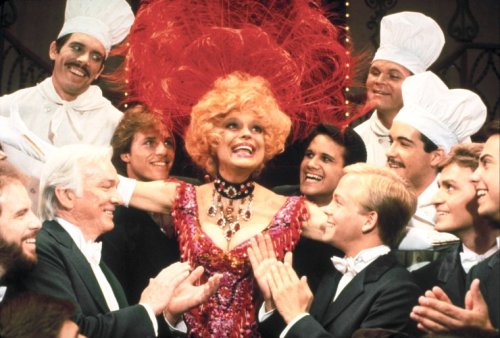
Carol Channing is so synonymous with Hello, Dolly! that producers have been hesitant to produce a major Broadway mounting without him.

Admittedly, part of my reason for wanting a Hello, Dolly! revival is that I have never seen it, and I'm curious what all the fuss is about.  But that larger-than-life reputation is also what makes Dolly such a prime candidate for a Broadway revival.  The show was a phenomenon when it premiered, and although its enduring popularity has led to plenty of regional and amateur productions, it has also caused the show to be looked down upon by certain segments of the theatre-going public.  Because the show is so associated with school productions and low-budget dinner theatre, a common conception is that it is not the type of show "serious" artists would waste their time on.

To which I say "hogcock!" (Tina Fey's brilliant portmanteau of "hogwash" and "poppycock," as heard on the dearly departed 30 Rock.Dolly is practically begging for a major New York production featuring the industry's best talent to restore the show's reputation as a fantastic example of musical comedy writing.  Also, the show is so closely tied to memories of Carol Channing - who originated the title role to Tony-winning effect and played it on Broadway and off for over 30 years - that it would be nice to see a different actress be given the chance to put her own stamp on it.

I believe the inevitable comparisons to Channing are the main reason no New York producer has been brave enough to tackle the show without her (the only Broadway outing not starring Channing was a brief, all black revival with Pearl Bailey in 1975).  You would have to cast a name star, someone who could sell tickets while still having the theatrical chops to actual pull off the role.  There was a brief period a few years back where producers were rumored to be courting Patti LuPone for a planned revival, but that production failed to materialize.  I would suggest a different bit of casting: Kristin Chenoweth.  The Tony-winner has not been shy about her desire to play Dolly, and I believe at this point in her career she has the mainstream clout to actual make a revival financially viable.  Like Channing, Chenoweth is a bit of an oddball comedienne, but in a very different mold - which would help limit comparisons - and she certainly has the comedic and vocal abilities to tackle the gargantuan role.  Plus, in my experience, seeing anyone perform their dream role is generally worth it, because they will pour every bit of themselves into the process.

Are you listening, Broadway?  Someone lock down Chenoweth before she goes back to Hollywood and her concert work.  Surround her with top tier theatrical talent and maybe one other bit of appropriate stunt casting to help guarantee ticket sales.  Don't skimp on the production costs, but don't go crazy either (please, no projections!).   I would be first in what I suspect would be a very long line to see her.

Tuesday, March 18, 2014

Glorious Music, Sung Gloriously

Review: The Bridges of Madison County

If Kelli O'Hara doesn't win the Tony for her work in Bridges, there is no justice in the world.

They simply don't make them like this anymore.  The Bridges of Madison County, the musical adaptation of the bestselling book currently playing the Gerald Schoenfeld Theatre, is the type of sweeping musical drama that has fallen out of favor in recent yearsUnabashedly earnest in its sentiment, the exquisitely scored Bridges features two central performances so transcendent they more than compensate for the musical's occasional listlessness via the sheer intensity of their star wattage.

The musical focuses on a brief but intense affair between Italian-American housewife Francesca (a positively radiant Kelli O'Hara) and National Geographic photographer Robert Kincaid (the smoldering Steven Pasquale, in his Broadway musical debut).  A war bride brought back to Madison County, Iowa by blue collar farmer Bud (Hunter Foster), Francesca has spent two decades being the dutiful wife and mother, so complacent in her role that she doesn't even realize how unfulfilled she feels.  When Robert innocently asks Francesca for directions to one of the titular covered bridges, a simple invitation to tea blossoms into a passionate, all-consuming love that forces Francesca to re-examine every choice she's ever made.

The material could easily descend in schmaltzy sentimentality, but never does thanks to the incredible contributions of composer Jason Robert Brown.  Brown rocketed to fame on the strength of his Broadway debut Parade, and his small but sterling body of work since then has only reconfirmed his early promise as one of the theatre's finest tunesmiths.  Brown's work on Bridges is that of a fully matured artist, able to write music that is irrefutably gorgeous in its own right while also perfectly servicing plot and character development.  He possesses a rare, precise understanding of the full potential of the human voice, and continually shows his knack for writing conversational yet deeply profound lyrics. Bridges finds Brown equally adept at writing lilting, mournfully introspective songs like "Another Life" (a knockout solo for, of all characters, Robert's ex-wife) and soaring, operatic duets like "One Second and a Million Miles" (the musical highlight of the evening, and possibly the entire Broadway season).  It is a staggering achievement, the kind of richly complex score that only comes around once every few years.

The fact that Marsha Norman's libretto for Bridges doesn't reach the dizzying heights of Brown's score is disappointing, although likely unavoidable given the virtuosic intensity of the songs.  Norman tries to expand the scope of the story beyond the central lovers, inserting subplots about Francesca's family traveling to the Iowa State Fair and a prying but ultimately supportive neighbor.  While interesting in theory, these subplots have a nebulous connection to the main story and aren't developed enough to be engaging in their own right.  Norman does an excellent job of establishing Francesca's disconnection from her family, to the point where the show doesn't give her a valid reason for not immediately running off with Robert (the show's primary source of dramatic conflict).  The script also hints at deeply rooted problems between Bud and his kids but fails to truly explore them, with the eventual resolution of these problems feeling forced and unsatisfactory.

Thankfully, the cast more than makes up for the script's shortcomings.  As Francesca, four-time Tony-nominee Kelli O'Hara is a revelation, giving the most nuanced performance of her illustrious career.  Through the subtlest glance or bit of stage business, O'Hara illuminates the myriad conflicting feelings going on inside Francesca, a free spirit who willingly entered into a mundane marriage and is finally confronting the consequences.  O'Hara makes Francesca's inner life readily apparent, creating a wholly sympathetic creature from a woman who in lesser hands would be easy to judge harshly.  And when she opens her mouth to sing, O'Hara reveals a vocal mastery on par with the greatest singers to ever grace the Broadway stage.  Her crystalline soprano has never been stronger, rich and soulful as it traverses the soaring heights and unexpected depths of Brown's score.  The fact that O'Hara has yet to be rewarded with Broadway's highest honor seems somewhat ludicrous given the unending reservoir of talent on display here, and hopefully this will finally be her year when the Tony Awards are handed out in June.

Surprisingly, Steven Pasquale proves every bit her equal, and watching his masterful portrayal of the lone wolf photographer makes one regret he hasn't had the opportunity to star in a Broadway musical before now.  Pasquale imbues Robert with a quiet charisma and smoldering sensuality that is intoxicating, easily explaining why Francesca would be drawn to him.  As O'Hara does with Francesca, Pasquale gives such a clear view into Robert's inner life that you instantly understand every choice he makes.  A beautiful sincerity permeates his entire performance, preventing the character from coming across as a predatory lout.  And when Pasquale unleashes his powerful baritone, the sheer force and beauty of it sends shivers down the spine.

Director Bartlett Sher stages the show with his typical precision, coaxing uniformly fantastic performances out of his cast.  As with his previous shows, Sher is occasionally seduced by the beauty of his material, letting certain moments last one beat too long.  The final fifteen minutes of the show drag (although this partly stems from the writing), and the constant scenery changes eat up too much of the evening's running time.  But credit must be given where credit is due; performances of the caliber O'Hara and Pasquale give don't just happen, and without Sher to help guide and mold them the two actors wouldn't be nearly as effective in their roles.

The fact that a maudlin novel like The Bridges of Madison County has been turned into such a powerful piece of art is a minor miracle, and despite some small missteps it makes for a worthwhile night in the theatre.  Kelli O'Hara proves once again that she is among the best singing actresses of all time, giving the kind of deeply felt, nuanced performance that theatrical legends are made of.  Steven Pasquale matches her note for note, and together they have a fiery chemistry that makes Jason Robert Brown's sterling compositions truly soar.  In an age of revivals and disposable works of escapist entertainment, it is truly refreshing to see and hear such a serious new musical on Broadway.