Showing posts with label bruce norris. Show all posts

Friday, December 21, 2012

Best Shows of 2012: #7


Best of 2012
#7 – Clybourne Park

Proof the white people should never, EVER attempt to "raise the roof."
 

Clybourne Park’s Broadway transfer almost didn’t happen.  Despite winning both the Pulitzer Prize for Drama and the Olivier Award for Best New Play, its planned Broadway bow was thrown into question when lead producer Scott Rudin withdrew from the production after a dispute with playwright Bruce Norris.  Thankfully producer/theatre owner Jordan Roth swooped in to save the show, as Clybourne Park’s mixture of black comedy and thought-provoking rhetoric made for a fantastically stimulating night at the theatre.

Set in the fictional Chicago neighborhood of Clybourne Park, Act I took place in 1959 and Act II took place in 2009.  The first half of the play concerned the imminent arrival of the neighborhood’s first black family (implied but never explicitly stated to be the Younger family from Lorraine Hansberry’s A Raisin in the Sun), while the latter portion dealt with a white family moving into the now all-black neighborhood.  This structure allowed the play to make many fascinating observations about how racism has and hasn’t changed over the past five decades, and if the first act seemed slow the near perfection of the second half not only elevated the evening but proved everything which preceded it was necessary to fully understanding what Norris had to say.

An actor himself, Norris managed to create two equally compelling sets of nuanced characters, making the racially-charged dialogue feel organic rather than didactic.  Norris also expertly avoided the trap of oversimplifying his arguments, letting every character make valid points which challenged the audience’s beliefs.  It was refreshing to see both black and white characters portrayed as equally right (and wrong), and that quality helped make Clybourne Park an especially satisfying encapsulation of the endlessly complex subject of race.  Even better, the play managed to tackle all of these topics while remaining laugh-out-loud funny, providing a welcome respite from the weighty matters being discussed.

The cast of Clybourne, all of whom originated their roles in the play’s world premiere Off-Broadway, was ideal.  Under the razor-sharp direction of Pam MacKinnon, the seven-strong company was a master class in ensemble acting, supporting and playing off one another with delightful ease.  With every actor tasked with portraying two characters (one in the first act, one in the second), the specificity and nuance in their characterizations became all the more impressive.  Their chameleon-like nature allowed the audience to fully immerse itself in the play’s world, and kept the focus squarely on Norris’ crackling dialogue.  The deserved winner of this year’s Best Play Tony, Clybourne Park gave audiences the perfect blend between art and entertainment, and that is why it is one of the Best Shows of 2012.


To read my full review of Clybourne Park, click here.

Wednesday, May 16, 2012

Everyone's a Little Bit Racist

Review:  Clybourne Park
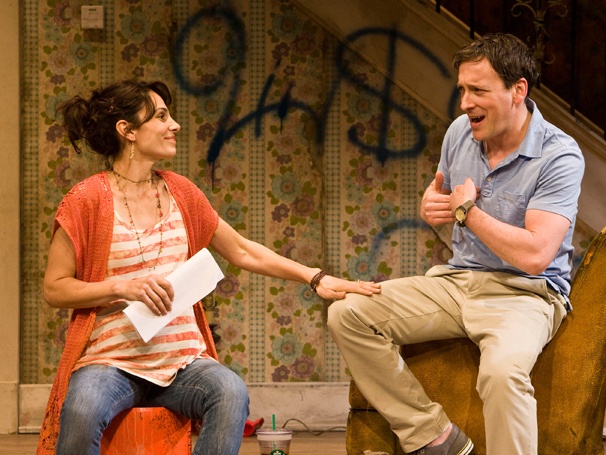
Annie Parisse and Jeremy Shamos in Clybourne Park.

While watching the first act of Clybourne Park, the new comedy by actor turned playwright Bruce Norris, you might find yourself wondering exactly what all the fuss is about.  While well written and ably performed, nothing about the play’s first hour seems to justify the mountains of praised heaped upon the work since its 2010 Off-Broadway premiere, which culminated in it winning of the Pulitzer Prize for Drama.  But by the time you reach the end of the howlingly funny second act, you realize that every word of Norris’ script was necessary to create the non-stop barrage of belly laughs and pointed sociological observations that make Clybourne one of the most entertaining and thought-provoking evenings of the current Broadway season.
Though set 50 years apart, both acts concern the impending arrival of unwanted residents in the fictional Chicago neighborhood which gives the play its title.  Wanting to escape the bad memories associated with their current home, 1950s suburbanites Bev (the excellent Christina Kirk) and Russ (the always outstanding Frank Wood) prepare to leave the all-white neighborhood of Clybourne Park in favor of greener pastures.  When it comes to light that the house has been sold at a deep discount to an African-American family (most likely the Youngers from Lorraine Hansbury’s seminal Raisin in the Sun, although that fact isn’t explicitly stated), Bev and Russ find themselves being harassed by their “concerned” neighbor Karl, played by a fantastic Jeremy Shamos. 
While Norris’ writing and Shamos’ acting ensure there’s more to Karl than just bigotry, it remains his overriding characteristic, and we are clearly meant to sympathize with the unseen black family.  Because of the distance provided by the period setting, it’s easy for us to sit in judgment of Karl, making the first act seem preachy and predictable despite its strong writing and convincing characterizations. 
But then Act II turns everything on its head by jumping ahead 50 years and reversing the races involved.  Clybourne Park, now an all-black neighborhood that has seen better days, is about to receive its first white residents in ages.  New owners Lindsey (Annie Parisse) and Steve (Shamos again, even better than before) plan to remodel the now historic building, prompting a meeting with the homeowners’ association that eventually leads to veiled accusations of racism and gentrification. 
Suddenly everything Norris wants to say becomes crystal clear, and you realize you had to sit through Act I to fully appreciate how far we have and haven’t come as a supposedly progressive society.  Norris expertly illustrates how even when talking about racism we don’t actually discuss it, since none of the characters really listen to what the others are saying, and all of the most racist comments come from characters voicing what they think is the subtext behind someone else’s words.  The second act is about everyday people who say occasionally racist things, and Norris forces us to ask the question, “Does that make them racist?”  The play offers no easy answers, making it all the more engaging.
The cast, who have been with the show since it’s Off-Broadway premiere, is uniformly excellent.  They all imbue their characters with a quirky specificity that adds volumes to the show’s charm without becoming grating or irksome, and everyone manages to create two fully realized people over the course of the evening.  The aforementioned Annie Parisse accomplishes the most drastic transformation – from a deaf housewife into a new aged “progressive” – with particular flair, and threatens to steal the show with her especially hilarious work in Act II.  Her Lindsey is a masterful satire on modern racism masquerading as liberalism, and yet Parisse plays her role without a hint of judgment on Lindsey’s increasingly misguided-if-well-intentioned worldview. 
Making her Broadway debut, Crystal A. Dickinson offers a fascinating look into the way modern racism is often a two-way street.  Her Lena devolves from a well-spoken individual with valid points into a vindictive, passive-aggressive antagonist who constantly invokes what has become colloquially known as “the black card.”  Her self-satisfied smugness as she gets under Lindsey and Steve’s skin is an excellent illustration of how any minority can take their righteous indignation too far, actually undermining their own cause in the name of advancing it.  (Dickinson also gets the biggest laugh of the evening with a joke that is, to put it mildly, extremely off-color.)
By the end of Clybourne Park, Norris has certainly earned his Pulitzer.  With a script that is simultaneously entertaining and intellectually stimulating, he leaves the audience with a lot to digest.  Along with the expert cast and superb direction by Pam MacKinnon’s (whose contributions cannot be underestimated), Norris’ script leaves you feeling satisfied and actually excited to go home and discuss the show with friends.  If that isn’t a hallmark of great theatre, then I don’t know what is.