Showing posts with label ticket prices. Show all posts

Thursday, February 19, 2015

Hamilton and the "Not-For-Profit" Off-Broadway Theatre Scene

This is as close as most of us will be able to get to Hamilton, Lin-Manuel Miranda's much ballyhooed new musical about one of America's founding fathers.

Anyone hoping to see Lin-Manuel Miranda's hotly anticipated new musical Hamilton better already have tickets. The show's thrice extended world premiere at the Public Theatre was essentially sold out even before the show opened to rapturous reviews on Tuesday night, making the chances of finding a ticket now about as likely as winning the lottery. Which is wonderful for Miranda, the actors, the Public Theatre, and the producers who are surely already plotting a Broadway transfer, but is maybe not the best thing for the Off-Broadway theatre scene.

Why? Because the Public Theatre, a non-profit which spends a great deal of time talking about making theatre accessible to everyone, has been charging almost Broadway level prices for the privilege of seeing this apparently groundbreaking new work. Regular tickets run $120, whereas Public Theatre members - who have already made a donation in support of this supposed not-for-profit - have access to tickets at the low, low price of $85. And as they have sold out an entire four month run, there isn't a whole lot to stop other Off-Broadway producers from attempting to charge the same thing.

To be fair, the Public is offering a daily "Hamilton for a Hamilton" lottery, with a whopping two whole seats per performance available for $10 each. And there is supposedly a $20 ticket lottery in the theatre's lobby prior to each performance "subject to availability," which in this case probably means "if anyone cancels." This to me does not sound like a company that is trying to make theatre accessible to the masses.

Now, obviously there are a lot of production costs involved with mounting a brand new musical, especially one with a large cast like Hamilton. Furthermore, I know that the Public has a whole season to finance, and many of their shows lack the sort of commercial appeal of Miranda's hip-hop historical opus. I'm sure a portion of the profits from Hamilton will go towards funding some of the Public's more obscure works, not to mention their hugely popular and much appreciated Shakespeare in the Park series (which remains free to anyone with the time and patience to wait in the legendarily long ticket line). And obviously they aren't charging more than the market can bear since, as previously mentioned, the show is legitimately sold out.

But I still find it sad and more than a little upsetting that Off-Broadway, and specifically not-for-profit Off-Broadway, has gotten so ridiculously expensive. What used to be known as a low cost alternative to the ever-more-expensive Broadway now routinely costs upwards of $100 for high profile shows, a price point most people can't afford more than once or twice a year if that. It's hard to totally blame the Public for charging what they're charging (obviously many people are happy to pay $120 a head), but at the same time it would be nice if a greater number of seats were set aside at a more affordable level for the vast number of people who don't have hundreds of dollars to spend on an evening's entertainment. Hamilton has a gloriously multicultural cast and a musical style that could attract vast segments of the population who don't normally see theatre, but for a multitude of reasons way too complex to address in this blog many of the people who look like the cast of Hamilton couldn't even begin to afford a ticket.

The New York theatre scene is currently in the midst of a vicious, self-destructive cycle that will take some drastic measures to change, and Hamilton is just the latest example. High ticket prices keep all but a narrow segment of the population from being able to see theatre, a segment that if we're being honest is getting older and dying out without a new generation of patrons to replace them. These high prices put pressure on producers to give audiences their money's worth in the form of needless spectacle and too many works that pander to the lowest common denominator. After all, if shows cost millions of dollars to mount, producers are understandably reluctant to tackle projects without a decent chance of financial success, which generally rules out more adventurous works and less established creative voices. Because the industry is notoriously tight lipped about each show's actual costs, it's difficult to know where cuts and changes can be made, but someone needs to tackle this problem before live theatre becomes just a diversion for the wealthy that has little cultural impact or significance to the general population. If a major non-profit with a stated focus on accessibility like the Public isn't willing/able to lower prices, then it may already be too late.

Tuesday, March 27, 2012

How to Increase Full Price Ticket Sales: A Suggestion

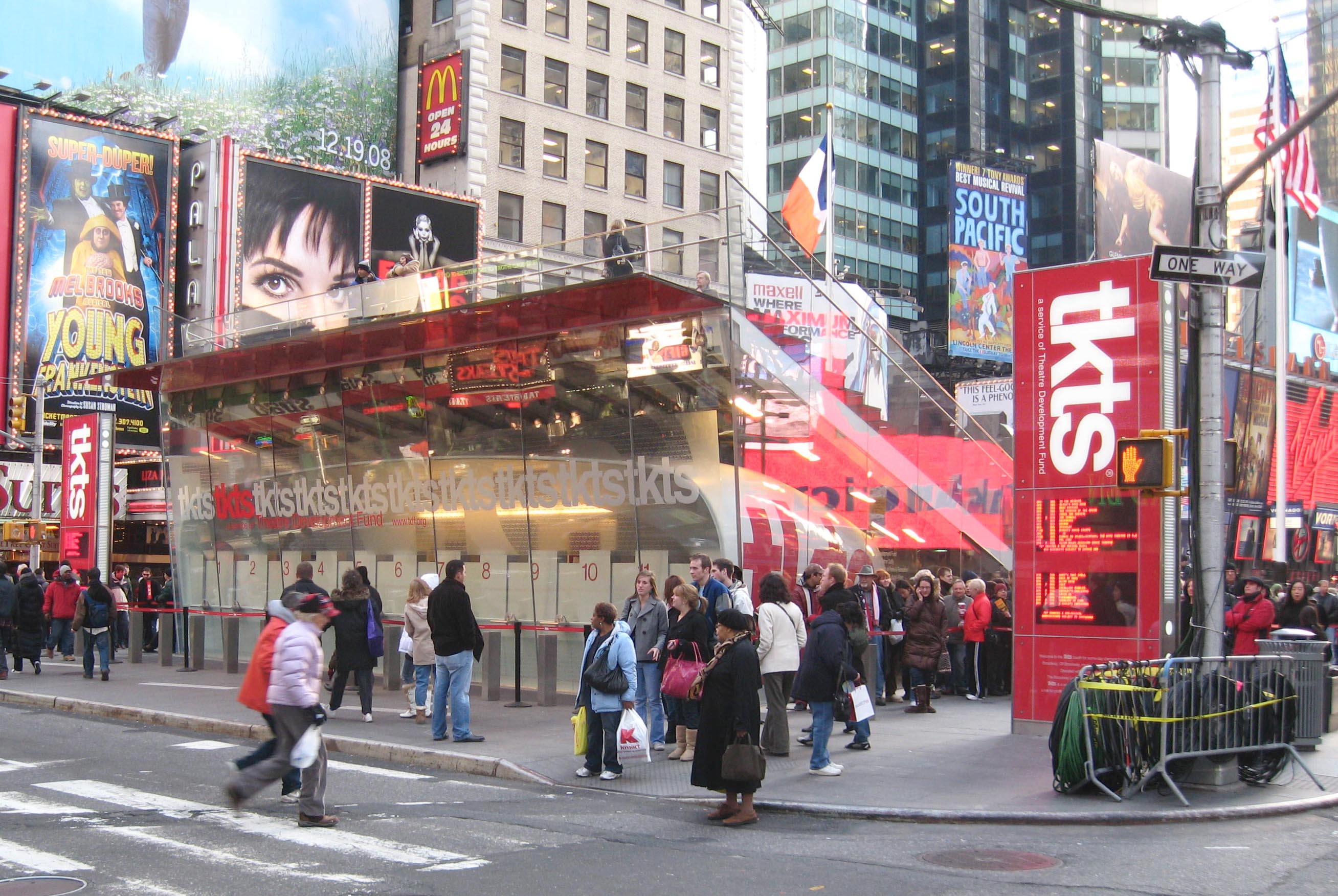
Are discount tickets actually driving the cost of full priced seats up????  News at 11.
As far as I know, no one (except perhaps the super-rich) is happy with current Broadway ticket prices.  Most people, especially the struggling artists who would probably be Broadway’s biggest supporters if they weren’t living paycheck to paycheck, think that show tickets cost too much.  Unless you manage to nab one of the extremely limited lottery or rush tickets to particular performance, you’re looking at spending at least $70 and more likely $100+ to see a Broadway show.  And the producers who are financing said shows keep raising those prices, not necessarily because they are evil money grubbing monsters, but because the running costs of theatre continue to escalate.
Now, getting said costs under control should be the producers’ first order of business, but that is a subject for another blog entry.  I would argue that one of the main reasons ticket prices have skyrocketed over the past decade is the abundance of discount ticket websites and venues.  With so many places selling tickets at 30%-50% off, producers have to plan on not getting full price on the majority of their ticket sales.  Let’s say, for example, that a certain show needs to sell the majority of its seats for $75 each in order to be reasonably successful, but audiences are so used to getting a discount that they won’t buy them at full price.  So producers mark the face value of the ticket up to $135, knowing that it will likely be sold at a discount the brings the price back down to the $75 they originally wanted for it.
Now, there’s a certain segment of the population that will only buy things at a discount.  They aren’t concerned with the actual price of an item as much as how much they saved off the original price.  These people, as proved by shows like Extreme Couponing on TLC, are not normal and cannot be reasoned with, and would probably happily buy a $150 ticket if they were told it was worth $300.  But a good number of people, myself included, aren’t so much concerned with how much we’re saving as the final dollar amount. 
The reason these people aren’t buying full priced tickets (and any producer will tell you they’d much rather sell full priced tickets than discounted ones) is simple: the current top tier ticket price of $135 a seat is simply too much for a lot of people to afford in this still shaky economy.  Now, you could argue that for these people there are the mid- (around $90) and lower-level ($67-is) ticket prices.  Unfortunately, for most shows there are only two rows of seats available for the lowest ticket price, and they are in the back of the house and sell out quickly.  The privilege of being able to sit slightly closer – because face it, three rows from the back is by no means “close” to the stage in most Broadway houses – and not have to buy months in advance is apparently worth an extra $25.
And this is the problem.  $90 is a lot of money to spend on two and a half hours of entertainment.  And even those of us who would gladly pay to see live theatre don’t necessarily have the luxury of spending that much money regularly.  $90 is costly enough to make most people stop and think, and when we realize that we’re sitting basically in the back of the house for a show we may not even enjoy, we tend to decide against spending it. 
So what’s the solution?  I propose changing the pricing scale so that the majority of the mezzanine/balcony retails for the low-level ticket price of $60.  Obviously, the front few rows are prime seating and can remain at their current prices (because some people can and will spend that much on a show without a second thought, and there’s no reason producers shouldn’t take that customer’s money).  Because for me, and I would imagine for a lot of people, the convenience of being able to buy in advance, rather than waiting in rush lines all day or hoping you win the lottery, is worth that much money.  Especially when you consider that most lottery and rush tickets are between $30 and $40 anyway.  I would gladly pay an extra $20 to have a better seat and know that I will actually get in to see the show I want to see.
I suspect that if Broadway shows instituted this practice, they would see a major increase in full price ticket sales, and also advance ticket sales.  That would give producers the ability to more effectively budget a production and to plan further out, rather than slashing a bunch of tickets at the last minute and hoping they sell.  It would make live theatre a more attractive option for small groups of people, who can’t afford $100 a person and can’t count on getting three or four tickets if they do go the lottery/rush ticket route.  And it would make the theatre going experience more pleasant, which would increase the amount of repeat business.
Now, not being a Broadway producer, there may be other factors that are keeping this plan from working.  But I think from a logic standpoint, it makes a lot of sense.  Yes, people will gladly pay $150 to see The Book of Mormon, but that show is the exception that proves the rule.  In most cases, you’d be better off lower the ticket price to a more palatable level, and then (surprise!) your show just might run long enough to turn a profit.