Showing posts with label shakespeare in the park. Show all posts

Monday, August 10, 2015

Fear No More, for Shakespeare in the Park Has Done It Again

Review: Cymbeline

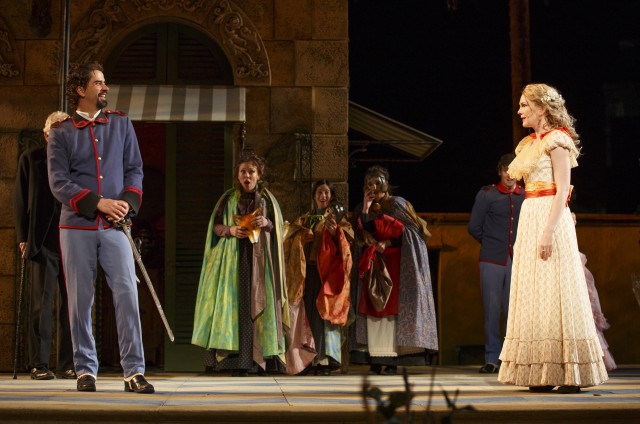
Hamish Linklater as the oafish Cloten and Lily Rabe as the pure-hearted Imogen in Shakespeare in the Park's latest production of William Shakespeare's Cymbeline.

Director Daniel Sullivan and actors Lily Rabe and Hamish Linklater have become beloved staples of the Public Theatre's annual productions at Central Park's Delacorte Theatre, tackling some of Shakespeare's greatest works with an unfailing dedication to excellence. This season the three acclaimed artists have teamed up for a pared-down version of Shakespeare's late career romance Cymbeline, and the results are quintessential Shakespeare in the Park: superbly acted, highly accessible, and fully embracing the open air setting for an evening of theatrical magic.

One of the Bard's less performed works, Cymbeline is actually the story of the title character's daughter, Princess Imogen. Against her father's wishes, Imogen has married a commoner named Posthumus Leonatus, a move which so outrages King Cymbeline that he banishes Posthumus to Italy. With Posthumus out of the way, the Queen - who is not Imogen's mother but Cymbeline's second wife - attempts to secure her family's royal position by marrying her loutish son Cloten to the princess, who despises him. Meanwhile, Posthumus makes a wager with the boastful Italian Iachimo that Imogen's heart is so pure it is incorruptible, leading Iachimo to travel to England and attempt to seduce the fair princess. There is also a subplot involving a war between Rome and Britain over unpaid monetary tributes, not to mention the mystery of Cymbeline's missing sons.

The plot is one of the most complex in all of Shakespeare, but thanks to Sullivan's expert direction and uniformly strong performances from the cast, this Cymbeline is easy to follow even without the benefit of the synopsis included in the program. This high level of accessibility is even more impressive given Sullivan's decision to double and triple cast most of his ensemble of 9 to fill the play's 16+ speaking roles. Smart costuming by David Zinn and distinctive hair and wig designs by Charles G. LaPointe combine with the physical malleability of the cast so that there is never any confusion over who is playing whom and when, adding to the production's magical quality and the evening's general sense of fun.

Rabe has tackled many of Shakespeare's most famous ingénues during her time in the park, and her Imogen is every bit the equal to her Portia and her Beatrice from seasons past. Rabe instantly commands the stage with her unmistakably regal presence, bringing an inner fire to Imogen while at the same time keeping the character's melodramatic leanings in check. When Rabe espouses the play's many rich and varied declarations of love she is utterly believable, and her sincerity grounds a work filled to the brim with credibility-straining coincidences. The luminescent actress can also access deep reserves of sorrow at the drop of a hat, crying giant, glistening tears during several of the production's more heart-wrenching moments.

Rabe's real-life partner Linklater tackles the dual roles of Imogen's exiled husband Posthumus and her unwanted suitor Cloten. As Posthumus, Linklater is an appealing romantic lead who is also capable of portraying the deep-seated rage that propels the character's actions through much of the second half (like Othello, Posthumus is a tad too quick to believe the worst about his wife). But Linklater's true showcase and the actor's clear favorite is the impossibly dim Cloten, who he plays to hammy perfection. Linklater fills Cloten's scenes with side-splittingly funny business while finding every conceivable joke in the character's dialogue, and his over the top rendition of "Hark, Hark the Lark" is one of the evening's highlights. (All the play's original music is provided by Next to Normal composer Tom Kitt, who offers work as strong and melodically interesting as any he's written for the musical stage.)

Patrick Page is wonderfully imposing as the title character, tiptoeing right up to the line of absurdity without actually crossing it. Kate Burton is suitably despicable as his second wife, clearly having a blast with the Queen's conniving ways. The surprise with Burton is that she is perhaps even more entertaining and convincing as Belarius, the disgraced nobleman who has been secretly raising Cymbeline's missing sons for the past twenty years. Four time Tony-nominee Raul Esparza struggles to find the right balance between Iachimo's smarmy, off-putting personality and the play's comedic leanings, failing to find the humor in his character's introductory scene and generally being a bit too terrible of a person for audiences to fully surrender to the evening's many charms. It is by no means a bad performance, but with Sullivan and the rest of his cast choosing to highlight the text's humor Esparza stands out in the wrong way.

After 53 summers at the Delacorte, Shakespeare in the Park has become a New York institution, bringing high quality productions of some of the greatest works in the theatrical cannon to the populace free of charge. Cymbeline is yet another triumph for director Sullivan and lead actors Rabe and Linklater, proving that this trio can work their magic on the Bard's more problematic plays just as easily as they can on populist classics like Much Ado About Nothing or The Merchant of Venice. Despite the intricate plot, this production is a marvel of accessible clarity without once sacrificing the complexities of Shakespeare's beautiful language or his observations on human nature, and is highly recommended for both Shakespearean scholars and the layperson alike.

Thursday, June 26, 2014

Much Ado About Shakespeare, and Deservedly So

Review: Much Ado About Nothing

Oh Benedict (Hamish Linklater), that sword is no match for Beatrice's (Lily Rabe) sharp tongue.

When discussing the merits of Shakespeare's various comedies, the ubiquitous Twelfth Night is generally agreed upon to be the best, a distinction I've always found puzzling for a play that is typically only haphazardly funny (the recent top-tier Broadway revival notwithstanding).  For my money, the acerbic wit of Much Ado About Nothing is a much more consistent generator of laughs, while also exploring one of the most complex romantic relationships in all of the Bard's cannon.  The side-splittingly hilarious and immensely satisfying Shakespeare in the Park production currently playing the Delacorte Theatre makes a strong case for Much Ado's merits, and provides the summer tradition with its strongest showing since the Al Pacino-led Merchant of Venice several seasons ago.

At the heart of Much Ado About Nothing's plot are the dueling, would-be lovers Beatrice and Benedict, self-professed bachelors who enjoy nothing more than using their razor-sharp wits to devise ever more creative insults for one another.  As a lark, the pair's friends decide to trick them into becoming an item by convincing each one that the other is secretly in love with them.  This well-intentioned scheme plays out during the group's extended stay at nobleman Leonato's Italian villa, while the young soldier Claudio prepares to woo and wed Leonato's daughter Hero.  The festivities threaten to grind to a halt when prince Don Pedro's bastard brother, Don John, decides to spread false rumors about Hero's fidelity, providing the play with some high drama to counterbalance all the laughs.

Much Ado ultimately lives or dies by the strength of its Beatrice and Benedict, here played by Shakespeare in the Park stalwarts Lily Rabe and Hamish Linklater.  Both are sensational in their respective roles, mining these iconic characters for all of their depth and comedic potential.  Rabe, Tony-nominated for her role in the aforementioned Merchant when it transferred to Broadway, is giving another award-worthy performance as the wickedly funny Beatrice.  Rarely has Shakespeare sounded as elegant and natural as it does when Rabe performs it, with the versatile actress proving once again that she is one of our greatest living classical performers.  Rabe also displays a searing emotional honesty during the play's more dramatic sections, and her chemistry with Linklater is palpable.

As Benedict, Linklater doesn't possess the same precision as his costar, opting for a looser and more contemporary portrayal.  This difference in style in no way diminishes Linklater's effectiveness, and line for line the malleable actor gets the most laughs of anyone in the cast.  A rubber-limbed clown, Linklater is especially winning during his many bouts of physical comedy, and watching him clumsily eavesdrop on his companions from the limbs of an orange tree is one of the evening's best sustained laughs.  Yet Linklater also knows when to dial down his antics for the play's more somber moments, and he leaves no doubt that ultimately, Benedict and Beatrice both love and are meant for one another.

Rabe and Linklater are surrounded by a stellar group of supporting actors that make this Much Ado a glowing example of ensemble acting.  Ismenia Mendes and Jack Cutmore-Scott are appropriately naïve is the young lovers Hero and Claudio, respectively, with Mendes in particular showcasing great depth during her character's public shaming.  John Glover is pitch perfect as Leonato, turning a largely expository role into a fully fleshed out character and one of the evening's standout performances.  Brian Stokes Mitchell, a Tony-winner known for his work in musicals like Ragtime and Kiss Me, Kate, reminds everyone just what a fantastic actor he is as the princely Don Pedro, Benedict's commanding officer.  (Not one to look a gift horse in the mouth, the production does provide Mitchell the chance to show off his legendary baritone in a first-rate musical interlude composed by Tony-nominee David Yazbek, who wrote all the production's delightful incidental music.)  And Game of Thrones' Pedro Pascal is suitably slimy as Don John, even though the character is one of Shakespeare's most underwritten villains.

The ringleader of these merry players is director Jack O'Brien, who despite a prolific career that encompasses almost every style of theatre imaginable is making his Shakespeare in the Park directing debut.  Put simply, O'Brien nails it, keeping the laughs coming fast and often but expertly shifting gears to a more serious tone when necessary.  O'Brien's fluid staging makes great use of John Lee Beatty's gorgeous two-story set, and the Tony-winning director adds just enough physical comedy to be punch up the laughs without distracting from the beauty of Shakespeare's language.  Despite the play's nearly three-hour runtime O'Brien never lets the energy start to drag, expertly juggling the multiple tones and plotlines with the assured hand of an old pro. 

O'Brien has also succeeded in the all-too-rare feat of updating the setting (in this case, moving the action to early 1900s Sicily) in a way that feels both natural and necessary.  Aided by stunning design work from the aforementioned Beatty and costumer Jane Greenwood, O'Brien makes the Italian milieu its own character which enhances rather than detracts from the action.  From the preshow stage business (charmingly executed in Italian) to a gorgeous masquerade to a thrilling second act storm sequence (vastly aided by Jeff Croiter's lights and ACME Sound Partners' sound design), O'Brien and his team transport us from Central Park to the Italian countryside.

Without a marquee star like Pacino, there's little chance this production transfers to Broadway, although it's certainly strong enough to survive on the Great White Way.  This Much Ado is a shimmering production of one of the Bard's finest comedies, headlined by two of the city's most accomplished Shakespearean actors.  Rabe and Linklater are as good a Beatrice and Benedict as you're likely to find, and the talent surrounding them is just as astounding.  Thanks to Jack O'Brien's nimble direction, this effervescent outdoor production proves to be a highlight of Shakespeare in the Park's recent history.  Much Ado About Nothing only runs until July 6th, so brave the lines and snag your free tickets before these unlikely lovers dance off into the sunset.

Thursday, August 9, 2012

Satisfaction in the Park with Sondheim


Review:  Into the Woods
Donna Murphy in a performance that would surely be Tony-nominated if it were eligible (here's hoping for a transfer!)


After a troubled preview period riddled with rain delays, cancelled rehearsals, and at least one Twitter scandal, the star-studded Shakespeare in the Park production of Into the Woods has finally opened at Central Park’s Delacorte Theatre, and the results are worth the wait.  While not perfect, this reimagining of the Stephen Sondheim-James Lapine musical avoids the long shadow cast by the beloved Broadway original and establishes the work as a modern classic capable of withstanding wildly different interpretations without losing its sizeable charm.
For those unfamiliar with the show’s premise, Into the Woods tells the story of a childless Baker (Tony-winner Dennis O’Hare) and his Wife (Oscar-nominee Amy Adams) who are tasked with gathering four mystical items by the mysterious and semi-malevolent Witch (Tony-winner Donna Murphy).  If they can find the items in three midnights’ time, the Witch will lift the curse she has placed upon them and grant them a child.  Along the way, the Baker and his Wife cross paths with famous fairy tale figures like Cinderella, Little Red Riding Hood, Jack (and his beanstalk) and Rapunzel.  And while all of the characters eventually get what they wish, the actions taken during their journeys come with unforeseen consequences that raise the question of what happens after Happily Ever After.
Based on a 2010 production at the Regent’s Park Open Air Theatre in London, this Into the Woods is a wholly contemporary take on what has previously been treated as a timeless tale.  Director Timothy Sheader, repeating his work from the London production, has added a framing device in which a runaway child (played by an accomplished Jack Broderick) assumes the role of the story’s Narrator and enacts the Baker’s story.  Having a child in such a pivotal role highlights the underlying themes of what parents teach their children and the loss of innocence, while also justifying the very contemporary mannerisms of the key players.  Emily Robholz’s costumes emphasize the updated setting with an appealing hodgepodge of modern dress and timeless clothing.
Sheader takes his concept and runs with it, letting it and the outdoor setting influence every aspect about the production.  Seamlessly blending in with the Central Park setting, John Lee Beatty’s multi-tiered set provides an excellent canvas for Sheader to work with, and the director deploys his actors onto the various crosswalks and ladders with assurance and style.  He also eschews modern stage trickery for something more simplistic and ultimately more satisfying, with his representations of Jack’s beanstalk and Giant proving particularly striking (both drew audible gasps at the performance I attended).
The cast is such an embarrassment of riches it’s difficult to know where to start, but Donna Murphy is particularly impressive as the Witch.  Filling the vast Delacorte Theatre with the presence of a true star, Murphy is transcendent in the role, from her mesmerizing first entrance until the final curtain.  Her initial wow factor is due in no small part to the ingenious make-up design of Joe Dulude II, which transforms her into a gnarled old crone on the verge of becoming one with the forest that surrounds her, but Murphy is too good an actress to let the costume do all the work.  She contrasts her frightening appearing with a deft comic delivery that mines the humor in Lapine’s book while remaining an imposing antagonist, and even after her transformation into a more conventional form Murphy remains transfixing.  And when she sings the haunting “Last Midnight,” Murphy propels the song to the showstopping heights it has always aspired to but never quite achieved.
Few could hope to equal Murphy’s brilliance, but that doesn’t mean the rest of the cast is anything less than incredibly compelling in its own right.  Amy Adams’ inherent charm serves her quite well as the put-upon Baker’s Wife, and although it takes her a while to find the show’s rhythm she becomes quite compelling by the end.   She certainly earns her right to perform alongside such accomplished theatre stars, and her singing voice is quite strong for someone with little formal training. 
Unfortunately for Adams, her main scene partner is the woefully miscast Dennis O’Hare, who proves to be the one weak link among an otherwise fine cast.  O’Hare, so adept at playing insane and/or eccentric characters, struggles in the everyman role of the Baker, often coming across as harshly sarcastic or obnoxiously neurotic.  He and Adams lack the chemistry needed for the audience to fully invest in their characters, and it is telling that O’Hare’s strongest moments occur when Adams is offstage.  The fact that the original Baker, Chip Zein, plays the Mysterious Man and often appears onstage with O’Hare serves as an unintentional reminder of the latter’s shortcomings, and you can’t help but feel the pair would be better served by switching roles.
Recent Tony-nominee Jessie Mueller does a fantastic job as Cinderella, convincingly conveying a mix of school-girl giddiness and underlying sadness that makes her the most grounded of all the major players.  Gideon Glick fully commits to the enthusiastic but dim-witted nature of Jack in an endearing portrayal that is central to the show’s underlying theme of children growing older.  As his female counterpoint, Sarah Stiles’ Little Red Riding Hood is hilariously daffy, but avoids the role’s tendency towards obnoxiousness by offering glimpses of the scared and confused young woman beneath the cloak.
The production’s few missteps occur when the director and cast favor the overt rather than the subtle.  Cinderella’s two Stepsisters are so over-choreographed that it becomes distracting, especially given their tangential importance to the plot and the lack of any real dance among the other characters.  Sheader and his cast play up the sexual undertones in the Little Red Riding Hood story to the point where they feel imposed on the tale rather than an essential part of its meaning, which undermines the work’s brilliantly subtle subversion of fairy tale tropes in the first act.  And the show runs into tonal problems at the start of its second half, when things awkwardly shift from straightforward musical comedy into more serio-comedic drama (to be fair, this is also the one area where James Lapine’s book could use some tweaking).
Overall, the only people who won’t find anything to enjoy about this Into the Woods are the purists who insist that all mountings of the show be perfect duplicates of the original production.  For everyone else, this version offers a fascinatingly new take on the material that stays true to its intention, complete with a top-tier cast and a towering central performance by the incomparable Donna Murphy.  Into the Woods is some of the best theatre of the summer, and that fact that it remains free to anyone willing to brave the long lines is added icing on the cake.  Go see it before it’s gone.

Wednesday, July 25, 2012

She Knows Things Now

Hi, I'm Broadway's Morgan James, and I apparently have no idea how the internet works.


I had another topic in mind for this blog entry, but then I saw this story about the uproar Broadway actress Morgan James caused by tweeting her negative reaction to Shakespeare in the Park’s Into the Woods and felt compelled to write about that instead.
If you’re too lazy to read the linked article, just know that Ms. James attended last night’s first public preview and was decidedly unimpressed.  She said as much via Twitter, criticizing the acting and musicians, and the rest of the Broadway community jumped down her throat for saying such negative things in a public forum.  James has since deleted the offending tweets and half-heartedly apologized, but maintains she is entitled to express her opinion. 
This is a subject that is close to my heart, as I am a theatre professional (or at least semi-professional with professional friends) who has a blog full of show reviews, and not all of them are complimentary.  I agree that James is entitled her opinion and that no one can force her to like a particular show, but I also agree with most people that she is in the wrong for tweet her displeasure.  Why?  In the spirit of the show, I have listed her offenses in the form of fairy tale morals.

1)      The difference between a thought and a tweet is a tweet can cause a commotion


Twitter is a social landmine.  The website’s format encourages users to tweet whatever thought pops into their head immediately, and then keeps a record of that thought forever (or at least until you go back and intentionally delete it).  This causes many users to forgo the mental filter they would use during face to face conversation, and the text format means you can’t claim you were misheard or pretend you didn’t say something.  This has been the bane of many celebrities’ existence, and yet after countless instances of people being taken to task for ill-considered tweets James seems surprised the same thing happened to her.

Also, being limited to 140 characters makes it very difficult to back up any assertions with examples.  If James had been having a face to face conversation (or just posting to something that allowed her more words to express herself), she could have provided some concrete examples of the flaws she was talking about.  But without examples, it comes across as if James is just being catty, especially since most performers give negative critiques in a way that seems to imply they would have done a better job. 


2)      A first preview is not opening night


The entire point of having a preview period is that it gives cast and crew time to work out the production’s kinks.  As a veteran of several Broadway shows, which often have three or four weeks of previews, James should have understood that what she saw last night was not meant to be the final product.  By choosing to attend the first preview, James essentially agreed to see a work in progress, and should have tempered her expectations accordingly.


3)      The harsher the words, the quieter you speak them (especially during previews).


Because elements of the show are still in flux during previews, being too harsh on them is generally frowned upon.  There is still time for things to improve, so speaking out against the show before it is finished makes James appear immature and rude.  This is why critics don’t see shows until the week before opening, and even then they hold off on publishing their judgments until after the production opens out of respect for all the hard working individuals involved.  Yes, theatre professionals love to gossip about troubled musicals, but most have enough tact to engage in those types of conversations in the privacy of their own homes (or a nearby bar) rather than on the very public internet.


4)      The younger the critic, the less people care


This entry could also be entitle, “Respect your elders.”  Simply put, Morgan James hasn’t earned the right to publically bash her fellow artists.  She may have Broadway credits, but you know what they are?  Ensemble in The Addams Family (a bad show), Wonderland (a worse show), and Soloist in Godspell (a decent show).  Nothing about her resume or body of work gives her any kind of industry clout or respect, especially when she is saying Tony winners and Oscar nominees don’t know how to act.  You have to earn the right to speak out against your peers, and James is a long way from being able to insult the abilities of other artists. 

When Stephen Sondheim decided to trash the Porgy and Bess revival before it had even started its out of town tryout, he did so with 60 years’ experience, multiple Tony Awards, a Pulitzer Prize, and a body of acclaimed work that demonstrates he knows a thing or two about what constitutes good musical theatre.  And even with all that expertise, a lot of people still felt he was out of line (although they promptly forgave him, as he’s still Stephen-freaking-Sondheim).  James’ dubious career doesn’t afford her the type of leeway given to the writer of acknowledged masterpieces like Sweeney Todd, Company, and yes, Into the Woods.


Hopefully this incident has taught James (and other performers) that there is a time and a place for peer criticism, and Twitter is not it.  The only acceptable public forum for such criticism is a review, which exists expressly for that purpose and has a format that allows you enough space to back up your assertions with examples.  Other than that, negative critiques should be reserved for private conversation among peers, preferably after the show is opened and therefore “finished.”  Otherwise, keep your damn mouth shut.

Friday, June 22, 2012

High Art for a Balmy Summer Evening


Review:  As You Like It

David Furr, Renee Elise Goldsberry, and Lily Rabe in Shakespeare in the Park's As You Like It


The problem with producing Shakespeare is that the Bard only wrote so many plays, which are mounted so often that making any individual production stand-out requires a combination of fantastic actors and strong directorial vision.  Thankfully, the As You Like It which just opened Shakespeare in the Park’s 50th anniversary season features both in equal measure, breathing (mostly) new life into this oft-produced comedy.

For those unfamiliar with the plot, As You Like It begins when the evil Duke Frederick banishes a host of people, including his niece Rosalind and his daughter Celia, to go live in the Forest of Arden with his usurped brother Duke Senior.  Just before her exile Rosalind meets and falls in love with the young Orlando, who also ends up in the Forest of Arden for separate reasons.  Unfortunately, in order to avoid execution Rosalind has disguised herself as a boy, and when she and Orland meet again he does not recognize her.  What follows is a series of comic misunderstandings involving a host of supporting characters which eventually sort themselves out just in time for the play’s ending.

As You Like It has never been my favorite Shakespeare, but remains a popular choice for theatre companies due in part to the showcase it offers for the actress playing Rosalind.  This production is blessed with the sensational Lily Rabe in the central role, who gives a dynamic performance that expertly balances comedy and pathos.  Intelligent and charismatic, Rabe lights up the stage with a captivating interpretation that proves she is one of the most gifted actresses of her generation by being entertaining, moving, and most of all truthful.  It is unfortunate that Rosalind isn’t more of a presence in the first act, as the production sags slightly when Rabe isn’t around to elevate it.

That is not to discredit the efforts of her uniformly excellent costars, who combine to create one of the finest acting ensembles of the year.  As Orlando, David Furr projects a humble and quiet confidence that keeps his lovelorn youth from becoming insufferably saccharine (even the other characters tease Orlando about his overly earnest proclamations of love).  As Rosalind’s cousin and best friend Celia, Renee Elise Goldsberry has excellent chemistry with Rabe and provides a welcome contrast to Rosalind and Orlando’s platitudes.  Oliver Platt makes for a hilarious Touchstone, the court jester who accompanies the cousins into the forest, and the veteran actor is particularly skilled in making the Shakespearean wordplay comprehensible to a modern audience.  And as the melancholy Jaques, Stephen Spinella gives an ingeniously underplayed performance which leaves the audience in stitches (he also does an excellent job with the famous “Seven Ages of Man” speech).

The glue holding this entire ensemble together is director Daniel Sullivan, who scored a similar triumph two years ago with the Al Pacino-led Merchant of Venice.  Sullivan is a fantastic director with an excellent understanding of pace and narrative clarity, and even those unfamiliar with the play’s twists and turns should have no trouble following this production.  Sullivan coaxes wonderfully layer performances out of his actors, and continues to be a wonderful asset to the Public Theatre in general and Shakespeare in the Park in particular.

John Lee Beatty’s set design does a great job of evoking the play’s whimsical setting, and it’s a shame the Delacorte’s thrust staging doesn’t allow him to bring his intricate forest setting further downstage.  Jane Greenwood’s period costumes are quite beautiful, and the original grassroots score by Steve Martin does an excellent job of setting the production’s mood. 

Overall, this As You Like It is a first-rate production of one of Shakespeare’s proven crowd-pleasers, and is an excellent way to spend an evening in Central Park.  Lily Rabe’s Rosalind is a marvel, and Daniel Sullivan’s assured direction helps reinvigorate this comedy even for those who are intimately familiar with it.  The impending arrival of the highly anticipated Into the Woods will likely prevent As You Like It from extending its limited run, so any interested parties should rush over to the Delacorte to catch it before it’s gone.