Thursday, October 18, 2012

Defying Gravity, Almost 9 Years Later


Review:  Wicked
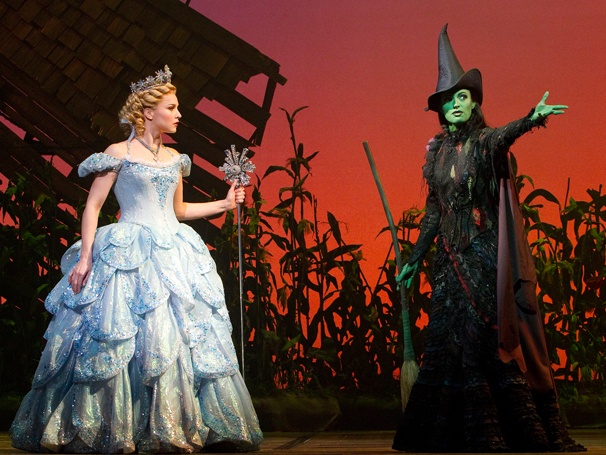
Chandra Lee Schwartz as Glinda and Jackie Burns as Elphaba in the Broadway production of Wicked.


Wicked is a show I’ve been interested in revisiting for quite some time.  After seeing the original Broadway cast during the summer of 2004, I left the show entertained but not blown away, and honestly wasn’t quite sure what all the fuss was about.  But after seeing the show do years of sell-out business in New York and on the road, while also developing an incredibly loyal fan community, my curiosity started getting the best of me.  Wicked has become not just a hit show, but a phenomenon that has struck a chord with millions of people, and I began wondering if there was something I had missed the first time around.  So eight years after my initial viewing, I headed back to the Gershwin Theatre this past weekend to view the Land of Oz with fresh eyes.

Seeing the show again, I can’t say my overarching opinion of it has changed much, but I will admit to appreciating Stephen Schwartz’s magnum opus more now than I did in 2004.  Now that the hype around the show has calmed down, it’s easier for me to evaluate the show own its own merits.  During that initial viewing, the show was widely considered a guaranteed winner for the Best Musical Tony, and as such I was evaluating it against some very high expectations (Wicked lost the award to Avenue Q just days after my first viewing).  I found Elphaba’s story to be full of big-budget spectacle but light on heart, which made the entire enterprise feel somewhat empty.

Wicked remains big and loud, but this time through I saw a lot more heart than I originally gave the show credit for.  The relationship between Elphaba and Glinda is one of the more complex musical theatre dynamics in recent history, and the musical does a good job hinting at the political implications of Gregory Maguire’s source novel without becoming bogged down with polemics.  Book writer Winnie Holzman did a great job of condensing that sprawling text into something more manageable and inherently theatrical, while still finding room to have a great deal of fun with the references to Dorothy’s concurrent adventures.  But keeping Dorothy offstage causes the second act to feel choppy, and I’d say the show’s greatest flaw is that it doesn’t satisfactorily pay off all its various plot threads.  But Holzman does give at least some indication how all of those stories turn out, which is more than can be said for a lot of lesser musical librettists.

The score is probably the best Stephen Schwartz has ever composed for the theatre, and he probably should have won his long-overdue first Tony for it.  The only explanations for his loss in the Best Score category are the absolute clunkers written for the Wizard, since the rest of the score displays an inventive adventurousness that holds up well to repeated listening.  Wicked is also one of the few shows where you can see exactly what your $135 ticket price is going toward, with lavish costumes and sets that are impressive for both their scale and attention to detail.  Joe Mantello’s staging moves everything along at a pace that never sags but still allows time for quiet character moments, which when played correctly supply the heart every good piece of theatre requires.

One concern I had going into the show was how the current cast would stack up to the near-legendary performances of the original company.  Such comparisons may not be fair but they are bound to happen, especially when this reviewer actually saw said performances and is not just extrapolating them from what’s preserved on the cast recording.  Happily, this current company acquits itself of the material quite well, with one major exception that I’ll address in a minute. 

Jackie Burns does a great job of fleshing out the different layers of Elphaba, the “Wicked” Witch of the West, making a clear transition from shy youth to impassioned freedom fighter while preserving the character’s internal logic.  Burns’ portrayal makes the show firmly (and rightfully) Elphaba’s story, rather than splitting the focus between her and Glinda as the original cast did.  Also, Burns has the vocal ability to make these oft-sung songs sound fresh and alive, an invaluable gift for such warhorses as “Defying Gravity” and “For Good.”

Many of the supporting actors do an excellent job of making a lasting impression with limited stage time.  Randy Danson chews scenery in the best possible way as Madame Morrible, displaying that perfect combination of camp and malice usually reserved for only the best Disney-style villains.  Jenny Fellner makes her Nessarose as complex as the writing will allow, keeping her sympathetic enough that we like her while understanding why other people wouldn’t.  If Kyle Dean Massey is a little too caught up in his Norbert Leo Butz impersonation to be an entirely compelling Fiyero, he still does a fine job in a role whose importance is often overstated to begin with.  And Adam Grupper is the one significant improvement over the original, as his Wizard comes across as far more interesting and menacing than Joel Grey’s ever did.

Unfortunately, the cast’s one weak link is a major one, and that is Chandra Lee Schwartz as Glinda.  Now admittedly I am biased after seeing Kristin Chenoweth’s truly transcendent take on the role, a performance I can recall in great detail to this very day.  But even grading on a curve, Ms. Schwartz fails because she is so concerned with the comedy that she forgets to make Glinda an actual human being.  Her attempts at comedy produce mixed results, and the more dramatic scenes fall completely flat.  There is nothing sympathetic about her performance, and her motivations remain so murky and unconvincing that you ultimately wish she would just go away so we could get back to the much more compelling story of Elphaba.  Considering every eligible actress in town has surely auditioned for this role, I find it tough to believe that Schwartz is the best the producers could find.*

All that said, I thoroughly enjoyed my return trip to the Land of Oz.  Any complaints I have are minor in comparison to the many things Wicked does right.  With its combination of compelling characters, interesting plot, and big-budget spectacle, Wicked earns its place as one of Broadway’s biggest hits.  It may not be a great musical, but it is a very good one, and makes an excellent First Broadway Show for kids and out-of-town relatives that don’t see theatre all that often.  The current cast performs the material with an abundance of professionalism and gusto, and I for one can think of a lot worse ways to spend an evening.

 
*Note:  Between the time I saw the show and wrote this review, Chandra Lee Schwartz left the Broadway company of Wicked.  The role of Glinda is currently played by Alli Mauzey, who is hopefully a lot better.

Wednesday, October 10, 2012

Shows We Don't "Get"

Jared, Jessica, and Christopher get together for this second edition of the Broadway, Etc. podcast to discuss the shows they just don't "get." Those shows that everyone else seems to adore, but they just can't get behind. Prepare for some surprising (controversial?) admissions. Also, the team discusses the future of the ill-fated musical "Rebecca," and if this European import will ever see the light of day on Broadway.

Monday, October 1, 2012

"Rebecca" is Dead (Again)

The the Manderly estate in which the show is set, Rebecca's Broadway dreams have gone up in smoke.

I’m generally not a superstitious person, but even I have to wonder if the American production of Rebecca is cursed.  On the eve of its long-delayed first rehearsal, the gothic musical thriller had to cancel its Broadway bow for a second time due to lack of financing.  This comes after the production was pushed back from the spring to the fall for the exact same reason, a move which forced the recasting of its two lead roles.

For those who haven’t been following Rebecca’s various ups and downs (mostly downs), here’s a quick recap.  The show, based on the novel of the same name, is a hit in Europe that already saw plans for a London production scrapped in favor of Broadway.  Lead producer Ben Sprecher has had a hell of a time securing the show’s $12 million capitalization, which is expensive but by no means unheard of for a big Broadway musical.  He claimed to have the money situation all shored up when a mysterious benefactor named Paul Abrams died in early August, taking his $4.5 million investment with him to the grave.  Sprecher scrambled to find more funds, pouring his own money into the project and finding a new, unnamed $2 million investor.  But now that investor has pulled out after being sent a “malicious e-mail” by a third party, prompting this latest delay.

Sprecher claims he still wants to make Rebecca happen, but at this point only a fool would believe him.  Remember, this isn’t a show that was rumored for the Great White Way; Sprecher has on two occasions announced firm opening dates, secured a theatre, and begun work on the show’s costumes and sets.  Canceling a show so far along in its development is almost never done, which serves as an indication of how bad things really are.  But whatever you think is happening behind the scenes, the latest information indicates that the truth could be much, much worse.

For instance, The New York Times published a very interesting article last week that speculated Paul Abrams and his $4.5 million never even existed.  Sprecher himself has admitted that he never actually met Abrams, and you have to wonder about a producer who would depend on a complete stranger for a full third of his production budget.  Even worse, the Times asserts that the e-mail address used by Abrams’ assistant to communicate with Sprecher is only a month old, AND points out that there is no independently verifiable information about Abrams’ death (you’d think such a wealthy man would merit at least a sentence or two in the obituary section of the local paper).

At best, Sprecher is an incompetent producer who isn’t performing his due diligence and therefore shouldn’t be in charge of large sums of money; at worst, he has willfully deceived his other investors and the general public.  The police certainly find all of this suspicious, and have begun to question Sprecher about the whole affair (to his credit, Sprecher seems to be cooperating).  And then there is this most recent investor, who was scared off by the content of a nasty e-mail – an e-mail he or she should never have received, because the investment was supposed to remain anonymous.  Assuming this person exists, the sudden departure makes you wonder how reliable Sprecher’s other investors are, and also how safe your personal information is with this untested Broadway producer.  I certainly wouldn’t trust my money to him, and I doubt many others would, either.

Even if the existence of Paul Abrams is proven and Sprecher cleared of all wrong doing, no one is going to support this show.  As the old saying goes, “Fool me once, shame on you.  Fool me twice, shame on me.”  Who’s to say that Rebecca won’t be canceled late in the game a third time?  Making money on a Broadway show is a tricky proposition to begin with; having an inexperienced and clearly unqualified person calling the shots isn’t going to increase the show’s financial chances.

The only way I see Rebecca happening now is if Sprecher leaves the project, and is replaced by someone a little more trustworthy.  That strategy worked on Spider-Man, Broadway’s last big budget disaster, which has miraculously overcome all of its early troubles to become one of Broadway’s top box office draws.  And if Spider-Man is your best case scenario, you have to wonder if it’s even worth it, considering that show is one of the most reviled and mocked pieces of entertainment to hit the Rialto in years. 

I would love for Rebecca’s fortunes to change, because as I’ve said before I think it is an excellent idea for a musical and could be a fantastic night at the theatre.  But at this point, I don’t think anyone would touch the show.  You’d basically be starting from scratch (as the Times points out, most of the investors are asking for their money back), and the stigma on the show is probably too much to overcome.  I think Rebecca is truly dead, and her ghost will haunt aspiring Broadway producers for years to come.

Tuesday, September 25, 2012

Movie Magic, Lost in Translation


Review:  Chaplin

Rob McClure, refusing to let subpar material ruin his big break on Broadway.
 

You want to like Chaplin, the new musical by composer/lyricist Christopher Curtis and bookwriter Thomas Meehan that’s currently playing the Barrymore Theatre.  The life of silent film star Charlie Chaplin certainly features enough drama to sustain a full-length musical, and the show benefits from several strong performances by a mix of Broadway veterans and relative newcomers.  Unfortunately, an abundance of structural missteps and ill-advised story tangents prevent the show from achieving its full potential, and the resulting work is a frustratingly muddled mess of unfulfilled promise.
Obviously, dramatizing anyone’s life brings with it inherent problems, as real life seldom occurs in steadily rising dramatic action that leads to a clean and tidy end.  Like many showbiz stories, Chaplin does a reasonably good job of chronicling Chaplin’s rise to fame in turn of the century Hollywood, utilizing his troubled relationship with his mentally-ill mother to provide dramatic tension during his virtually unencumbered ascension to superstardom.  But the second act, which chronicles Chaplin’s tumultuous personal life and eventual fall from grace, feels unfocused and haphazard.  In Meehan and Curtis’ libretto, one scene rarely flows smoothly into the next, and coherent character motivations are practically nonexistent.
The show also suffers from an uncertain tone, unsuccessfully attempting to split the difference between low comedy and high drama.  Even the relatively conflict-free first act fails to create many laughs, a sin that seems almost unforgivable in a show whose central figure is one of the all-time masters of slapstick.  Things are generally played straight and very serious, but the authors stop themselves from fully committing to the inherent drama of Chaplin’s life by glossing over its more unpleasant aspects.  The star’s multiple marriages to underage woman aren’t explored in any detail, and his demanding and somewhat unethical directorial methods are given only a cursory mention.  Even Chaplin’s relationship with his mother seems underdeveloped, as he spends a majority of the show avoiding her and we are mostly told rather than shown that her condition is getting worse.
Christopher Curtis’ score also underwhelms, with his sometimes interesting melodic ideas rarely coalescing into fully formed songs.  The only piece of music that feels complete is the jazzy “All Falls Down,” written for a vindictive gossip columnist named Hedda Hopper who has made it her life’s mission to ruin Chaplin’s good name.  And even that song is difficult to enjoy because it comes out of nowhere, forcing the audience to spend much of its duration wondering why a woman who has never even met Chaplin suddenly hates him so much (it apparently has something to do with his refusal to grant her an interview).
Yet the hardworking cast takes this subpar material and performs it with such earnestness and conviction that they almost succeed in making it sing.  In the title role, Rob McClure gives such a tour de force performance that you don’t question for a second why the producers entrusted an unknown with such an enormous part.  McClure has clearly spent hours researching the Little Tramp and perfecting his mannerisms, which pays off in his expert handling of the large amounts of physical comedy and recreation of some of Chaplin’s most famous bits.  He performs all of his numbers with gusto, and imbues the eleven o’clock ballad “Where Are All the People?” with a dramatic weight it honestly doesn’t deserve (like “All Falls Down,” the song comes out of nowhere).  McClure paints as complete a picture of Chaplin as the material will allow, and uses his buoyant, assured performance to cover up many of the writing’s flaws.
Past Tony-nominee Christiane Noll does well with the underwritten role of Chaplin’s mother, cramming one of the biggest character arcs of the night into her limited stage time.  Jenn Colella’s hardboiled Hedda Harper is such a strong presence you end up wishing there was more of her, which would have the added benefit of fleshing out one of the story’s key conflicts.  And as Oona O’Neil, Chaplin’s fourth and final wife, Erin Mackey imbues her character with enough charm and quiet strength that you can almost forgive the fact that she doesn’t appear until midway through Act II, despite being the show’s primary love interest.
Finally, special mention must be made of Zachary Unger, the child actor who plays the young Charlie Chaplin.  Displaying a startling amount of maturity and emotional honesty, Unger could give many adult actors lessons in sincerity.  When he breaks into tears as Chaplin’s mother is taken away to the mental hospital, he’s so convincing you want to run onstage and give him an enormous hug.  (The fact that Unger is cute as a button doesn’t hurt, either.)
From a production standpoint, director/choreographer Warren Carlyle does a serviceable job, although you get the impression that his desire for more dancing hinders the show more than it helps.  Particularly egregious is Carlyle’s decision to end Act I with a chorus of dancing Chaplin lookalikes, a decision so out of left field that the audience will spend most of intermission wondering what he was thinking.  The design team’s creative conceit to construct the sets and costumes using only shades of black and white is a neat idea that isn’t fully realized, and results in the show appearing too dark on more than one occasion.  Meanwhile, the ten person orchestra is in desperate need of a few extra players to provide the show with a richer and fuller sound.
Thanks to the hardworking cast, Chaplin has all-too-brief moments of entertainment and genuine dramatic interest.  Because the performers are so good, you really wish the musical they appear in gave them better material to work with.  The idea of a show about Charlie Chaplin remains an intriguing notion, and one hopes that eventually a great version of the story makes its way to Broadway.  For now, we will have to settle for this half-baked concoction instead.

Wednesday, September 19, 2012

Why Legit Vocal Training Matters

Alice Ripley: fierce, fierce actress.  But that voice of hers is a little wonky lately.

Happy fall, everyone!  Now that the weather here in NYC has gotten a little brisk, it’s time to end my impromptu summer vacation from blogging and get back to talking about the theatre.
This is a blog I meant to write a few weeks ago, when I stumbled across this video on Playbill.com.  In the midst of interviewing/goofing off with Broadway’s Stephanie J. Block, musician and internet personality Seth Rudetsky asks Block how familiar she was with the score of her next gig, The Mystery of Edwin Drood, before being cast in the show.  Block admits she’d only heard the soprano ballad “Moonfall,” and sings a few bars before Rudetsky cuts her off and jokingly tells her to “never sing like that again.”
The joke is that Block actually sounds fabulous singing with a legit soprano, but should only belt because that is what she is known for (having been a high profile replacement for roles like Elphaba and Reno Sweeney).  Sky high belting is what’s currently in vogue on Broadway, and Block bemoans the fact that she never gets to sing “Moonfall” at auditions because no one wants to hear her do it.  And the implications of that statement worry me.
If you are an up and coming actor who wants to be on Broadway these days, you have to be able to belt.  Contemporary musicals are almost invariably written as marathon belting sessions, and many classic shows are revived with a more pop-influenced sound.  This isn’t bad in and of itself, and I enjoy a good belt show as much as the next guy.  I lost track of how many times I listened to Rent when it first came out, and one of my biggest complaints about the current Evita revival is the distinct lack of belting done by its leading lady.  BUT legit singing is equally valuable, and should be a major part of any young singer’s training.
When someone learns how to sing in the classical/legit style, two of the most important things they learn are proper placement and breath support.  These form the basis of healthy singing in any genre, and are essential to anyone who wants to have a long career in the industry.  Without them, it is simply a matter of time before nodules or some other type of vocal damage renders a singer unable to manage the demands of doing eight shows a week. 
I would argue the reason someone like Block is able to consistently belt into the rafters is because her background in legit singing taught her proper placement and healthy vocal production.  These principles can be adapted into the contemporary/pop musical vein, but are much easier to practice and learn in classical singing.  The problem with belting and pop-influenced scores is that many of the hallmarks of the style can be achieved through strain and poor technique.  This may work in the short term, but over time it will absolutely destroy someone’s voice (see: Side Show Alice Ripley vs. Next to Normal Alice Ripley, or to use an example from pop music Songs in A Minor Alicia Keys vs. Element of Freedom Alicia Keys).
But since nobody is interested in hearing legit singing, it isn’t being taught as much.  We won’t have proof for another ten years or so, but I fear this is producing a generation of Broadway singers who are using poor technique to wail to the rafters now, but will be unable to sing much of anything by their mid-30s due to all the vocal damage they’ve sustained.  Resilient young voices can handle a fair amount of poor technique, but it will always catch up with you in the end.  Unless something changes, we’re looking at a future where catching that Tony-nominated performance will be a matter of luck, because the actor giving it doesn’t have the vocal stamina to do eight shows a week.  And nobody wants that

Saturday, August 18, 2012

Podcast: 2012-2013 Broadway Season Preview Extravaganza

Today we're doing something a little different here on Broadway, Etc.  Rather than write a series of posts about the upcoming Broadway season, I thought it would be fun to get a group of friends together and make a podcast about it.  So please welcome Jessica, McKenna, and Christopher to the blog! 

We're dishing about the shows we're most excited about (and a couple we aren't), and I hope you have as much fun listening to it as we had making it.  Who knows?  Maybe this will become a more regular thing.  Enjoy!

PS - Thanks to Christopher for all the technical support! :-)

Tuesday, August 14, 2012

Sometimes, Pretty Is Enough


Review:  Bring It On: The Musical

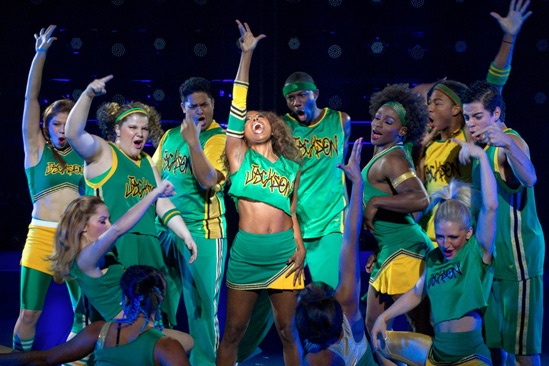
Adrienne Warren and the cast of Bring It On serve up major musical theatre realness.  And they're pretty good athletes, too.

Needless to say, Bring It On: The Musical is not high art.  Anyone with such lofty expectations for the show has a gross misunderstanding of the source material on which it is based.  What this stage adaptation of the film series of the same name does offer is plenty of fun and high-flying acrobatics, even if some questionable story and tonal choices keep it from becoming the great piece of fluff theatre it could be.

Set in the world of competitive cheerleading, Bring It On doesn’t precisely follow the plot of the original movie or any of its sequels, instead using the franchise’s general premise and themes as inspiration for an original story.  The show begins with perky blonde Campbell being elected captain of the Truman High School cheerleading squad, but her dreams of winning the National Cheering Trophy are dashed when some questionable school redistricting results in her forced transfer to the scary multi-ethnic Jackson High.  Not only is Campbell a fish out of water, but the closest thing to a cheerleading squad at Jackson is a dance crew led by sassy queen bee Danielle.  This is obviously the Worst Thing Ever, and poor Campbell must somehow find a way to convince Danielle to form a cheerleading squad so that they both can compete at Nationals and win that coveted trophy.

Obviously, this campy setup is meant to provide more jokes than drama, a fact the show knows but doesn’t fully embrace.  The biggest problem is that Bring It On doesn’t take the outrageousness far enough, opting to play a large portion of the show completely straight despite a steady stream of one-liners provided by book writer Jeff Whitty (a Tony-winner for his work on Avenue Q).  As a result, the predictable plot drags at the start, although the approach does lead to some surprisingly heartfelt scenes as the characters struggle with growing up.  The second act ballad “Enjoy the Trip” is an especially poignant and insightful commentary on the ultimate importance of high school drama, and a highlight of the show.

Like most musical comedies, the real interest lies in the production numbers, which are plentiful and generally well done.  The contemporary score, co-written by Tom Kitt (Next to Normal) and Lin-Manuel Miranda (In the Heights), highlights the very distinctive styles of its two composers while still sounding like a cohesive whole.  The R&B stylings that characterize Miranda’s work are particularly prominent and enticing, and the Bring It On score ends up being one of the most fully realized blendings of showtunes and modern pop to ever grace a Broadway stage.  Mirroring this mix is the excellent choreography by Andy Blankenbuehler (who also directed), which makes hip hop dance wholly theatrical and is a refreshingly new addition to an art form that can be painfully slow to evolve.

And when the fresh-faced cast breaks into the cheer routines that form the centerpiece of Bring It On, prepare to be amazed.  The dizzying combination of backflips, tumbling, and aerial acrobatics will take even the most jaded theatre-goer’s breathe away, and these athletic feats are performed with a precision and sleekness any show would do well to emulate.  It is honestly a shame there aren’t more of them – setting the first act primarily in a cheerleader-less school makes the routines hard to sneak in – although the upside of this decision is that it makes the dueling routines of the musical’s climax even more exciting.

The vast majority of the cast is making their Broadway debuts, and what the performers lack in experience they make up for with enthusiasm and general charisma.  Taylor Louderman’s Campbell can be a little bland, but she is believable, earnest, and a generally likeable leading lady (Louderman also does an excellent job with the enormous amount of singing she’s been handed).  Adrienne Warren belts to the rafters as Danielle, and her well-executed transformation from antagonistic to grudgingly respectful to genuinely friendly is one of the more dramatic character arcs in the show.  The supporting players all manage to make a positive impression, although the sheer number of characters leaves a lot of the actors with precious little to do.

The real standout among the cast is Gregory Haney’s camp-tastic turn as a drag queen student called La Cienega.  One of the few actors with prior Broadway experience, Haney takes a character we know nothing about (only one line in the show even acknowledges that her attending school in drag might have made her life difficult) and makes her into the most compelling person on the stage.  Completely over the top and reveling in every minute of it, Haney represents the type of show Bring It On is *this close* to being: a high-camp delight that is simultaneously hilarious and oddly engaging.

As stated above, Bring It On isn’t high art.  It has some fairly glaring oversights, like a story that meanders for much of the first act until settling into the predictable but effective drama of a sporting competition.  Everything seems to be just a little too easy for Campbell, which makes it difficult to fully invest in the plot or her hardships.  And for a show that traffics in cheerleader stereotypes, there is a surprising lack of unrepentantly bitchy girls to serve as effective antagonists.  The absence of a truly memorable villain, someone the audience could love to hate, keeps Bring It On from entering the realm of top-tier escapist entertainment, and we the audience must settle for merely very good rather than great.  That said, there are certainly worse ways to spend a summer night than with this slickly polished musical confection, and I for one am glad this national tour decided to stop by and play in the big leagues.