Wednesday, February 29, 2012

He's (Still) There, The Phantom of the Opera

If Christine's father were still around, he would surely advise against gondola rides with masked strangers.
Well, I finally saw it.  A mere 24 years after its Broadway premiere and approximately 10 years after I became seriously interested in musical theatre, I finally walked myself over to the Majestic Theatre and saw the theatrical phenomenon that is The Phantom of the Opera.

How have I never seen Phantom, you ask?  Several reasons.  First and foremost, I just don’t like Andrew Lloyd Webber.  In general, I find his shows to be overwrought, underwritten affairs where big ballads trump petty concerns like storytelling and character development.  In fact, at several points in his career I think he was actively mocking the theatergoing public, seeing just how many people he could get to buy tickets to plotless concerts about dancing cats or absurdist spectacles involving roller-skating trains.  Having heard the Phantom soundtrack, I found the show to rely too heavily on reprises disguised as new songs (it sounds as if a grand total of five melodic themes were continuously recycled, with new lyrics, during the show’s two-and-a-half hour runtime).  In addition, while listening to the show I felt no connection or emotional attachment to the two-dimensional characters, who could all die without the slightest bit of anguish from me.  And finally, I had the misfortune of sitting through the atrocious film version, which only the show’s most ardent fans could find halfway tolerable.  That experience effectively moved Phantom to the very bottom of my viewing list.

But now I’ve finally seen Broadway’s longest running smash, and I have to admit that it wasn’t as bad as I feared.  I still find it deeply flawed, but I wasn’t offended by its ineptitude the way I am by certain other megamusicals featuring masked men and an abundance of special effects.  In the plus column, most of the current collection of principals do a good job making some sort of sense out of their underwritten and often irrational characters, and help keep the show feeling fresh well into its third decade on Broadway.  The performances border on melodramatic at times, but so does the show, and they are in a massive theatre that doesn’t really allow naturalistic acting.  And regardless of my personal opinion of the quality of the score, it is certainly well-handled by the cast and orchestra, although the electronic keyboard is frighteningly pronounced at times.

The production’s strongest assets are Hal Prince’s staging and Maria Bjornson’s production design.  The show is a spectacle in every sense of the word, but rarely do the special effects or massive set pieces impede its progress.  Even after all these years, one can’t help but marvel at the ingenuity and efficiency of some of the set changes, and the excellent way Prince has deployed his actors on Bjornson’s ever-changing scenery.  The initial descent into the Phantom’s underground lair during the title song or the Act II opener “Masquerade” are particularly thrilling, and while the famed chandelier could probably be improved upon with modern technology this one still gets the job done.  Prince (and the various stage managers throughout the years) has done an excellent job of maintaining the show’s pace, which rarely flagged throughout the show’s slightly bloated runtime.

In fact, I would argue that without Prince and Bjornson, Phantom wouldn’t have become Phantom.  Lloyd Webber’s score and book (which he co-authored with Richard Stilgoe) have their moments, but without the sheer theatricality Prince and Bjornson added to the proceedings I doubt the show would have run past the early 90s.  But thanks to Prince and company, it recently celebrated a record-shattering 10,000 performance on the Great White Way with no end in sight, all due to an electric staging that covers many of the show’s flaws. 

If I had to guess, I would say that is the secret to Phantom’s record-breaking success; the show tricks you into thinking its more complex than it actually is.  The story has just enough depth that audiences can pretend they are seeing something deep and meaningful – a self-delusion not possible with pure fluff like Annie – but also contains the large cast and impressive sets people associate with a Broadway musical.  While the characters aren’t that complex or believably written – Christine in particular oscillates between being a frightened child and strong-willed upstart – and there are multiple plot holes that are probably less apparent in Gaston Leroux’s source material, the spectacle lets the audience feel like they are seeing an event rather than just a play.  And for all its dark undertones, the show never challenges us with any truly unsettling details or hard to digest moral gray areas, making it a family friendly entertainment that adults don’t want to claw their eyes out during.  It is this exact same formula that has made Wicked into the Phantom of the new millennium, and there’s no reason to expect it to stop working anytime soon.

At this point, I honestly wouldn’t be surprised if Phantom runs forever.  It has firmly entrenched itself as a Broadway institution, and is clearly the show to see for tourists, especially international ones.  It is admittedly a good first Broadway show, and at this point has been running so long that people who first saw it as children are now returning with their kids in tow.  So while I may not love it, I’ve at least seen what all the fuss is about, and have made my peace with the fact that it will never close.  I honestly can’t imagine walking down 44th St. and not seeing its distinctive marquee.

And perhaps most importantly, it isn’t Cats.

Thursday, February 23, 2012

Where Have All The New Musicals Gone?

Elena Roger, if you're going to kick Follies out of the Marquis, you better be spectacular!

I know, I know.  It’s been a while since my last blog entry.  In my defense, I have been busy with work and starting rehearsals for my production of Joseph and the Amazing Technicolor Dreamcoat.  Plus, the winter is traditionally a slow time on Broadway and since the holidays wrecked my bank account, I haven’t been able to afford as many shows as I’d like.

Right now, most industry folk are busily preparing for the spring onslaught of shows, looking ahead to the ever-nearing Tony madness to come.  Unfortunately, I have also looked ahead, and I don’t like what I see.  Hence, the topic of this blog entry: the dismal slate of new musicals on tap for the spring.

I can honestly say the musical I am most excited about this spring is the revival of Evita.  Which wouldn’t be that odd if: a) I didn’t despise almost everything Andrew Lloyd Webber has ever written; and b) I wasn’t such a staunch supporter of new work.  I’m one of the ten people who actually paid to see Lysistrata Jones, for crying out loud!  And I didn’t do it because of glowing word of mouth (everyone warned me it was bad), but because I wanted to see something new.  But even my love of the new can’t override my complete lack of enthusiasm for this spring’s shows.

Part of this is a matter of timing.  Last season was a particularly strong one for new musicals; one of the best in recent memory.  Some were good, some were bad, and a couple were flat out amazing, but almost all of them were *interesting* ideas that were inherently theatrical.  The same cannot be said of these upcoming shows, which means a fourth trip to The Book of Mormon is likely in order.

Exhibit A in “Ill-Advised Ideas” is Ghost: The Musical, a show whose producers are clearly desperate to make into the big hit of the spring.  To which I saw “bleh.”  First of all, I cannot think of a single instance in which a show subtitled The Musical has turned out to be any good.  And not only is Ghost: The Musical based on a film – which like it or not has replaced the book as the go-to source material for Broadway – but it is based on a film that doesn’t lend itself particularly well to musicalization.  And thanks to the copious amount of promotional film available from the London production, it looks like Ghost: The Musical has fallen into all of the traps awaiting a film-to-stage adaptation, including generic music, pretty but bland leads, and an overreliance on high tech scenery in a desperate attempt to replicate film’s ability to quick cut from location to location.  I’m looking forward to it about as much as I’m looking forward to my next dentist visit.

The show that seems to be generating the most industry excitement, at least among the 30 and under set, is the quickie transfer of Disney’s Newsies, also based on the film of the same name.  Now maybe I’m a bad music theatre nerd, but I have never seen said film in its entirety.  I saw about 20 minutes of it in high school with a group of friends who clearly *loved* it, and couldn’t quite discern what all the fuss was about.  I suspect that if I were to watch it from beginning to end, my opinion would coincide more with the critics who panned it upon its release than with my peers who consider it a treasured part of their childhood.  Add in the fact that the show exists solely because it was the most-inquired about Disney property among amateur theatre groups (meaning Disney expects to make a mint from licensing fees), and I become even warier of the show.  The only reason I haven’t completely written it off is that Disney swears Broadway wasn’t originally in the cards, and that popular demand and the encouraging reviews prompted the transfer.

A great deal of positive word of mouth has also accompanied Once (again based on a film).  Like Newsies, it is something of a cult hit among my generation, and its earlier production was well-enough received by critics and the public to prompt the Broadway transfer.  But while the Oscar-winning song “Falling Slowly” is hauntingly beautiful, the thought of two hours of similar singer/songwriter hipster bait makes me vaguely nauseous.  I’m very afraid that outside of an intimate Off-Broadway setting, the entire endeavor will come across as pretentious and more concerned with being “art” than being “entertaining,” which despite what most critics would have you believe are not mutually exclusive pursuits.

Finally, we have three accomplished Tony-nominees returning to Broadway in two dubious sounding vehicles.  Raul Esparza, an interesting actor who has made some dubious career choices, is back in yet another film adaptation, this one based on a 1992 movie I’ve never heard of called Leap of Faith.  Oscar-winner and reliable songsmith Alan Menken is providing the music, although his recent track record (Sister Act, The Little Mermaid) leaves me skittish about the quality of Faith, especially since he will be splitting his focus between it and Newsies.  And golden-voiced Kelli O’Hara returns with Tony-winner Matthew Broderick in the new-ish Gershwin musical Nice Work If You Can Get It, which is suspect due to its pseudo-jukebox nature (it is made up of Gershwin trunk songs with a new book).  This is the one I’m stubbornly hoping will turn out amazing, if for no other reason than it will help ease the disappointment that Nice Work effectively precludes any chance of the delightful Crazy for You getting revived in the near future.

Making matters even worse for me personally is the fact that two musicals originally scheduled for the spring that actually looked promising have been postponed until a later date.  The Susan Stroman-helmed adaptation of Big Fish may be based on a movie, but it is a movie with a particularly theatrical premise that would benefit strongly from Stroman’s imaginative staging and inventive choreography.  It was also supposed to star my TV boyfriend Michael C. Hall taking a needed break from slaying serial killers over on Showtime, which made it all the more appealing.  And while I was suspicious of its Germanic origins (Germany, let’s not forget, loves David Hasselhoff as a *singer* and has an inexplicable fascination with Starlight freakin’ Express), I thought Rebecca sounded intriguing.  The gothic-tinged novel(!) it’s based on easily lends itself to musicalization, and as an entirely character-driven piece I think it would adapt to the stage quite well.  Plus, announced star Sierra Borgess has a ridiculously pure soprano that deserves to sing something other than sappy Lloyd Webber ballads.

So while I will likely end up seeing most of these new musicals, I am most looking forward to hearing Elena Roger recklessly belt her way through “Buenos Aries” and “A New Argentina.”  And if I don’t understand a damn word she says, at least I can blame it on the fact that English is not her first language, an excuse unfortunately not applicable to the otherwise divine Patti LuPone J

Sunday, February 12, 2012

Even Flops Deserve an Encore

Review: Merrily We Roll Along
Celia Keenan-Bolger, Collin Donnell, and Lin-Manuel Miranda in the Encores staging of Merrily We Roll Along
I hope that Stephen Sondheim’s Merrily We Roll Along, running this weekend and next as part of the Encores! concert series at NY City Center, receives that oft-speculated about Broadway transfer. Not because the show (or this production) is perfect; far from it, as there are many problems plaguing this 1981 flop musical about a group of friends dealing with life’s many disappointments. But the show is so close to being the grandly affecting theatrical revelation that we *want* it to be, and I firmly believe that it could achieve those lofty heights with just a bit more work.
A brief history lesson for the uninitiated: Merrily was the sixth collaboration between Stephen Sondheim and Hal Prince, an artistic partnership that gave the world shows like Follies, Company, and Sweeney Todd. It tells the story of Franklin Shepard, a songwriter and film producer who is estranged from virtually everyone, including his longtime lyricist Charley Kringas and their novelist friend Mary Flynn. The story unfolds backwards, slowly revealing how these three inseparable friends ended up hating one another. The musical was such a critical and commercial failure when it opened on Broadway that it not only ended the Sondheim-Prince collaboration, but almost caused the gifted composer to retire from the theatre altogether.
But the show was preserved on a glorious original cast album, one which I have been in love with for many years. This Encores! concert, the latest in a decade-long, city wide fascination with all things Sondheim, was my first chance to see the show on its feet, and judge for myself whether the show (heavily revised by Sondheim and bookwriter George Furth since its initial Broadway run) was as bad as history would have you believe.
And unfortunately, this production doesn’t quite work. But it is so maddeningly close that I can’t help but think that with more time, it could become a truly transcendent theatrical event. The notoriously short Encores! rehearsal period hasn’t provided the performers with enough time to crack these complex characters, leaving us with a show that has its moments but is ultimately unsatisfying.

The book is partially to blame, but there’s no easy way to fix it. The same choice that makes the show fascinating – telling the story in reverse chronological order – also creates a host of challenges. It requires the actors to start the show at such an intense emotional level, where the depth of their bitterness and disappointment should be emanating from their pores, that few would be up to the task even in a traditional setting, let alone the abridged rehearsal period allowed here. Rather than having the entire evening to work up to that level of angst, the characters start at their emotional peak and slowly shed layers of regret to become the hopeful youths seen in the play’s final scene. The reverse narrative also requires the audience to absorb an incredible amount of back story early on, as we try to piece together the various relationships and how they got that way.

I honestly feel that Furth’s book does this in the most economical way possible; the rest is up to the actors and director. Helmer James Lapine and his cast are headed in the right direction here, but have obviously run short on time. More rehearsal, and a longer preview period, would certainly provide all of them with the chance to deepen their own understanding of the text and how to best illustrate that to the audience, which is why I would love to see the show transfer to Broadway and be able to revisit it after they had had a solid month or more to explore it. And everyone knows that Sondheim’s songs (which are at their most heart-wrenchingly beautiful here) can reveal new meanings on each subsequent listening, again making a convincing case for more rehearsal time.

As is, none of the three leads have a strong handle on their characters, although all are respectable actors who have solid moments throughout. As Franklin Shepard, Colin Donnell is so charming that you end up rooting for him even as the character makes some truly repugnant choices. Donnell has a gorgeous singing voice, and enough intelligence to be able to convey the inner conflict that underlies all of Shepard’s actions without ever being voiced. But at least two numbers require Shepard be absolutely reamed by other characters without chance for rebuttal, and Donnell misses the opportunity to really demonstrate the emotional toll it takes on Shepard.
Lin-Manuel Miranda is more problematic as Charley. Though a Tony-nominee for his performance in In the Heights, Miranda is not a singer, and seems to be outside of his natural range for most of the show. Occasionally his acting abilities allow him to compensate, but he is usually too concerned with hitting the right notes to be fully convincing. Yet all this doesn’t stop him from delivering a strong rendition of “Franklin Shepard, Inc,” an incredible piece of musical theatre writing that is one of the greatest gifts Sondheim ever gave a male actor.
But Miranda utterly botches Charley’s other big number, “Good Thing Going,” although I’m not sure he is entirely to blame. A song from Frank and Charley’s work-in-progress show that they sing at a backer’s audition, on the original cast album it is a solo wherein you see Charley’s dawning realization that he is losing his friend to the soulless entertainment industry. Contrasted with some technically dazzling counterpoint from the backers, who are discussing anything but the song they’re hearing, it’s an utterly heartbreaking moment. But in this production the song is a duet for Charley and Frank (mostly Frank) that serves no purpose; it no longer illustrates Charley’s increasing isolation, and the fact that these backers have no interest in making the “art” Charley and Frank aspire to has already been well-established. Now, this may be a rewrite done by Sondheim and Furth (though an ill-advised one), but it reads as if Miranda simply couldn’t sing the song and the music director hastily added Donnell in to compensate. Either way, it kills what could have been one of the most gut-wrenching scenes in the entire show.
Completing the trio of leads is Celia Keenan-Bolger, who does her best with the ill-defined Mary. The show never does a great job of establishing Mary as a character in her own right; she functions purely as a mediator between the bickering Charley and Frank. But given the amount of stage time Mary has and the serious dramatic ambitions of the show, she really should be given more depth than “mediator” and “occasional comic relief.” Keenan-Bolger does a decent job with the one-liners and makes a very convincing drunk in the opening scenes, but can’t overcome the limitations placed on her by the book.
The performer that comes out the best in all of this is Elizabeth Stanley as Gussie Carnegie, the star of Frank and Charley’s Broadway hit and Frank’s second wife. Although Gussie’s function in the story is clear – she’s the temptress that prompts most of Frank’s bad decisions – unlike Mary she is given enough personality and idiosyncrasies to evolve beyond that. Stanley is fantastic in the role, effortlessly capturing the glamour of a bona fide star and the neuroticism that all too often accompanies it. Although she gets plenty of stage time, I found myself wanting more of her, since the show tended to flounder when she was offstage. And as Frank’s first wife Beth, Betsy Wolfe sings and acts well enough, although her rendition of the show’s big ballad “Not a Day Goes By” needs more time to deepen into the emotional sucker punch it can be when sung by someone like Bernadette Peters (who has made it a staple of her concert performances).
Again, this is a show I dearly love, and so part of my disappointment with the Encores! production may stem from lofty expectations. But this production and this cast is clearly headed in the right direction, which makes it even more upsetting that they don’t have the luxury of more time to tackle this behemoth of a show. I suspect the difference between the first and second weekends will be enormous, and who knows what could be achieved with even more time to settle into these roles. Hopefully the reception for the concert staging will be warm enough that some producer risks bringing the show to Broadway, where I think the extra rehearsal time will result in a first rate staging of this important but problematic work.

Tuesday, February 7, 2012

Does NBC Have a "Smash" Hit On Its Hands?

Megan Hilty and cute boys in sparkly baseball uniforms - Just two of Smash's many valuable assets
After months of hype and weeks of Facebook statuses about how much more awesome Smash is going to be than Glee, the NBC musical drama about the creation of a Broadway show finally aired on TV last night.  And I have to say, I enjoyed it.  A lot.  Am I obsessively addicted to it, ready to devour any and all information I can lay my clammy little fanboy hands on?  No.  But I will certainly be tuning in next week to see where things go after a very solid pilot.

First off, I want to say that any comparisons to Glee are apples to oranges comparisons.  Whereas Glee is primarily aimed at young girls with attention spans no longer than a typical YouTube video (and gays who act like said young girls), Smash is aimed squarely at adults.  This goes a long way towards explaining why it is already functioning on a higher level than the Fox series, since most adults won’t put up with the kind of nonsensical shenanigans that occur with alarming frequency at McKinley High.

Thankfully, the characters in Smash are all reasonably coherent, believable people who behave in consistent and mostly logical ways.  I say mostly because it is a tad suspicious that such an on-the-ball personal assistant to a famous Broadway composer wouldn’t realize that sending at an unauthorized copy of a demo recording would be frowned upon.  And even more suspicious is that Katherine McPhee’s character, a 24-year-old who seems well adjusted to New York City and the theatrical scene, would receive a call at 10 o’clock at night telling her to go to the house of the Broadway director she just auditioned for and not figure out he wanted to sleep with her.  But other than that, the characters are well written and serve their functions well.

A large part of this is due to casting, which is spot on.  I particularly enjoyed Debra Messing and Christian Borle as the composing team, and Jack Davenport is deliciously smarmy as the hotshot Broadway director (and I can’t wait to find out why his character and Borle’s hate one another).  Even McPhee, who was probably the biggest question mark as far as acting ability was concerned, is doing a fine job.  Do I want to give her an Emmy?  No, but I also don’t want to yell at her to get off the screen, either. 

I also think the show did an excellent job in handling the biggest concern among theatre lovers prior to the pilot airing.  Most people I know, in typical diva worshipping fashion, seem to be of the opinion that any sane person would cast Megan Hilty on the spot.  I happen to agree that she is probably a more appropriate choice to play Marilyn Monroe, but the pilot of Smash makes a good case for at least seeing what McPhee has to offer in the role.  And honestly, they sold me on the idea of this rivalry with a single line of dialogue: the dismissive “thanks” given to Hilty by the director after her workshop performance of the baseball number.  He clearly doesn’t like Hilty, and honestly, that sort of unfounded bias would be more than enough to hold someone back in this business.

Yet in another way, their rivalry actually is my biggest concern with the series.  If Smash is going to be about the development of a Marilyn Monroe musical, the fictional creative team is going to have to pick their lead relatively early on.  But the pilot sets up the competition between these two actresses as the main conflict for the series, so I’m interested to see what new obstacles they manage to invent while keeping both women in play. 

It also drove me *insane* when I heard that disgusting, Autotune-style mechanical reverb kick in on the FIRST NOTE of McPhee’s rendition of “Beautiful.”  People do not sound like that in real life, and they certainly don’t sound that way when they audition.  If it had kicked in after McPhee went into fantasy-land later in the number, I could have dealt with it, but not right away.  It was the one bad habit from Glee to rear its ugly head, but was thankfully confined to that one performance (Hilty’s vocals sounded gloriously unaltered, which is what happens when you cast actual Broadway talent).

I was also happy to see that unlike Glee, Smash is putting a lot more effort into the “book scenes.”  On the high-school set series, they get so busy singing their pop covers that I often feel like the story is rushed and underdeveloped.  By cutting the number of songs in half, Smash actually had time to begin to develop its large cast of characters and their various problems.  And when the songs did occur, they were for the most part new songs of a very high quality.  And by having the musical at the center of Smash be about a showbiz star, the songs written for the show-within-a-show will be able to reflect the same themes going on in the characters’ lives, which makes them actually work within the context of the TV show.

As Glee continues to be undone by its erratic behavior, the impending graduation of its core characters, and the dramaturgical gymnastic that will be required to keep said characters around for season 4, it’s nice to see Smash come along and take the TV musical into adult territory.  I will certainly be watching, and I hope the rest of America will as well. 

Wednesday, February 1, 2012

Tony Watch: Assessing the Fall Season Part 2

Stockard Channing, satisfied to know she's a likely Tony nominee for her work in Other Desert Cities
Moving right along, it’s time to continue picking apart the Tony chances for last fall’s crop of shows.  Next!

Relatively Speaking
I have to tell you, I rolled my eyes every time this show came up in the press.  Before it opened, there seemed to be a consensus among the media that this was an event, filled with A-list talent in front of and behind the curtain.  Well, I certainly wasn’t excited about any of the “stars” announced for this collection of one acts; I hadn’t even heard of most of them.  And while the three authors certainly have marquee value at the cinema, we all know that theatre and film are two very different mediums, and success in one by no means guarantees success in the other.

Three months later, and who was right?  I was.  Not only did the production receive tepid reviews, it failed to light the box office on fire.  Even if we assume that the so-called stars appealed to the older generation, who typically has more money to spend on Broadway tickets, the pitiful weekly grosses prove that this was a non-event no one was clamoring for.  It has thankfully closed, and we can all forget it ever happened, because that is surely what Tony voters will do.

Chinglish
Like Relatively Speaking, here was a show seemingly destined for commercial failure; unlike that other show, I actually feel bad for the now-closed Chinglish.  Given the current realities of Broadway box office, there is something admirable about the producers’ decision to premiere this play without any name stars.  And while playwright David Henry Hwang is certainly a respected member of the theatrical community, he has been largely absent from the New York scene for years, robbing this play of the kind of commercial appeal it might otherwise have had.  Reviews were admirable but not raves, which probably sealed the production’s fate.

Tony-wise, it is a long shot (but not impossible) Best Play nominee.  Its best chance at Tony recognition rests with leading lady Jennifer Lim, whose dual-language portrayal of a Chinese translator was by all account breathtaking and resoundingly praised by the press.  That kind of goodwill should help keep her in voters’ minds when they announce nominations this May.

Other Desert Cities
The heavyweight among this fall’s new plays, Other Desert Cities comes to Broadway after a critically lauded Off-Broadway run with much of its cast intact.  The returning actors received another round of raves, with newcomers Rachel Griffiths and Judith Light deemed worthy additions to this Great American Play in the making.  All of these factors have combined to create strong box office for the production, resulting in its limited run being extended well into the spring, keeping this critical darling front and center during the crucial spring Tony voting season.

I would be shocked if Other Desert Cities doesn’t wind up among the Best Play nominees.  And with such a uniformly excellent cast, acting nods are virtually assured, although who will get them is still open for debate.  The smart money would be on awards darling Stockard Channing, possibly joined by Ms. Griffiths in the Best Actress category.  Both men in the cast are well positioned to score Supporting Actor recognition, and I suspect Joe Mantello will receive his umpteenth Best Director nomination as well.

Venus in Fur
And the new plays just keep coming!  Venus in Fur is another winner, an Off-Broadway hit that was again embraced by critics for its Broadway debut.  I personally adored this production, and would love to see it among the Best Play nominees.  I’m not sure it will make the cut, though, given the stiff competition this year (I believe there are around 12 new plays competing for 4 nomination slots).

While the show’s fate is uncertain, Nina Arianda will surely be among this year’s Best Actress nominees, making her two for two in her fast growing Broadway career.  She is sensational as Wanda, and anyone who hasn’t seen this rising star work her magic needs to rush out and buy tickets to Venus’ upcoming commercial transfer.  Depending on how well or poorly the men in this spring’s plays do, her costar Hugh Dancy could also find himself walking the Tony red carpet as a Best Actor nominee in June.

Hugh Jackman: Back on Broadway
Honestly, the Tony committee should feel pretty stupid for doing away with the Special Theatrical Event category a few years back.  Had it been around, they would have the perfect excuse to nominate Broadway golden boy Hugh Jackman, thereby encouraging him to return to Broadway that much sooner and make some lucky producers very, very rich.  As it stands, they may still give him a special achievement Tony for his record-breaking one man show and Herculean fundraising efforts for Broadway Cares/Equity Fights AIDS.  If not, their next chance to shower Jackman with praise will be in 2013, when he stars in Stephen Schwartz’s Houdini musical to what will surely be lots of acclaim and insane box office figures.

Private Lives
Oh, Kim Cattrall.  You gave it a nice shot.  You even managed to earn pretty decent reviews for your performance in this oft-revived Noel Coward comedy, which appears on Broadway every 10 years or so with big name stars making delicious fools of themselves.  But the show was simply too familiar, and I’m not sure the gays have completely forgiven you for making them wait so long for that first Sex in the City movie (we all know she was the sole holdout among the main cast when the movie deals were being drawn up).  But while I don’t foresee any Tony glory in your immediate future, you can go on with your head held high, and maybe return in a vehicle better suited to your persona.

Seminar
In case you haven’t clued in, the fall is clearly the time to launch new plays.  And this one, by Pulitzer Prize finalist Theresa Rebeck, is another work that scored solid but not spectacular reviews.  Since Tony voters tend to favor serious dramas when picking Best Play nominees, I don’t think the comedic Seminar stands a very good shot in that category.  But Alan Rickman, who has been Tony nominated both times he has graced Broadway with his presence, will likely complete the hat trick and be three for three in the Best Actor category.

Tuesday, January 31, 2012

In Defense of Glee

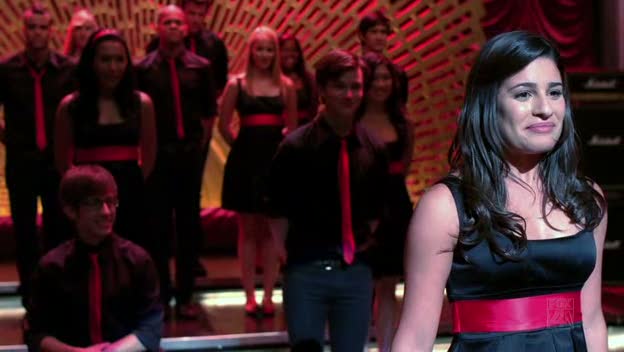
"Don't Rain on My Parade," that shining moment where Glee actually lived up to its potential

There seems to be a growing sentiment among the theatre community that Glee, that Fox show about all the misfit “teenagers” with a predisposition for bursting out into song, has jumped the shark.  I find this turning of public sentiment on a show that just two years ago was the obsession of literally everyone to be both hilarious and a little sad.  Because, dear reader, this sudden swelling of hatred for the show is entirely undeserved.

Now don’t get me wrong.  Glee has major problems.  It is an underwritten, poorly plotted piece of trash TV filled with two-dimensional characters who act in ludicrously unbelievable ways, while singing heavily auto-tuned renditions of songs only tangentially related to the plot.  Whenever there is a storyline that holds actual interest, it is often shoved to the side to make way for yet another musical number or some nonsense about babies.  There are more recurring characters than the writers know what to do with, a problem exacerbated by the constant parade of guest stars eating up valuable screen time that would be better used developing the leads.

But what most people seem to forget/deny is that the show has ALWAYS been this way.  From the very beginning.  Between the six or seven main kids and the half-dozen recurring adults, there have always been more characters than the writers have been able to comfortably handle.  They have always behaved ludicrously, from Coach Sue’s irrational hatred of the Glee club (which, incidentally, was probably the most praised aspect of the show’s first season and even won Jane Lynch an Emmy) to Will’s wife attempting to fake a pregnancy around her freakin’ husband!

The show has also always struggled to incorporate the musical numbers in a way that makes sense.  I distinctly remember an episode where Mercedes was convinced Kurt, the gayest TV character outside of the LOGO network, was actually straight, and when she found out he wasn’t interested in her smashed the window of his SUV while singing “Bust the Window Out Your Car.”  As far as I can tell, this entire plot was concocted to allow her the chance to sing this song, and it came at the expense of making the character look like a complete idiot.

To claim that Glee has suddenly become bad TV is to willfully ignore the fact that it was bad to begin with.  I think the majority of people confused “different” with “good” when the show first premiered, and I’ve suddenly gone from the being the guy arguing the show isn’t that good to arguing its better than people give it credit for.  If you ask me, Glee has remained at about the same quality level as it always was: wildly uneven.  Certain episodes (or segments of episodes) work like gangbusters, and others are so excruciatingly awful you wonder how it ever made it to air. 

So be honest with yourselves.  Glee is bad, and has always been that way.  If you’re a former fan of the show who is now bashing it, you need to fess up to the fact that your former favorite show was never all it was cracked up to be.

Wednesday, January 25, 2012

Tony Watch: Assessing the Fall Season Part 1

One lady who should really start shopping for her Tony night gown

It’s never too early to talk about the Tony Awards.  Ever.  Hell, sometimes it can be more fun to discuss them months in advance, when almost any prediction is pure speculation.  And while I won’t go so far as discussing productions and performances that have yet to open, I thought this mid-winter lull was the perfect time to reflect on those shows that have already opened.  So read on for my completely biased, 100% speculative opinion on who is and isn’t a contender for a nomination this year.

Let’s start at the very beginning (a very good place to start, I’m told), and run through this year’s Broadway shows in chronological order:

Spider-Man: Turn Off the Dark
In a turn of events that positively sickens me, this show is actually in a good position to score some Tony love.  This is not due to any actual merit in the production (it’s terrible, and earned my Worst of 2011 award), but because of Tony politics.  You see, a large number of Tony voters are producers, either for Broadway or touring houses, and they tend to favor shows with wide commercial appeal.  Having awards to brag about helps with advertising, and a Best Musical win has been proven to boast almost any show’s box office.  With an average of $1.5 million in weekly grosses, Spider-Man’s definitely has monetary appeal, and it’s the only new musical still running after this fall’s flops.  Since none of the new musicals this spring are surefire critical or commercial hits, Spider-Man could end up with a Best Musical nod, further signifying that the Mayans were right about the world ending this year.

On the positive side, I can’t imagine it scoring any writing nominations (it is much easier for a short-lived show to get nominated in the Score and Book categories).  And while I found the design aspects of the production disappointing given the amount of money and hype involved with the show, I wouldn’t be offended to see it nominated for Scenic or Costume Design.  And since the Best Supporting Actor in a Musical category is pretty slim pickings thus far, Patrick Page could find himself nominated for being easily the show’s strongest asset.

Master Class
Yes, this show happened.  It even got pretty good reviews.  But it closed so long ago, and there are many more plays opening between now and Tony time.  It may manage to make it onto the Best Play Revival list, and leading lady Tyne Daly could conceivable get a Best Actress nomination.  But with so many plays premiering this season, such recognition seems unlikely.

Follies
Follies will be a major presence at this year’s Tony Awards.  That isn’t mere speculation, it’s fact.  The toast of the fall season and an event musical for the Broadway community, there was such overwhelming love of both the show and this production in particular that I can’t imagine it not getting a bevy of nominations.  It’s a lock for Best Revival, leaving only three slots up for grabs in that category.  It will also end up in one or more design categories (if it only gets one design nod, my money is on the costumes).  For so expertly realizing such a tricky piece, director Eric Schaeffer really deserves a directing nod, and “Who’s That Woman” (the mirror number) should be enough to net Warren Carlyle a Best Choreography nomination on its own.

Oddly enough, the show’s greatest potential of being snubbed comes in the acting categories.  With such a uniformly excellent cast, and many of them competing against one another, someone will surely get overlooked.  Of the four leads, I would say Rob Raines is the weakest, and he was still wonderful.  Although I would never underestimate the Broadway community’s love of Bernadette Peters, her take on Sally has proven oddly divisive and may keep her from being a strong contender in a year when Best Actress in a Musical is likely to be a bloodbath (we’ll see why a bit later).

However, there are two performers who so deserve acting recognition that if either one is omitted, you can expect a lengthy blog entry from me decrying how wrong the Tony voters got it.  Jan Maxwell was utterly sensational as Phyllis, and if her universally praised performance doesn’t warrant one of the five Best Actress slots I don’t know what does.  And Danny Burstein, who was positively revelatory as Buddy Plummer, is not only a shoe-in for a Best Actor nomination, but at this early date is the man to beat.

Man and Boy
Did you remember that this early fall revival even happened?  Probably not, which tells you just about everything you need to know as far as its Tony chances are concerned.  Three-time Tony-winner Frank Langella is so adored by critics that he may end up with a Best Actor nomination, but that is Man and Boy’s only shot at Tony gold.

The Mountaintop
This show disappointed a lot of people, and will pay for it come Tony time.  After receiving a lot of critical accolades during its London run and securing two genuine movie stars for its US premiere, this new drama underwhelmed most critics.  Samuel L. Jackson and Angela Bassett got good but not great reviews, and the entire enterprise seems to have been damned by faint praise.  If the show had opened in the spring it would be more of a contender, but with the amount of competition this year it may be completely shut out.


There’s plenty more Tony chatter where this came from, but given the short attention spans of internet readers, I’ve probably already lost you.  The rest will have to wait for another day, while I spend the rest of this week trying to figure out what the hell a Superbowl is.