Showing posts with label tom kitt. Show all posts

Monday, August 10, 2015

Fear No More, for Shakespeare in the Park Has Done It Again

Review: Cymbeline

Hamish Linklater as the oafish Cloten and Lily Rabe as the pure-hearted Imogen in Shakespeare in the Park's latest production of William Shakespeare's Cymbeline.

Director Daniel Sullivan and actors Lily Rabe and Hamish Linklater have become beloved staples of the Public Theatre's annual productions at Central Park's Delacorte Theatre, tackling some of Shakespeare's greatest works with an unfailing dedication to excellence. This season the three acclaimed artists have teamed up for a pared-down version of Shakespeare's late career romance Cymbeline, and the results are quintessential Shakespeare in the Park: superbly acted, highly accessible, and fully embracing the open air setting for an evening of theatrical magic.

One of the Bard's less performed works, Cymbeline is actually the story of the title character's daughter, Princess Imogen. Against her father's wishes, Imogen has married a commoner named Posthumus Leonatus, a move which so outrages King Cymbeline that he banishes Posthumus to Italy. With Posthumus out of the way, the Queen - who is not Imogen's mother but Cymbeline's second wife - attempts to secure her family's royal position by marrying her loutish son Cloten to the princess, who despises him. Meanwhile, Posthumus makes a wager with the boastful Italian Iachimo that Imogen's heart is so pure it is incorruptible, leading Iachimo to travel to England and attempt to seduce the fair princess. There is also a subplot involving a war between Rome and Britain over unpaid monetary tributes, not to mention the mystery of Cymbeline's missing sons.

The plot is one of the most complex in all of Shakespeare, but thanks to Sullivan's expert direction and uniformly strong performances from the cast, this Cymbeline is easy to follow even without the benefit of the synopsis included in the program. This high level of accessibility is even more impressive given Sullivan's decision to double and triple cast most of his ensemble of 9 to fill the play's 16+ speaking roles. Smart costuming by David Zinn and distinctive hair and wig designs by Charles G. LaPointe combine with the physical malleability of the cast so that there is never any confusion over who is playing whom and when, adding to the production's magical quality and the evening's general sense of fun.

Rabe has tackled many of Shakespeare's most famous ingĂ©nues during her time in the park, and her Imogen is every bit the equal to her Portia and her Beatrice from seasons past. Rabe instantly commands the stage with her unmistakably regal presence, bringing an inner fire to Imogen while at the same time keeping the character's melodramatic leanings in check. When Rabe espouses the play's many rich and varied declarations of love she is utterly believable, and her sincerity grounds a work filled to the brim with credibility-straining coincidences. The luminescent actress can also access deep reserves of sorrow at the drop of a hat, crying giant, glistening tears during several of the production's more heart-wrenching moments.

Rabe's real-life partner Linklater tackles the dual roles of Imogen's exiled husband Posthumus and her unwanted suitor Cloten. As Posthumus, Linklater is an appealing romantic lead who is also capable of portraying the deep-seated rage that propels the character's actions through much of the second half (like Othello, Posthumus is a tad too quick to believe the worst about his wife). But Linklater's true showcase and the actor's clear favorite is the impossibly dim Cloten, who he plays to hammy perfection. Linklater fills Cloten's scenes with side-splittingly funny business while finding every conceivable joke in the character's dialogue, and his over the top rendition of "Hark, Hark the Lark" is one of the evening's highlights. (All the play's original music is provided by Next to Normal composer Tom Kitt, who offers work as strong and melodically interesting as any he's written for the musical stage.)

Patrick Page is wonderfully imposing as the title character, tiptoeing right up to the line of absurdity without actually crossing it. Kate Burton is suitably despicable as his second wife, clearly having a blast with the Queen's conniving ways. The surprise with Burton is that she is perhaps even more entertaining and convincing as Belarius, the disgraced nobleman who has been secretly raising Cymbeline's missing sons for the past twenty years. Four time Tony-nominee Raul Esparza struggles to find the right balance between Iachimo's smarmy, off-putting personality and the play's comedic leanings, failing to find the humor in his character's introductory scene and generally being a bit too terrible of a person for audiences to fully surrender to the evening's many charms. It is by no means a bad performance, but with Sullivan and the rest of his cast choosing to highlight the text's humor Esparza stands out in the wrong way.

After 53 summers at the Delacorte, Shakespeare in the Park has become a New York institution, bringing high quality productions of some of the greatest works in the theatrical cannon to the populace free of charge. Cymbeline is yet another triumph for director Sullivan and lead actors Rabe and Linklater, proving that this trio can work their magic on the Bard's more problematic plays just as easily as they can on populist classics like Much Ado About Nothing or The Merchant of Venice. Despite the intricate plot, this production is a marvel of accessible clarity without once sacrificing the complexities of Shakespeare's beautiful language or his observations on human nature, and is highly recommended for both Shakespearean scholars and the layperson alike.

Wednesday, May 7, 2014

If Every Show Were This Daring, Then Broadway Would Be a Truly Magical Place

Review: If/Then

Idina Menzel returns to Broadway in the central role of If/Then, possibly the finest piece of stage acting she has ever done.

Let's get this out of the way: If/Then is not as good as Next to Normal.  But expecting Tom Kitt and Brian Yorkey's follow-up to that near-perfect Pulitzer Prize-winner to reach such lofty heights is an unreasonable standard to have, and makes the brazenly ambitious If/Then sound like a much bigger failure than it actually is.  While no means perfect, this entirely original musical is one of the most intellectually stimulating and emotionally satisfying new works of the season, provided you're willing to stick with it through a sometimes muddled first act.  And just as they did for Alice Ripley, Kitt and Yorkey have written an absolute gift of a role for the immensely talented Idina Menzel, arguably having the biggest year of her career thanks to this and her work in Disney's smash-hit Frozen.

If/Then follows Elizabeth (Idina Menzel), a woman in her late 30s who has returned to New York following the end of her marriage.  She agrees to meet two friends in the park: Lucas (Rent star Anthony Rapp), her activist best friend and occasional lover from college, and Kate (Tony-winner LaChanze), the outgoing neighbor she just met while moving into her new apartment.  She is presented with a seemingly inconsequential choice - go with Lucas to a protest or spend the afternoon in the park with Kate - that sends her life in two entirely different directions, one career-oriented and one focused on her personal life.  The show cuts back and forth between her parallel potential lives (both timelines include an emotionally charged 39th birthday party and an unplanned pregnancy), ultimately asking the audience to consider such weighty issues as fate-versus-chance and career-versus-home-life.

While fascinating (and the very crux of the show), these parallel stories do present narrative challenges that bookwriter Yorkey and director Michael Greif don't entirely solve.  They've named the career-oriented persona Beth and dressed her in power suits and business attire, while the family-oriented Liz favors glasses and cardigans.  There are generally (but not always) color-coordinated lighting cues to help distinguish the two.  Yorkey's book works extra hard to weave in pertinent reminders of which set of circumstances applies to the current scene, and actually succeeds more often than not in making the references seem natural rather than forced.  Nevertheless, the first act in particular is hard to follow, and you are bound to miss some plot points the first time through despite Greif's fluid direction and Menzel's incredibly assured performance.

But just when you're ready to write the show off, something miraculous happens after intermission.  Suddenly the show clicks, and you realize that despite the confusion you gleaned all the information needed from the plot-heavy first act to set you up for the engrossing character study of the second.  With the necessary exposition out of the way, the show is free to explore the notion of regret and the road not taken, along with the often conflicting emotions of adult contemporary life.  Liz loves her family but is clearly frustrated she put her career on the back burner, while Beth feels validated and fulfilled by her job as a prominent urban planner but has precious few people to share in her success.  The show thankfully avoids portraying one choice as inherently better than the other; they are simply choices, both with major pros and cons, and as the show wisely argues it is ultimately up to the individual to decide what is best for him or her.

Kitt's score is intricate and expressive, although it mostly avoids the catchy melodic hooks that defined a good portion of his Next to Normal score; in fact, the show's weaker numbers are the ones that adhere to the more conventional verse-chorus-verse structure of musical theatre.  Yorkey's excellent lyrics are simultaneously conversational and profound, capturing the rhythms of contemporary New York speech (the show is, among other things, a love letter to the island of Manhattan).  The writing of If/Then is not perfect, but it does a large number of things remarkable well, a feat even more impressive considering there is no source material providing a roadmap for how to tell this story.

As previously mentioned, Menzel is sensational in the central role.  Her ten years away from Broadway haven't in any way diminished her considerable stage chops; if anything, her skills have only grown.  Menzel's performance is several steps above her Tony-winning turn as the misunderstood Elphaba in Wicked, demonstrating an unexpected emotional breadth and depth.  Yes, she sounds fantastic with her seemingly inexhaustible belt, but the true beauty of Menzel's work is the complex emotional shading she brings to each lyric and phrase.  She is charming, unexpectedly funny, and occasionally heartbreaking in a performance carried out with such warmth, intelligence, and charisma that is appears almost effortless despite the fact she rarely leaves the stage.  Her characters in Wicked and Rent will likely remain Menzel's signature roles, but If/Then represents the artistic pinnacle of her career as a stage actress thus far.

Although they don't get nicknames to distinguish their two personas, both Rapp and LaChanze do great work portraying Elizabeth's best friends in both timelines.  Rapp, with a voice seemingly unchanged from his days in Rent, is endearingly snarky as the crusading Lucas, and his rapport with Menzel clearly benefits from the pair's long off-stage history.  Lucas, established early on as bisexual, gets a boyfriend named David (Jason Tam) in one storyline, allowing Rapp to show a more vulnerable, playful side that results in some of the show's most heartwarming moments.  LaChanze, all sass and gutso as the out and proud lesbian Kate, wins the audience over by the sheer force of her personality in the same way her character does (Kate is constantly referring to her "dear friends who she just met").  LaChanze also has a dynamite duet with Jenn Colella as Kate's partner Anne, with Colella providing the most unexpectedly thrilling vocal pyrotechnics of the night.  There is also strong support provided by James Snyder as Josh and Jerry Dixon as Stephen, the main love interests for Liz and Beth respectively.

Michael Greif's staging keeps the show moving at a brisk pace, helping to cram a remarkable amount of story into the two and a half hour runtime.  Greif isn't always successful at clarifying the busy narrative, but it certainly isn't from lack of trying, and he does as well as anyone could be expected to do given the same material.  He makes continually interesting use of Mark Wendland's multi-faceted set (which includes several catwalks, a mirrored ceiling, AND a turntable), and guides the entire cast through the mazelike plot with aplomb.  Emily Rebholz's costumes provide subtle but crucial hints as to which timeline any particular scene is set in, while remaining stylish and pleasing to the eye (something often taken for granted in contemporary-set shows that can all too quickly go awry in the wrong hands).

Ultimately, If/Then is the most artistically daring show to open on Broadway this spring, and although its ambition causes it to occasionally stumble, the show is more successful than many would have you believe.  Brian Yorkey's book tackles a lot of big issues with intelligence and humor, while still maintaining the depth of character needed to keep the show emotionally engaging.  Idina Menzel is positively radiant in the gargantuan dual roles of Beth and Liz (Broadway hasn't seen a star vehicle of this caliber in years), returning after a ten-year absence with a performance so assuranced it feels as if she never left.  Menzel has repeatedly stated in interviews she was waiting for a piece she felt strongly about for her Broadway return, and her belief in If/Then is certainly validated.  Rarely is a show this emotionally involving and intellectually stimulating, and anyone who claims to want originality on Broadway owes it to themselves to see this remarkable piece.

Tuesday, August 14, 2012

Sometimes, Pretty Is Enough


Review:  Bring It On: The Musical

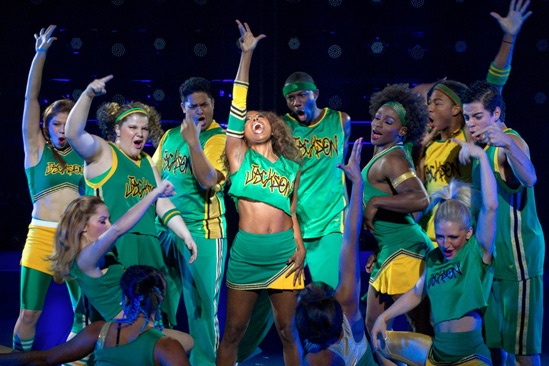
Adrienne Warren and the cast of Bring It On serve up major musical theatre realness.  And they're pretty good athletes, too.

Needless to say, Bring It On: The Musical is not high art.  Anyone with such lofty expectations for the show has a gross misunderstanding of the source material on which it is based.  What this stage adaptation of the film series of the same name does offer is plenty of fun and high-flying acrobatics, even if some questionable story and tonal choices keep it from becoming the great piece of fluff theatre it could be.

Set in the world of competitive cheerleading, Bring It On doesn’t precisely follow the plot of the original movie or any of its sequels, instead using the franchise’s general premise and themes as inspiration for an original story.  The show begins with perky blonde Campbell being elected captain of the Truman High School cheerleading squad, but her dreams of winning the National Cheering Trophy are dashed when some questionable school redistricting results in her forced transfer to the scary multi-ethnic Jackson High.  Not only is Campbell a fish out of water, but the closest thing to a cheerleading squad at Jackson is a dance crew led by sassy queen bee Danielle.  This is obviously the Worst Thing Ever, and poor Campbell must somehow find a way to convince Danielle to form a cheerleading squad so that they both can compete at Nationals and win that coveted trophy.

Obviously, this campy setup is meant to provide more jokes than drama, a fact the show knows but doesn’t fully embrace.  The biggest problem is that Bring It On doesn’t take the outrageousness far enough, opting to play a large portion of the show completely straight despite a steady stream of one-liners provided by book writer Jeff Whitty (a Tony-winner for his work on Avenue Q).  As a result, the predictable plot drags at the start, although the approach does lead to some surprisingly heartfelt scenes as the characters struggle with growing up.  The second act ballad “Enjoy the Trip” is an especially poignant and insightful commentary on the ultimate importance of high school drama, and a highlight of the show.

Like most musical comedies, the real interest lies in the production numbers, which are plentiful and generally well done.  The contemporary score, co-written by Tom Kitt (Next to Normal) and Lin-Manuel Miranda (In the Heights), highlights the very distinctive styles of its two composers while still sounding like a cohesive whole.  The R&B stylings that characterize Miranda’s work are particularly prominent and enticing, and the Bring It On score ends up being one of the most fully realized blendings of showtunes and modern pop to ever grace a Broadway stage.  Mirroring this mix is the excellent choreography by Andy Blankenbuehler (who also directed), which makes hip hop dance wholly theatrical and is a refreshingly new addition to an art form that can be painfully slow to evolve.

And when the fresh-faced cast breaks into the cheer routines that form the centerpiece of Bring It On, prepare to be amazed.  The dizzying combination of backflips, tumbling, and aerial acrobatics will take even the most jaded theatre-goer’s breathe away, and these athletic feats are performed with a precision and sleekness any show would do well to emulate.  It is honestly a shame there aren’t more of them – setting the first act primarily in a cheerleader-less school makes the routines hard to sneak in – although the upside of this decision is that it makes the dueling routines of the musical’s climax even more exciting.

The vast majority of the cast is making their Broadway debuts, and what the performers lack in experience they make up for with enthusiasm and general charisma.  Taylor Louderman’s Campbell can be a little bland, but she is believable, earnest, and a generally likeable leading lady (Louderman also does an excellent job with the enormous amount of singing she’s been handed).  Adrienne Warren belts to the rafters as Danielle, and her well-executed transformation from antagonistic to grudgingly respectful to genuinely friendly is one of the more dramatic character arcs in the show.  The supporting players all manage to make a positive impression, although the sheer number of characters leaves a lot of the actors with precious little to do.

The real standout among the cast is Gregory Haney’s camp-tastic turn as a drag queen student called La Cienega.  One of the few actors with prior Broadway experience, Haney takes a character we know nothing about (only one line in the show even acknowledges that her attending school in drag might have made her life difficult) and makes her into the most compelling person on the stage.  Completely over the top and reveling in every minute of it, Haney represents the type of show Bring It On is *this close* to being: a high-camp delight that is simultaneously hilarious and oddly engaging.

As stated above, Bring It On isn’t high art.  It has some fairly glaring oversights, like a story that meanders for much of the first act until settling into the predictable but effective drama of a sporting competition.  Everything seems to be just a little too easy for Campbell, which makes it difficult to fully invest in the plot or her hardships.  And for a show that traffics in cheerleader stereotypes, there is a surprising lack of unrepentantly bitchy girls to serve as effective antagonists.  The absence of a truly memorable villain, someone the audience could love to hate, keeps Bring It On from entering the realm of top-tier escapist entertainment, and we the audience must settle for merely very good rather than great.  That said, there are certainly worse ways to spend a summer night than with this slickly polished musical confection, and I for one am glad this national tour decided to stop by and play in the big leagues.