Showing posts with label jack O'Brien. Show all posts

Thursday, April 12, 2018

How Do You Solve a Problem Like Julie Jordan?

Review: Carousel

Jessie Mueller and Joshua Henry as Julie Jordan and Billy Bigelow in Carousel.

It is said that of all Richard Rodger's collaborations with Oscar Hammerstein, Carousel contained the composer's favorite score. The classic musical certainly has an abundance of soaring melodies, and it greatly develops the now ubiquitous concept of the extended musical scene, something that didn't really exist prior to the famed duo's groundbreaking work. And while the show certainly has artistic and historical merit, the extremely well done revival now on Broadway also fully unmasks the inherent problems in the script, the most glaring of which is the domestic violence issue embedded in the central romance.

*Note: If you aren't familiar with Carousel - I'd never seen it prior to this production - there are spoilers coming. There's no way to discuss the show in the context of 2018 without getting into them.*

There's no way around it: Carousel as written is inherently problematic. Carnival barker Billy Bigelow falls in love with and marries a young mill worker named Julie Jordan, who abandons her job just to get the chance to know Billy better (the mill Julie works at insists their workers maintain a "good girl" image which doesn't allow for late night talks with strange men). Then, in a scene we never see, Billy hits Julie; the town characterizes it as continual abuse, although Billy insists that it was just one time. But the frequency of the abuse doesn't really matter, because either way Julie insists there's nothing wrong with it despite the protestations of literally everyone she knows.

Note Julie never *denies* being hit. She claims people don't know Billy like she does, and that she understands why he hit her. But Julie - and by extension, Rodgers and Hammerstein - never verbalizes those reasons to the other characters or to the audience. In fact, her second act solo "What's the Use of Wond'rin," the song specifically designed to address this concern, essentially boils down to Julie saying she loves him, so what else can she do but accept the situation? And late in the show, when a now dead Billy is asked by a heavenly character called The Starkeeper if he regrets hitting Julie, Billy defiantly responds, "I regret nothing."

Now, obviously Carousel was written during a different time that had different attitudes about what was and wasn't acceptable behavior in a marriage. So while it is disappointing that the fairly progressive Rodgers and Hammerstein - who wrote the anti-racism creed "You Have to Be Carefully Taught" for South Pacific and centered The King & I around a strong, capable female protagonist - created such a problematic portrayal of the abused-but-we-don't-know-how-much Julie, it isn't entirely surprising.

What is surprising is that Tony-winner Jessie Mueller, who can pack a wealth of conflicting emotions into the space between her lines, isn't able to find some way to give more insight or depth to Julie and help us better understand her actions. Given that her last Broadway outing Waitress focused on a character in a similar situation, but with much more complexity and agency, it is downright baffling that Mueller chose this as her immediate follow-up.

Perhaps this disconnect explains why Mueller, normally a firebrand who you cannot take your eyes off of, feels oddly subdued throughout. She sings the role beautifully - is there nothing her mercurial voice cannot do? - and acts it as well as anyone can be expected to, which leaves no choice but to conclude the problem is with the material and not the performer. Put bluntly, Julie just isn't a very compelling character, especially contrasted with the other women in the show.

Julie's best friend Carrie Pipperidge manages to do what society expects of her in a way that makes it clear she's making a choice and not just resigned to whatever comes her way, and she is the first to express concern about Julie's home life. Lindsey Mendez is a delight in the role, beautifully adapting her vocal pyrotechnics to the more legit stylings of Carousel's score and landing the evening's biggest laughs. And opera superstar Renee Fleming is a revelation as the matronly Nettie Fowler; her rendition of the show's big anthem "You'll Never Walk Alone" is a masterclass in dramatic song interpretation, musically impeccable while still feeling spontaneous and unforced.

And despite the problems with his character, it's undeniable that two-time Tony-nominee Joshua Henry has never been better than as carnival barker Billy Bigelow. His natural charisma makes it easy to see why Julie or anyone else would be drawn to him, and his performance makes it clear that his gruff exterior is masking a deep seated inner pain and self loathing. He also sings like a dream, making a famously taxing role seem easy and imbuing every song with a freshness that makes the show's well worn ballads sound new. His "Soliloquy," the seven minute monologue in song that ends the first act, is positively thrilling, his rendition easily among the best there's ever been. Henry's performance is the stuff Tony wins are made of, and a strong argument for the merits of color conscious casting. (The production never overtly references Henry's race, but it subtly informs his interactions.)

Director Jack O'Brien's thoughtful staging and direction is exactly what you hope for when one of these Golden Age musicals is revived. The show feels fresh and alive, almost like new, honoring the material without ever holding it so sacred that it feels like a museum piece. O'Brien wisely avoids any impulse to dress the material up with modern bells and whistles, letting the actors and musicians carry the day. The producers have also wisely employed NY City Ballet choreographer-in-residence Justin Peck to handle the musical's abundant dance numbers, including the patented Rodgers and Hammerstein dream ballet in the second act. Peck's choreography has a complexity and artistic maturity rarely seen on the Broadway stage, and is danced to perfection by the nimble men and women of the ensemble (who also sound fantastic during the group choral numbers).

From a physical standpoint, this Carousel is often breathtaking thanks to the lavish yet unfussy design work. Ann Roth's costumes have an attention to detail and carefully considered color palette that make them look like a million bucks, even though they are largely everyday casual wear. Santo Loquasto's stunning set wonderfully evokes a sleepy seaside town, with his stellar backdrops and multilayered sets giving the production an astonishing amount of visual depth. His take on the titular carousel is particularly striking, an image that will stay with you long after the final curtain falls. Both sets and costumes are gorgeously lit by Brian MacDevitt, whose sophisticated work greatly helps in the evocation of the story's many different moods.

All of the talent and care that has gone into this Carousel makes the show's dubious worldview that much more upsetting. These are clearly smart artists who are doing their absolute best to do justice to this show, but they have not been able to solve the central conundrum of getting us to understand and empathize with such a problematic relationship. The lead female role is basically a doormat, accepting and excusing any negative behavior that comes her way in the name of love, and putting that kind of message into the world in 2018 seems questionable at best. Rather than "fixing" Carousel for future generations, this production may have killed it once and for all by exposing it as inexorably linked to a bygone and now unacceptable social attitude. If O'Brien and company aren't able to satisfactorily address Carousel's problems, then who can?

Friday, October 31, 2014

Despite the Star Power, It's Only a Play

Review: It's Only a Play

Rupert Grint, Megan Mullally, Matthew Broderick, Nathan Lane, and Stockard Channing anxiously await their opening night reviews in Broadway's It's Only a Play.

There is no lack of star wattage over at the Schoenfeld Theatre, home to the smash hit revival of Terrance McNally's 1978 comedy It's Only a Play. It's hard to recall the last time so many film and theatrical heavyweights were gathered on one stage, with this production's cast having collectively earned 5 Tonys, 6 Emmys, and 1 Oscar (not to mention dozens more nominations and plenty of widespread acclaim). But despite an unquestionably high level of talent, this mighty ensemble struggles and ultimately fails to elevate McNally's heavily updated script into something greater than what it is: an overlong and only haphazardly funny pseudo-farce.

The premise seems rife for comedic gold: at the opening night party, playwright Peter Austin (Matthew Broderick) is anxiously waiting for the reviews of his latest Broadway play, financed by first time producer Julia Budder (Megan Mullally) and directed by British wunderkind Frank Finger (Rupert Grint). Also on hand are Austin's best friend James Wicker (Nathan Lane), who turned down the play's lead role due to his television commitments; booze-addled leading lady Victoria Noise (Stockard Channing); legendarily harsh drama critic Ira Drew (F. Murray Abraham); and a coat check boy who landed this gig on his first night in New York City (newcomer Micah Stock, who probably doesn't have to dig too deep to portray his character's starry eyed admiration). We learn very early on that despite his outward praise, Wicker hated Austin's play - aptly titled The Golden Egg - and is secretly hoping for validation of his feelings from the press, including the all important Ben Brantley from The New York Times.

McNally's setup easily lends itself to off the wall characterizations and more theatrical in jokes than you can shake a stick at; Bernadette Peters, Liza Minelli, and Tommy Tune are just a few of the many theatrical personalities that are mentioned and mocked to varying degrees. However, the ultimately thin premise struggles to fill the production's two-and-a-half hour runtime, and you can't help but think everyone would have been better served by condensing the play down to one act. While some of McNally's barbs are truly hilarious, others feel weirdly out of place in a show that never lets you forget you're watching theatrical royalty. This production embodies many of the theatrical movements it rails against, with complaints about celebrity led revivals and digs at the artistic wasteland of Hollywood ringing false when spoken by such a famous cast widely known for their film work. Such observations are clearly meant to mirror McNally's own feelings, leaving the author looking something like a hypocrite as he happily perpetuates these trends on his way to the bank.

The production also feels oddly censored despite the proliferation of four letter words (anyone who's ever wanted to hear Stockard Channing drop the f-bomb will more than get their money's worth). There is a cranky-old-man undercurrent running through the work that you wish McNally and director Jack O'Brien had more fully embraced, because when they do the play is downright hysterical. Certain jokes seem to have been toned down out of fear of offending the myriad celebrities mentioned in the play, especially since the cast and creative team know many of them personally, but most theatre folk have a sense of humor that surely could have withstood some well-intentioned ribbing. There is a particularly pointed bit about Harvey Fierstein, but you just know the gravely voiced actor would be laughing as loudly as anyone because ultimately, the joke is both hilarious and true. Between the watered down jokes and bloated runtime, It's Only a Play too often produces mere chuckles when belly laughs are called for.

The cast, for all of their talent, runs the gamut from very good to oddly misused. Lane, one of the most reliably excellent actors around, comes across the best, although even his normally boundless energy feels tamped down. Still, every actor could learn from Lane's ability to skirt the line between milking a joke and mugging; no matter how long he draws out a beat it never crosses the line into self indulgence, and when called for he can summon deep wells of emotion. Channing also does fine work as the washed up film actress hoping to make her comeback, although the character is too thinly written to allow her to really cut loose. In his Broadway debut, Grint plays the temperamental director archetype with aplomb, proving as easily accessible on stage as he is on film. And Oscar-winner Abraham is woefully underused in what is ultimately an inconsequential part as the one critic who doesn't seem to have an actual opinion about The Golden Egg.

Mullally, so assured in her previous stage appearances, seems lost as the ditzy first time producer. Employing a weird pigeon-toed shuffle whenever she moves across the stage, Mullally seems unsure just how dumb to make Budder, and appears self-consciously aware of how little sense her character's arc makes. As the playwright of the hour, Broderick is better than he's been in a long time, displaying genuine emotion during a climatic fight with Lane's character. Some of his line readings still feel stilted and forced, but his performance serves as a reminder of the qualities that made him a star in the first place. And saddled with the most ill-defined character of the lot, young Micah Stock struggles to find a signature characteristic to latch onto; like Mullally, Stock would have been better served by embracing his character's stupidity rather than trying to redeem or explain it.

Jack O'Brien, one of the most accomplished and versatile directors working today, fails to bring his signature energy and comedic precision to this piece. Like all of his actors, O'Brien is hamstrung by the weak material, and seems afraid to push the absurdity too far. He doesn't even make particularly good use of Scott Pask's beautiful and well designed set, which is packed with the kind of detail only a Broadway budget can sustain. Ann Roths' costumes are suitably gorgeous, although her most stand-out pieces aren't actually worn; they are the parade of coats Stock collects from unseen celebrity party guests, each one an almost perfect distillation of its owner.

Writing a negative review of It's Only a Play is difficult, because one thing the play does very well is demonstrate how much bad reviews can hurt the individuals who poured their blood, sweat, and tears into a project. So let me be clear: while this production is not the best work of anyone involved, they are all extremely talented and capable artists who have been responsible for some of the most memorable pieces of film and theatre of the past 30+ years. There is an undeniable thrill of seeing them all onstage at the same time, and while the material often lets them down there are still plenty of reminders of what formidable performers they all are. And ultimately, any review of the production is a moot point. It is already a sold out hit, and will likely continue breaking box office records until the end of its limited run in early January. But if you can't afford the $200+ tickets, there's no reason to stress. After all, it's only a play.

Thursday, June 26, 2014

Much Ado About Shakespeare, and Deservedly So

Review: Much Ado About Nothing

Oh Benedict (Hamish Linklater), that sword is no match for Beatrice's (Lily Rabe) sharp tongue.

When discussing the merits of Shakespeare's various comedies, the ubiquitous Twelfth Night is generally agreed upon to be the best, a distinction I've always found puzzling for a play that is typically only haphazardly funny (the recent top-tier Broadway revival notwithstanding).  For my money, the acerbic wit of Much Ado About Nothing is a much more consistent generator of laughs, while also exploring one of the most complex romantic relationships in all of the Bard's cannon.  The side-splittingly hilarious and immensely satisfying Shakespeare in the Park production currently playing the Delacorte Theatre makes a strong case for Much Ado's merits, and provides the summer tradition with its strongest showing since the Al Pacino-led Merchant of Venice several seasons ago.

At the heart of Much Ado About Nothing's plot are the dueling, would-be lovers Beatrice and Benedict, self-professed bachelors who enjoy nothing more than using their razor-sharp wits to devise ever more creative insults for one another.  As a lark, the pair's friends decide to trick them into becoming an item by convincing each one that the other is secretly in love with them.  This well-intentioned scheme plays out during the group's extended stay at nobleman Leonato's Italian villa, while the young soldier Claudio prepares to woo and wed Leonato's daughter Hero.  The festivities threaten to grind to a halt when prince Don Pedro's bastard brother, Don John, decides to spread false rumors about Hero's fidelity, providing the play with some high drama to counterbalance all the laughs.

Much Ado ultimately lives or dies by the strength of its Beatrice and Benedict, here played by Shakespeare in the Park stalwarts Lily Rabe and Hamish Linklater.  Both are sensational in their respective roles, mining these iconic characters for all of their depth and comedic potential.  Rabe, Tony-nominated for her role in the aforementioned Merchant when it transferred to Broadway, is giving another award-worthy performance as the wickedly funny Beatrice.  Rarely has Shakespeare sounded as elegant and natural as it does when Rabe performs it, with the versatile actress proving once again that she is one of our greatest living classical performers.  Rabe also displays a searing emotional honesty during the play's more dramatic sections, and her chemistry with Linklater is palpable.

As Benedict, Linklater doesn't possess the same precision as his costar, opting for a looser and more contemporary portrayal.  This difference in style in no way diminishes Linklater's effectiveness, and line for line the malleable actor gets the most laughs of anyone in the cast.  A rubber-limbed clown, Linklater is especially winning during his many bouts of physical comedy, and watching him clumsily eavesdrop on his companions from the limbs of an orange tree is one of the evening's best sustained laughs.  Yet Linklater also knows when to dial down his antics for the play's more somber moments, and he leaves no doubt that ultimately, Benedict and Beatrice both love and are meant for one another.

Rabe and Linklater are surrounded by a stellar group of supporting actors that make this Much Ado a glowing example of ensemble acting.  Ismenia Mendes and Jack Cutmore-Scott are appropriately naïve is the young lovers Hero and Claudio, respectively, with Mendes in particular showcasing great depth during her character's public shaming.  John Glover is pitch perfect as Leonato, turning a largely expository role into a fully fleshed out character and one of the evening's standout performances.  Brian Stokes Mitchell, a Tony-winner known for his work in musicals like Ragtime and Kiss Me, Kate, reminds everyone just what a fantastic actor he is as the princely Don Pedro, Benedict's commanding officer.  (Not one to look a gift horse in the mouth, the production does provide Mitchell the chance to show off his legendary baritone in a first-rate musical interlude composed by Tony-nominee David Yazbek, who wrote all the production's delightful incidental music.)  And Game of Thrones' Pedro Pascal is suitably slimy as Don John, even though the character is one of Shakespeare's most underwritten villains.

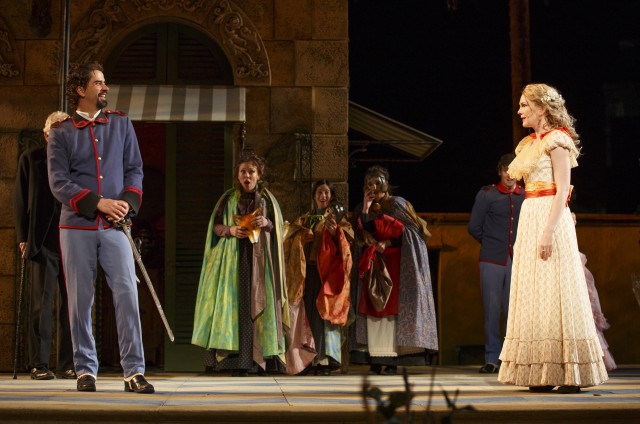
The ringleader of these merry players is director Jack O'Brien, who despite a prolific career that encompasses almost every style of theatre imaginable is making his Shakespeare in the Park directing debut.  Put simply, O'Brien nails it, keeping the laughs coming fast and often but expertly shifting gears to a more serious tone when necessary.  O'Brien's fluid staging makes great use of John Lee Beatty's gorgeous two-story set, and the Tony-winning director adds just enough physical comedy to be punch up the laughs without distracting from the beauty of Shakespeare's language.  Despite the play's nearly three-hour runtime O'Brien never lets the energy start to drag, expertly juggling the multiple tones and plotlines with the assured hand of an old pro. 

O'Brien has also succeeded in the all-too-rare feat of updating the setting (in this case, moving the action to early 1900s Sicily) in a way that feels both natural and necessary.  Aided by stunning design work from the aforementioned Beatty and costumer Jane Greenwood, O'Brien makes the Italian milieu its own character which enhances rather than detracts from the action.  From the preshow stage business (charmingly executed in Italian) to a gorgeous masquerade to a thrilling second act storm sequence (vastly aided by Jeff Croiter's lights and ACME Sound Partners' sound design), O'Brien and his team transport us from Central Park to the Italian countryside.

Without a marquee star like Pacino, there's little chance this production transfers to Broadway, although it's certainly strong enough to survive on the Great White Way.  This Much Ado is a shimmering production of one of the Bard's finest comedies, headlined by two of the city's most accomplished Shakespearean actors.  Rabe and Linklater are as good a Beatrice and Benedict as you're likely to find, and the talent surrounding them is just as astounding.  Thanks to Jack O'Brien's nimble direction, this effervescent outdoor production proves to be a highlight of Shakespeare in the Park's recent history.  Much Ado About Nothing only runs until July 6th, so brave the lines and snag your free tickets before these unlikely lovers dance off into the sunset.

Monday, August 12, 2013

A Triumphant Return for Broadway's Greatest Funnyman


Review:  The Nance
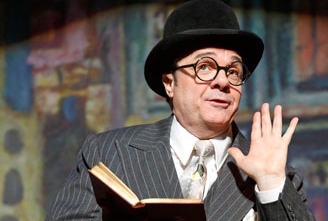
Nathan Lane commands the stage in his latest tour de force performance, as the title character in Douglas Carter Beane's The Nance.
 
After several forays into the world of musical theatre bookwriting, Douglas Carter Beane returns to his roots as a serio-comedic playwright with The Nance, his latest Broadway venture that is recently finished up its run at the Lyceum Theatre (and will be recorded for broadcast on PBS).  And while the play is certainly a more accomplished work than any of his musical outings, it remains a frustratingly conflicted piece that attempts a variety of things without fully succeeding at any of them.  The play wants to be a probing character study but fails to really explore the motivations of its protagonist.  It wants to make an admittedly topical political statement but ends up feeling preachy and pedantic rather than relevant and illuminating.  It wants to be both a serious drama and a low-brow comedy, but rather than complimenting one another each of these disparate elements continually undercuts the effectiveness of the other.

But at the play’s center is a Herculean performance so electric, so accomplished in its specificity and authenticity that it almost succeeds in elevating the play to the lofty realms which it so obviously aspires to.  Nathan Lane’s work as protagonist Chauncey Mills is nothing short of extraordinary, reasserting his status as one of the most accomplished stage actors of his generation.  With no disrespect meant to his very talented costars, Lane acts circles around everyone else onstage, and actually manages to make the play’s disparate tones seem organic and even necessary. 

The plot centers on Lane’s Chauncey Mills character, a man who has made a name for himself doing burlesque skits in Depression Era New York City.  Mills’ signature role is that of the overtly effeminate stock character dubbed “The Nance,” a professional choice made infinitely more complex by the fact that Mills is himself gay.  After years of anonymous sex with strangers, Mills seduces a young man named Ned who is just coming to grips with his own sexuality, and to the surprise of both men they find themselves entering a long-term relationship together.  Meanwhile, Mills’ burlesque theatre and his act in particular are coming under increasing pressure from city officials taking a stance against indecency, forcing the outspoken Mills to make a choice between being himself and suppressing his true nature to fit in.

It cannot be overstated how brilliant Nathan Lane is in the central role. From the opening moments of the show until the final curtain, Lane dominates the stage and exhibits such mastery of his craft that even his accomplished costars look like amateurs in comparison.  The play gives him ample opportunity to demonstrate his dramatic chops, while simultaneously providing him with an unending string of zingers and comic bits that utilize his unparalleled sense of comedic timing.  Throughout the play we are treated to excerpts from Mills’ stage act, and Lane absolutely kills in these scenes of perfectly reconstructed vaudeville comedy.  Where a normal actor would earn one laugh Lane manages to get three, often by using little more than a cock of the eyebrow or a sideways glance at the audience.  More miraculous still is Lane’s ability to make such carefully calculated choices feel utterly spontaneous, leaving the audience with the impression that this virtuosic performance is being created from scratch each night.

And while none of his costars are operating on Lane’s level (there are few actors in the world that could match such inspired lunacy), the rest of the cast turns in fine performances in their own right.  In his Broadway debut, Jonny Orsini charts a beautifully realized journey of self-acceptance as Mills’ lover Ned, and watching him realize that his sexuality doesn’t automatically prevent him from enjoying the perks of a domesticated life is particularly poignant in this time when marriage equality is on the forefront of the national debate.  If there is one criticism of Orsini’s performance it’s that he plays the character rather dumb, which at times comes into direct conflict with the highly literate dialogue playwright Beane has provided all of the characters.

Lewis J. Stadlen plays the lovably gruff Efram with aplomb, and makes an excellent foil for Lane during the burlesque skits that are the show’s highlight.  In a lesser actor’s hands Efram’s discomfort with Mills’ sexuality would make him the clear villain of the piece, but Stadlen tempers his performance with enough begrudging respect to make it clear that Efram isn’t a bad person.  As the trio of burlesque dancers that work at the same theatre, Cady Huffman, Jenni Barber and Andrea Burns make for excellent support, although the writing doesn’t do enough to differentiate their three characters.  Huffman (reunited with Lane after they both won Tonys for The Producers a decade ago) makes the strongest impression, although she is unfortunately saddled with the most overtly political and unnecessarily knowing dialogue.

Director Jack O’Brien keeps the evening moving at a steady pace, and during the show’s final twenty minutes manages to synthesize the disparate bits and repeating motifs into something resembling resonance.  He is aided immensely by John Lee Beaty’s marvel of a rotating set, which allows for virtually seamless transitions from one locale to the next.  Ann Roth clearly had a ball with the period costumes, and her designs for the burlesque outfits in particular possess just the right amount of winking outlandishness.  The lights and sound by Japhy Weideman and Leon Rothenberg get the job done but aren’t particularly memorable, and the original music by Glen Kelly is a nice if unassuming addition to the proceedings.

Ultimately, The Nance’s primary reason for being is to provide Nathan Lane with a showcase for his immense talents, and in that respect it succeeds wholeheartedly.  The comedic genius’ work manages to elevate Douglas Carter Beane’s passable script into something approaching greatness, and everyone involved has graciously taken a backseat while letting the master work his magic.  It is a worthwhile evening for those who are interested, although I do hope that Lane’s next Broadway outing is in a vehicle more worthy of his extraordinary gifts.