Showing posts with label William finn. Show all posts

Thursday, October 27, 2016

Welcome to Falsettoland

Review: Falsettos


The cast of Falsettos, one of the most hotly anticipated musicals of the fall season.

Alternatively messy and engaging, the first Broadway revival of William Finn and James Lapine's Falsettos highlights the core strengths and weaknesses of the piece in sometimes unexpected ways. Originally premiering on Broadway in 1992, the show is composed of two one act musicals (which debuted Off-Broadway in 1981 and 1990 respectively) that chart the growth of gay protagonist Marvin's unorthodox family over the course of two years. While some of the narrative specifics are deeply tied to the late '70s/early '80s setting, this production thankfully proves the show's core themes of love, family, and identity are universal and still relevant despite the huge advances in gay rights and the advent of marriage equality. Unfortunately, this production also highlights how the William Finn who wrote March of the Falsettos, the basis for Act I, is a far inferior writer to the William Finn who wrote Falsettoland, the basis for Act II.

In Act I, we are introduced to Marvin, who has left his ex-wife Trina and their son Jason to live with his male lover, Whizzer. The breakup of Marvin's traditional family unit has left all three in various states of distress, leading each to seek the help of Mendel, a therapist with questionable professional ethics who ultimately becomes involved with Trina. The second act moves the action forward two years and sees everyone obsessing over the planning of Jason's upcoming bar mitzvah, while also introducing the specter of the AIDS crisis.

Act I proves to be a rather disjointed affair, more of an impressionistic character study than a coherent narrative. The young Finn has yet to refine his signature off-kilter sensibility, which comes across as manic here and lacks the thematic coherence which connects his later flights of fancy. Musically the writing isn't anywhere near as complex or interesting as Finn's later work, and as a result both the performers and director James Lapine (who also wrote the book) seem slightly adrift as they struggle to sell the material. The songs don't build the way you want them to, and Lapine attempts to compensate for this lack of emotional momentum by having the performers constantly rearrange the pieces of David Rockwell's jenga cube of a set. Layer onto this Spencer Liff's awkwardly flailing choreography - which often hinders the performer's ability to enunciate their lyrics - and the first half of Falsettos becomes an exhaustively busy journey with characters that aren't particularly likable or compelling.

Act II is a much richer and more rewarding experience, as it's clear that in the nine years between writing March of the Falsettos and Falsettoland Finn vastly matured as a songwriter and storyteller. Centering the act on Jason's impending bar mitzvah gives Finn and Lapine a stronger foundation to build their characters' quirky behavior around, and Finn becomes much more adept at tempering his characters' off-putting neuroses with humanizing qualities. Even with the introduction of two additional characters - Cordelia and Dr. Charlotte, the "lesbians next door" - everyone feels more nuanced and alive in the second half, and the show does a better job of balancing its wry cynicism with deeply felt emotion. With stronger writing to work with, Lapine and the cast are able to relax; the busy choreography is all but abandoned, and Lapine's staging is less self-consciously showy. The two halves are integrated enough that it would rob Act II of some of its impact to completely throw out Act I, but the jump in quality is pronounced.

The best unifying element of this revival is the strength of its cast, all of whom range from good to great. As Marvin, Christian Borle abandons the scenery chewing that has defined his last two Broadway outings to deliver a more nuanced, believable characterization. Unfortunately, the first half of the show really highlights Marvin's self-serving qualities, something you wish Borle was able to undercut with some tenderness to make him a more likable protagonist. The second act gives Borle a lot more opportunity to show different sides of Marvin, and ultimately your heart breaks with him during the show's final scene (which also features the most striking image of Lapine's staging).

Andrew Rannells is a competent foil as Whizzer, although you wish the show afforded him more of a chance to show off his comedic chops. Brandon Uranowitz brings much appreciated authenticity to his portrayal of Mendel, and young Anthony Rosenthal's innate charm makes the temperamental Jason feel like a real preteen rather than an adult author's caricature of one. Tracie Thoms and Betsy Wolfe are a welcomed presence as the next door neighbors, with Thoms notably in very fine voice throughout.

But the cast's biggest standout is Stephanie J. Block, back on Broadway for the first time since her Tony-nominated turn in The Mystery of Edwin Drood. As Trina, Block blossoms into the most compellingly drawn and engaging character in the show, to the point where she often feels like the lead in what is ostensibly Marvin's show. Block is certainly its emotional center, which makes her effortless delivery of "I'm Breaking Down," one of the most broadly comedic songs in the show, all the more impressive. Block offers a fascinating peak beneath Trina's determinedly perfect facade, showing us a woman not wholly prepared to deal with the curveballs life has given her and yet soldiering on anyway. It is a marvelously accomplished performance which is endlessly watchable and yet never overstated.

Overall, there is both good and bad to be found in Falsettos, and it's unfortunate that the less successful elements are concentrated in the first half. By the end of the night, Falsettos proves to be an engaging and even moving portrait of an imperfect yet loving family, with the talented cast doing much to smooth over the rough patches at the beginning of the show. When the show stops being concerned with novelty and showiness, it truly sings, illustrating how the trials and tribulations of love and family are the same no matter what your sexual orientation.

Thursday, November 14, 2013

A Musical Comedy Stuck in 2nd Gear

Review:  Little Miss Sunshine

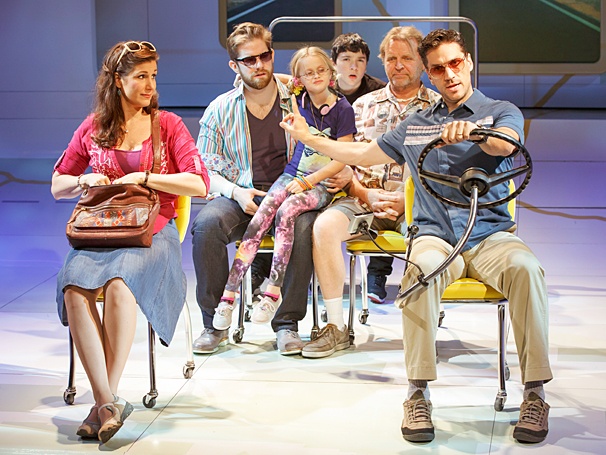
Stephanie J. Block, Rory O'Malley, and Will Swenson prove why they're all Tony-nominated actors as they struggle mightily to overcome Little Miss Sunshine's shortcomings.


Perhaps it's fitting that Little Miss Sunshine, the latest collaboration between director/librettist James Lapine and composer William Finn, fails to live up to expectations.  The new tuner, just like the 2006 independent film on which it is based, examines how a dysfunctional family deals with the dashed expectations of their rather run-of-the-mill lives.  And just like in real life, it is borderline painful to watch hard-working and talented people (in this case, the mostly excellent cast) struggle to overcome the bad hand they've been dealt, which here takes the form of a poorly constructed and tonally confused one-act musical.  Not since 2010's deeply flawed Women on the Verge of a Nervous Breakdown has a show sounded so good on paper and so thoroughly failed to deliver on stage.

Like it's filmic counterpart, Little Miss Sunshine tells the story of the unassuming Hoover clan and their cross-country road trip to get 9-year-old Olive (Hannah Nordberg) to the titular beauty pageant.  Family matriarch Sheryl (Stephanie J. Block) works long hours to support her family since her husband Richard (Will Swenson) was laid off of his job.  Richard is hoping to sell the publishing rights to his self-help blog, much to the derision of his foul-mouthed, lascivious father, known only as Grandpa (David Rasche).  Meanwhile Sheryl and Richard's son Dwayne (Logan Rowland) has taken a vow of silence until he achieves his goal of joining the Air Force, and Sheryl's suicidal gay brother Frank (Rory O'Malley) is staying with the family while he recovers from his latest "episode."  When the family finds out that little Olive has been chosen as a last minute contestant, they all pile into the family's VW bus in hopes of making it to the pageant on time.

The source material presents several challenges, none of which are successfully addressed by the creative team.  With the exception of Olive, the family members all seem to barely tolerate one another, giving off the impression they'd rather be anywhere but stuck in a van together.  Yes, the narrative is designed to show these people come to realize how much they love each other, but without even a glimmer of kindness or affection to begin with the first half of the show is a rather miserable experience.  There are hints of interesting and dynamic pairings during the opening scenes, and the show would be better served by expounding on these so there was at least some joy in the opening segments.  For instance, Grandpa may have total disdain for the rest of the Hoover clan, but playing up his affection for Olive would have gone a long way towards making him more bearable (he's easily the show's most insufferable character).  There is an odd bond caused by the shared existentialism of Frank and Dwayne that would be great to see explored further and sooner.  If each character seemed to like at least one other person at the musical's outset, then there would be something to help offset the snarkiness and general misery of what is advertised as a musical "comedy."

Even more devastating is the writing team's inability to settle on a workable tone.  There is a lot of drama and angst on display, but it isn't presented or examined in enough detail for the show to effectively work as serious character piece.  Yet there is enough heavy subject matter - including undertones of marital strife, the burdens of unemployment, and the disappointment of unrealized ambition - that the attempts at comedy never really take off.  The razor sharp wit and gonzo sense of humor so apparent in Lapine's libretto for the duo's last collaboration, The 25th Annual Putnam County Spelling Bee, is inexplicably absent for much of the show.  The scenes set during the "Little Miss Sunshine" pageant have this self-aware cheekiness in spades, and are so effective that it makes you retroactively wish the entire production was an equally over-the-top farce. 

Finn's score is easily the least memorable aspect of the show, which is especially disappointing given the composer's sterling work elsewhere.  There are some fine bits of ensemble music scattered throughout, but these sections are few and far between and unfortunately bookended by fairly clunky solo numbers.  Even worse, almost none of the songs have a clear purpose, lessening their dramatic impact.  There is an extended sequence where Frank encounters the man who prompted his suicide attempt, and though Frank claims to have moved on he continually sings about the other man's physical beauty.  Rather than coming across as a believably mixed set of emotions, the song makes Frank seem bipolar and lacks any kind of internal logic.  There is a flashback to before Sheryl and Richard got married that appears designed to show the love they once felt for each other, but consists of the characters being incredibly ambivalent toward one another until suddenly they aren't.  What are intended to be revealing character moments come across as muddy and confused instead, and leave the audience even more confused about who these people truly are.

The cast struggles mightily to rise above the writing's shortcomings, and do a good enough job that you can't help but wish they had better material to work with.  Stephanie J. Block shows a subtleness and range she hasn't often been asked to use, while still finding moments to show off her comedic chops (if only the score allowed her a better showcase for that phenomenal voice).  Rory O'Malley does some of his most affecting work yet as the deeply troubled Frank, and sounds fantastic on his two main duets.  Richard's straight-laced nature robs Will Swenson of the chance to use the utter fearlessness that made him so beguiling in Hair, but it's nice to see such a talented actor push himself in new directions.  Young Hannah Nordberg is cute as a button as Olive, and Logan Rowland conveys plenty of character despite remaining mute for over half of the show.  There are also two scene-stealing turns by Jennifer Sanchez as Linda the "Bereavement Consoler" and as the reigning Miss California, which point to the show that could have been had the authors chosen to fully embrace the quirkiness that turned Spelling Bee into a surprise hit.  The only actor who fails to make much of an impression is David Rasche as Grandpa, who is saddled with the worse material of the bunch and does little to disguise its shortcomings.

Lapine the director comes across better than Lapine the librettist, managing to keep the staging fresh and interesting despite the fact that over half the action takes place in the confines of an old VW bus.  He somehow manages to make actors running in place and miming the pushing of a van exciting, and knows just how to use Beowulf Boritt's deceptively simple set to maximum effect.  There are also fun touches by costumer Jennifer Capiro (who thankfully gets to costume both a swimsuit and eveningwear competition for the 9-year-old pageant girls) and lighting designer Ken Billington.

But ultimately, all of the talent in the world cannot save bad writing, and unfortunately Little Miss Sunshine features some very bad writing by people who should really know better.  Lapine and Finn have been responsible for some of the most innovative small-scale musicals of the past 20 years, not to mention Lapine's incredible collaborations with musical theatre genius Stephen Sondheim.  How Lapine and Finn managed to drop the ball so completely remains a mystery, and unfortunately their talented cast and crew are left to pick up the pieces.  Even diehard musical theatre fans can find a better use of their time this fall, given the wealth of innovative and inventive new musicals both on Broadway and Off.