Sunday, November 4, 2012

What's So Speacial About the Original Cast?

There have been five Broadway productions of Gypsy, and for many the Ethel Merman original remains the best

One interesting phenomenon among musical theatre aficionados – really all theatre fans, but it’s more pronounced in musical theatre circles – is the near-universal belief that a show’s original cast is always the best one.  No matter how many times a show has been successfully revived or remounted, these fans insist the original group of actors represent the best possible incarnation of a property.  If the work is particularly beloved, suggesting different actors for the lead roles becomes tantamount to sacrilege, and eventually you get people who think the then 43-year-old Sarah Brightman is an appropriate choice to play ingĂ©nue Christine Daae in the 2004 Phantom of the Opera film.

The above example is extreme, but the thinking behind it is so widespread that people have paid good money to see a 37-year-old Adam Pascal play Roger in Rent or a septuagenarian Carol Channing do Hello, Dolly!  Those real-life examples can be explained away as people who missed legendary performances willingly suspending their disbelief in order to see great actors recreate their most famous roles, but such reasoning doesn’t justify the idea that no matter how many times Gypsy or West Side Story get done, the original cast will always be the best.

So what’s driving this belief?  Is there any substance to the assertion that the original cast is always the superior one?  In large part, I think the primary reason comes down to mere familiarity.  With musicals, many times the only thing resembling a permanent record of the show is the Original Cast Recording.  This is how the vast majority of fans are first exposed to a show, and it is just about the only way anyone can relive the experience of actually seeing a live production.  The particular set of mannerisms, vocal tics, and acting choices captured by the recording becomes subconsciously ingrained in the listener’s head, and through repeated exposure becomes the accepted or “correct” way the material should be done.  If the person has never actually seen the show in question, then the cast album becomes representative of the ideal version of the property that’s been created in the listener’s head.  Any deviation from this imagined ideal can prove off-putting, even with supposedly open-minded people.

But if the reasoning behind this preference for the original cast seems somewhat arbitrary, that doesn’t mean the resulting wisdom is entirely wrong.  The truth of the matter is that the originating actor often ends up being the best, or at least one of the best, people to tackle a particular role.  If the performer is lucky enough to have the part written expressly for them, the way Gypsy was written for Ethel Merman or The Producers was tailored specifically to Nathan Lane, then of course he or she is going to impress in the role.  Even if the writers don’t have a particular person in mind when creating a character, they will inevitably end up fashioning the part around the person chosen to play it.  If a scene or song isn’t working, any rewrites will almost certainly take the performer’s strengths into account.  In a particularly collaborative environment, the actor may have direct input into the character’s moods and actions, subtly but forever skewing the script towards that performer’s interpretation of the role.

Then there are the times when a performer proves so compelling in a role that it takes on a life of its own, becoming greatly expanded in order to fully utilize that actor’s talents.  Anyone who has read the novel Wicked will tell you Glinda is a much more prominent presence in the musical, because the writers wanted to put for focus on Kristin Chenoweth’s bravura performance.  Stephen Flaherty and Lynn Ahrens wrote the song “Sarah Brown Eyes” in Ragtime specifically to give Tony-winner Audra McDonald more to do, since she was simply too good to leave out of the second act.  Rory O’Malley’s Elder McKinley didn’t even exist is early drafts of The Book of Mormon, but Matt Stone and Trey Parker were so entertained by his antics in the ensemble they crafted a role to better highlight him.  When a role is so specifically tailored to the original performer, their take on it will naturally be one of the strongest.

Original casts (and premiere casts of revivals) also have the benefit of extended rehearsal time to explore their roles.  A typical Broadway musical has about a month of rehearsals and another month of previews, giving the performers plenty of time to discover the nuances of their characterizations and iron out any kinks.  Add to that the months or even years spent workshopping a modern musical, and you have an artist who is intimately familiar with their particular character.  By the time workshops, out-of-town tryouts, and previews are taken into account, Idina Menzel spent three to four years refining her Elphaba, whereas her many replacements got at best a couple weeks of rehearsal before their first public performance.

The massive investment of time, combined with the knowledge that they are the first person to portray a particular role, results in actors feeling a sense of ownership that is difficult to replicate.  The original cast of a show has a heightened investment in making the show succeed, and going through the journey of discovering their characters with the writers and director gives their performances a more fully-realized and believable quality.  In contrast, many subsequent actors are encouraged to replicate the original’s performance, which can create a feeling of inauthenticity in their work.  Even if the production is new, such as a revival with entirely original staging, the shadow of their predecessor can loom large over any actor.  Every woman who’s played Joanne in Company has had to choose between trying to mimic Elaine Stritch (thereby inviting director comparison) or veering from Stritch’s blueprint and likely being criticized for it.

As we have seen, there are a lot of factors that contribute to making the original cast of a particular show the preferred one.  Because of this, I will always try to see a show while the original company is intact, but I have also seen enough replacements and understudies to know that they can be every bit as strong as the original performers.  I’ve also seen some incredible revivals that surely must compare favorably with the originals, such as the Patti LuPone-led Gypsy or the most recent New York staging of Follies.  Ultimately, the right actor in the right role will make for amazing theatre, whether that actor is the first person to ever play that character of the hundredth.  That is what makes live theatre so exciting, and being able to see multiple interpretations of the same show is what keeps me coming back, time and again. 

Sunday, October 21, 2012

The Best Bad Party You'll Ever See


Review:  Who’s Afraid of Virginia Woolf?

George has found his bite, and it's truly scary.
Carrie Coon, Tracy Letts, Madison Dirks, and Amy Morton in Steppenwolf's Who's Afraid of Virginia Woolf?
 
You just can’t keep a good play down.  Edward Albee’s classic drama Who’s Afraid of Virginia Woolf? last played Broadway a scant seven years ago, but any audience member thinking it’s too soon to revive this American masterpiece will have all doubts wiped away within the first few minutes of the sensational new production currently playing the Booth Theatre.  Imported from Chicago’s famed Steppenwolf Theatre Company with its original cast intact, this devastating new interpretation of the 50-year-old work feels as immediate and fresh as if it were written yesterday.

For those unfamiliar with the play, Who’s Afraid of Virginia Woolf? depicts the incredibly dysfunctional relationship of a college history professor named George (Tracy Letts) and his supremely dissatisfied wife, Martha (Amy Morton).  Booze-addled and vicious, the pair has turned their frequent verbal assaults into a highly structured game of wits that’s been perfected through years of practice.  They’ve tricked the unsuspecting Nick and Honey (Madison Dirks and Carrie Coon, respectively) into unwittingly participating in this blood sport by inviting the younger couple over for a nightcap following a faculty party, and after a series of escalating arguments the sun rises on four completely shattered human beings.

Albee is a three-time Pulitzer Prize winner and acknowledged master of the theatre, and Virginia Woolf is the work that first catapulted him to national attention.  The passage of time has done nothing to dull its incendiary bite and pulse-pounding immediacy, and the depth of these supposedly civilized characters’ cruelty remains shocking 50 years later.  The dialogue, especially that of the fiercely intelligent George and Martha, dazzles with its inventiveness and complexity, offering a feast for the ears while providing a wealth of information about the characters speaking it.  How the characters talk is just as revealing as what they say, and repeated visits will unearth new turns of phrase and clever wordplay to appreciate.

Albee has such fun with the language that his play manages to be oppressively dark and blisteringly funny, a duality wisely highlighted by director Pam MacKinnon and her phenomenal cast.  MacKinnon’s razor sharp direction perfectly balances comedy and drama, giving the play a kinetic energy that alternates between uproarious laughter and squirm-inducing discomfort.  The play’s three-plus hours fly by, leaving you thoroughly exhausted and yet hungry for more.

The cast may lack any recognizable Hollywood names, but the level of talent displayed by this incredible ensemble of Steppenwolf actors more than compensates for the lack of star wattage.  This is the finest group of performers to set foot on Broadway in years, working in such perfect tandem that the production never feels anything less than completely authentic.  The attention to detail and emotional honesty is truly stunning, and although I don’t typical prognosticate in reviews, I expect this company to do exceedingly well come Tony season.

The greatest revelation among the cast is Tracy Letts, who won virtually every award imaginable as the author of the Pulitzer Prize-winning August: Osage County.  His acting talents are every bit as astounding as his playwriting abilities, and his George emerges as the standout in a play usually dominated by Martha’s grandstanding theatrics.  Letts initially appears to be the unambitious “nothing” Martha constantly accuses him of being, but as the night progresses he shows a bite and extreme callousness that far surpasses anything his wife is capable of.  His malice is palpable, and when George loses his cool you’ll find yourself shrinking away in abject horror.  But just as George reaches his most monstrous, Letts will do something so utterly charming that you cannot help but be drawn to him, and by play’s end he’s demonstrated that all of his actions are motivated by a twisted but wholly sincere love for his wife.

Of course, George cannot exist without Martha, and Amy Morton does thoroughly impressive work in the role.  From her first entrance she displays a perfectly modulated level of intoxication, using every nuance of her movement and mannerisms to create the most convincing depiction of a high functioning alcohol I’ve ever seen.  Morton fully embraces all of Martha’s less admirable qualities, including her particularly egregious actions in Act II, but tempers her anger enough that you never once doubt her deep, uninhibited love of George.  Morton creates a devastating portrait of a tragically lonely, wounded human being, one who ultimately knows she’s brought this all upon herself and is deeply remorseful about it.  The interplay between Morton and Letts is the centerpiece of the evening, and they portray George and Martha’s relationship in all of its off-putting complexity.

As the most unfortunate houseguests ever, Carrie Coon and Madison Dirks more than hold their own against the powerhouse performances going on around them.  Carrie Coon’s Honey may not have much to say, but she communicates volumes through her body language and physicality.  Honey’s the most obviously intoxicated of the bunch, and Coon creates a convincing alcohol-induced haze around herself while still giving the audience access to the myriad of thoughts swirling around in her head.  Coon also provides the evening’s most hilarious moments of physical comedy, gamely throwing herself at whatever piece of furniture (or person) happens to be closest.

Madison Dirks has the trickiest role in the show, as Nick acts as much as an audience surrogate as he does a participant in the story.  Instantly distrustful of George and Martha’s antics, Nick initially seems like a nice guy caught in a bad situation, but eventually reveals himself to be every bit as depraved and morally reprehensible as his hosts.  Dirks slowly unravels the layers of pretension and arrogance surrounding Nick, leaving us with a wholly honest portrait of a young man already beginning to feel the bitter sting of regret.

The production design perfectly complements and enhances the work of the actors.  Todd Rosenthal’s set looks exactly like you’d expect the house of two alcoholic academics to look, with each nook and cranny filled with enough perfectly ordered chaos that it could hold our attention all by itself.  Allen Lee Hughes’ lighting subtly conveys the passage of time as the evening wears on and dawn approaches, and the costumes by Nan Cibula-Jenkins inform all of the characters without overwhelming any of them.

In short, this top-tier Virginia Woolf is a must see for any serious theatre fan.  The Steppenwolf Theatre Company is home to some of the greatest actors working today, and we are lucky that these four have chosen to grace the New York stage with their abundance of talent.  Tracy Letts and Amy Morton earn their place among the all-time great George and Marthas, while Pam MacKinnon’s expert direction keeps the entire production moving forward with a crackling energy that is thrilling to behold.  Who’s Afraid of Virginia Woolf? is the epitome of Broadway theatre, and simply cannot be missed.

Thursday, October 18, 2012

Defying Gravity, Almost 9 Years Later


Review:  Wicked
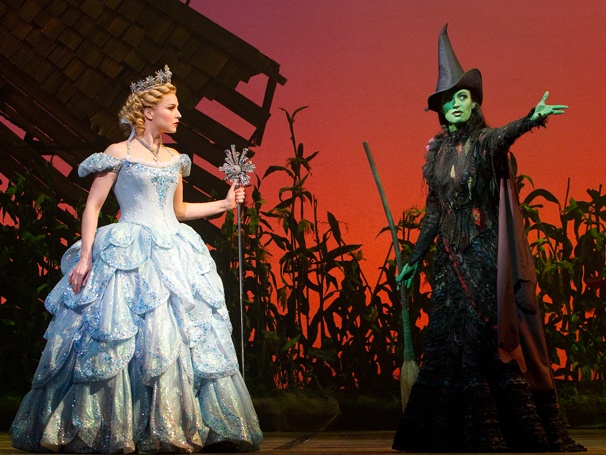
Chandra Lee Schwartz as Glinda and Jackie Burns as Elphaba in the Broadway production of Wicked.


Wicked is a show I’ve been interested in revisiting for quite some time.  After seeing the original Broadway cast during the summer of 2004, I left the show entertained but not blown away, and honestly wasn’t quite sure what all the fuss was about.  But after seeing the show do years of sell-out business in New York and on the road, while also developing an incredibly loyal fan community, my curiosity started getting the best of me.  Wicked has become not just a hit show, but a phenomenon that has struck a chord with millions of people, and I began wondering if there was something I had missed the first time around.  So eight years after my initial viewing, I headed back to the Gershwin Theatre this past weekend to view the Land of Oz with fresh eyes.

Seeing the show again, I can’t say my overarching opinion of it has changed much, but I will admit to appreciating Stephen Schwartz’s magnum opus more now than I did in 2004.  Now that the hype around the show has calmed down, it’s easier for me to evaluate the show own its own merits.  During that initial viewing, the show was widely considered a guaranteed winner for the Best Musical Tony, and as such I was evaluating it against some very high expectations (Wicked lost the award to Avenue Q just days after my first viewing).  I found Elphaba’s story to be full of big-budget spectacle but light on heart, which made the entire enterprise feel somewhat empty.

Wicked remains big and loud, but this time through I saw a lot more heart than I originally gave the show credit for.  The relationship between Elphaba and Glinda is one of the more complex musical theatre dynamics in recent history, and the musical does a good job hinting at the political implications of Gregory Maguire’s source novel without becoming bogged down with polemics.  Book writer Winnie Holzman did a great job of condensing that sprawling text into something more manageable and inherently theatrical, while still finding room to have a great deal of fun with the references to Dorothy’s concurrent adventures.  But keeping Dorothy offstage causes the second act to feel choppy, and I’d say the show’s greatest flaw is that it doesn’t satisfactorily pay off all its various plot threads.  But Holzman does give at least some indication how all of those stories turn out, which is more than can be said for a lot of lesser musical librettists.

The score is probably the best Stephen Schwartz has ever composed for the theatre, and he probably should have won his long-overdue first Tony for it.  The only explanations for his loss in the Best Score category are the absolute clunkers written for the Wizard, since the rest of the score displays an inventive adventurousness that holds up well to repeated listening.  Wicked is also one of the few shows where you can see exactly what your $135 ticket price is going toward, with lavish costumes and sets that are impressive for both their scale and attention to detail.  Joe Mantello’s staging moves everything along at a pace that never sags but still allows time for quiet character moments, which when played correctly supply the heart every good piece of theatre requires.

One concern I had going into the show was how the current cast would stack up to the near-legendary performances of the original company.  Such comparisons may not be fair but they are bound to happen, especially when this reviewer actually saw said performances and is not just extrapolating them from what’s preserved on the cast recording.  Happily, this current company acquits itself of the material quite well, with one major exception that I’ll address in a minute. 

Jackie Burns does a great job of fleshing out the different layers of Elphaba, the “Wicked” Witch of the West, making a clear transition from shy youth to impassioned freedom fighter while preserving the character’s internal logic.  Burns’ portrayal makes the show firmly (and rightfully) Elphaba’s story, rather than splitting the focus between her and Glinda as the original cast did.  Also, Burns has the vocal ability to make these oft-sung songs sound fresh and alive, an invaluable gift for such warhorses as “Defying Gravity” and “For Good.”

Many of the supporting actors do an excellent job of making a lasting impression with limited stage time.  Randy Danson chews scenery in the best possible way as Madame Morrible, displaying that perfect combination of camp and malice usually reserved for only the best Disney-style villains.  Jenny Fellner makes her Nessarose as complex as the writing will allow, keeping her sympathetic enough that we like her while understanding why other people wouldn’t.  If Kyle Dean Massey is a little too caught up in his Norbert Leo Butz impersonation to be an entirely compelling Fiyero, he still does a fine job in a role whose importance is often overstated to begin with.  And Adam Grupper is the one significant improvement over the original, as his Wizard comes across as far more interesting and menacing than Joel Grey’s ever did.

Unfortunately, the cast’s one weak link is a major one, and that is Chandra Lee Schwartz as Glinda.  Now admittedly I am biased after seeing Kristin Chenoweth’s truly transcendent take on the role, a performance I can recall in great detail to this very day.  But even grading on a curve, Ms. Schwartz fails because she is so concerned with the comedy that she forgets to make Glinda an actual human being.  Her attempts at comedy produce mixed results, and the more dramatic scenes fall completely flat.  There is nothing sympathetic about her performance, and her motivations remain so murky and unconvincing that you ultimately wish she would just go away so we could get back to the much more compelling story of Elphaba.  Considering every eligible actress in town has surely auditioned for this role, I find it tough to believe that Schwartz is the best the producers could find.*

All that said, I thoroughly enjoyed my return trip to the Land of Oz.  Any complaints I have are minor in comparison to the many things Wicked does right.  With its combination of compelling characters, interesting plot, and big-budget spectacle, Wicked earns its place as one of Broadway’s biggest hits.  It may not be a great musical, but it is a very good one, and makes an excellent First Broadway Show for kids and out-of-town relatives that don’t see theatre all that often.  The current cast performs the material with an abundance of professionalism and gusto, and I for one can think of a lot worse ways to spend an evening.

 
*Note:  Between the time I saw the show and wrote this review, Chandra Lee Schwartz left the Broadway company of Wicked.  The role of Glinda is currently played by Alli Mauzey, who is hopefully a lot better.

Wednesday, October 10, 2012

Shows We Don't "Get"

Jared, Jessica, and Christopher get together for this second edition of the Broadway, Etc. podcast to discuss the shows they just don't "get." Those shows that everyone else seems to adore, but they just can't get behind. Prepare for some surprising (controversial?) admissions. Also, the team discusses the future of the ill-fated musical "Rebecca," and if this European import will ever see the light of day on Broadway.

Monday, October 1, 2012

"Rebecca" is Dead (Again)

The the Manderly estate in which the show is set, Rebecca's Broadway dreams have gone up in smoke.

I’m generally not a superstitious person, but even I have to wonder if the American production of Rebecca is cursed.  On the eve of its long-delayed first rehearsal, the gothic musical thriller had to cancel its Broadway bow for a second time due to lack of financing.  This comes after the production was pushed back from the spring to the fall for the exact same reason, a move which forced the recasting of its two lead roles.

For those who haven’t been following Rebecca’s various ups and downs (mostly downs), here’s a quick recap.  The show, based on the novel of the same name, is a hit in Europe that already saw plans for a London production scrapped in favor of Broadway.  Lead producer Ben Sprecher has had a hell of a time securing the show’s $12 million capitalization, which is expensive but by no means unheard of for a big Broadway musical.  He claimed to have the money situation all shored up when a mysterious benefactor named Paul Abrams died in early August, taking his $4.5 million investment with him to the grave.  Sprecher scrambled to find more funds, pouring his own money into the project and finding a new, unnamed $2 million investor.  But now that investor has pulled out after being sent a “malicious e-mail” by a third party, prompting this latest delay.

Sprecher claims he still wants to make Rebecca happen, but at this point only a fool would believe him.  Remember, this isn’t a show that was rumored for the Great White Way; Sprecher has on two occasions announced firm opening dates, secured a theatre, and begun work on the show’s costumes and sets.  Canceling a show so far along in its development is almost never done, which serves as an indication of how bad things really are.  But whatever you think is happening behind the scenes, the latest information indicates that the truth could be much, much worse.

For instance, The New York Times published a very interesting article last week that speculated Paul Abrams and his $4.5 million never even existed.  Sprecher himself has admitted that he never actually met Abrams, and you have to wonder about a producer who would depend on a complete stranger for a full third of his production budget.  Even worse, the Times asserts that the e-mail address used by Abrams’ assistant to communicate with Sprecher is only a month old, AND points out that there is no independently verifiable information about Abrams’ death (you’d think such a wealthy man would merit at least a sentence or two in the obituary section of the local paper).

At best, Sprecher is an incompetent producer who isn’t performing his due diligence and therefore shouldn’t be in charge of large sums of money; at worst, he has willfully deceived his other investors and the general public.  The police certainly find all of this suspicious, and have begun to question Sprecher about the whole affair (to his credit, Sprecher seems to be cooperating).  And then there is this most recent investor, who was scared off by the content of a nasty e-mail – an e-mail he or she should never have received, because the investment was supposed to remain anonymous.  Assuming this person exists, the sudden departure makes you wonder how reliable Sprecher’s other investors are, and also how safe your personal information is with this untested Broadway producer.  I certainly wouldn’t trust my money to him, and I doubt many others would, either.

Even if the existence of Paul Abrams is proven and Sprecher cleared of all wrong doing, no one is going to support this show.  As the old saying goes, “Fool me once, shame on you.  Fool me twice, shame on me.”  Who’s to say that Rebecca won’t be canceled late in the game a third time?  Making money on a Broadway show is a tricky proposition to begin with; having an inexperienced and clearly unqualified person calling the shots isn’t going to increase the show’s financial chances.

The only way I see Rebecca happening now is if Sprecher leaves the project, and is replaced by someone a little more trustworthy.  That strategy worked on Spider-Man, Broadway’s last big budget disaster, which has miraculously overcome all of its early troubles to become one of Broadway’s top box office draws.  And if Spider-Man is your best case scenario, you have to wonder if it’s even worth it, considering that show is one of the most reviled and mocked pieces of entertainment to hit the Rialto in years. 

I would love for Rebecca’s fortunes to change, because as I’ve said before I think it is an excellent idea for a musical and could be a fantastic night at the theatre.  But at this point, I don’t think anyone would touch the show.  You’d basically be starting from scratch (as the Times points out, most of the investors are asking for their money back), and the stigma on the show is probably too much to overcome.  I think Rebecca is truly dead, and her ghost will haunt aspiring Broadway producers for years to come.

Tuesday, September 25, 2012

Movie Magic, Lost in Translation


Review:  Chaplin

Rob McClure, refusing to let subpar material ruin his big break on Broadway.
 

You want to like Chaplin, the new musical by composer/lyricist Christopher Curtis and bookwriter Thomas Meehan that’s currently playing the Barrymore Theatre.  The life of silent film star Charlie Chaplin certainly features enough drama to sustain a full-length musical, and the show benefits from several strong performances by a mix of Broadway veterans and relative newcomers.  Unfortunately, an abundance of structural missteps and ill-advised story tangents prevent the show from achieving its full potential, and the resulting work is a frustratingly muddled mess of unfulfilled promise.
Obviously, dramatizing anyone’s life brings with it inherent problems, as real life seldom occurs in steadily rising dramatic action that leads to a clean and tidy end.  Like many showbiz stories, Chaplin does a reasonably good job of chronicling Chaplin’s rise to fame in turn of the century Hollywood, utilizing his troubled relationship with his mentally-ill mother to provide dramatic tension during his virtually unencumbered ascension to superstardom.  But the second act, which chronicles Chaplin’s tumultuous personal life and eventual fall from grace, feels unfocused and haphazard.  In Meehan and Curtis’ libretto, one scene rarely flows smoothly into the next, and coherent character motivations are practically nonexistent.
The show also suffers from an uncertain tone, unsuccessfully attempting to split the difference between low comedy and high drama.  Even the relatively conflict-free first act fails to create many laughs, a sin that seems almost unforgivable in a show whose central figure is one of the all-time masters of slapstick.  Things are generally played straight and very serious, but the authors stop themselves from fully committing to the inherent drama of Chaplin’s life by glossing over its more unpleasant aspects.  The star’s multiple marriages to underage woman aren’t explored in any detail, and his demanding and somewhat unethical directorial methods are given only a cursory mention.  Even Chaplin’s relationship with his mother seems underdeveloped, as he spends a majority of the show avoiding her and we are mostly told rather than shown that her condition is getting worse.
Christopher Curtis’ score also underwhelms, with his sometimes interesting melodic ideas rarely coalescing into fully formed songs.  The only piece of music that feels complete is the jazzy “All Falls Down,” written for a vindictive gossip columnist named Hedda Hopper who has made it her life’s mission to ruin Chaplin’s good name.  And even that song is difficult to enjoy because it comes out of nowhere, forcing the audience to spend much of its duration wondering why a woman who has never even met Chaplin suddenly hates him so much (it apparently has something to do with his refusal to grant her an interview).
Yet the hardworking cast takes this subpar material and performs it with such earnestness and conviction that they almost succeed in making it sing.  In the title role, Rob McClure gives such a tour de force performance that you don’t question for a second why the producers entrusted an unknown with such an enormous part.  McClure has clearly spent hours researching the Little Tramp and perfecting his mannerisms, which pays off in his expert handling of the large amounts of physical comedy and recreation of some of Chaplin’s most famous bits.  He performs all of his numbers with gusto, and imbues the eleven o’clock ballad “Where Are All the People?” with a dramatic weight it honestly doesn’t deserve (like “All Falls Down,” the song comes out of nowhere).  McClure paints as complete a picture of Chaplin as the material will allow, and uses his buoyant, assured performance to cover up many of the writing’s flaws.
Past Tony-nominee Christiane Noll does well with the underwritten role of Chaplin’s mother, cramming one of the biggest character arcs of the night into her limited stage time.  Jenn Colella’s hardboiled Hedda Harper is such a strong presence you end up wishing there was more of her, which would have the added benefit of fleshing out one of the story’s key conflicts.  And as Oona O’Neil, Chaplin’s fourth and final wife, Erin Mackey imbues her character with enough charm and quiet strength that you can almost forgive the fact that she doesn’t appear until midway through Act II, despite being the show’s primary love interest.
Finally, special mention must be made of Zachary Unger, the child actor who plays the young Charlie Chaplin.  Displaying a startling amount of maturity and emotional honesty, Unger could give many adult actors lessons in sincerity.  When he breaks into tears as Chaplin’s mother is taken away to the mental hospital, he’s so convincing you want to run onstage and give him an enormous hug.  (The fact that Unger is cute as a button doesn’t hurt, either.)
From a production standpoint, director/choreographer Warren Carlyle does a serviceable job, although you get the impression that his desire for more dancing hinders the show more than it helps.  Particularly egregious is Carlyle’s decision to end Act I with a chorus of dancing Chaplin lookalikes, a decision so out of left field that the audience will spend most of intermission wondering what he was thinking.  The design team’s creative conceit to construct the sets and costumes using only shades of black and white is a neat idea that isn’t fully realized, and results in the show appearing too dark on more than one occasion.  Meanwhile, the ten person orchestra is in desperate need of a few extra players to provide the show with a richer and fuller sound.
Thanks to the hardworking cast, Chaplin has all-too-brief moments of entertainment and genuine dramatic interest.  Because the performers are so good, you really wish the musical they appear in gave them better material to work with.  The idea of a show about Charlie Chaplin remains an intriguing notion, and one hopes that eventually a great version of the story makes its way to Broadway.  For now, we will have to settle for this half-baked concoction instead.

Wednesday, September 19, 2012

Why Legit Vocal Training Matters

Alice Ripley: fierce, fierce actress.  But that voice of hers is a little wonky lately.

Happy fall, everyone!  Now that the weather here in NYC has gotten a little brisk, it’s time to end my impromptu summer vacation from blogging and get back to talking about the theatre.
This is a blog I meant to write a few weeks ago, when I stumbled across this video on Playbill.com.  In the midst of interviewing/goofing off with Broadway’s Stephanie J. Block, musician and internet personality Seth Rudetsky asks Block how familiar she was with the score of her next gig, The Mystery of Edwin Drood, before being cast in the show.  Block admits she’d only heard the soprano ballad “Moonfall,” and sings a few bars before Rudetsky cuts her off and jokingly tells her to “never sing like that again.”
The joke is that Block actually sounds fabulous singing with a legit soprano, but should only belt because that is what she is known for (having been a high profile replacement for roles like Elphaba and Reno Sweeney).  Sky high belting is what’s currently in vogue on Broadway, and Block bemoans the fact that she never gets to sing “Moonfall” at auditions because no one wants to hear her do it.  And the implications of that statement worry me.
If you are an up and coming actor who wants to be on Broadway these days, you have to be able to belt.  Contemporary musicals are almost invariably written as marathon belting sessions, and many classic shows are revived with a more pop-influenced sound.  This isn’t bad in and of itself, and I enjoy a good belt show as much as the next guy.  I lost track of how many times I listened to Rent when it first came out, and one of my biggest complaints about the current Evita revival is the distinct lack of belting done by its leading lady.  BUT legit singing is equally valuable, and should be a major part of any young singer’s training.
When someone learns how to sing in the classical/legit style, two of the most important things they learn are proper placement and breath support.  These form the basis of healthy singing in any genre, and are essential to anyone who wants to have a long career in the industry.  Without them, it is simply a matter of time before nodules or some other type of vocal damage renders a singer unable to manage the demands of doing eight shows a week. 
I would argue the reason someone like Block is able to consistently belt into the rafters is because her background in legit singing taught her proper placement and healthy vocal production.  These principles can be adapted into the contemporary/pop musical vein, but are much easier to practice and learn in classical singing.  The problem with belting and pop-influenced scores is that many of the hallmarks of the style can be achieved through strain and poor technique.  This may work in the short term, but over time it will absolutely destroy someone’s voice (see: Side Show Alice Ripley vs. Next to Normal Alice Ripley, or to use an example from pop music Songs in A Minor Alicia Keys vs. Element of Freedom Alicia Keys).
But since nobody is interested in hearing legit singing, it isn’t being taught as much.  We won’t have proof for another ten years or so, but I fear this is producing a generation of Broadway singers who are using poor technique to wail to the rafters now, but will be unable to sing much of anything by their mid-30s due to all the vocal damage they’ve sustained.  Resilient young voices can handle a fair amount of poor technique, but it will always catch up with you in the end.  Unless something changes, we’re looking at a future where catching that Tony-nominated performance will be a matter of luck, because the actor giving it doesn’t have the vocal stamina to do eight shows a week.  And nobody wants that